
Table 1
Body parameters and life expectancy of crayfish
| Species | Total length (mm) | Maximum mass (g) | Maximum age (years) | References |
|---|---|---|---|---|
| A. astacus | 200–250 | > 200 | 25 | Collins et al. 1983; Strużyński 2007 |
| A. leptodactylus | 150–200 | 150 | 20–25 | Trouilhé 2006; Strużyński 2007 |
| P. lenisculus | 200 | > 200 | 20 | Mastyński & Andrzejewski 2005; Strużyński 2007 |
| F. limosus | 122 (female); 111 (male) | * | 5 | Kulmatycki 1936; Pieplow 1938 |
| P. clarkii | 150 | > 200 | * | Paglianti & Gherardi 2004; Loureiro et al. 2015 |
| P. virginalis | 103 | > 30.1 | * | Vogt et al. 2015 |
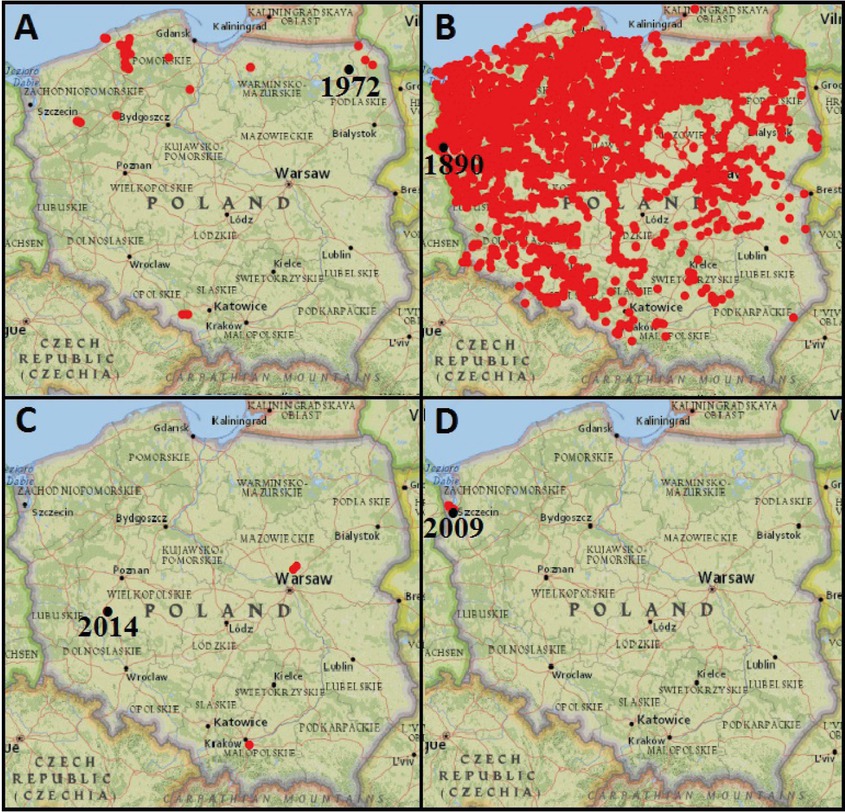
Figure 1
First observation (black dots) and distribution (red dots) of invasive crayfish in Poland in January 2020; A – P. leniusculus (signal crayfish), B– F. limosus (spiny-cheek crayfish), C– P. clarkii (red swamp crayfish), D– P. virginalis (marbled crayfish) (http://geoserwis.gdos.gov.pl/)
Table 2
Optimum pH and tolerance range of crayfish
| Species | pH | ||
|---|---|---|---|
| Optimum | Range | References | |
| A. astacus | 7.8–8.0 | 4–11 | Pârvulescu et al. 2011; Kozák et al. 2015 after Svobodová et al. 1987 |
| P. leptodactylus | 7–9 | 6.8–7.8 | Mazlum et al. 2010; Kozák et al. 2015 after Svobodová et al. 1987 |
| P. leniusculus | 7.8–8.0 | 7.2–9.1 | Hesni et al. 2008; Dobrzycka-Krahel et al. 2017 |
| F. limosus | * | 6.7–9.1 | Kozák et al. 2005; Ďuriš et al. 2006 |
| P. clarkii | * | 6.5–8.6 | Smart et al. 2002; Scalici et al. 2009 |
| P. virginalis | 7.5–8.0 | * | Velisek et al. 2014 |
Table 3
Optimum water temperature and tolerance range of crayfish
| Species | Temperature (°C) | ||
|---|---|---|---|
| Optimum | Range | References | |
| A. astacus | 20.0 | 1.0–28.0 | Strużyński 2007; Reynolds & Souty-Grosset 2011 |
| P. leptodactylus | 17.0–21.0 | 4–32.0 | Karimpour et al. 2011; Reynolds & Souty-Grosset 2011; Kozák et al. 2015 after Svobodová et al. 1987 |
| P. leniusculus | 13.0–23.0 | 1.0–33.0 | Holdich 2002; Reynolds & Souty-Grosset 2011 |
| F. limosus | c. 20.0 | from 10.0 | Pieplow 1938; Dubé & Portelance 1992; Kozák et al. 2015 |
| P. clarkii | 21.0–29.0 | to 34.0–35.0 | Arrignion et al. 1990; Holdich 2002; Reynolds & Souty-Grosset 2011 |
| P. virginalis | 18.0–25.0 | * | Seitz et al. 2005; Pârvulescu et al. 2017 |
Table 4
Optimum water oxygen content and tolerance range of crayfish
| Species | Oxygen content (mg l−1) | ||
|---|---|---|---|
| Optimum | Range | References | |
| A. astacus | 8.0–9.0 | from 3.2 | Mastyński & Andrzejewski 2005; Reynolds & Souty-Grosset 2011 |
| P. leptodactylus | 8.0–9.0 | from 2.0 | Mastyński & Andrzejewski 2005; Kozák et al. 2015 after Sládeček 1988 |
| F. limosus | * | from 4.7 | Babović et al. 2011 |
| P. clarkii | * | from 3.0 | Souty-Grosset et al. 2006 |
| P. virginalis | * | from 2.9 | Lőkkös et al. 2016 |
Table 5
Maximum water salinity tolerance in adult individuals
| Species | Water salinity (PSU) | |
|---|---|---|
| Range | References | |
| A. astacus | to 14.0 | Rasmussen & Bjerregaard 1995 |
| P. leptodactylus | to 20.8 | Susanto & Charmantier 1999; Kozák et al. 2009 |
| P. leniusculus | to 21.0 | Rutledge & Pritchard 1981; Holdich et al. 1997 |
| F. limosus | to 7.0 | Jaszczołt & Szaniawska 2011 |
| P. clarkii | to 35.0 | Bissattini et al. 2015; Dörr 2020 |
| P. virginalis | to 0.0 | Veselý et al. 2017 |
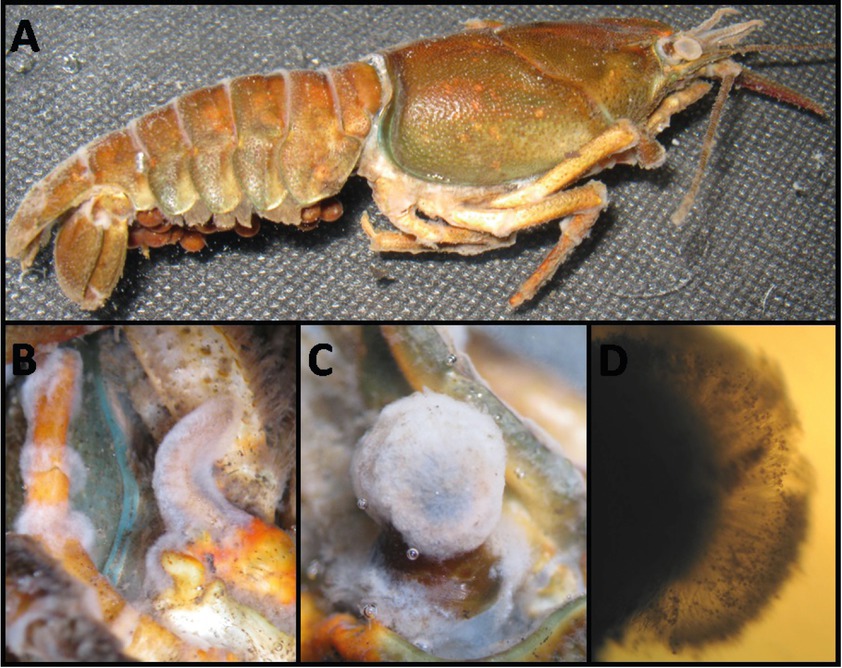
Figure 2
Symptoms of the plague on dead noble crayfish (after Jiří Svoboda)