
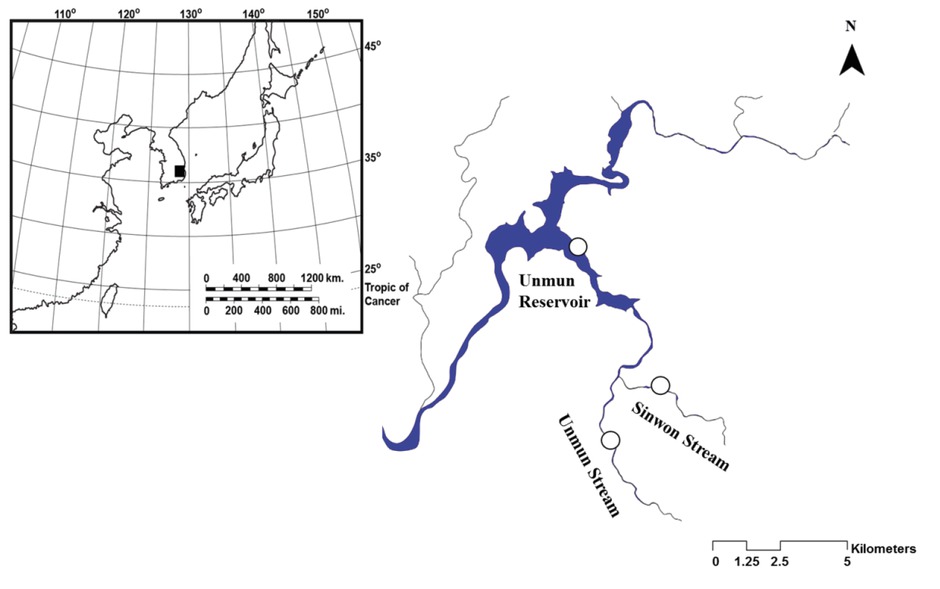
Figure 1
Map of the study sites. Location of the study sites in southeastern South Korea are indicated by a solid square (■) in the inset map of the Korean Peninsula. The main map shows the Unmun Reservoir and two tributary streams (Unmun and Sinwon). The sampling points are indicated by open circles (○).
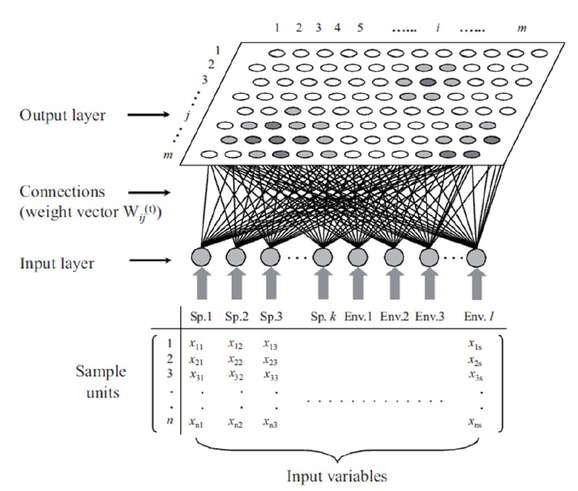
Figure 2
Basic structure of the self-organizing map (SOM)
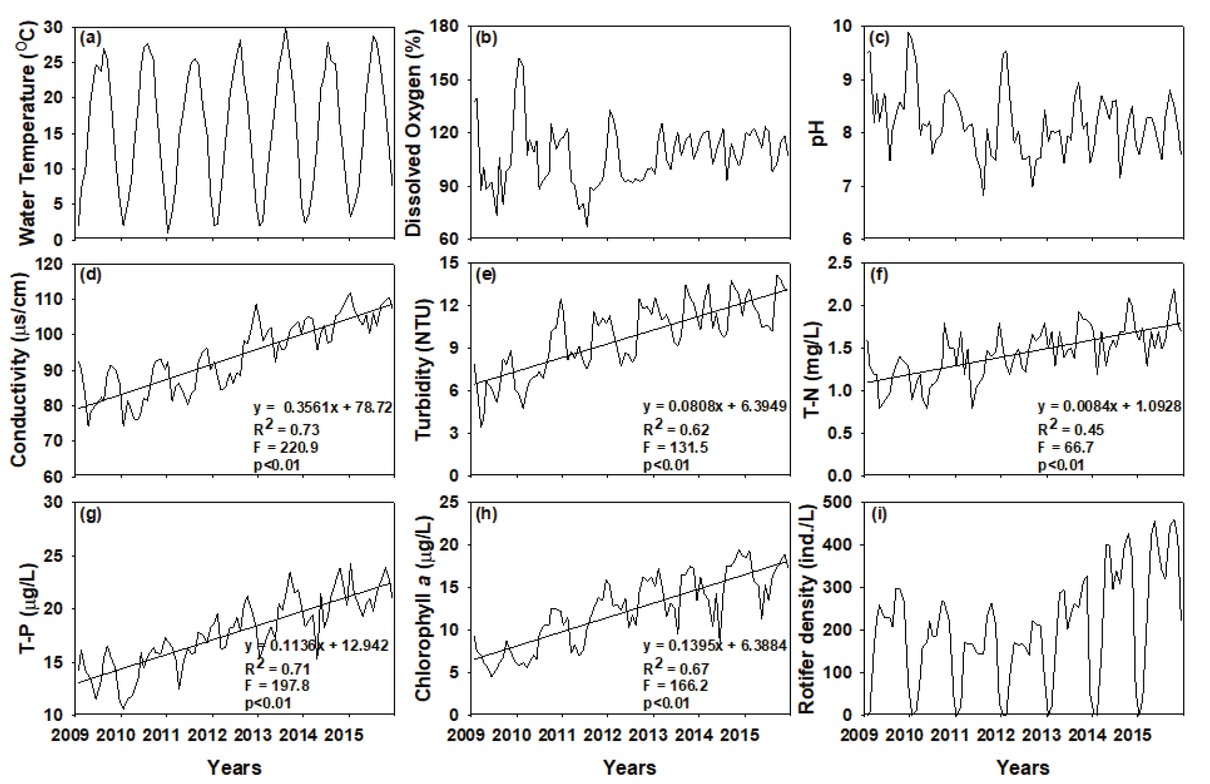
Figure 3
Time-series fluctuations in environmental factors and rotifer density at the study sites in the Unmun Reservoir in 2009–2015. (a) WT (°C), water temperature; (b) DO (mg l−1), dissolved oxygen; (c) pH, (d) conductivity (μS cm−1), (e) turbidity (NTU), (f ) T-N (mg l−1), total nitrogen; (g) T-P (μg l−1), total phosphorus; (h) chlorophyll a (μg l−1), and (i) rotifer density (ind. l−1)
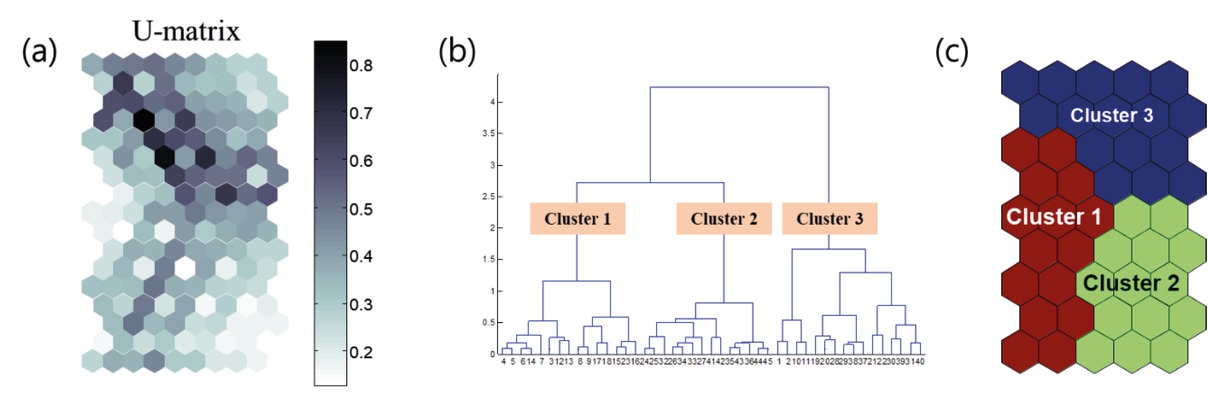
Figure 4
Clustering through data learning in the self-organizing map. (a) U-matrix, (b) hierarchical dendrogram, (c) clustering result
Table 1
Environmental factors and rotifer density in different clusters defined by SOM. Significant differences between clusters were based on one-way ANOVA. SD – standard deviation; F – F-value; p – probability value; WT (°C) – water temperature; DO (mg l−1) – dissolved oxygen; T-N (mg l−1) – total nitrogen; T-P (μg l−1) – total phosphorus
| Factor | Units | Mean | SD | Cluster | F | p | ||
|---|---|---|---|---|---|---|---|---|
| 1 | 2 | 3 | ||||||
| WT | °C | 15.6 | 8.8 | 19.6 ± 5.9 | 19.3 ± 7.1 | 4.2 ± 2.1 | 52.3 | < 0.01 |
| DO | mg l−1 | 107.8 | 17.2 | 94.6 ± 13.3 | 108.1 ± 10.7 | 124.0 ± 16.3 | 28.5 | < 0.01 |
| pH | 8.19 | 0.6 | 8.04 ± 0.5 | 8.06 ± 0.5 | 8.60 ± 0.8 | 6.9 | 0.02 | |
| Conductivity | μS cm−1 | 93.9 | 10.2 | 85.6 ± 6.9 | 100.3 ± 6.7 | 93.5 ± 10.6 | 25.9 | < 0.01 |
| Turbidity | NTU | 9.8 | 2.5 | 8.0 ± 2.1 | 11.2 ± 1.8 | 9.8 ± 2.6 | 16.6 | < 0.01 |
| T-N | mg l−1 | 1.5 | 0.3 | 1.2 ± 0.3 | 1.6 ± 0.2 | 1.5 ± 0.3 | 19.9 | < 0.01 |
| T-P | μg l−1 | 17.8 | 3.3 | 15.2 ± 1.8 | 20.2 ± 2.1 | 16.9 ± 3.5 | 33.4 | < 0.01 |
| Chlorophyll a | 12.3 | 4.2 | 8.9 ± 3.0 | 14.7 ± 2.8 | 12.6 ± 4.3 | 22.4 | < 0.01 | |
| Anuraeopsis fissa | ind. l−1 | 32.9 | 36.9 | 12.0 ± 5.9 | 65.6 ± 34.5 | 3.6 ± 6.8 | 61.8 | < 0.01 |
| Ascomorpha ovalis | 26.0 | 27.7 | 59.1 ± 21.4 | 13.8 ± 11.5 | 4.4 ± 8.6 | 96.7 | < 0.01 | |
| Brachionus calyciflorus | 29.6 | 32.8 | 10.4 ± 4.2 | 59.3 ± 29.8 | 3.6 ± 6.6 | 69.7 | < 0.01 | |
| Keratella cochlearis | 41.5 | 30.2 | 36.9 ± 10.7 | 65.3 ± 26.1 | 6.4 ± 7.7 | 66.0 | < 0.01 | |
| Ploesoma hudsoni | 16.8 | 23.4 | 47.6 ± 16.0 | 2.3 ± 3.3 | 1.9 ± 4.0 | 199.3 | < 0.01 | |
| Polyarthra spp. | 20.5 | 12.4 | 26.7 ± 8.3 | 25.8 ± 8.3 | 3.7 ± 5.4 | 65.3 | < 0.01 | |
| Synchaeta oblonga | 9.2 | 7.4 | 13.8 ± 6.1 | 10.8 ± 5.8 | 0.6 ± 1.8 | 39.5 | < 0.01 | |
| Trichocerca gracilis | 22.0 | 27.3 | 5.2 ± 6.9 | 46.8 ± 24.4 | 1.1 ± 2.8 | 68.5 | < 0.01 | |
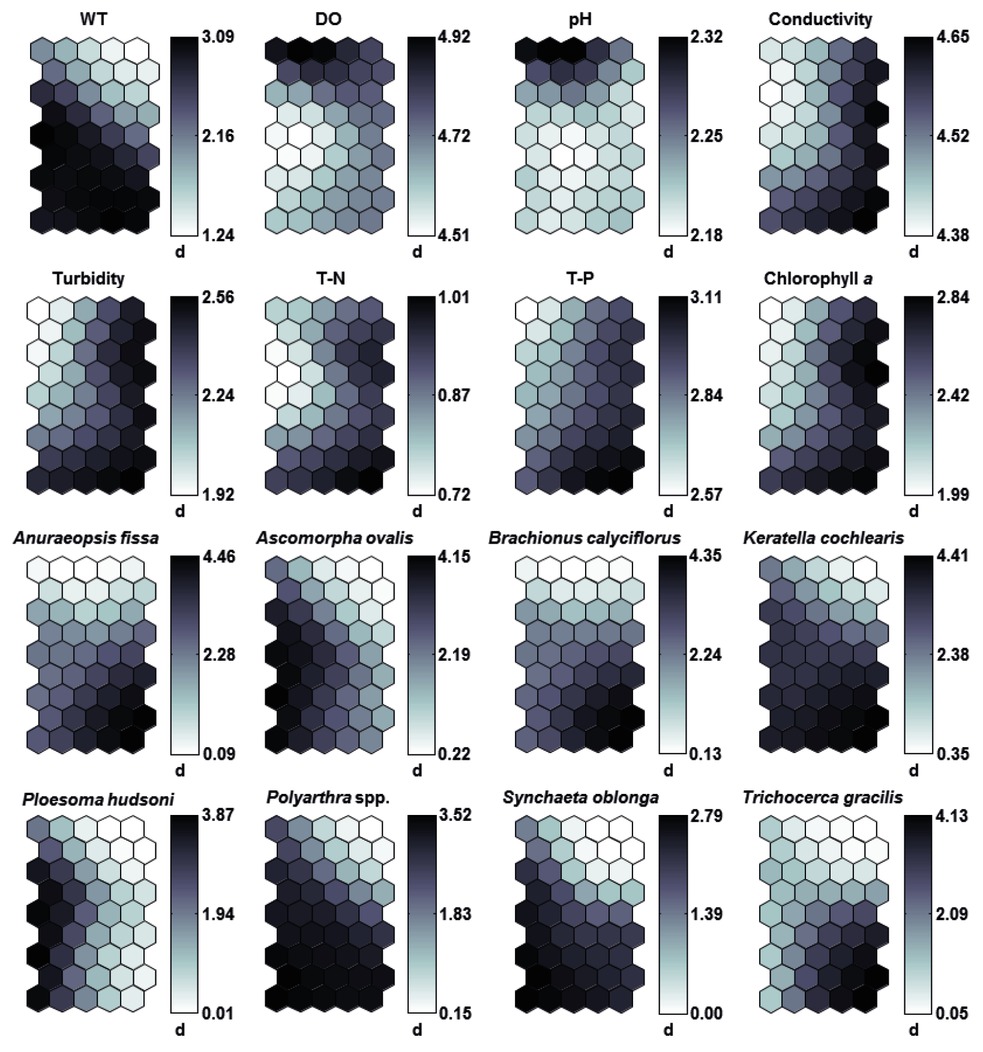
Figure 5
Environmental factors and rotifer density measured in the Unmun Reservoir. WT (°C) – water temperature; DO (mg l−1) – dissolved oxygen; T-N (mg l−1) – total nitrogen; T-P (μg l−1) – total phosphorus
Table 2
Characteristics of each cluster based on the distribution patterns of input variables and the number of study sites in each cluster. WT (°C) – water temperature; DO (mg l−1) – dissolved oxygen; T-N (mg l−1) – total nitrogen; T-P (μg l−1) – total phosphorus
| Cluster | Variable | Year | Season | Characteristics | No. | |
|---|---|---|---|---|---|---|
| Environment | Rotifer | |||||
| 1 | WT | Ascomorpha ovalis, Ploesoma hudsoni, Polyarthra spp., Synchaeta oblonga | 2009, 2010, 2011 | spring, summer, autumn | low nutrient concentration | 27 |
| 2 | WT, Conductivity, Turbidity, T-N, T-P, Chlorophyll a | Anuraeopsis fissa, Brachionus calyciflorus, Keratella cochlearis, Polyarthra spp., Synchaeta oblonga, Trichocerca gracilis | 2012, 2013, 2014, 2015 | spring, summer, autumn | eutrophication state, most rotifers are abundant | 36 |
| 3 | DO, pH, T-N | - | - | winter | low water temperature, low rotifer density | 21 |
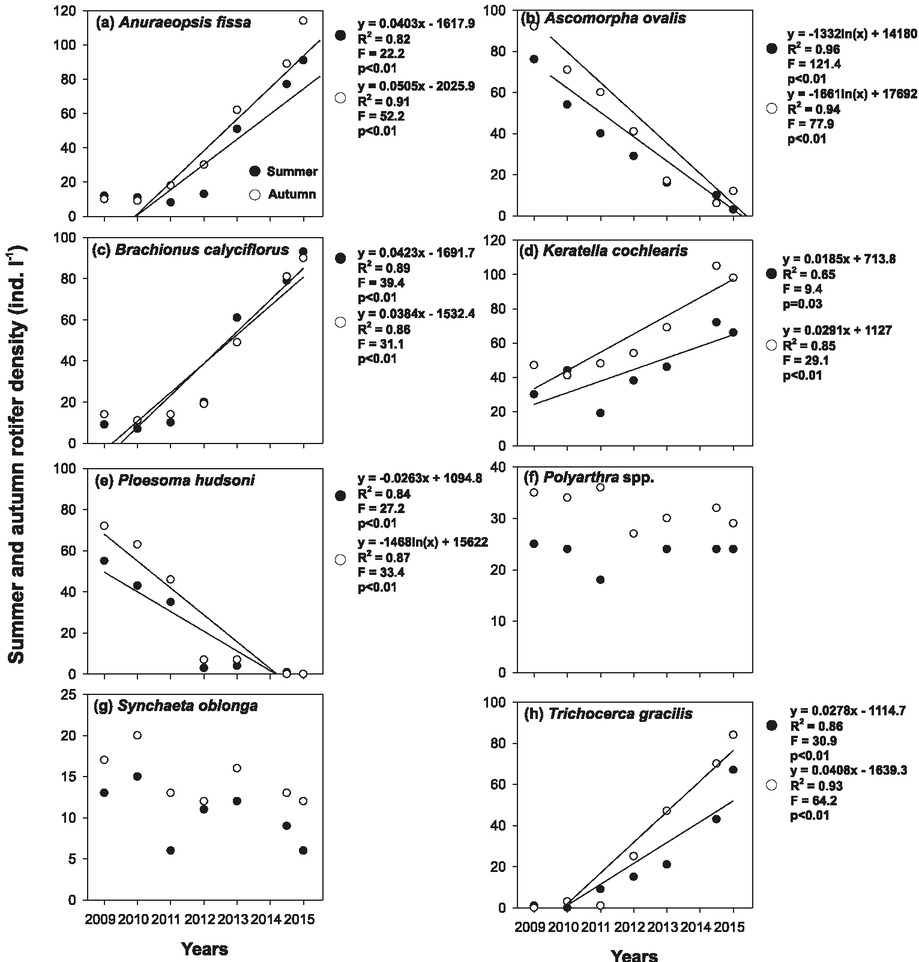
Figure 6
Interannual summer and autumn distribution of eight dominant rotifer species in the Unmun Reservoir. (a) Anuraeopsis fissa, (b) Ascomorpha ovalis, (c) Brachionus calyciflorus, (d) Keratella cochlearis, (e) Ploesoma hudsoni, (f ) Polyarthra spp., (g) Synchaeta oblonga, (h) Trichocerca gracilis. ●: summer, ○: autumn
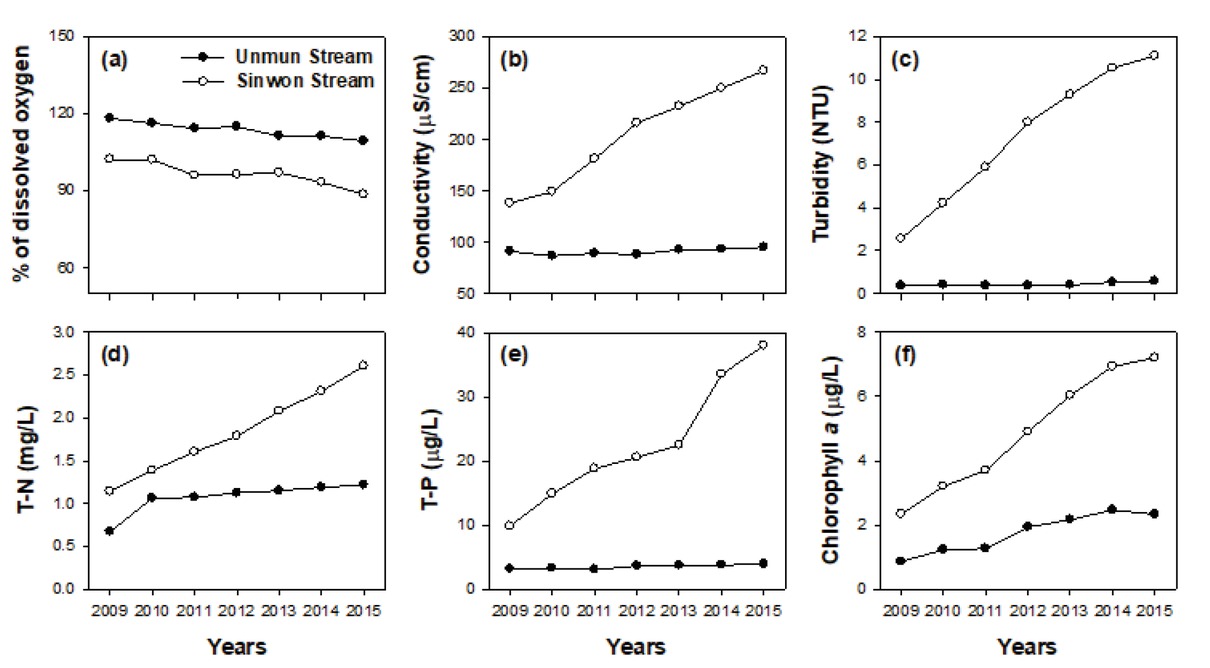
Figure 7
Interannual summer change of environmental factors in the Unmun and Sinwon streams. (a) DO (mg l−1) dissolved oxygen; (b) conductivity (μS cm−1); (c) turbidity (NTU); (d) T-N (mg l−1) total nitrogen; (e) T-P (μg l−1) total phosphorus; (f ) chlorophyll a (μg l−1)
Table 3
Land cover (m2) change of the Unmun and Sinwon streams. Res. – residential area; Com. – commercial area; Cul. – cultural/recreational area; Paddy – paddy area; Field – field
| Unmun Stream | Sinwon Stream | |||||||||
|---|---|---|---|---|---|---|---|---|---|---|
| Res. | Com. | Cul. | Paddy | Field | Res. | Com. | Cul. | Paddy | Field | |
| 2003 | 108 132 | 0 | 0 | 352 613 | 197 180 | 139 634 | 5082 | 0 | 329 444 | 326 708 |
| 2007 | 124 809 | 6066 | 0 | 362 887 | 186 557 | 167 932 | 6186 | 0 | 302 955 | 308 158 |
| 2013 | 195 124 | 10 734 | 4209 | 218 754 | 266 878 | 154 048 | 44 684 | 40 504 | 112 260 | 256 991 |