
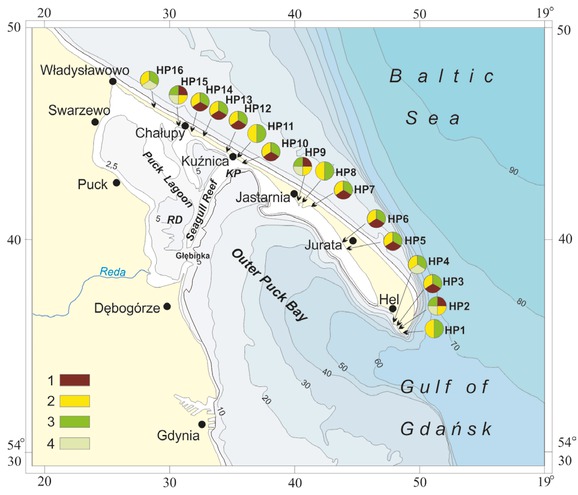
Figure 1
Location of the sampling sites in the Hel Peninsula; 1 – stones, 2 – sands, 3 – seagrass, 4 – macroalgae, RD – Rzucewo Deep, KP – Kuźnica Passage
Table 1
Parameters of the analyzed samples
| Samples | Φ | λ | Location | Type of substrate | |||
|---|---|---|---|---|---|---|---|
| sediments | macroflora | ||||||
| stones | sand | seagrass | macroalgae | ||||
| HP1/1014 | 54°35ʹ34.2ʹʹN | 18°48ʹ38.8ʹʹE | Hel | ✓ | ✓ | ||
| HP2/1014 | 54°35ʹ39.3ʹʹN | 18°48ʹ35.7ʹʹE | Hel | ✓ | ✓ | ✓ | ✓ |
| HP3/1014 | 54°35ʹ41.2ʹʹN | 18°48ʹ30.6ʹʹE | Hel | ✓ | ✓ | ✓ | |
| HP4/1014 | 54°36ʹ22.7ʹʹN | 18°47ʹ59.6ʹʹE | Hel | ✓ | ✓ | ✓ | |
| HP5/1014 | 54°40ʹ51.98ʹʹN | 18°42ʹ29.48ʹʹE | Jurata | ✓ | ✓ | ✓ | |
| HP6/1014 | 54°40ʹ56.3ʹʹN | 18°42ʹ36.4ʹʹE | Jurata | ✓ | ✓ | ✓ | |
| HP7/1014 | 54°41ʹ38.6ʹʹN | 18°40ʹ21.1ʹʹE | Jastarnia | ✓ | ✓ | ✓ | |
| HP8/1014 | 54°41ʹ45.5ʹʹN | 18°40ʹ13.8ʹʹE | Jastarnia | ✓ | ✓ | ||
| HP9/1014 | 54°47ʹ10.4ʹʹN | 18°25ʹ18.3ʹʹE | Jastarnia | ✓ | ✓ | ✓ | ✓ |
| HP10/1014 | 54°41ʹ05.4ʹʹN | 18°40ʹ13.3ʹʹE | Kuźnica | ✓ | ✓ | ✓ | |
| HP11/1014 | 54°44ʹ01.2ʹʹN | 18°35ʹ13.2ʹʹE | Kuźnica | ✓ | ✓ | ||
| HP12/1014 | 54°44ʹ13.3ʹʹN | 18°34ʹ42.7ʹʹE | Kuźnica | ✓ | ✓ | ✓ | |
| HP13/1014 | 54°44ʹ52.1ʹʹN | 18°32ʹ47.1ʹʹE | Chałupy | ✓ | ✓ | ✓ | |
| HP14/1014 | 54°45ʹ30.3ʹʹN | 18°30ʹ59.1ʹʹE | Chałupy | ✓ | ✓ | ✓ | |
| HP15/1014 | 54°45ʹ40.6ʹʹN | 18°30ʹ24.1ʹʹE | Chałupy | ✓ | ✓ | ✓ | ✓ |
| HP16/1014 | 54°46ʹ29.9ʹʹN | 18°27ʹ56.5ʹʹE | Chałupy | ✓ | ✓ | ✓ | |
Table 2
Classification of the diatom flora according to autecological preferences
| Habitat: | Salinity: |
|---|---|
| planktic – living in the water column | euhalobous – marine species with the optimum at salinity of 30–40 PSU |
| benthic – developing on any type of substrate: | mesohalobous – brackish-water species living at salinity of 5–20 PSU |
| epilithon – growing on stones | oligohalobous – species living in fresh water: |
| epiphyton – growing on plants | halophilous – reaching the optimum at salinity < 5 PSU |
| epipsammon – growing on sands | indifferent – euryhaline forms tolerating a low content of salts |
| halophobous – stenohaline forms that do not tolerate even the lowest salinity | |
| Trophic status: | Saprobity: |
| eutraphentic – living in very fertile water | polysaprobous – living in heavily polluted water |
| eu-mesotraphenti c – living in fertile water | α-mesosaprobous – living in moderately polluted water |
| mesotraphentic – living in water of moderate fertility | α-β-mesosaprobous – living in intermediate conditions between α- and β-mesosaprobity |
| meso-oligotraphenti c – living in relatively nutrient-poor water | |
| oligotraphentic – living in nutrient-poor water | β-mesosaprobous – living in less polluted water |
| eu-dystraphenti c – diatoms with high nutrient tolerance | oligosaprobous – living in low polluted water |
| xenosaprobous – living in clean water |
Table 3
The number of diatom taxa (species, subspecies, varieties, forms) vs ecological preferences
| Salinity* | Trophic status** | Saprobity*** | Total | |||||||||||||||
|---|---|---|---|---|---|---|---|---|---|---|---|---|---|---|---|---|---|---|
| eh | mh | oh | oi | et | emt | mt | ot | edt | ir | ps | ams | abms | bms | os | x | ir | ||
| Epilithon | 8 | 27 | 16 | 21 | 35 | 10 | 2 | 5 | 1 | 19 | 2 | 17 | 3 | 24 | 4 | - | 22 | 72 |
| Epipsammon | 12 | 36 | 17 | 25 | 39 | 13 | 4 | 8 | 1 | 25 | 2 | 13 | 4 | 26 | 8 | 1 | 36 | 90 |
| Epiphyton | 13 | 33 | 17 | 22 | 33 | 8 | 4 | 7 | 2 | 31 | 2 | 16 | 3 | 22 | 2 | 1 | 39 | 85 |
| Total | 19 | 50 | 24 | 40 | 51 | 17 | 7 | 12 | 2 | 44 | 2 | 21 | 5 | 36 | 13 | 1 | 55 | 133 |
* eh – euhalobous, mh – mesohalobous, oh – oligohalobous halophilous, oi – oligohalobous indifl erent
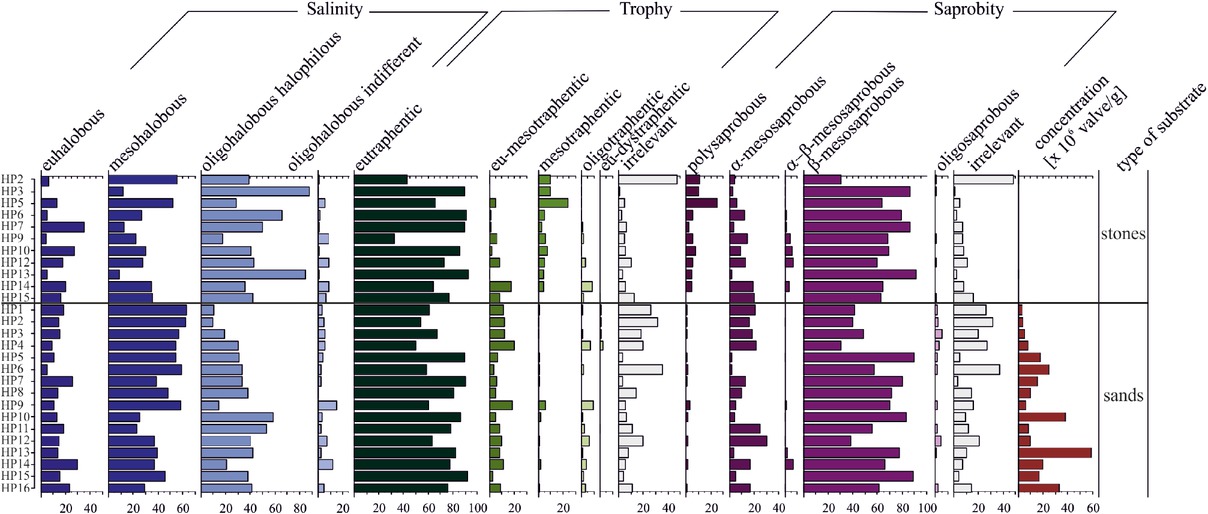
Figure 2
Percentage content of the diatom ecological groups in epilithon and epipsammon
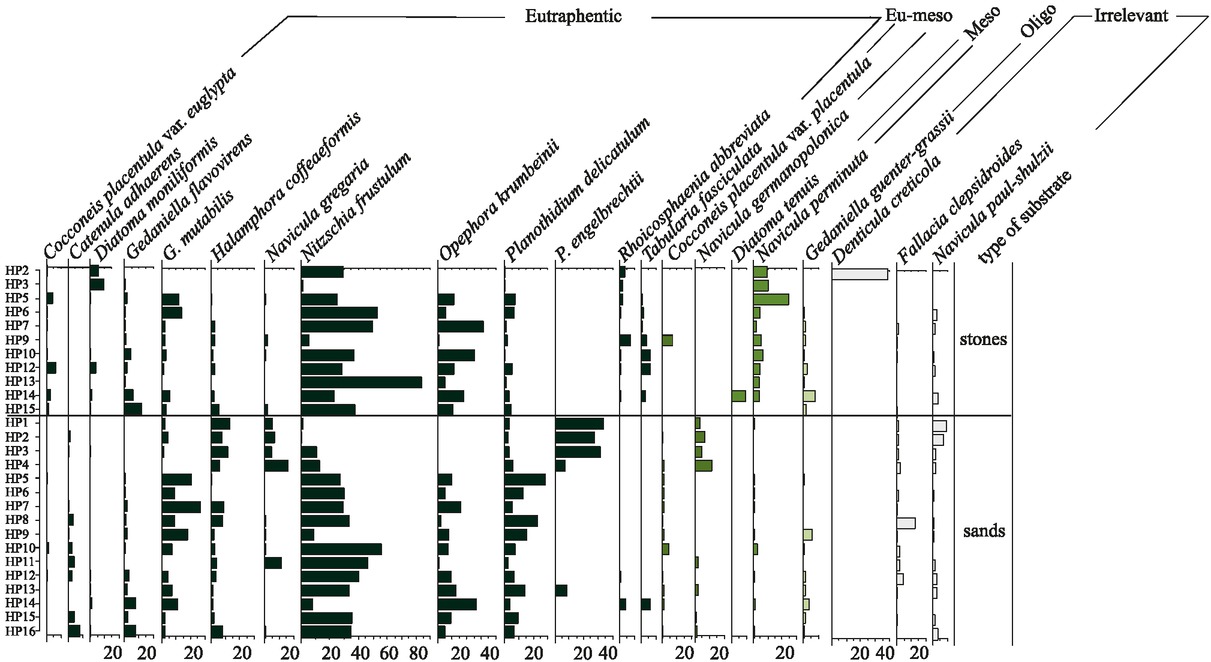
Figure 3
Frequency of the main diatom taxa in epilithon and epipsammon; eu-meso – eu-mesotraphentic, meso – mesotraphentic, oligo – oligotraphentic
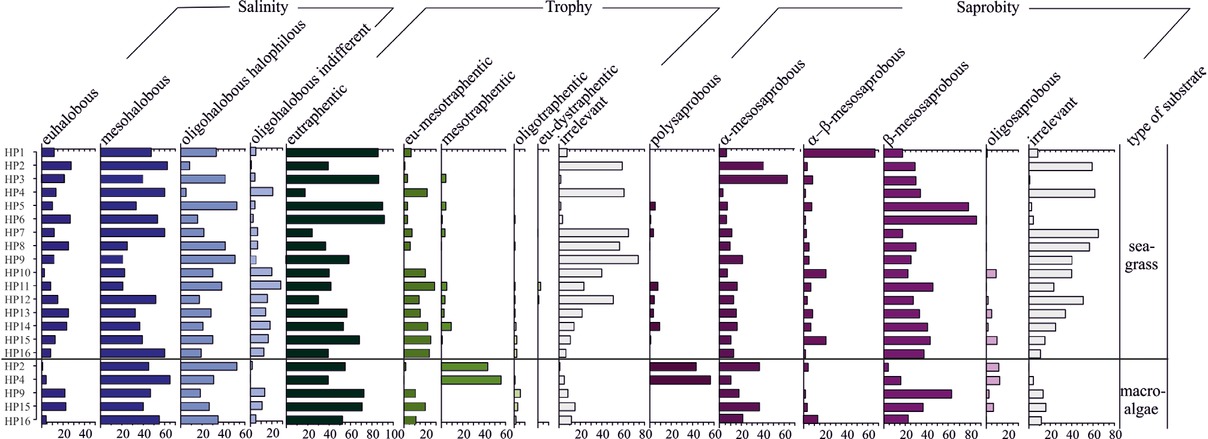
Figure 4
Percentage content of diatom ecological groups in epiphyton (seagrass and macroalgae)
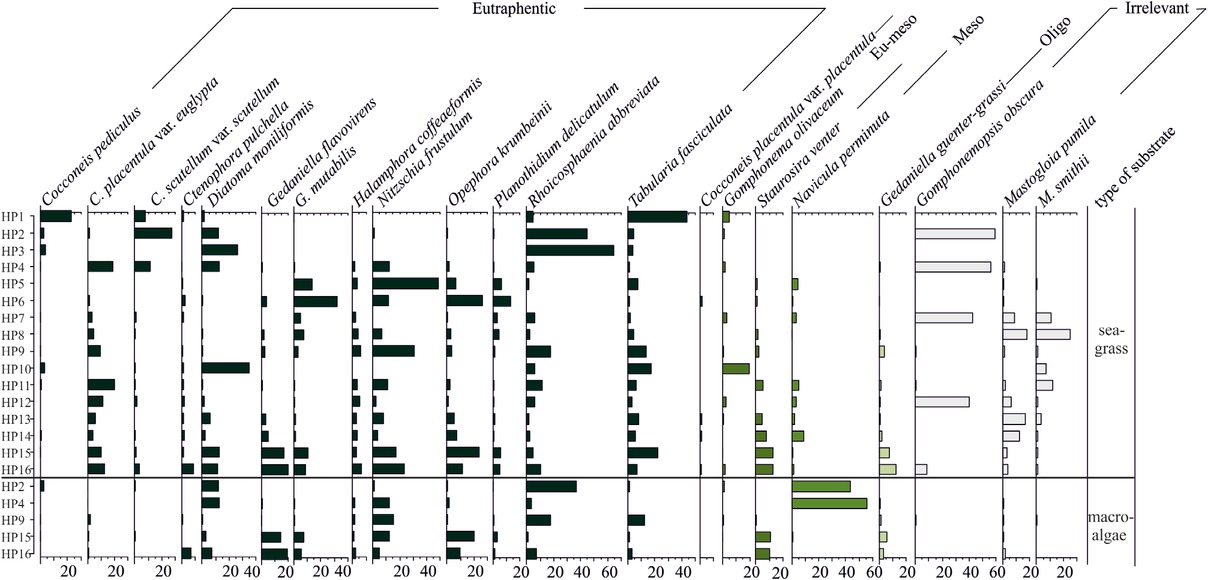
Figure 5
Frequency of the main diatom taxa in epiphyton (seagrass and macroalgae); eu-meso – eu-mesotraphentic, meso – mesotraphentic, oligo – oligotraphentic
Table 4
Distribution and autecology of the main diatom taxa in the study area
| Diatom taxa | Salinity* | Trophic status* | Saprobity* | Habitat | ||
|---|---|---|---|---|---|---|
| Epilithon | Epipsammon | Epiphyton | ||||
| Cocconeis pediculus Ehrenberg | oh | et | bms | ✓ | ||
| C. placentula var. euglypta (Ehrenberg) Grunow | oi | et | bms | ✓ | ✓ | ✓ |
| C. placentula var. placentula Ehrenberg | oi | et | bms | ✓ | ||
| C. scutellum var. scutellum Ehrenberg | eh | et | bms | ✓ | ||
| Catenula adhaerens Mereschkovsky | eh | et | bms | ✓ | ||
| Ctenophora pulchella (Ralfs ex Kützing) D.M. Williams & Round | oh | et | ams | ✓ | ||
| Denti cula creti cola (Østrup) Lange-Bertalot & Krammer | mh | ir | ir | ✓ | ||
| Diatoma moniliformis (Kützing) D.M. Williams | oh | et | bms | ✓ | ✓ | |
| Diatoma tenuis C. Agardh | oi | mt | ams | ✓ | ||
| Fallacia clepsidroides Witkowski | mh | ir | ir | ✓ | ✓ | |
| Gedaniella fl avovirens (Takano) Li, Witkowski & Ashworth | mh | et | ams | ✓ | ✓ | |
| G. guenter-grassii (Witkowski & Lange-Bertalot) Li, Sato & Witkowski | mh | ot | os | ✓ | ✓ | ✓ |
| G. mutabilis (Grunow) Li & Witkowski | mh | et | bms | ✓ | ✓ | ✓ |
| Gomphonema olivaceum (Hornemann) Ehrenberg | oi | emt | bms | ✓ | ||
| Gomphonemopsis obscura (Krasske) Lange-Bertalot | mh | ir | ir | ✓ | ||
| Halamphora coffeaeformis (C. Agardh) Mereschkowsky | eh | et | ams | ✓ | ✓ | |
| Mastogloia pumila (Grunow) Cleve | eh | ir | ir | ✓ | ||
| M. smithii Thwaites ex W. Smith | oh | ir | ir | ✓ | ||
| N. germanopolonica Witkowski & Lange-Bertalot | mh | emt | bms | ✓ | ||
| N. gregaria Donkin | mh | et | ams | ✓ | ✓ | |
| N. paul-schulzii Witkowski & Lange-Bertalot | mh | ir | ir | ✓ | ✓ | |
| N. perminuta Grunow in Van Heurck | mh | mt | ps | ✓ | ✓ | |
| Nitzschia frustulum (Kützing) Grunow | oh | et | bms | ✓ | ✓ | ✓ |
| Opephora krumbeinii Witkowski, Witak & Stachura | eh | et | bms | ✓ | ✓ | |
| Planothidium delicatulum (Kützing) Round & Bukhti yarova | mh | et | bms | ✓ | ✓ | |
| P. engelbrechti i (Cholnoky) Round & Bukhti yarova | mh | et | bms | ✓ | ||
| Rhoicosphaenia abbreviata (C. Agardh) Lange-Bertalot | oh | et | ams | ✓ | ✓ | |
| Staurosira venter (Ehrenberg) Cleve & Möller | oi | met | bms | ✓ | ||
| Tabularia fasciculata (C.Agardh) D.M.Williams & Round | mh | et | abms | ✓ | ✓ | |
* for explanations see Table 3
* for explanations see Table 3
* for explanations see Table 3