
Introduction
Copepods are one of the most diverse groups of aquatic organisms (Dürbaum & Künnemann 2010) that inhabit groundwater and its dependent ecosystems (Brancelj et al. 2013). Two copepod orders, Harpacticoida and Cyclopoida, show high species diversity in groundwater (Pipan & Brancelj 2004; Pipan 2005; Stoch 2000).
Many species are part of the psammon, some live deep in silt and are present in large numbers in interstitial waters and wells (Stoch 1995). Considering the degree of adaptation to subterranean life, copepods can be classified as stygobionts, stygophiles and stygoxenes. Stygobionts are closely associated with this environment throughout their entire life cycle and occur in surface waters only occasionally. Stygophiles can often be found in springs, karst springs, pit caves or interstitial waters. They reproduce in the subterranean environment and have developed, to varying degrees, features considered to be characteristic of stygobionts, but they are also present in typical surface waters. Stygoxenes, in turn, are organisms that occur occasionally in the subterranean environment, but may periodically be present there in large numbers (Stoch 1995).
Geographical distribution of cyclopoid copepods is determined by many factors. Climate change has affected the distribution of cyclopoids in Europe (Hewitt 2001). The glaciation has displaced many organisms outside the ice-covered areas, forcing them to seek more favorable climatic and environmental conditions. Thus, the distribution of i.a. stygobiontic species and their subsequent settlement can be related to the disappearance of a glacier and the formation of postglacial water connections (Botosaneanu & Holsinger 1991). There is evidence that not all organisms had been forced to the south of Europe and that cryptic modern refugia or microrefugia existed (Rull 2009; Schmitt & Varga 2012). They could have survived in the Kraków-Czestochowa Upland and in the Swietokrzyskie Mountains (Jancewicz & Falkowska 2017). Analysis of the geographical distribution of organisms will help to understand the basis of colonization of the subterranean environment by cyclopoid copepods and may indicate the location of refugia where these organisms could have survived climate change. Refugia could have protected populations of geographically isolated organisms that may subsequently re-colonize a region when environmental conditions return to levels tolerated by these organism (Haffer 1969). The major regions that were not completely glaciated by the Scandinavian ice-sheet were karst areas (Lindner 2005), probably elevated above the ice sheet (Jancewicz & Falkowska 2017). In Poland, karst topography can be observed mainly in the Kraków-Czestochowa Upland and the Western Tatras, and to a lesser extent in the Pieniny, the Swietokrzyskie mountains and the Sudetes (Bajkiewicz-Grabowska 2001). Karst areas in Poland are composed of: Precambrian and Paleozoic marbles in the Sudetes and the Swietokrzyskie mountains, Mesozoic limestones and dolomites in the Kraków-Czestochowa Upland, the Tatras and the Pieniny Mountains, Mesozoic chalk in the Lublin Upland and Tertiary halite and gypsum in the Nida Basin (Pulina 1997).
In contrast to many studies on the copepod fauna of surface water in Poland (Razowski 1997), cyclopoid copepods inhabiting groundwater-dependent habitats are poorly described (Prószyńska 1963; Dumnicka & Galas 2017). Only three stygobiontic species of Cyclopida are known from Poland (Chodorowska & Chodorowski 1960; Tabacki 1971; 1980; Wróblewski & Sywula 1997; Kur 2012; Dumnicka & Galas 2017). According to Dumnicka & Skalski (1999), representatives of Cyclopoida and Harpacticoida can be found both in petrostygal and interstitial waters in this part of southern Poland, however, it is not known whether stygobionts occur among them, as this group of invertebrates has not yet been described in detail.
In our earlier work, we investigated the process of colonization of a newly exposed underground space (Kur et al. 2016). In the current study, we focused on the species composition of cyclopoid copepods.
The objectives of this paper were therefore as follows: i) to determine the number of cyclopoid copepod species in the subterranean environment, ii) to identify basic differences in the distribution patterns of cyclopoid copepods in the surface and subterranean waters, and iii) to attempt to answer the question whether the limit of the Middle Polish Glaciations (about 730–440 kyrs BP) was consistent with the occurrence of subterranean cyclopoid copepods?
Materials and methods
Sampling Sites
Thirty seven sampling sites were located in southern Poland (Fig. 1; GPS coordinates – Table 1), were both young and old glacial (periglacial) and glaciofluvial landscapes dominated (Pulina 1997). Numerous surveys were carried out there from 2005 to 2010 by two different surveyors (Table 1).
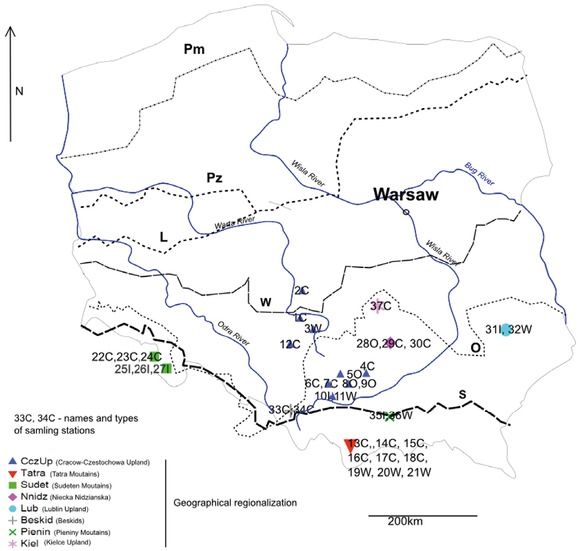
Figure 1
The surveyed regions with geographical regionalization by Kondracki (2002) with the network of rivers and Pleistocene glacial sheets by Marks (2005): S – Sanian 2 or Sanian 1, O – Odranian, W – Wartanian, Vistulian: L Phase, Pz – Poznan Phase, Pm – Pomeranian Phase. Sampling sites with exact location marked. C – caves and mines, W – wells, I – interstitial, O – other places
Table 1
Sampling information and GPS location. Type of environment: C – caves and mines, W – wells, I – interstitial, O – other places. Description of fieldwork dates, sampling device (N – plankton nets, D – diving pump, T – trap) and collector’s name
| Site No. | Site name | Type of environment | GPS coordinates | Date of sampling | Sampling methods and collector’s name |
|---|---|---|---|---|---|
| 1 | Jaskinia Na Kamieniu | C | 50°49ʹ38ʹʹN; 19°8'48ʹʹE | 1 Feb. 2008 | N; Kur |
| 2 | Jaskinia Szmaragdowa | C | 50°52ʹ27ʹʹN; 19°14ʹ1ʹʹE | 2006–2010 | NDT; Kur |
| 3 | Mstow | W | 50°49ʹ45ʹN; 19°17ʹ26ʹʹE | 5–6 Aug. 2007, 27 Feb. 2008, 10 Sept. 2010 | N; Dumnicka |
| 4 | Jaskinia Kryspinowska | C | 50°2ʹ56ʹʹN; 19°48ʹ6ʹʹE | 10 Feb. 2007, 10 March 2008 | N; Kur |
| 5 | Lake Kryspinów | O | 50°2ʹ58ʹʹN; 19°47ʹ55ʹʹE | 10 Feb. 2007, 10 March 2008 | N; Kur |
| 6 | Forty dirty | C | 50°1ʹ15ʹʹN; 19°51ʹ27ʹʹE | 2006–2010 | ND; Kur |
| 7 | Forty clean | C | 50°1ʹ16ʹʹN; 19°51ʹ29ʹʹE | 2006–2010 | ND; Kur |
| 8 | Vistula River 1 | O | 50°2ʹ21ʹʹN; 19°50ʹ36ʹʹE | 2006–2010 | N; Kur |
| 9 | Vistula River 2 | O | 50°2ʹ24ʹʹN; 19°50ʹ36ʹʹE | 2006/2010 | N; Kur |
| 10 | Broszkowice (bridge) | I | 50°3ʹ42ʹʹN; 19°14ʹ9ʹʹE | 14–16.10.2009 | N; Kur |
| 11 | Broszkowice | W | 50°2ʹ34ʹʹN; 19°12ʹ18ʹʹE | 11 Oct. 2008, 14–16 Oct. 2009 | N; Kur |
| 12 | Blachówka (mine) | C | 50°24ʹ4ʹʹN; 18°51ʹ17ʹʹE | 20 Feb. 2010 | NT; Kur |
| 13 | Jaskinia Zimna | C | 49°15ʹ49ʹʹN; 19°52ʹ33ʹʹE | 2006/2010 | ND; Kur |
| 14 | Jaskinia Kasprowa Niżnia | C | 49°16ʹ0ʹʹN; 19°59ʹ13ʹʹE | 2006/2010 | ND; Kur |
| 15 | Jaskinia Kalacka | C | 49°15ʹ51ʹʹN; 19°57ʹ53ʹʹE | 20–22 Jan. 2008 | N; Kur |
| 16 | Jaskinia Wodna Pod Raptawicką | C | 49°15ʹ23ʹʹN; 19°51ʹ54ʹʹE | 4 Oct. 2006 | N; Kur |
| 17 | Jaskinia Dudnica | C | 49°15ʹ7ʹʹN; 19°57ʹ31ʹʹE | 23 Jan. 2008 | N; Kur |
| 18 | Jaskinia Bańdzioch Kominiarski | C | 49°14ʹ33ʹʹN; 19°50ʹ14ʹʹE | 25 Jan. 2008 | N; Kur |
| 19 | Witów | W | 49°18ʹ52ʹʹN; 19°49ʹ36ʹʹE | 20–22 Jan. 2008 | N; Kur |
| 20 | Chochołów (well) | W | 49°22ʹ23ʹʹN; 19°48ʹ56ʹʹE | 20–22 Jan. 2008, 10 June 2008 | N; Kur |
| 21 | Kościelisko (well) | W | 49°18ʹ5ʹʹN; 19°53ʹ58ʹʹE | 20–22 Jan. 2008, 10 June 2008 | N; Kur |
| 22 | Jaskinia Niedźwiedzia | C | 50°14ʹ03ʹʹN; 16°50ʹ03ʹʹE | 3–4 Feb. 2008 | N; Kur |
| 23 | Jaskinia Radochowska | C | 50°21ʹ31ʹʹN; 16°49ʹ09ʹʹE | 3 Feb. 2008 | N; Kur |
| 24 | Jaskinia Solna Jama | C | 50°11ʹ49ʹʹN; 16°35ʹ1ʹʹE | 3–4 Feb. 2008 | N; Kur |
| 25 | Zieleniec | I | 50°20ʹ48ʹʹN; 16°23ʹ40ʹʹE | 3 Feb. 2008 | N; Kur |
| 26 | Romanowskie (spring) | I | 50°20ʹ5ʹʹN; 16°44ʹ26ʹʹE | 2 March 2008 | N; Kur |
| 27 | Kamieniec | I | 50°16ʹ56ʹʹN; 16°47ʹ8ʹʹE | 5 Feb. 2008 | N; Kur |
| 28 | Gacki | O | 50°27ʹ39ʹʹN; 20°35ʹ23ʹʹE | 11–13 Oct. 2008 | N; Kur |
| 29 | Siesławice | C | 50°27ʹ26ʹN; 20°41ʹ29ʹʹE | 11-13 Oct. 2008, 01 Oct. 2009 | NT; Kur |
| 30 | Jaskinia Skorocicka | C | 50°24ʹ53ʹʹN; 20°40ʹ12ʹʹE | 11-13 Oct. 2008, 1 Oct. 2009 | NT; Kur |
| 31 | Radecznica (spring) | O | 50°45ʹ49ʹʹN; 22°49ʹ34ʹʹE | 21–22 Oct. 2009 | N; Kur |
| 32 | Radecznica (well) | W | 50°45ʹ51ʹʹN; 22°49ʹ33ʹʹE | 21–22 Oct. 2009 | N; Kur |
| 33 | Jaskinia Miecharska 1 | C | 49°39ʹ34.8ʹʹN; 18°58ʹ41.6ʹʹE | 12 Oct. 2008 | N; Kur |
| 34 | Jaskinia Miecharska 2 | C | 49°39ʹ34.8ʹʹN; 18°58ʹ41.6ʹʹE | 20 Jan. 2009 | N; Kur |
| 35 | Szczawnica (river) | I | 49°25ʹ11ʹʹN; 20°29ʹ23ʹʹE | 20 Jan. 2009 | N; Kur |
| 36 | Szczawnica (well) | W | 49°25ʹ39ʹʹN; 20°26ʹ44ʹʹE | 20 Jan. 2009 | N; Kur |
| 37 | Chelosiowa Jama | C | 50°51ʹ36ʹʹN; 20°29ʹ41ʹʹE | 14 March 2007 | N; Dumnicka |
Cyclopoid copepods were collected from: caves, mining sites, interstitial water, wells, cave pools, small reservoirs and springs. The research focused only on cyclopoid copepods. Harpacticoid copepods were present in samples but they were mostly in larval stages, while calanoid copepods were not found at all. Samples were collected from the water column to avoid sampling net contamination by sediment. The sites were divided into four groups: caves (C), wells (W), interstitial (I), others (O) – Table 1. Sampling sites marked as O represented typical surface sites: 5 – Lake Kryspinów, 8 – Vistula River, 9 – Vistula River, 28 – Lake Gacki, 31 – Radecznica field spring.
Some of the sites were artificially contaminated, mainly by waste. Geographical regions are presented (Fig. 1) according to Kondracki (2002).
Sampling and Taxonomic Identification
In general, a standard plankton net (200 mm ring) with a cod-end cylinder was used to collect samples (Gutkowska et al. 2012). In addition, a 45 μm mesh net was also used sometimes and a scuba diver operating a pump collected samples from surrounding areas. A 45 μm mesh net was fitted at the end of the pump. We focused particularly on stygobiontic cyclopoid copepods that could inhabit the saturated zone. Samples from cave pools were collected separately into plastic containers and then water was poured into bottles and filtered through the mesh net. Sampling methods were selected in such a way as to avoid the destruction of groundwater habitats as much as possible. Underwater traps were built from modified PVC boxes (length – 100 mm; inner diameter – 65 mm); two traps per site were placed on the bottom. The traps were left in situ for 7 days and then removed and taken to the laboratory. The plastic box contained a small piece of chicken meat (20 g) to attract copepods.
All samples (Table 1) collected by the plankton net (N), the diving pump (D) and the trap (T) were filtrated through the 45 μm mesh net.
Individuals from plastic containers were fixed in 70% final ethanol solution at the sampling sites and stored for further processing. In the laboratory, the organisms were separated under a Nikon stereomicroscope at 40× magnification and stored in a refrigerator. Further processing and identification of the organisms were performed under a microscope. Body parts were dissected in glycerine medium and checked for species identification. Basic identification was conducted using a key by Rybak & Błędzki (2005) and Błędzki & Rybak (2016), nauplii were not identified to the species level. Finally, female adults of cyclopoids and last larval stages (copepodite V) were identified to the species level following the identification keys by: Dussart & Defaye (2001), Iepure & Defaye (2008), Kiefer (1960), Mirabdullayev & Kuzmetov (1998), Pesce & Galassi (1984), Pesce (1992), Pospisil & Stoch (1999), Stoch (2001). The information provided here on the general geographical distribution pertains only to the European sites of the species.
Ecometrics
The Jaccard index was used to compare the similarity and diversity (qualitative composition) of sample sets [species assemblage per habitat type (C, W, I, and O)].
where:
a – number of species shared by site 1 and 2
b– number of species present only at site 1
c– number of species present only at site 2
Similarity coefficients for binary data can range from 0 (no similarity) to 1.0 (complete similarity – 100%; Jaccard 1912). Single linkage clustering, called the nearest neighbor method was used for agglomerative cluster analysis (Clarke & Gorley 2005; Colwell et al. 2012).
The PRIMER v7 (Plymouth Routines In Multivariate Ecological Research) software was used to analyze species data for community assemblages per habitat type (Clarke & Gorley 2005).
Results and discussion
Meiofauna samples from different habitats indicated that both surface and subterranean sites were inhabited by Copepoda. A total of 37 sites were sampled. Samples from sites: 2, 9, 28, 18, 17, 15, 22 and 21 did not contain any adult copepods (Table 2). Copepodites were found at almost all sampling sites; only one copepodite (no adults) was found at site 14. In total, 22 copepod species belonging to the order Cyclopoida and eight genera were identified. Their distribution is summarized in Table 2. Acanthocyclops venustus, Diacyclops bicuspidatus and Eucyclops serrulatus were most abundant in the samples.
Table 2
List of species of copepods (Cyclopoida) ▲ – stygobiotic species
| Site |  |  |  |  |  |  |  |  |  |  |  |  |  |  |  |  |  |  |  |  |  |  |
|---|---|---|---|---|---|---|---|---|---|---|---|---|---|---|---|---|---|---|---|---|---|---|
| 1 | * | |||||||||||||||||||||
| 2 | ||||||||||||||||||||||
| 3 | * | * | * | * | * | * | ||||||||||||||||
| 4 | * | |||||||||||||||||||||
| 5 | * | * | * | * | ||||||||||||||||||
| 6 | * | * | * | |||||||||||||||||||
| 7 | * | * | * | * | * | * | * | |||||||||||||||
| 8 | * | |||||||||||||||||||||
| 9 | ||||||||||||||||||||||
| 10 | * | * | * | |||||||||||||||||||
| 11 | * | * | * | |||||||||||||||||||
| 12 | * | |||||||||||||||||||||
| 13 | * | |||||||||||||||||||||
| 14 | ||||||||||||||||||||||
| 15 | ||||||||||||||||||||||
| 16 | * | |||||||||||||||||||||
| 17 | ||||||||||||||||||||||
| 18 | ||||||||||||||||||||||
| 19 | * | * | ||||||||||||||||||||
| 20 | * | * | ||||||||||||||||||||
| 21 | ||||||||||||||||||||||
| 22 | ||||||||||||||||||||||
| 23 | * | |||||||||||||||||||||
| 24 | * | |||||||||||||||||||||
| 25 | * | * | * | |||||||||||||||||||
| 26 | * | * | * | * | ||||||||||||||||||
| 27 | * | |||||||||||||||||||||
| 28 | * | |||||||||||||||||||||
| 29 | * | * | ||||||||||||||||||||
| 30 | * | * | * | * | * | * | * | * | ||||||||||||||
| 31 | * | * | ||||||||||||||||||||
| 32 | * | |||||||||||||||||||||
| 33 | * | * | ||||||||||||||||||||
| 34 | * | |||||||||||||||||||||
| 35 | * | * | * | * | * | * | ||||||||||||||||
| 36 | * | * | * | |||||||||||||||||||
| 37 | * | * |
Description of recorded species
Species accounts
Order: Cyclopoida
Family: Cyclopidae
Subfamily: Cyclopinae
Genus: Acanthocyclops
The genus Acanthocyclops was represented by four species in the collected material (Table 2).
Acanthcyclops kieferi (Chappuis, 1925) was found in both natural and artificial cavities. The species has already been reported by Kur & Wojtasik (2007) and Mioduchowska & Wojtasik (2009) from northern Poland. Acanthcyclops kieferi is common in groundwater, in deep littoral and profundal zones (Pesce & Galassi 1984). It is a subterranean species of kieferi – the group has been known to occur in European caves, e.g. in the Apuseni Mountains (north-western Romania), also known as the Western Carpathians (Iepure, Oarga 2011). It was also encountered in streams (Iepure, Dafaye 2008). The stygobiontic subspecies A. kieferi kieferi was also reported from Italy (Pesce, Galassi 1984). According to Iepure & Defaye (2008), the taxonomic status of this group is rather unclear, as the species included combine traits different from their epigean congenerics. The species has not been recorded in Northern Europe. Poland, Ukraine and Germany are the northern limit of the range of this species (De Jong et al. 2014). The A. kieferi complex includes exclusively stygobiotic species, mainly widespread in cave habitats of Southeastern Europe (Iepure & Defaye 2008).
Acanthocyclops robustus (Sars, 1863) is a species found among plants in the littoral zone and in the upper reaches as well as in slow-flowing rivers with a wide range of use (Einsle 1996). It is rarely found by researchers in samples of underground undeground water (Einsle 1992) and is considered to be a stygoxene or stygophile. The species was recorded in Central and Northern Europe (De Jong et al. 2014).
Acanthocyclops venustus (Norman, Scott, 1906) was reported for the first time by Kur & Wojtasik (2007) and Mioduchowska & Wojtasik (2009) from Pomerania. Until then, it had not been reported from Poland (Razowski 1997). A. venustus prefers higher temperature waters, even though it is quite often found in subterranean environments. The species has been classified as a stygoxene (Pipan 2005).
Acanthocyclops vernalis Fischer, 1853 a stygoxene, not often recorded in subterranean waters in Europe (Pipan 2005; De Jong et al. 2014). Based on morphological research, Bláha et al. (2010) concluded that this species is morphologically very diverse.
Genus: Cyclops
The genus was represented by three species (see Table 2 for the sites); none of them was classified as a species associated with the subterranean environment (Einsle 1996).
Cyclops abyssorum Sars, 1863 – only one specimen was found during long-term studies in various types of groundwater-dependent habitats of the Tatra National Park, which may indicate its accidental presence in Jaskinia Wodna pod Raptawicka (cave), despite the fact that the species is common in lakes of the Tatra Mountains (Gliwicz & Rowan 1984). The species is typical of freshwater lakes (Einsle 1996), but Pipan (2005) found it also in karst caves. The species is also known from Poland (Lake Wigry) and is characterized by an arctic/boreo-alpine distribution in Europe (De Jong et al 2014; Hołynska & Wyngaard 2019).
Cyclops bohater Koźmiński, 1933 – typical for lakes with high and moderate trophic conditions. The species was originally described from Poland (Lake Wigry; Koźmiński 1933) and recorded in central Europe (Hołynska & Dimante-Deimantovica 2016; Hołynska & Wyngaard 2019).
Cyclops vicinus Uljanin, 1875 – according to the literature, it may occur in various localities all over Europe (Einsle 1996).
Genus: Diacyclops
The genus Diacyclops, comprising a large number of stygobiontic species (Pipan 2005), was represented in our material by six species, including only one stygobiont (D. clandestinus; Table 2).
Diacyclops abyssicola (Lilljeborg, 1901) – it is more characteristic for the northern part of Europe (Pesce 1992; De Jong et al. 2014). In Poland to date, it has only been found on the coast (Mioduchowska, Wojtasik 2009).
Diacyclops bicuspidatus (Claus, 1857) – a species with a very wide range and resistance to difficult environmental conditions (Stoch 2001); occasionally associated with underground waters, considered to be a stygoxene (Por & Dimentman 2001); found both in deep lakes and in small shallow reservoirs (Por & Dimentman 2001). The species was recorded all over Europe (De Jong et al. 2014).
Diacyclops clandestinus (Kiefer, 1926) – a species difficult to identify, forming many local varieties and subjected to intensive taxonomic research (Pesce 1992; Pipan 2005). The species has not been recorded in Northern Europe. Poland and Germany are the northern limit of its range (De Jong et al. 2014).
Diacyclops crassicaudis (Sars, 1863) – a species typical of the psammon fauna and the littoral zone of lakes (Stoch 2001). The species was recorded in Europe (De Jong et al. 2014).
Diacyclops languidoides (Lilljeborg, 1901) – it develops underground forms, with characteristic morphological changes. It is a stygophilic species, although some authors classify it as a stygoxene (Stoch 2001). It can occur in both surface and underground waters (Pesce 1992). Diacyclops languidoides s. l. has been reported from the whole Palearctic and comprises several subspecies, the taxonomic status of which requires clarification.
Diacyclops nanus (Sars, 1863) – the species was recorded in throughout Europe (De Jong et al. 2014).
Genus: Megacyclops
The genus Megacyclops was represented by two common species (Table 2); neither of them is stygobiontic, although they occur in the interstitial environment. They are also found in caves and spring waters. They are classified as stygophiles and stygoxenes (Einsle 1996).
Megacyclops gigas (Claus, 1857) – most common in small ponds and lakes (Einsle 1996). The species was recorded all over Europe (De Jong et al. 2014).
Megacyclops viridis (Jurine, 1820) – it is found throughout Europe; most common in small ponds rich in nutrients (De Jong et al. 2014).
Genus: Thermocyclops
The genus Thermocyclops was represented by only one species (Table 2).
Thermocyclops crassus (Fischer, 1853) – it occurs in both pelagic and littoral zones of lakes (Mirabdullayev & Kuzmetov 1998). The species is widely distributed in Europe (De Jong et al. 2014).
Subfamily: Eucyclopinae
Genus Eucyclops
Two common and eurybiontic species from the Eucyclops genus were identified. They were found in the subterranean environment (Table 2). Eucyclops are usually classified as stygoxenes (Pipan 2005).
Eucyclops macruroides (Lilljeborg, 1901) and Eucyclops serrulatus (Fischer, 1851) inhabit small pools and the littoral zone of larger lakes. Morphological changes characteristic of subterranean species may develop in these species after inhabiting the subterranean environment. They are usually classified as stygoxenes (Alekseev et al. 2006). Species are found all over Europe (De Jong et al. 2014).
Genus: Macrocyclops
In our study, the genus Macrocyclops was represented by one species (Table 2).
Macrocyclops albidus (Jurine, 1820) – although recorded in groundwaters, it is not a stygobiontic species. Macrocyclops albidus is classified as a stygophile (Dürbaum, Künnemann 2010). The species is widely distributed in Europe (De Jong et al. 2014).
Genus: Paracyclops
Paracyclops was represented by three species. Although they are not stygobiontic species, they were found in the subterranean environment (Pipan 2005). According to Pipan (2005), Paracyclops adapt well to different environments, including subterranean environments (except for D. poppei).
Paracyclops affinis (Sars, 1863) – it is found in water bodies of all sizes; the species is found throughout Europe (De Jong et al. 2014).
Paracyclops fimbriatus (Fischer, 1853) – it is characterized by high morphological variability (Dussart & Defaye 2001). In the current study, P. fimbriatus was found in typical karst subterranean environments. The species is found all over Europe (De Jong et al. 2014), including Poland (Rybak & Błędzki 2005; Hołynska 2008).
Paracyclops poppei (Rehberg, 1880) – it occurs mainly in ponds and slow-flowing rivers (Pipan 2005). The species is found all over Europe (De Jong et al. 2014).
Distribution and diversity of copepod communities
Acanthocyclops kieferi, Acanthocyclops venustus, Diacyclops bicuspidatus, Acanthocyclops robustus and Macrocyclops albidus were the most common species at all the study sites. Acanthocyclops kieferi dominated in the subterranean environment and had not been previously recorded in the study area (southern Poland). Typical species were also recorded in the caves: Cyclops vicinus, Diacyclops crassicaudis and Paracyclops affinis. We believe that a relatively large number of unidentified juveniles in water of the caves may be due to the extension of their life cycles (Berger & Maier 2001), which is a consequence of limited energy resources available in groundwater. This phenomenon also occurs in other crustacean groups (Glazier & Sparks 1997). However, the number of taxa in some reservoirs/groundwater bodies can be limited (Stoch 1998). The low number of cyclopid species recorded in the subterranean water samples collected in our study is consistent with literature data (Galassi et al. 2001; Galassi et al. 2002; Stoch 1998; 2000; 2003).
The clustering tree (based on the Jaccard similarity analysis) shows the maximum similarity index between sites 1 and 8, and 27, 34, 4, 12, 13 and 24 (Figure 2). Two sites, 1 and 8, were located in the same geographical region. The first site was located in the Vistula riverbed, while the second one was located inside a cave that was periodically flooded by the Warta River. Sites 27, 34, 4, 12, 13, 24 were located in different geographical regions, but mainly included water bodies in caves and mines. Sites 28, 29 and 30 were located in the gypsum karst area. Sites 22, 23, 24, 25, 26, 27 and 13, 14, 15, 16, 17, 18 were located outside of the glacial sheet, and there was a considerable divergence between the cyclopoid fauna at the sampling sites. A very low similarity index was determined for site 16, where the stygobiontic species was found. Sampling site 5 – Lake Kryspinów – is located almost 100 m away from site 4 and had a different species composition. Acanthocyclops kieferi was found at sites 37, 33, 34, 24, 20, 12, 13 and 4. They were mostly natural caves or were located in the limestone area.
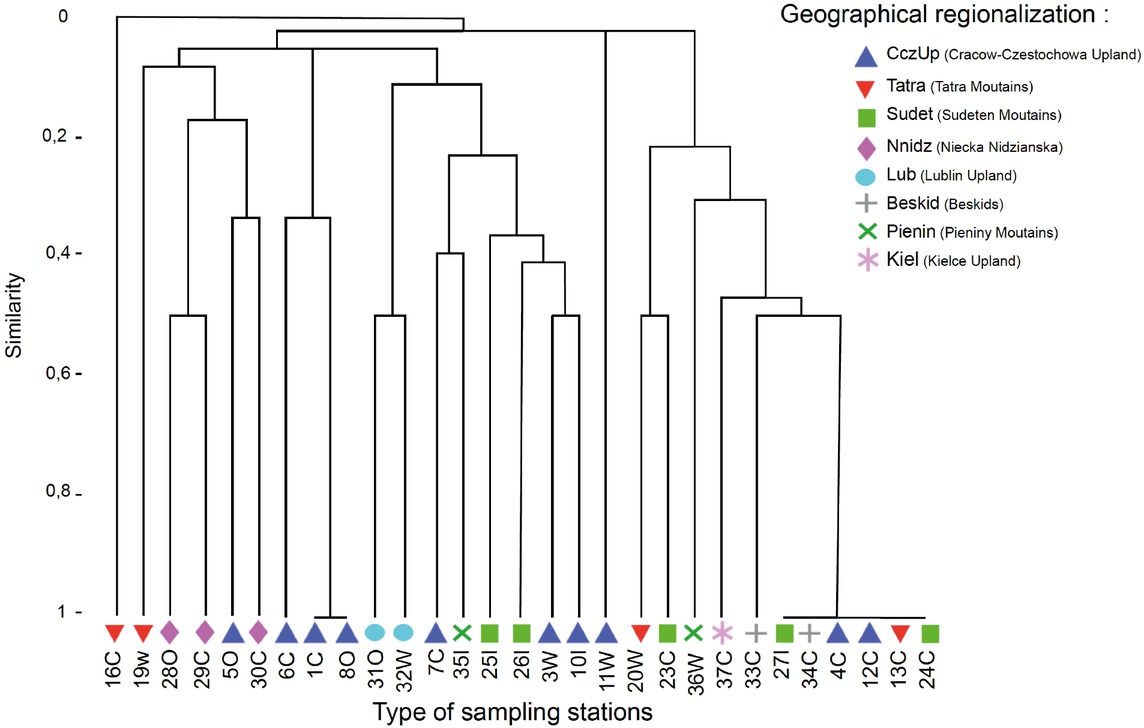
Figure 2
Spatial distribution and similarity between the sites. Graph of the group average standardized on the Jaccard similarity coefficient. Software PRIMER v7 (Clarke & Gorley 2005). C – caves and mines, W – wells, I – interstitial, O – other places
It is believed that the main factor affecting the distribution of individual taxa in the springs and caves is the glaciation phenomenon occurring in the past (Galassi et al. 2001; 2002; Stoch 2000; 2003). According to Lindner (2005), nine major glacial and interglacial periods occurred in Poland in the Pleistocene. During this period, the expansion of aquatic organisms was affected by the direction of glacial and river water flow, resulting from glacier retreat. The northern part of Poland was covered by glaciers to varying degrees (e.g. during the second San glaciation, the area was almost completely covered by ice; Lindner 2005), causing the retreat of organisms from this area. On the other hand, the mountains in the south of Poland served as a barrier to the species migration. Arctic steppes and a tundra valley were formed between these two barriers. However, this area could have been a refuge for some species. The isolation of populations in different glacial refugia constituted the main historical factor affecting the contemporary species distribution (Hewitt 2001 – genetic diversity of recolonizing species). Individual regions in southern Poland have diverse subterranean environments as a consequence of different glacial history. Recolonization of groundwater originates from surface waters, where active migrations and changes in species composition continue to change under the influence of anthropogenic factors (Hewitt 2001).
In the past, Copepoda were recorded in springs and caves of the Kraków-Czestochowa Upland, but since taxonomic identification was not carried out, it was impossible to determine whether stygobiontic species were present among them (Dumnicka & Wojtan 1990). Some Metacyclops species were found in the Mąciwoda cave, but their specific identity is unknown. Namiotko (1990) found the stygobiontic ostracod Candona eremita (Vejd, 1882) in northern Poland in Zuławy Wislane (alluvial delta area of the Vistula River). The occurrence of stygobiontic ostracod species in the north and our stygobiontic copepod findings indicate that river catchments could contribute to the dispersion of crustaceans.
Understanding the subterranean species biodiversity requires knowledge of the regional distribution of these species in surface water. The number of species found in a specific cave or subsurface site is small compared to the number of species in the region (Culver & Sket 2000). More than 51 species of cyclopoid copepods are known from Poland (Hołynska 2008) and 22 species were found during our research. This is consistent with the findings of Culver & Sket (2000). However, Slusarczyk (2003) conducted research in an artificial open reservoir (Lake Zakrzówek) flooded with groundwater from the same sources as sites 6 and 7 (located within a few hundred meters from Lake Zakrzówek in the Kraków-Czestochowa Upland) and recorded three species [Eudiaptomus gracilis (Sars, 1863), Cyclops vicinus Uljanin, 1875 and Thermocyclops crassus (Fischer, 1853)]. This also shows low species richness, but these species were not found at the subterranean sites. During our research we found three species at site 6, and seven species at site 7 (both were subterranean sites). The small number of species in Lake Zakrzówek is likely a result of predation pressure on copepods by other organisms.
Species composition at sites 4 and 5 differed quite considerably (one species in the cave). Both sites were located in the Vistula riverbed, which was completely covered by the ice sheet during the Sanian glaciation (Lindner 2005). The only explanation for this situation is that site 4 is a natural karst cave, where samples were collected from natural cave ponds that are not supplied with groundwater. Site 5 represents surface water (Lake Kryspinów). Water bodies at sites 6 and 7 were formed less than 100 years ago in limestone (artificial). The species composition is highly diverse at surface sites. Frequent occurrence of Acanthocyclops kieferi in natural caves and wells could indicate their similar species composition, as confirmed by studies of Culver & Sket (2000). At artificial sites, more opportunistic species of cyclopoid copepods can be observed. This would explain our earlier work where we investigated the process of colonization of a newly exposed underground space. We observed that opportunistic organisms could colonize it (in a short period of time) for several reasons, including survival, convenience (Kur et al. 2016).
The following cyclopoid species were identified by other authors in the caves and springs of the Western Sudetes and Lower Silesia (south-western Poland): Megacyclops viridis (Jurine, 1820), Macrocyclops albidus (Jurine, 1820), Paracyclops fimbriatus (Fischer, 1853), Eucyclops serrulatus (Fischer, 1851), Diacyclops languidus disjunctus (Thallwitz, 1927) and D. crassicaudis (Sars, 1863) (Garden 1923; 1924; Herr 1921; Tomaszewski 1932). The regions of the Western Sudetes, Lower Silesia and the Tatra Mountains (southern Poland) were not permanently exposed to the impact of glaciation in the past (Lindner 2005), but most of these species were also found at sites where the solid ice sheet was present during the Middle Polish Glaciations.
Conclusions
Low species richness of subterranean cyclopoid copepods and a smaller number of cyclopoid copepod stygobionts in Poland compared to the south of Europe (Pipan 2005; Kur 2012) seems to be a direct consequence of complex geological history, different habitat types, habitat fragmentation and extinction during Pleistocene glacial cycles.
Based on the cluster analysis of species composition, the surface and subterranean copepod fauna do not separate from each other. Our research does not directly confirm that the presence of the solid ice sheet during the Middle Polish Glaciations affected the occurrence of cyclopoid copepods.
The main result of our work was finding Acanthocyclops kieferi at sites located mostly in caves: Kryspinowska, Miecharska, Zimna, Jama Solna and the Blachówka mine, as well as in the interstitial habitat in Kamieniec, and Diacyclops clandestinus in the well in Broszkowice. At these subterranean sites, despite their geographical and geological differences, the same species were found, which had not been previously recorded in the study area (southern Poland).
Future research on subterranean Copepoda should also focus on old artificial wells. Places where such research can be carried out have been transformed due to human activity and water pollution, and most of them will vanish in the near future.
Acknowledgements
The study was supported by a grant from the National Science Center in Poland (No. ID 46387 N N304 326236). We would like to thank Prof. Elzbieta Dumnicka and two anonymous reviewers for unstinting support.