
Table 1
Sampled turtles and geographical location
| oceanic basin | location | species | nesting or subadult | juvenile | latitude | longitude |
|---|---|---|---|---|---|---|
| Caribbean Sea (Marti nique) | Grande Anse d'Arlet | CM | 8 | 14°30ʹ10.95ʹʹN | 61°05ʹ13.01ʹʹW | |
| Anse du Bourg d’Arlet | CM | 22 | 14°29ʹ13.43ʹʹN | 61°04ʹ58.89ʹʹW | ||
| EI | 1 | |||||
| Macabou | DC | 1 | 14°29ʹ55.06ʹ'N | 60°49ʹ25.42ʹʹW | ||
| Les Sâlines | EI | 1 | 14°23ʹ45.55ʹʹN | 60°52ʹ14.74ʹʹW | ||
| Anse Noire | EI | 1 | 14°31ʹ42.47ʹʹN | 61°5ʹ20.36ʹʹW | ||
| CM | 1 | |||||
| Prêcheur | EI | 1 | 14°49ʹ60ʹʹN | 61°12ʹ0ʹʹW | ||
| CM | 1 | |||||
| Carbet | CM | 4 | 14°42ʹ0ʹʹN | 61°10ʹ60ʹʹW | ||
| Saint Pierre | CM | 2 | 14°43ʹ60ʹʹN | 61°10ʹ60ʹʹW | ||
| EI | 1 | |||||
| Petite Anse d’Arlet | CM | 1 | nd | nd | ||
| Equatorial Atlantic Ocean (French Guiana) | Yalimapo | DC | 16 | 5°44ʹ47.96ʹʹN | 53°56ʹ37.36ʹʹW | |
| CM | 13 | |||||
| Aztèque | CM | 4 | 5°41ʹ12.57ʹʹN | 53°43ʹ49.07ʹʹW | ||
| DC | 1 | |||||
| Cayenne | DC | 3 | 4°55ʹ10.54ʹʹN | 52°16ʹ5.31ʹʹW | ||
| LO | 6 | |||||
| South Pacific Ocean (French Polynesia) | Te Mana O Te Moana (Moorea) | CM | 2 | 17°29ʹ39.639ʹʹS | 149°52ʹ13.527ʹʹW | |
| Tiaraunu (Tetiaroa) | CM | 7 | 16°59ʹ21.5ʹʹS | 149°34ʹ48.1ʹʹW | ||
| Oroatera (Tetiaroa) | CM | 1 | 16°59ʹ37.4ʹʹS | 149°32ʹ24.0ʹʹW | ||
| Onetahi (Tetiaroa) | CM | 9 | 17°01ʹ17.9ʹʹS | 149°35ʹ45.2ʹʹW | ||
| Tahiti | EI | 1 | nd | nd | ||
| Afareaitu (Moorea) | EI | 2 | 17°33ʹS | 149°48ʹW | ||
| Nu’uroa (Moorea) | CM | 1 | 17°32ʹ5.793ʹʹS | 149°54ʹ10.325ʹʹW | ||
| Haapiti (Moorea) | CM | 1 | 17°33ʹ56.2ʹʹS | 149°52ʹ09.9ʹʹW | ||
| Atiha (Moorea) | CM | 1 | 17°35ʹ09.7ʹʹS | 149°50ʹ26.8ʹʹW | ||
| Tetiaroa | EI | 2 | nd | nd | ||
| LO | 1 | nd | nd | |||
| Tikehau | CM | 1 | 15°S | 148° 10'W | ||
| Moorea Lagoon | EI | 1 | nd | nd | ||
| Maatea (Moorea) | EI | 1 | 17°35ʹ13.92ʹʹS | 149°48ʹ20.7036ʹʹW | ||
| Opunohu (Moorea) | CM | 1 | 17°30ʹ28.7352ʹʹS | 149°51ʹ23.9328ʹʹW | ||
| Temae (Moorea) | CM | 1 | nd | nd | ||
| Moorea | EI | 1 | nd | nd | ||
| Papetoai (Moorea) | CM | 1 | nd | nd | ||
| Horoatera (Teti aroa) | CM | 1 | nd | Nd |
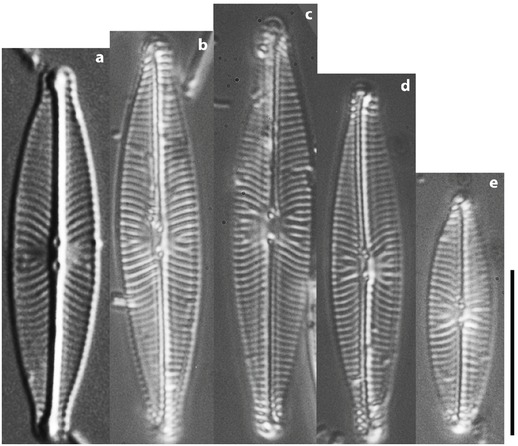
Figure 1a–e (LM)
Navicula dermochelycola sp. nov. Note the alternating longer and shorter striae around the central area. Scale bar = 10 μm for all images
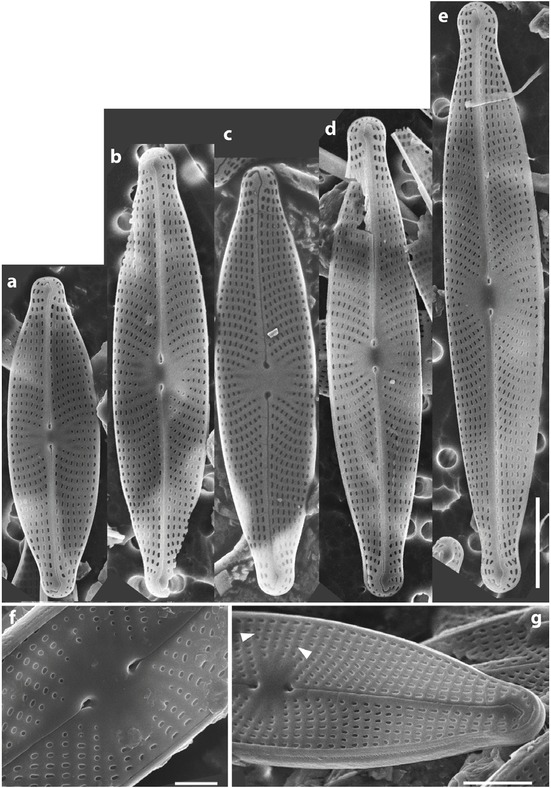
Figure 2a–g (SEM)
Navicula dermochelycola sp. nov.: (a–e) External views of complete valves in valve view, with capitate apices; (f, g) Large and irregular central area with alternating longer and shorter striae (g arrowheads). Note the decussate pattern of areolae. Scale bars 4 μm (a–e); 1 μm (a, f ); 2 μm (g)
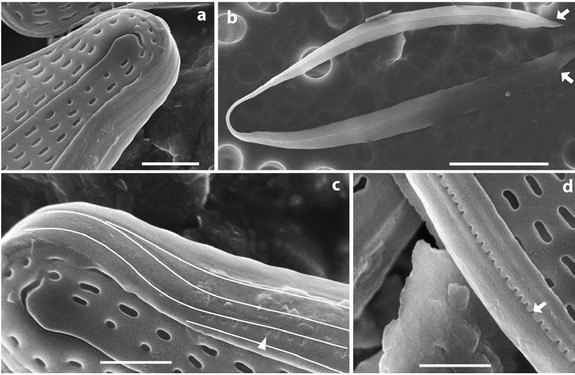
Figure 3a–d (SEM)
Navicula dermochelycola sp. nov. External views: (a) Capitate apex with visible convergent striae. (b) Free open copula without ornamentation. (c) Apex with open copulae and one row of transapically-elongate and irregularly-spaced puncta (c arrowhead). Note that puncta are not present on copulae at the apex. (d) Copula (probably the valvocopula) with a row of irregular short puncta (d arrow). Scale bars: 3 μm (b); 1 μm (a); 700 nm (c); 600 nm (d)
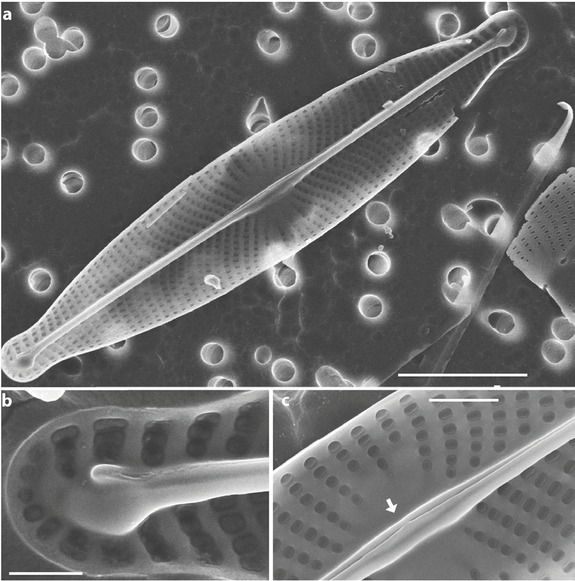
Figure 4a–c (SEM)
Navicula dermochelycola sp. nov. Internal valve views: (a) Entire valve with strongly arched striae near the central area. (b) Helictoglossa laterally-positioned on the central rib. (c) Asymmetrical position of the proximal raphe endings on the elevated rib (c arrow). Note the ellipsoidal areolae. Scale bars: 5 μm (a); 3 μm (c); 600 nm (b)
Table 2
Features of Navicula dermochelycola sp. nov. (French Guiana, Yalimapo, DC). Comparison with several other Navicula taxa (see text)
| Navicula dermochelycola sp. nov. | Navicula rostelllata | Navicula capitatoradiata | Navicula salinarum | Navicula fucicola | |
|---|---|---|---|---|---|
| n (SEM observations) | 21 | nd | nd | nd | nd |
| Valve shape | linear elliptic with capitate apices | linear to linear-lanceolate, strongly capitate, narrow ends | lanceolate, protracted and rostrate apices | elliptical-lanceolate, rostrate apices | lanceolate, rostratecapitate |
| Length Width L/W | 15–25 (19 ± 3.0) 3.7–5.0 (4 ± 0.3) 4 ± 0.8 | 32–50 8–10 nd | 35–40 7–8 nd | 30–40 9–10 nd | 12–22 5–7 nd |
| Stria density | 24.5–30 (28 ± 1.6) | 11–14 (15) | 12–13 | 14–16 | 20–24; 24–28 on apices |
| Areolae on the valve face | radiate to arched striae, apically elongate areolae | striae bent and radiate around the center, apically elongate areolae | radiate to arched striae, apically elongate areolae | striae arched, parallel near apices | striae radiate to arched |
| Striae around the central area | alternatively short and long | all of the same length | alternatively short and long | alternatively short and long | of irregular length |
| Central area | distinct, bow-tie/butterfly like, expanded, not really asymmetrical | expanded and asymmetrical | relatively restricted | relatively large, symmetrical | small |
| Ethology | epizoic, marine | freshwater, cosmopolitan | freshwater | brackish | marine, in the mucilage of the apical slit of Fucus vesiculosus |
| Reference | present study | Kützing 1844 Lange-Bertalot 2001 Potapova & Kociolek 2011 | Germain 1981 Rushforth & Spaulding 2010 | Grunow in Cleve & Grunow 1880 Patrick & Reimer 1966 Germain 1981 Kociolek 2011 | Taassen 1975 |