
Introduction
Diatoms are a very diverse group (Mann 1999; Wojtal 2009) and good indicators of water quality in freshwater ecosystems (Bere & Tundusi 2011; Alakananda et al. 2011). Bacillariaceae are a group of diatoms associated with water quality. They comprise well-known raphid diatoms that have the raphe positioned near the valve margin and enclosed within a canal raised onto a keel on one side of the valve (including such genera as Nitzschia, Tryblionella, Grunowia, Hantzschia and Simonsenia) or in a spiral way (Cylindrotheca) (Round et al. 1990). Many members of this group are associated with fine sediments (Kociolek et al. 2015) and some taxa are apochlorotic and secondarily heterotrophic (Blackburn et al. 2009). Many species of Bacillariaceae are considered to be indicative of degraded environmental conditions (McPherson 1996-98; Beyene et al. 2009).
Although many Bacillariaceae are associated with degraded environmental conditions and some species (such as Nitzschia palea among many others) are indicative of eutrophic waters, the number of publications documenting species of this group, either reporting new records or being floristic studies, is surprisingly limited. Mann (1978) reviewed much of the historical literature for the group, with publications by Smith (1853; 1856), Grunow (1862) and Cleve and Grunow (1880) being the most outstanding in terms of species descriptions in the 19th century. During his long career, from the early to mid-20th century, Hustedt described 271 taxa of Bacillariaceae. Also in the 20th century, but later, an approach developed that tended to "lump" many species together (Archibald 1966; 1972; Lange-Bertalot & Simonsen 1978). Subsequently, new species descriptions were presented by Hlúbikova et al. (2009), Zidarova et al. (2010), Alakananda et al. (2012, 2015), Trobajo et al. (2013) and Kociolek et al. (2014).
The challenging taxonomy of the group, especially in the case of the genus Nitzschia (where many species have very similar shapes and very fine striae, i.e. the "Lanceolatae" group), the number of features available for the species identification by both light and electron microscopy is limited. Therefore, there are only a few floristic studies dealing with Bacillariaceae, most of which are from Europe (e.g. Hustedt 1930; Cleve-Euler 1952), but also from Africa (Hustedt 1955), South America (Metzeltin & Witkowski 1998) and Asia (Alakananda et al. 2012; You & Wang 2011).
Knowledge about the freshwater diatom flora of Turkey is still advancing. Despite the long history of reports on freshwater diatoms in Turkey, dating back to the work of Ehrenberg (1844), and including modern studies, the current work has recently accelerated, driven by taxonomic and ecological research. Our current knowledge of the species diversity of freshwater diatoms in Turkey is still growing (Solak et al. 2016). This is particularly true for Bacillariaceae in Turkish freshwaters. A total of 895 freshwater diatom taxa have so far been documented from Turkey (Solak et al. 2012; Gönülol 2017), including some new records in recent years (e.g. Baykal et al. 2009; Ongun-Sevindik & Gönülol 2011; Baytut & Gönülol 2016; Solak et al. 2016; 2018; Varol et al. 2018), as well as a single species from the genus Nitzschia – Nitzschia incognita Legler & Krasske(1940).
Kütahya has a rich water network with three different river catchments, including the Gediz, Sakarya and Susurluk basins. Of these basins, the Sakarya river basin has been surveyed most often (e.g. Yıldız 1987; Yıldız & Atıcı 1996; Atıcı 1997; Atıcı & Ahıska 2005; Solak & Wojtal 2012; Solak et al. 2016), while the Susurluk and Gediz river basins are much less frequently researched (e.g. Dere et al. 2002; 2006).
The objective of this study is to present the species richness of diatoms (Bacillariaceae) in the three major river basins of the Kütahya region in Turkey.
Materials and methods
Study Area
Kütahya is located between Inner and Western Anatolia and has a rich river and stream network, which includes three different river catchments (Susurluk, Sakarya and Gediz). A total of 53 sites were surveyed in the rivers and streams of these catchments. Samples were collected from large and fast flowing rivers (Emet, Gediz, Kocasu, Simav Rivers etc.) and some from slow flowing streams (Felent, Kokar, Kırık, Murat, Porsuk, Safa Streams) and from two thermal discharge waters (Eynal & Naşa thermals). Some of them were collected from small streams, located near villages of the Kütahya Province (e.g. Tiraz, Altintaş, Domaniç, Eynal etc.; Fig. 1, Table 1). The Emet River, about 90 km long, is located in the village of Saruhan and some small springs join together to form a river called the Kocadere Stream. Then, it flows into Lake Uluabat (Ramsar area). The Gediz River, approximately 400 km long, is one of the largest and most important rivers in the Aegean region. It originates in the village of Akkaya and flows into the Aegean Sea in İzmir. The Kocasu River, approximately 45 km long, originates in the Naşa village and is one of the largest tributaries of the Emet River. The Simav River, 321 km long, has its sources in Simav and flows
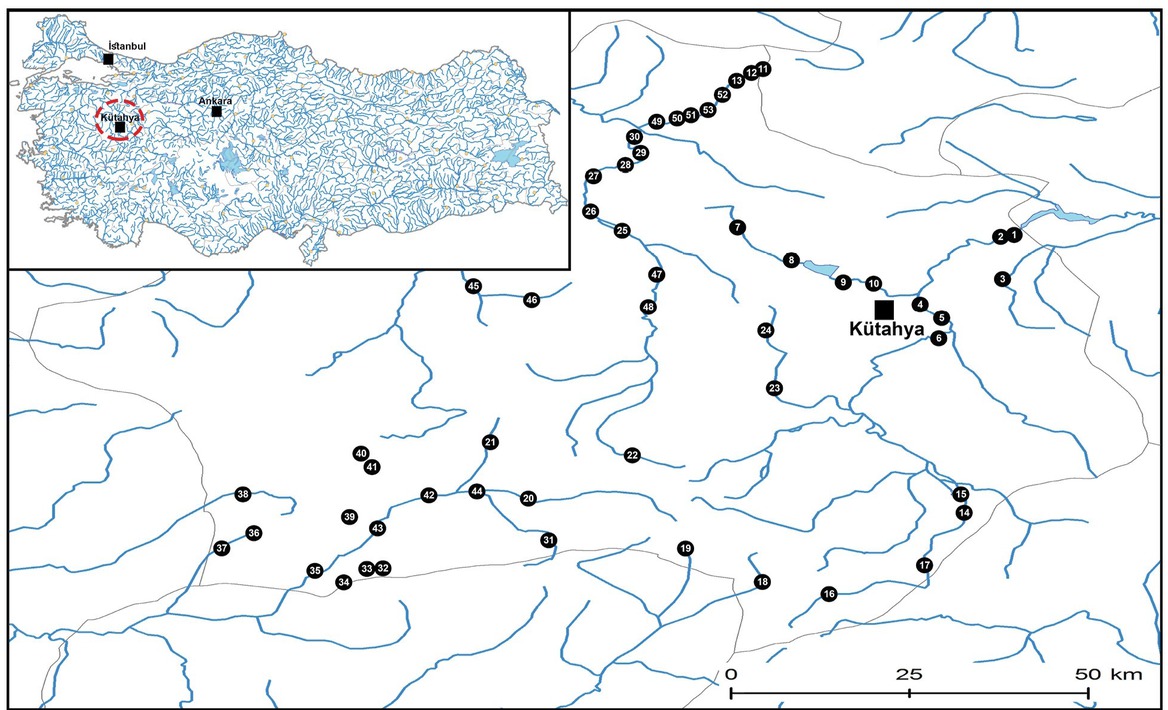
Figure 1
Distribution of the surveyed localities
Table 1
Sampling sites
| Site | River basin name | Waterbody name | Coordinates | Altitude | |
|---|---|---|---|---|---|
| K1 | Porsuk River_1 | 39°34.130'N | 30°06.109'E | 890 m | |
| K2 | Ilıca Stream | 39°35.606'N | 30°05.129'E | 888 m | |
| K3 | Porsuk River_2 | 39°29.061'N | 30°02.199'E | 925 m | |
| K4 | Porsuk River_3 | 39°26.918'N | 30°01.196'E | 917 m | |
| K5 | Porsuk River_4 | 39°22.644'N | 30°04.030'E | 914 m | |
| K6 | Sakarya RB | Porsuk River_5 | 39°19.846'N | 30°00.384'E | 947 m |
| K7 | Felent Stream_1 | 39°30.808'N | 29°44.148'E | 1017 m | |
| K8 | Felent Stream_2 | 39°30.506'N | 29°45.037'E | 1022 m | |
| K9 | Felent Stream_3 | 39°29.414'N | 29°49.850'E | 1008 m | |
| K10 | Felent Stream_4 | 39°29.110'N | 29°50.450'E | 999 m | |
| K11 | Safa Stream | 39°49.651'N | 29°39.120'E | 1118 m | |
| K12 | Susurluk RB | Small stream in Tiraz village | 39°49.161'N | 29°38.370'E | 870 m |
| K13 | Small stream in Tiraz village | 39°50.039'N | 29°33.252'E | 1299 m | |
| K14 | Kokar Stream_1 | 39°07.545'N | 30°06.511'E | 1005 m | |
| K15 | Sakarya RB | Kokar Stream_2 | 39°06.925'N | 30°06.913'E | 1017 m |
| K16 | Murat Stream | 39°01.548'N | 29°58.958'E | 1040 m | |
| K17 | Small stream in Altintaş village | 39°04.908'N | 30°07.629'E | 1012 m | |
| K18 | Gediz River_1 | 38°59.170'N | 29°36.476'E | 960 m | |
| K19 | Gediz RB | Gediz River_1 | 38°58.627'N | 29°23.823'E | 831 m |
| K20 | Emet River_1 | 39°14.859'N | 29°14.215'E | 752 m | |
| K21 | Emet River_2 | 39°20.453'N | 29°14.956'E | 772 m | |
| K22 | Emet River_3 | 39°19.089'N | 29°23.962'E | 1118 m | |
| K23 | Kocasu Stream_1 | 39°21.824'N | 29°36.529'E | 916 m | |
| K24 | Kocasu Stream_2 | 39°26.493'N | 29°36.922'E | 917 m | |
| K25 | Kocasu Stream_3 | 39°31.637'N | 29°30.328'E | 829 m | |
| K26 | Susurluk RB | Kocasu Stream_4 | 39°35.114'N | 29°27.775'E | 814 m |
| K27 | Kırık Stream | 39°48.081'N | 29°36.746'E | 926 m | |
| K28 | Small stream in Domaniç village | 39°51.464'N | 29°67.943'E | 1234 m | |
| K29 | Kocasu Stream_5 | 39°41.762'N | 29°30.674'E | 674 m | |
| K30 | Kocasu Stream_6 | 39°36.314'N | 29°27.782'E | 731m | |
| K31 | Small stream in Simav village | 38°56.359'N | 29°15.738'E | 927 m | |
| K32 | Eynal thermal discharge water | 39°07.345'N | 28°59.270'E | 794 m | |
| K33 | Simav Stream_1 | 39°08.213'N | 28°57.806'E | 788 m | |
| K34 | Simav Stream_2 | 39°06.899'N | 28°52.848'E | 833 m | |
| K35 | Gediz RB | Simav Stream_3 | 39°09.933'N | 28°45.037'E | 596 m |
| K36 | Simav Stream_4 | 39°10.016'N | 28°39.801'E | 515 m | |
| K37 | Simav Stream_5 | 39°09.854'N | 28°46.753'E | 613 m | |
| K38 | Small stream in Eğir village | 39°12.714'N | 28°52.016'E | 931m | |
| K39 | Small stream in Eğir village | 39°14.033'N | 28°14.667'E | 1432 m | |
| K40 | Kocasu Stream_7 | 39°18.771'N | 28°57.724'E | 805 m | |
| K41 | Susurluk RB | Kocasu Stream_8 | 39°17.738'N | 28°58.567'E | 714 m |
| K42 | Naşa thermal discharge water | 39°08.701'N | 28°57.397'E | 789 m | |
| K43 | Small stream in Naşa village | 39°08.747'N | 28°57.577'E | 780 m | |
| K44 | Simav Stream_6 | 39°07.772'N | 28°58.196'E | 794 m | |
| K45 | Gediz RB | Small stream in Değirmisaz village | 39°30.476'N | 29°18.741'E | 690 m |
| K46 | MustafaKemalPaşa Stream | 39°29.439'N | 29°12.258'E | 513 m | |
| K47 | Small stream in Hamidat village | 39°39.45'N | 29°29.451'E | 812 m | |
| K48 | Small stream in Domaniç village | 39°34.29'N | 29°27.503'E | 818 m | |
| K49 | Small stream in Güneyköy village | 39°43.11'N | 29°30.420'E | 662 m | |
| K50 | Susurluk RB | Small stream in Domaniç village | 39°44.37'N | 29°33.135'E | 743 m |
| K51 | Small stream in Domaniç village | 39°47.28'N | 29°35.437'E | 833 m | |
| K52 | Small stream in Sefaköy village | 39°49.25'N | 29°38.160'E | 913 m | |
| K53 | Ilıcaksu Stream | 39°46.21'N | 29°38.492'E | 804 m |
into the Sea of Marmara. The Kırık and Safa Streams are small tributaries of the Emet River. The Felent, Kokar and Murat Streams are also small streams and main tributaries of the Porsuk River (Akbulut et al. 2009).
Diatom Analyses
Some physicochemical parameters – dissolved oxygen (DO, mg I–1), temperature (TEMP, °C) and conductivity (COND, μS cm–1) – were measured in the field using Lange Hach 40d (Table 2). The conductivity was classified according to Taylor et al. (2006): < 50 μS cm"1 – very low electrolyte content; 50–100 μS cm–1 – low electrolyte content; 100–500 μS cm–1 – moderate electrolyte content; > 500 μS cm–1 – high electrolyte content; > 1000 μS cm–1 – very high electrolyte content. The general distribution and ecological features of the species are presented according to Krammer & Lange-Bertalot (1988), Van Dam et al. (1994) and Wojtal(2013).
Epilithic samples (38 samples in total) were collected by brushing submerged stones, while epipelic samples (15 samples in total) were obtained by using a pipette aspirator. Samples were boiled with H2O2 and HCl to remove the organic matter. After repeated washing with distilled water, the material was air-dried on cover glasses and mounted in Naphrax. Observations of the diatoms were performed both at the University of Szczecin, Poland, and Dumlupınar University. Light microscope (LM) observations were conducted using an OLYMPUS BX-51 and a NIKON Eclipse e800 light microscope. Micrographs were taken with a Nikon DS-Fi1 camera. Diatoms were identified according to Krammer & Lange-Bertalot (1991), Hofmann et al. (2011), Bąk et al. (2012), Bey & Ector (2013) and Wojtal (2013). The size (length & breadth) of the species was measured using the ImageJ software (Schneider et al. 2012). The distribution of the Turkish flora is presented according to Gönülol (2017). We have tried to use the latest classification system for freshwater diatoms (Fourtanier & Kociolek 2011). Species and infraspecific taxa are arranged alphabetically in the text and figures.
Results
Based on our observations of benthic diatom samples collected from 53 sites across the three major river basins of the Kütahya region in Turkey, a total of 65 taxa from Bacillariaceae were identified. Of these 65 taxa, 15 are recognized as the first records for Turkey. The list of identified taxa is presented in Table 3.
Table 2
Selected physicochemical parameters of the sampling sites (EPL - epilithic, EPP - epipelic, DO - dissolved oxygen, TEMP - temperature, COND - conductivity)
| Site | Physicochemical parameters | ||||
|---|---|---|---|---|---|
| Habitat | DO (mg l−1) | TEMP (°C) | COND (μS cm−1) | pH | |
| K1 | EPL | 4.6 | 11.7 | 723 | 7.9 |
| K2 | EPL | 8.9 | 17.6 | 806 | 8.7 |
| K3 | EPL | 2.3 | 12.1 | 665 | 7.7 |
| K4 | EPL | 5.5 | 14.2 | 913 | 7.4 |
| K5 | EPL | 10.2 | 12.6 | 515 | 8.4 |
| K6 | EPL | 11.6 | 9.6 | 478 | 8.4 |
| K7 | EPL | 9.2 | 5.6 | 541 | 8.1 |
| K8 | EPL | 8.4 | 10.1 | 609 | 7.8 |
| K9 | EPL | 11.9 | 5.6 | 634 | 8.5 |
| K10 | EPP | 8.6 | 15.9 | 758 | 8.1 |
| K11 | EPL | 10.8 | 11.0 | 130 | 8.0 |
| K12 | EPL | 11.1 | 7.6 | 88 | 7.5 |
| K13 | EPL | 9.2 | 10.7 | 689 | 8.4 |
| K14 | EPP | 8.3 | 9.7 | 514 | 8.2 |
| K15 | EPL | 8.5 | 9.3 | 550 | 8.3 |
| K16 | EPP | 10.1 | 9.0 | 405 | 8.5 |
| K17 | EPL | 5.8 | 10.9 | 751 | 7.5 |
| K18 | EPP | 9.7 | 8.4 | 368 | 8.4 |
| K19 | EPP | 9.7 | 9.7 | 1077 | 8.3 |
| K20 | EPL | 8.5 | 14.6 | 758 | 8.2 |
| K21 | EPL | 6.9 | 22.8 | 737 | 8.2 |
| K22 | EPP | 9.6 | 9.3 | 534 | 7.8 |
| K23 | EPP | 9.5 | 12.8 | 496 | 8.2 |
| K24 | EPL | 10.0 | 10.4 | 435 | 8.4 |
| K25 | EPP | 9.6 | 10.9 | 539 | 8.5 |
| K26 | EPL | 2.5 | 15.4 | 1125 | 7.5 |
| K27 | EPP | 7.5 | 15.1 | 765 | 8.6 |
| K28 | EPL | 9.2 | 10.9 | 118 | 8.1 |
| K29 | EPL | 6.7 | 17.2 | 864 | 8.4 |
| K30 | EPL | 1.7 | 15.6 | 717 | 7.8 |
| K31 | EPL | 6.5 | 18.3 | 1365 | 7.8 |
| K32 | EPL | 11.1 | 17.2 | 658 | 8.5 |
| K33 | EPL | 4.9 | 20.3 | 834 | 8.4 |
| K34 | EPL | 10.7 | 9.9 | 307 | 8.6 |
| K35 | EPL | 9.8 | 16.6 | 609 | 8.6 |
| K36 | EPL | 10.9 | 17.0 | 572 | 9.0 |
| K37 | EPL | 8.4 | 16.3 | 587 | 8.0 |
| K38 | EPL | 6.8 | 14.0 | 292 | 7.3 |
| K39 | EPL | 9.8 | 7.6 | 599 | 7.6 |
| K40 | EPL | 9.4 | 17.9 | 314 | 8.4 |
| K41 | EPL | 10.9 | 16.2 | 370 | 8.6 |
| K42 | EPL | 5.8 | 33.7 | 1449 | 8.6 |
| K43 | EPP | 9.2 | 21.3 | 829 | 8.2 |
| K44 | EPL | 8.9 | 22.9 | 745 | 8.5 |
| K45 | EPL | 5.5 | 16.8 | 1502 | 8.9 |
| K46 | EPL | 10.1 | 19.2 | 895 | 8.5 |
| K47 | EPP | 6.4 | 14.4 | 973 | 7.8 |
| K48 | EPP | 7.4 | 12.5 | 338 | 7.9 |
| K49 | EPL | 9.3 | 13.1 | 263 | 8.7 |
| K50 | EPP | 8.9 | 14.7 | 362 | 8.6 |
| K51 | EPP | 8.4 | 15.0 | 341 | 8.8 |
| K52 | EPL | 9.1 | 9.5 | 107 | 8.4 |
| K53 | EPP | 8.6 | 15.8 | 327 | 7.5 |
Table 3
Species of Bacillariales examined in the present study (*first record for Turkish Freshwater Diatom Flora)
| Species |
|---|
| Cylindrotheca gracilis (Brébisson) Grunow |
| Dentcula subtilis Grunow * |
| Hantzschia abundans Lange-Bertalot * |
| Hantzschia amphioxys (Ehrenberg) Grunow |
| Hantzschia calcifuga Reichardt & Lange-Bertalot * |
| Hantzschia cf. abundans Lange-Bertalot |
| Nitzschia abbreviata Hustedt* |
| Nitzschia acicularis (Kützing) W. Smith |
| Nitzschia acidoclinata Lange-Bertalot * |
| Nitzschia alpina Hustedt |
| Nitzschia amphibia Grunow |
| Nitzschia angustata (W. Smith) Grunow |
| Nitzschia angustatula Lange-Bertalot |
| Nitzschia archibaldii Lange-Bertalot * |
| Nitzschia bacilliformis Hustedt * |
| Nitzschia bergii Cleve-Euler * |
| Nitzschia brunoi Lange-Bertalot |
| Nitzschia capitellata Hustedt |
| Nitzschia clausii Hantzsch |
| Nitzschia communis Rabenhorst |
| Nitzschia denticula Grunow |
| Nitzschia desertorum Hustedt |
| Nitzschia dissipata (Kützing) Rabenhorst |
| Nitzschia dissipata var. media (Hantzsch) Grunow |
| Nitzschia draveillensis Coste & Ricard |
| Nitzschia dubia W. Smith |
| Nitzschia elegantula Grunow * |
| Nitzschia flexa Schumann |
| Nitzschia fonti cola (Grunow) Grunow |
| Nitzschia graciliformis Lange-Bertalot & Simonsen * |
| Nitzschia gracilis Hantzsch |
| Nitzschia hantzschiana Rabenhorst |
| Nitzschia heufleriana Grunow |
| Nitzschia homburgiensis Lange-Bertalot |
| Nitzschia inconspicua Grunow |
| Nitzschia leistikowii Lange-Bertalot * |
| Nitzschia linearis (C. Agardh) W. Smith |
| Nitzschia microcephala Grunow |
| Nitzschia palea (Kützing) W. Smith |
| Nitzschia paleacea (Grunow) Grunow * |
| Nitzschia pusilla Grunow |
| Nitzschia recta Hantzsch |
| Nitzschia rosenstockii Lange-Bertalot * |
| Nitzschia sigma (Kützing) W. Smith |
| Nitzschia sigmoidea (Nitzsch) W. Smith |
| Nitzschia sociabilis Hustedt |
| Nitzschia solgensis A.Cleve-Euler |
| Nitzschia solita Hustedt |
| Nitzschia soratensis Morales & Vis * |
| Nitzschia subacicularis Hustedt |
| Nitzschia subtilis (Grunow) Hustedt * |
| Nitzschia supralitorea Lange-Bertalot |
| Nitzschia tabellaria (Grunow) Grunow |
| Nitzschia thermaloides Hustedt |
| Nitzschia umbonata (Ehrenberg) Lange-Bertalot |
| Nitzschia vermicularis (Kützing) Hantzsch |
| Nitzschia vitrea Norman |
| Nitzschia vitrea var. salinarum Grunow |
| Nitzschia wuellerstorffii Grunow |
| Simonsenia delognei (Grunow) Lange-Bertalot |
| Tryblionella apiculata W. Gregory |
| Tryblionella calida (Grunow) D.G. Mann |
| Tryblionella debilis Arnott |
| Tryblionella hungarica (Grunow) Frenguelli |
| Tryblionella sp. |
Cylindrotheca gracilis (Brébisson) Grunow in Van Heurck; Fig. 2:1, 2
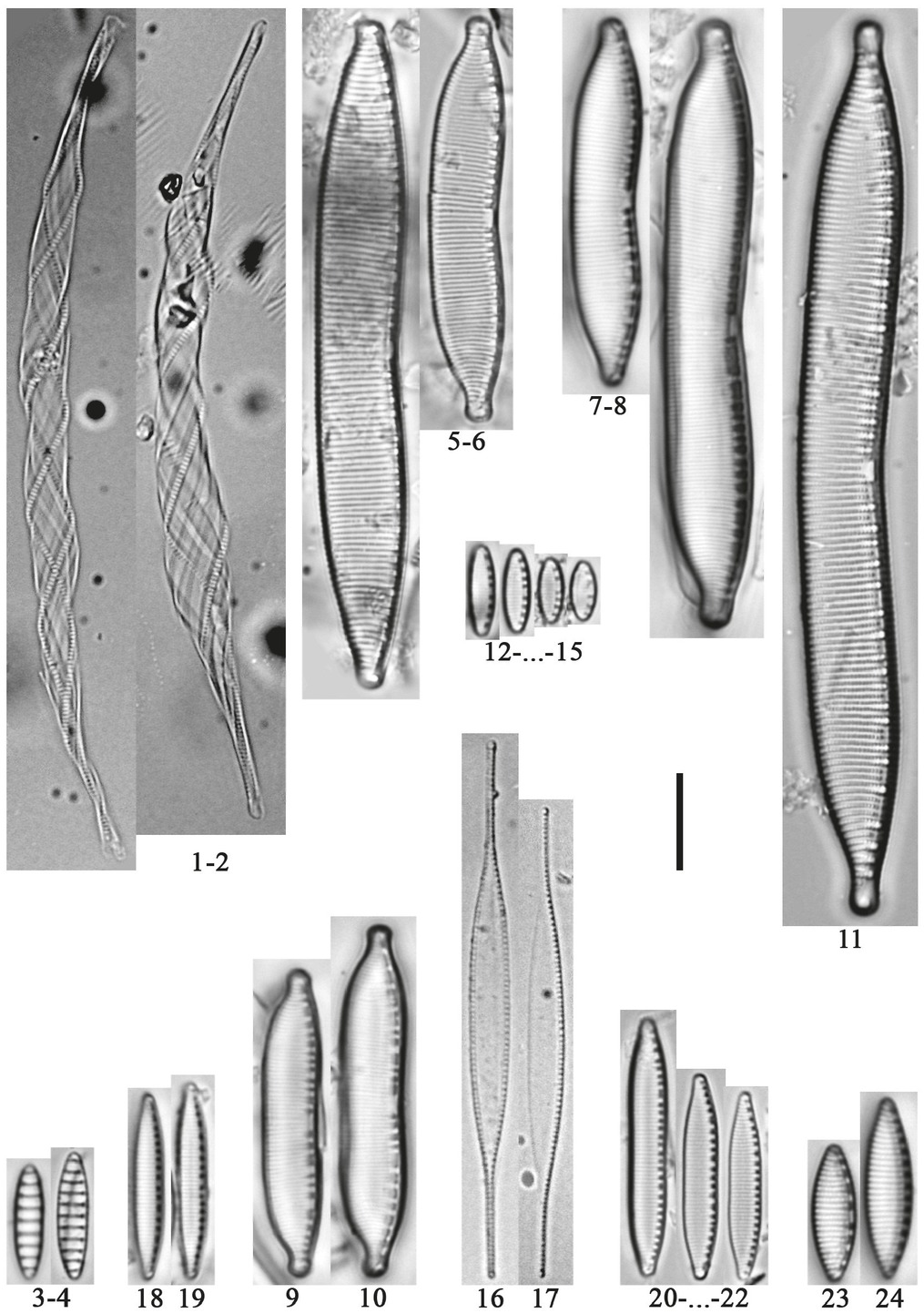
Figure 2
1,2– Cylindrotheca gracilis (Brébisson) Grunow in Van Heurck; 3, 4 – Denticula subtilis Grunow; 5, 6 – Hantzschia abundans Lange-Bertalot; 7, 8 – H. cf. abundans; 9, 10 – H. amphioxys (Ehrenberg) Grunow; 11 – H. calcifuga Reichardt &Lange-Bertalot; 12–15–Nitzschia abbreviata Hustedt; 16, 17– N.acicularis (Kützing) W.Smith; 18, 19– N.acidoclinata Lange-Bertalot; 20–22 – N. alpina Hustedt; 23–24 – N. amphibia Grunow. Scale bar: 10 μm
Basionym: Ceratoneis gracilis Brébisson
Ref. Hofmann et al. 2011 (p. 142, pl. 118:6).
Dimensions of the examined specimens. 65.3–128.7 μm long; 4.0–5.6 um wide.
Distribution and ecology in Kütahya waters. K19, K32, K33, K42, K48, K52. The species was found in samples characterized by moderate to very high electrolyte content (107–1449 μS cm–1).
Distribution in Turkey. The taxon occurs in the Inner Anatolia and Aegean regions (Gönülol 2017).
General distribution and ecology. It is a ß-mesosaprobious, eutraphentic, aerophile and brackish water species (Van Dam et al. 1994). According to Wojtal (2009), the species is also rarely found in Polish waters.
Denticula subtilis Grunow; Fig. 2:3, 4
Ref. Krammer & Lange-Bertalot 1991 (p. 140, pl. 96: 1–9), Hofmann et al. 2011 (p. 168, pl. 117:38–42).
Dimensions of the examined specimens. 12.0–13.3 μm long; 3.2–3.3 μm wide; 9 fibulae in 10 μm.
Distribution and ecology in Kütahya waters. K42. The species was found only in one sample, characterized by a very high electrolyte content (1449 μS cm–1).
Distribution in Turkey. This is the first record of the species for the Turkish freshwater diatom flora.
Hantzschia abundans Lange-Bertalot; Fig. 2:5, 6
Ref. Hofmann et al. 2011 (p. 333, pl. 102:6–10).
Dimensions of the examined specimens. 40.8–67.5 um long; 8.3–10.2 μm wide; 4–7 fibulae in 10 μm.
Distribution and ecology in Kütahya waters. K7, K13, K15, K16, K40. The species was found in several samples characterized by moderate or high electrolyte content (314–689 μS cm–1).
Distribution in Turkey. This is the first record of the species for the Turkish freshwater diatom flora. The species is likely confused with H. amphioxys in Turkish waters.
General distribution and ecology. The species is cosmopolitan (Lange-Bertalot 1993). According to Van Dam et al. (1994), it is a neutrophilous, a-mesosaprobious, eurytraphentic and fresh-brackish water species.
Hantzschia amphioxys (Ehrenberg) Grunow; Fig. 2: 9, 10
Basionym. Eunotia amphioxys Ehrenberg
Ref. Krammer & Lange-Bertalot (1991 p. 128, pl. 88: 1–7), Hofmann et al. 2011 (p. 333, pl. 102:1–5).
Dimensions of the examined specimens. 30.0–46.7 μm long; 5.3–8.3 μm wide; 19–26 striae and 6–8 fibulae in 10 μm.
Distribution and ecology in Kütahya waters. K13, K14, K15, K22, K27, K38, K39, K40. The species was found in samples characterized by moderate or high electrolyte content (292–765 μS cm–1).
Distribution in Turkey. The taxon is widespread in Turkey (Solak & Wojtal 2012; Gönülol 2017).
General distribution and ecology. It is a neutrophilous, α-mesosaprobious, eurytraphentic and fresh-brackish water species (Van Dam et al. 1994). According to Wojtal (2009), the species is also rarely found in Polish waters.
Hantzschia cf. abundans; Fig. 2: 7, 8
Dimensions of the examined specimens. 36.7-61.7 μm long; 6.7–8.3 μm wide; 20–23 striae in 10 μm.
Distribution and ecology in Kütahya waters. K12, K22, K40. The species was found in a few samples characterized by low to high electrolyte content (88–534 μS cm–1).
Remarks. The species is similar to H. abundans and H. amphioxys. However, striation and areolation are more visible and the dorsal outline is more rounded. The striae density in this species (21 in 10 μm) is similar to H. amphioxys (20–29 striae in 10 μm, according to Hofmann et al. 2011).
Hantzschia calcifuga Reichardt & Lange-Bertalot; Fig. 2:11
Ref. Hofmann et al. 2011 (p. 334, pl. 102: 11).
Dimensions of the examined specimens. Only one valve was found: 90.0 μm long; 8.3 μm wide; 14 striae and 5 fibulae in 10 μm.
Distribution and ecology in Kütahya waters. K39. The species was found in one sample characterized by high electrolyte content (599 μS cm-1).
Distribution in Turkey. This is the first record of the species for the Turkish freshwater diatom flora.
Nitzschia abbreviata Hustedt; Fig. 2: 12–15
Ref. Hofmann et al. 2011 (p.431, pl. 112: 21–27).
Dimensions of the examined specimens. 6.1–9.3 μm long; 2.1–2.6 μm wide; 28–30 striae and 10–14 fibulae in 10 μm.
Distribution and ecology in Kütahya waters. K2, K10, K11, K31, K46, K52. The species was found in several samples characterized by moderate to very high electrolyte content (130–1365 μS cm–1).
Distribution in Turkey. This is the first record of the species for the Turkish freshwater diatom flora.
Nitzschia acicularis (Kützing) W.Smith; Fig. 2:16,17
Basionym. Synedra acicularis Kützing
Ref. Krammer & Lange-Bertalot 1991 (p. 123, pl. 85: 1–4), Hofmann et al. 2011 (p. 123, pl. 107: 20–24).
Dimensions of the examined specimens. 45.2–65.3 μm long; 3.7–4.8 μm wide; 17–21 fibulae in 10 μm.
Distribution and ecology in Kütahya waters. K14, K32, K33, K36, K37, K41, K44. The species was found in several samples characterized by moderate to high electrolyte content (370–814 μS cm–1).
Distribution in Turkey. The taxon is widespread in Turkey (Solak & Wojtal 2012; Gönülol 2017). Most of the data on the distribution of N. acicularis come from Turkish lakes (Solak et al. 2002). This diatom was also found in rivers, in plankton and benthic samples. Its saprobity was estimated as eurysaprobic, and salinity as oligohalobous-indifferent (Özer et al. 2018).
General distribution and ecology. The species is also very common in Poland. According to Van Dam et al. (1994), it is an alkaliphilous, α-mesosaprobious, eutraphentic and fresh-brackish water species.
Nitzschia acidoclinata Lange-Bertalot; Fig. 2: 18, 19
Ref. Hofmann et al. 2011 (p. 431, pl. 112: 50–54), Bey & Ector 2013 (p. 996).
Dimensions of the examined specimens. 19.2–20.0 μm long; 2.7–3.0 μm wide; 25 striae and 10–11 fibulaein 10 μm.
Distribution and ecology in Kütahya waters. K41, K52. The species was found in two samples characterized by moderate electrolyte content (107–370 μS cm–1).
Distribution in Turkey. This is the first record of the species for the Turkish freshwater diatom flora. General distribution and ecology. The species is also common in Poland. It prefers oligotrophic waters with low conductivity (Krammer & Lange-Bertalot 1988). According to Van Dam et al. (1994), it is a neutrophilous, ß-mesosaprobous, mesotraphentic and freshwater. It was observed in waters with very low to high conductivity, but high dissolved oxygen concentrations in the Tatra springs (Wojtal 2013).
Nitzschia alpina Hustedt; Fig. 2: 20–22
Ref. Hofmann et al. 2011 (p. 432, pl. 112: 41–45), Wojtal 2013 (p. 117, pl. 114: 1–12).
Dimensions of the examined specimens. 19.1–31.2 μm long; 3.2–3.7 wide; 25–26 striae and 10–13 fibulae in 10 μm.
Distribution and ecology in Kütahya waters. K3, K7, K11, K13, K30, K42, K52. The species was found in samples characterized by moderate to very high electrolyte content (130–1449 μS cm–1).
Distribution in Turkey. The species was found only in the Black Sea region by Tunca et al. (2014). General distribution and ecology. The species was found in waters characterized by low to moderate conductivity and high to very high dissolved oxygen concentrations (Wojtal 2013).
Nitzschia amphibia Grunow; Fig. 2: 23, 24
Ref. Hofmann et al. 2011 (p.433,- pl.117:9–15).
Dimensions of the examined specimens. 8.9–41.7 μm long; 4.1–5.3 μm wide; 16–20 striae and 6–9 fibulae in 10 μm.
Distribution and ecology in Kütahya waters. K8, K9, K10, K28. The species was found in samples characterized by moderate to high electrolyte content (118–758 μS cm–1).
Distribution in Turkey. The taxon is widespread in Turkey (Solak & Wojtal 2012; Gönülol 2017). General distribution and ecology. The species is a cosmopolitan diatom, occurring in waters characterized by a wide range of conductivity (Krammer & Lange-Bertalot 1998). According to Van Dam et al. (1994), it is an alkaliphilous, α-mesosaprobous, eutraphentic and fresh-brackish water species. It was also found in waters with moderate specific conductivity and high dissolved oxygen concentrations (Wojtal 2013).
Nitzschia angustata (W. Smith) Grunow; Fig. 3:25–27
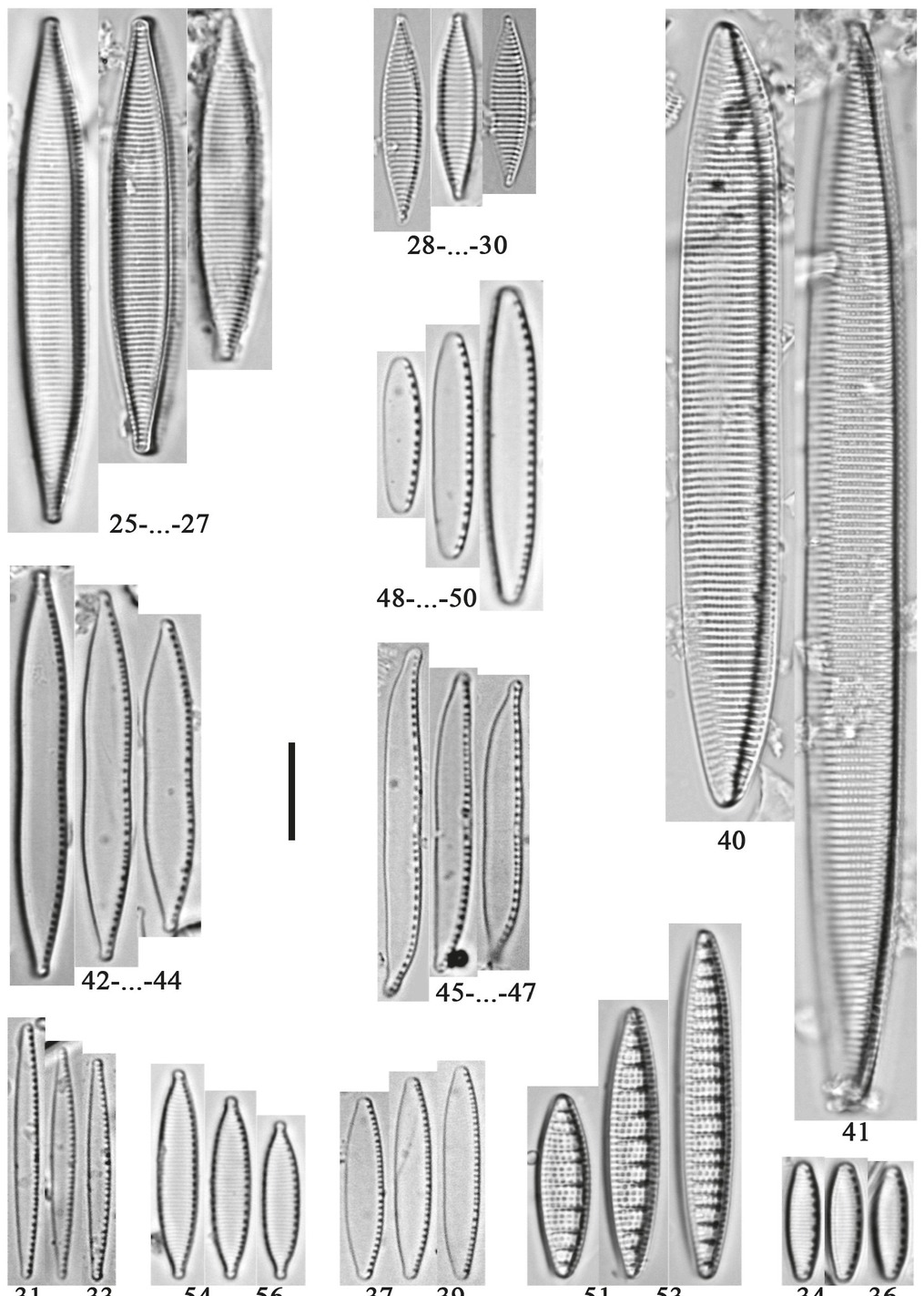
Figure 3
25–27 – Nitzschia angustata (W.Smith) Grunow; 28–30 – N. angustatula Lange–Bertalot; 31–33 – N. archibaldii Lange-Bertalot; 34–36 – N. bacilliformis Hustedt; 37–39 – N. bergii Cleve-Euler; 40, 41 – N. brunoi Lange-Bertalot; 42–44 – N. capitellata Hustedt; 45–47 – N. clausii Hantzsch; 48–50 – N. communis Rabenhorst; 51–53 – N. denticula Grunow; 54–56 – N. desertorum Hustedt. Scale bar: 10 μm
Basionym. Tryblionella angustata W. Smith
Ref. Krammer & Lange-Bertalot 1991 (p. 48, pl. 36: 1–5),
Hofmann et al. 2011 (p. 434, pl. 104: 13–17)
Dimensions of the examined specimens. 35.8–64.7 μm long; 5.1–7.5 μm wide; 16–18 striae in 10 μm.
Distribution in Kütahya waters. K5, K6, K14, K16, K23, K24, K25. The species was found in samples characterized by moderate electrolyte content (405–539 μS cm–1).
Distribution in Turkey. The taxon is widespread in Turkey (Gönülol 2017).
Nitzschia angustatula Lange-Bertalot; Fig. 3: 28–30
Ref. Krammer & Lange-Bertalot 1991 (p. 48, pl. 36: 6–10), Hofmann et al. 2011 (p. 434, pl. 104: 8–12).
Dimensions of the examined specimens. 16.6–26.3 μm long; 3.8–4.9 μm wide; 17–18 fibulae in 10 μm.
Distribution and ecology in Kütahya waters. K5, K6, K14, K16. The species was found in a few samples characterized by moderate electrolyte content (405–515 μS cm–1).
Distribution in Turkey. The taxon was found only in Western Anatolia (Kütahya lotic waters) by Solak et al. (2016) and Inner Anatolia (the Dicle River by Varol & Sen 2014).
Nitzschia archibaldii Lange-Bertalot; Fig. 3: 31–33
Ref. Krammer & Lange-Bertalot 1991 (p. 115, pl. 81: 10–12), Hofmann et al. 2011 (p. 435, pl. 111: 30–34).
Dimensions of the examined specimens. 22.6–26.3 μm long; 2.3–2.6 μm wide; 14–18 fibulae in 10 μm.
Distribution and ecology in Kütahya waters. K23, K32, K34, K51, K52. The species was found in samples characterized by moderate to high electrolyte content (107–638 μS cm–1).
Distribution in Turkey. This is the first record of the species for the Turkish freshwater diatom flora.
General distribution and ecology. The species is widespread in oligosaprobic to β-mesosaprobic waters with moderate conductivity (Krammer & Lange-Bertalot 1988). According to Van Dam et al. (1994), it is a neutrophilous, ß-mesosaprobous, eutraphentic and fresh-brackish water species.
Nitzschia bacilliformis Hustedt; Fig. 3: 34–36
Ref. Krammer & Lange-Bertalot 1991 (p. 102, pl. 74: 18–26).
Dimensions of the examined specimens. 11.6–16.3 μm long; 3.0–3.4 μm wide; 24–28 striae and 10–13fibulae in 10 μm.
Distribution and ecology in Kütahya waters. K13, K28, K52. The species was found in a few samples characterized by moderate to high electrolyte content (107–689 μS cm–1).
Distribution in Turkey. This is the first record of the species for the Turkish freshwater diatom flora.
Nitzschia bergii Cleve-Euler; Fig. 3: 37–39
Ref. Krammer & Lange-Bertalot 1991 (p. 113, pl. 80: 10–15).
Dimensions of the examined specimens. 18.0–21.9 μm long; 3.4–4.0 μm wide; 14–19 fibulae in 10 μm.
Distribution and ecology in Kütahya waters. K12, K32, K33, K34, K36, K37, K40, K41, K44, K48, K52. The species was commonly found in waters characterized by low to high electrolyte content (88–814 μS cm–1).
Distribution in Turkey. This is the first record of the species for the Turkish freshwater diatom flora.
Nitzschia brunoi Lange-Bertalot; Fig. 3:40,41
Ref. Hofmann et al. 2011 (p. 437, pl. 104: 1–2).
Dimensions of the examined specimens. 67.3–112.1 μm long; 9.5–11.9 μm wide; 12–13 striae in 10 μm.
Distribution and ecology in Kütahya waters. K3, K14, K15, K16, K50. The species was found in several samples characterized by moderate to high electrolyte content (362–665 μS cm–1).
Distribution in Turkey. The taxon was found only in the Aegean region (Kütahya lotic waters) by Solak et al. (2016).
Nitzschia capitellata Hustedt; Fig. 3: 42–44
Ref. Krammer & Lange-Bertalot 1991 (p. 88, pl. 62: 1–12), Hofmann et al. 2011 (p. 438, pl. 113: 11–16).
Dimensions of the examined specimens. 18.5–49.7 μm long; 4.5–5.2 μm wide; 12–13 fibulae in 10 μm.
Distribution and ecology in Kütahya waters. K1, K4, K28. The species was found in a few samples characterized by moderate to high electrolyte content (118–913 μS cm–1).
Distribution in Turkey. The taxon is widespread in Turkey (Gönülol 2017).
General distribution and ecology. The species is cosmopolitan, reported frequently from waters with moderate conductivity (Krammer & Lange-Bertalot 1988). According to Van Dam et al. (1994), it is an alkaliphilous, α-meso-polysaprobous,hypereutraphentic and brackish water species.
Nitzschia clausii Hantzsch; Fig. 3: 45–47
Ref. Krammer & Lange-Bertalot 1991 (p. 27, pl. 19: 1–6), Hofmannetal. 2011 (p. 438, pl. 116: 15–18).
Dimensions of the examined specimens. 31.6–35.6 μm long; 3.5 μm wide; 9 fibulae in 10 μm.
Distribution and ecology in Kütahya waters. K15. The species was found in one sample characterized by moderate electrolyte content (550 μS cm–1).
Distribution in Turkey. The taxon is widespread in Turkey (Gönülol 2017).
General distribution and ecology. The species is cosmopolitan (Krammer & Lange-Bertalot 1988). According to Van Dam et al. (1994), it is an alkaliphilous, α-mesosaprobous, eutraphentic and brackish water species.
Nitzschia communis Rabenhorst; Fig. 3: 48–50
Ref. Krammer & Lange-Bertalot 1991 (p. 110, pl. 79: 1–6), Hofmann et al. 2011 (p. 439, pl. 112: 1–5).
Dimensions of the examined specimens. 16.1–32.7 μm long; 3.9–5.1 μm wide; 9–12 fibulae in 10 μm.
Distribution and ecology in Kütahya waters. K3, K4, K5, K7, K16, K28, K35, K36, K37, K38, K40, K41, K44, K45, K50. The species was commonly found in samples characterized by moderate to very high electrolyte content (118–1502 μS cm–1).
Distribution in Turkey. The taxon is widespread in Turkey (Gönülol 2017).
General distribution and ecology. The species is cosmopolitan, preferring waters with high conductivity (Krammer & Lange-Bertalot 1988). According to Van Dam et al. (1994), it is an alkaliphilous, α-meso-polysaprobous, eutraphentic and fresh-brackish water species. It was found in waters with moderate to very high conductivity (Wojtal 2013).
Nitzschia denticula Grunow; Fig. 3: 51–53
Ref. Krammer & Lange-Bertalot 1991 (p. 143, pl. 99: 11–23), Hofmann et al. 2011 (p. 441, pl. 26–31).
Dimensions of the examined specimens. 18.7–38.7 μm long; 5.3–7.0 μm in wide; 5–7 fibulae in 10 μm.
Distribution and ecology in Kütahya waters. K15, K16, K24, K31, K47. The species was found in several samples characterized by moderate to very high electrolyte content (405–1365 μS cm–1).
Distribution in Turkey. The taxon is widespread in Turkey (Gönülol 2017).
Nitzschia desertorum Hustedt; Fig. 3: 54–56
Ref. Krammer & Lange-Bertalot 1991 (p. 98, pl. 70: 10–13).
Dimensions of the examined specimens. 14.7–26.4 μm long; 4.4–4.7 μm wide; 21–22 striae and 9–13 fibulaein 10 um.
Distribution and ecology in Kütahya waters. K7, K8, K9, K10, K25, K32, K33, K40, K42, K44. The species was commonly found in samples characterized by moderate to high electrolyte content (314–1449 μS cm–1).
Distribution in Turkey. This is the first record of the species for the Turkish freshwater diatom flora.
Nitzschia dissipata (Kützing) Rabenhorst; Fig. 4: 57–59
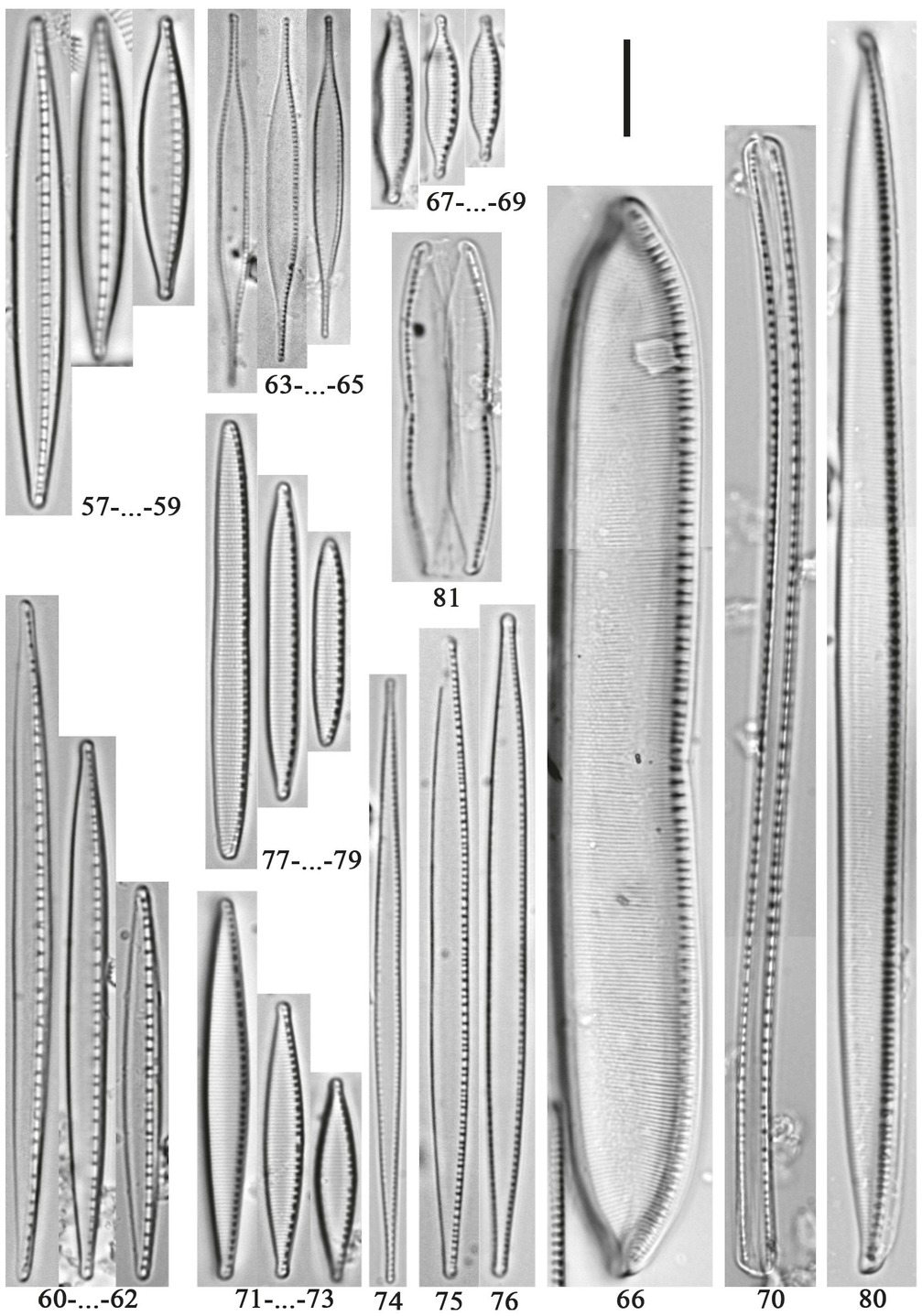
Figure 4
57–59 – Nitzschia dissipata (Kützing) Rabenhorst; 60–62 – N. dissipata var. media (Hantzsch) Grunow; 63–65 – N. draveillensis Coste & Ricard; 66 – N. dubia W.Smith; 67–69 – N. elegantula Grunow; 70 – N. flexa Schumann; 71–73 – N. fonticola (Grunow) Grunow; 74 – N. graciliformis Lange-Bertalot & Simonsen; 75, 76 – N. gracilis Hantzsch; 77–79 – N. hantzschiana Rabenhorst; 80 – N. heufleriana Grunow; 81 – N. homburgiensis Lange-Bertalot. Scale bar: 10 μm
Basionym: Synedra dissipata Kützing
Ref. Hofmann et al. 2011 (p. 441, pl. 109: 8–13), Hofmann et al. 2011 (p. 441: 8–13).
Dimensions of the examined specimens. 16.7–28.4 μm long; 4.8–5.2 μm wide; 9–12 fibulae in 10 μm.
Distribution and ecology in Kütahya waters. K2, K6, K7, K8, K9, K10. The species was found in samples characterized by moderate to high electrolyte content (478–806 μS cm–1).
Distribution in Turkey. The taxon is widespread in Turkey (Solak & Wojtal 2012; Gönülol 2017).
General distribution and ecology. The species is cosmopolitan, one of the most frequently reported diatoms from waters with moderate and high conductivity (Krammer & Lange-Bertalot 1988). According to Van Dam et al. (1994), it is an alkaliphilous, β-mesosaprobous, meso- to eutraphentic and fresh-brackish water species.
Nitzschia dissipata var. media (Hantzsch) Grunow; Fig. 4: 60–62
Basionym: Nitzschia media Hantzsch
Ref. Krammer & Lange-Bertalot 1991 (p. 19, pl. 11:8–14), Hofmannetal. 2011 (p. 441: 14–18).
Dimensions of the examined specimens. 32.4–73.4 μm long; 3.6–5.1 μm wide; 6–8 fibulae in 10 μm.
Distribution and ecology in Kütahya waters. K2, K5, K6, K7, K9. The species was found in several samples characterized by moderate to high electrolyte content
(478–806 μS cm–1).
Distribution in Turkey. The taxon is widespread in Turkey (Gönülol 2017).
General distribution and ecology. The species occurs in waters with a wide trophic spectrum (Lange-Bertalot 1993). According to Van Dam et al. (1994), it is an alkaliphilous and fresh-brackish water species.
Nitzschia draveillensis Coste & Ricard; Fig. 4: 63–65
Ref. Krammer & Lange-Bertalot 1991 (p. 123, pl. 85: 5, 6), Hofmann et al. 2011 (p. 463, pl. 106: 13).
Dimensions of the examined specimens. 32.9–38.3 μm long; 3.0–3.2 μm wide; 19–21 fibulae in 10 μm.
Distribution in Kütahya waters. K35, K41. The species was found in two samples characterized by moderate to high electrolyte content (370–609 μS cm–1).
Distribution in Turkey. The taxon was found only in the Inner Anatolia (Çanıllı and Asartepe Reservoirs by Atıcı et al. 2008 and Atıcı & Obalı 2010) and Aegean regions (Kütahya lotic waters by Solak et al. 2016).
Nitzschia dubia W.Smith; Fig. 4: 66
Ref. Krammer & Lange-Bertalot 1991 (p. 55, pl. 41: 1, 2), Hofmann et al. 2011 (p. 442, pl. 105:1, 2)
Dimensions of the examined specimens. 109.4–111.9 μm long; 14.0–16.5 μm wide; 23 striae and 8–10 fibulae in 10 μm.
Distribution and ecology in Kütahya waters. K7, K8, K25. The species was found in a few samples characterized by high electrolyte content (539–641 μS cm–1).
Distribution in Turkey. The taxon is widespread in Turkey (Gönülol 2017).
General distribution and ecology. The species is cosmopolitan, especially in brackish waters (Krammer & Lange-Bertalot 1988). According to Van Dam et al. (1994), it is a neutrophilous, β-mesosaprobous, eutraphentic and brackish-freshwater species.
Nitzschia elegantula Grunow; Fig. 4: 67–69
Ref. Krammer & Lange-Bertalot 1991 (p. 120, pl. 83: 20–24).
Dimensions of the examined specimens. 13.7–19.4 μm long; 2.8–3.8 μm wide; 26–28 striae and 12–14 fibulaein 10 um.
Distribution and ecology in Kütahya waters. K48. The species was found in one sample characterized by moderate electrolyte content (338 μS cm"1).
Distribution in Turkey. This is the first record of the species for the Turkish freshwater diatom flora.
Nitzschia flexa Schumann; Fig. 4: 70
Ref. Krammer & Lange-Bertalot 1991 (p. 16, pl. 4: 6, 9: 1–4).
Dimensions of the examined specimens. 77.1–116.8 μm long; 3.3–5.4 μm wide; 7–10 fibulae in 10 μm.
Distribution in Kütahya waters. K14, K16. The species was found in two samples characterized by moderate electrolyte content (405–514 μS cm–1).
Distribution in Turkey. The taxon was found only in the regions of Western Anatolia (Tunca River by Öterler et al. 2014) and the Black Sea (Kızılırmak River by Baytut & Gönülol 2016).
Nitzschia fonticola (Grunow) Grunow; Fig. 4: 71–73
Basionym: Nitzschia palea var. fonticola Grunow
Ref. Krammer & Lange-Bertalot 1991 (p. 103, pl. 75: 1–22), Hofmann et al. 2011 (p. 444, pl. 108:9–15).
Dimensions of the examined specimens. 20.4–40.7 μm long; 3.8–4.3 μm wide; 26–28 striae and 10–12 fibulaein 10 um.
Distribution and ecology in Kütahya waters. K5, K6, K7, K9, K11, K20, K23, K27, K35, K36, K41, K49, K50, K52, K53. The species was commonly found in samples characterized by moderate to high electrolyte content (107–765 μS cm–1).
Distribution in Turkey. The taxon is widespread in Turkey (Solak & Wojtal 2012; Gönülol 2017).
General distribution and ecology. The species is probably cosmopolitan and common in European waters characterized by a broad range of conductivity and oligosaprobic to β-mesosaprobic conditions (Krammer & Lange-Bertalot 1988). According to Van Dam et al. (1994), it is an alkaliphilous, β-mesosaprobous, meso- to eutraphentic and fresh-brackish water species. It was found in waters with moderate conductivity (Wojtal 2013).
Nitzschia graciliformis Lange-Bertalot & Simonsen; Fig. 4: 74
Ref. Krammer & Lange-Bertalot (p. 115, pl. 81: 8, 9).
Dimensions of the examined specimens. Only one valve was found: 62.0 μm long; 2.6 μm wide; 18 fibulaein 10 μm.
Distribution and ecology in Kütahya waters. K6. The species was found in one sample characterized by moderate electrolyte content (478 μS cm–1).
Distribution in Turkey. This is the first record of the species for the Turkish freshwater diatom flora.
Nitzschia gracilis Hantzsch; Fig. 4: 75, 76
Ref. Krammer & Lange-Bertalot 1991 (p. 93, pl. 66: 1–11), Hofmannetal. 2011 (p. 447, pl. 107: 10–14).
Dimensions of the examined specimens. 65.2–68.2 μm long; 3.5–3.8 μm wide; 13–16 fibulae in 10 μm.
Distribution in Kütahya waters. K17. The species was found in one sample characterized by high electrolyte content (751 μS cm–1).
Distribution in Turkey. The taxon is widespread in Turkey (Gönülol 2017). Most of the data on the distribution of the species come from rivers (Solak et al. 2002).
General distribution and ecology. According to Van Dam et al. (1994), the species is a neutrophilous, β-mesosaprobous, mesotraphentic strictly aquatic and freshwater species.
Nitzschia hantzschiana Rabenhorst; Fig. 4: 77–79
Ref. Krammer & Lange-Bertalot 1991 (p. 101, pl. 73: 9–18), Hofmannetal. 2011 (p. 448, pl. 112:61–65).
Dimensions of the examined specimens. 15.2–45.3 long; 3.1–3.5 wide; 22–25 striae and 10–13 fibulae in 10 μm.
Distribution and ecology in Kütahya waters. K7, K12, K13, K38, K41, K49, K50, K52. The species was found in samples characterized by low to high electrolyte content (88–689 μS cm–1).
Distribution in Turkey. The taxon is widespread in Turkey (Gönülol 2017). General distribution and ecology. The species is probably cosmopolitan (Krammer & Lange-Bertalot 1988). According to Van Dam et al. (1994), it is a neutrophilous, oligosaprobous, mesotraphentic, aerophilous and freshwater species.
Nitzschia heufleriana Grunow; Fig. 4: 80
Ref. Krammer & Lange-Bertalot 1991 (p. 22, pl. 13: 1–5), Hofmann et al. 2011 (p. 448, pl. 109: 19–23).
Dimensions of the examined specimens. 112.1–152.1 μm long; 5.8–7.1 μm wide; 24–25 striae and 9–11 fibulaein 10 μm.
Distribution and ecology in Kütahya waters. K25. The species was found in one sample characterized by moderate electrolyte content (539 μS cm"1).
Distribution in Turkey. The taxon is widespread in Turkey (Gönülol 2017).
Nitzschia homburgiensis Lange-Bertalot; Fig. 4: 81
Ref. Hofmann et al. 2011 (p. 449, pl. 105: 9–13), Hofmann et al. 2011 (p. 449, pl. 105: 9–13).
Dimensions of the examined specimens. 32.2 μm long; 4.4 μm wide; 15 fibulae in 10 μm.
Distribution and ecology in Kütahya waters. K39. The species was found in one sample characterized by moderate to high electrolyte content (118–758 μS cm–1).
Distribution in Turkey. The taxon occurs rarely in the Inner Anatolia and Aegean regions (Pamukkale travertines by Güner 1966 and some lakes in Anatolia – Isikli, Uluabat, İznik, Salda, Burdur – by Skuja 1937).
Nitzschia inconspicua Grunow; Fig. 5: 82–84
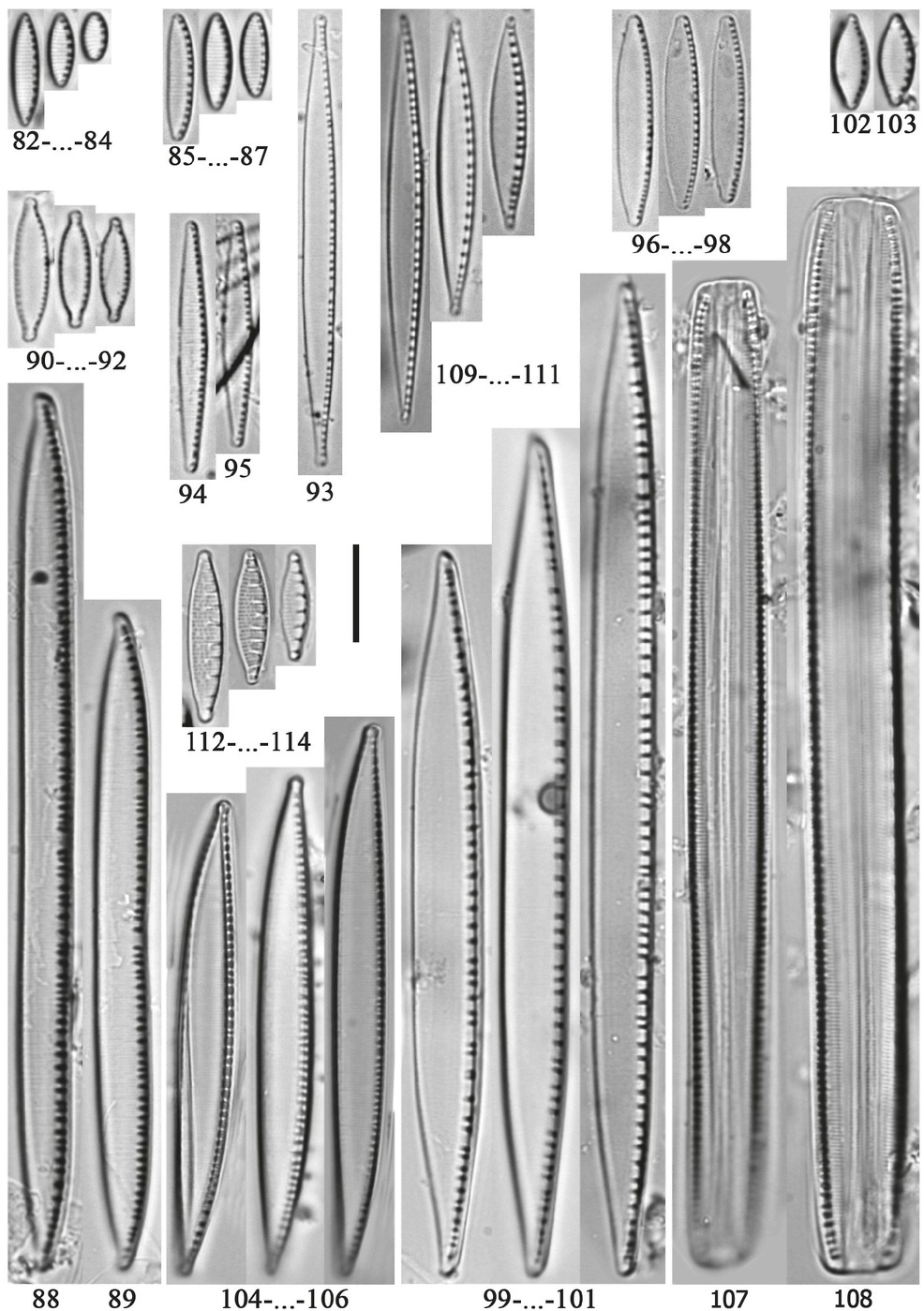
Figure 5
82–84 – Nitzschia inconspicua Grunow; 85–87 – N. leistikowii Lange-Bertalot; 88, 89 – N. linearis (C.Agardh) W.Smith; 90–92 – N. microcephala Grunow; 93 – N. palea (Kützing) W.Smith; 94, 95 – N. paleacea (Grunow) Grunow; 96–98 – N. pusilla Grunow; 99–101 – N. recta Hantzsch; 102, 103 – N. rosenstockii Lange-Bertalot; 104–106 – N. sigma (Kützing) W.Smith; 107, 108 – N. sigmoidea (Nitzsch) W.Smith; 109– 111 – N. sociabilis Hustedt; 112–114 – N. solgensis A.Cleve-Euler. Scale bar: 10 μm
Ref. Krammer & Lange-Bertalot 1991 (p. 95, pl. 69: 1–13), Hofmann et al. 2011 (p. 446, pl. 112: 35–40).
Dimensions of the examined specimens. 5.0–12.3 μm long; 2.9–3.2 μm wide; 10–11 fibulae in 10 μm.
Distribution in Kütahya waters. K2, K5, K6, K7, K9, K10, K11, K28, K31, K35, K45, K52. The species was commonly found in samples characterized by moderate to very high electrolyte content (118–1365 μS cm–1).
Distribution in Turkey. The taxon is widespread in Turkey (Gönülol 2017).
General distribution and ecology. The species is cosmopolitan, common in waters with moderate and high conductivity, up to the α-β-mesosaprobic zone (Krammer & Lange-Bertalot 1988). According to Van Dam et al. (1994), it is an alkaliphilous, α-mesosaprobous, eutraphentic and brackish-freshwater species.
Nitzschia leistikowii Lange-Bertalot; Fig. 5: 85–87
Ref. Krammer & Lange-Bertalot 1991 (pl. 68: 20–24).
Dimensions of the examined specimens. 8.6–13.2 μm long; 2.5–3.1 μm wide; 26–28 striae and 12–13 fibulaein 10 um.
Distribution and ecology in Kütahya waters. K2, K7, K9, K28, K36. The species was found in several samples characterized by moderate to high electrolyte content (118–806 μS cm–1).
Distribution in Turkey. This is the first record of the species for the Turkish freshwater diatom flora.
Nitzschia linearis (C.Agardh) W.Smith; Fig. 5: 88, 89
Basionym: Frustulia linearis C.Agardh
Ref. Krammer & Lange-Bertalot 1991 (p.69, pl. 55: 1–4), Hofmann et al. 2011 (p. 452, pl. 106: 1–3).
Dimensions of the examined specimens. 58.8–105.4 μm long; 5.4–6.0 μm wide; 10–12 fibulae in 10 μm.
Distribution and ecology in Kütahya waters. K5, K7, K33, K36. The species was found in a few samples characterized by moderate to high electrolyte content (515–834 μS cm–1).
Distribution in Turkey. The taxon is widespread in Turkey (Solak & Wojtal 2012; Gönülol 2017).
General distribution and ecology. The species is one of the most frequently reported diatoms, with a wide ecological spectrum, neutrophilous (Krammer & Lange-Bertalot 1988). According to Van Dam et al. (1994), it is an alkaliphilous, β-mesosaprobous, mesoto eutraphentic and fresh-brackish water species.
Nitzschia microcephala Grunow; Fig. 5: 90–92
Ref. Krammer & Lange-Bertalot 1991 (p. 120, pl. 83: 10–18), Hofmann et al. 2011 (p. 452, pl. 111:43–47).
Dimensions of the examined specimens. 9.0–13.8 μm long; 3.3–3.4 μm wide; 16 fibulae in 10 μm.
Distribution and ecology in Kütahya waters. K40, K45, K51. The species was found in a few samples characterized by moderate to very high electrolyte content (314–1502 μS cm–1).
Distribution in Turkey. The taxon is widespread in Turkey (Gönülol 2017). Most of the data on the distribution of the species come from Turkish lakes (Solak et al. 2002).
Nitzschia palea (Kützing) W.Smith; Fig. 5: 93
Basionym: Synedra palea Kützing
Ref. Krammer & Lange-Bertalot 1991 (p. 85, pl. 59: 1–10), Hofmann et al. 2011 (p. 454, pl. 111: 1–9).
Dimensions of the examined specimens. 34.7–46.3 μm long; 3.5–4.1 μm wide; 8–13 fibulae in 10 μm.
Distribution and ecology in Kütahya waters. K48. The species was found in one sample characterized by moderate electrolyte content (338 μS cm–1).
Distribution in Turkey. The taxon is widespread inTurkey (Solak & Wojtal 2012; Gönülol 2017).
General distribution and ecology. The species is cosmopolitan and common, especially in α-mesosaprobic and polysaprobic waters (Krammer & Lange-Bertalot 1988). According to Van Dam et al. (1994), it is a neutrophilous, polysaprobous, hypereutraphentic and fresh-brackish water species.
Nitzschia paleacea (Grunow) Grunow; Fig. 5: 94, 95
Basionym. Nitzschia subtilis var. paleacea Grunow
Ref. Krammer & Lange-Bertalot 1991 (p. 114, pl. 81: 1–7), Hofmann et al. 2011 (p. 455, pl. 111: 21–29).
Dimensions of the examined specimens. 23.1–25.7 μm long; 2.9–3.0 μm wide; 13 fibulae in 10 μm.
Distribution and ecology in Kütahya waters. K5, K44. The species was found in two samples characterized by high electrolyte content (515–745 μS cm–1).
Distribution in Turkey. This is the first record of the species for the Turkish freshwater diatom flora. General distribution and ecology. The species is cosmopolitan and very common in eutrophic waters with moderate or high conductivity (Krammer & Lange-Bertalot 1988). According to Van Dam et al. (1994), it is an alkaliphilous, α-mesosaprobous, eutraphentic and fresh-brackish water species.
Nitzschia pusilla Grunow; Fig. 5: 96–98
Ref. Hofmann et al. 2011 (p. 457, pl. 112: 10–15).
Dimensions of the examined specimens. 18.3–21.7 μm long; 3.3–3.7 μm wide; 15–19 fibulae in 10 μm.
Distribution in Kütahya waters. K32, K33, K34, K37, K40, K41, K51. The species was found in samples characterized by moderate to high electrolyte content (307–834 μS cm–1).
Distribution in Turkey. The taxon is widespread in Turkey (Gönülol 2017).
General distribution and ecology. The species is cosmopolitan and common, characterized by a wide ecological tolerance, up to α-mesosaprobic (Krammer & Lange-Bertalot 1988). According to Van Dam et al. (1994), it is a neutrophilous, β-mesosaprobous, eurytraphentic and fresh-brackish water species.
Nitzschia recta Hantzsch;Fig. 5: 99–101
Ref. Krammer & Lange-Bertalot 1991 (p. 20, pl. 12: 1–11).
Dimensions of the examined specimens. 38.2–71.6μm long; 4.4–5.0 μm wide; 6–7 fibulae in 10 μm.
Distribution and ecology in Kütahya waters. K6, K7, K9, K10, K14, K15, K49. The species was found in samples characterized by moderate to high electrolyte content (263–758 μS cm–1).
Distribution in Turkey. The taxon is widespread in Turkey (Gönülol 2017). General distribution and ecology. According to Van Dam et al. (1994), it is an alkaliphilous, β-mesosaprobous, eurytraphentic, strictly aquatic and fresh-brackish water species.
Nitzschia rosenstockii Lange-Bertalot; Fig. 5: 102, 103
Ref. Krammer & Lange-Bertalot 1991 (p. 116, pl. 81: 17–20).
Dimensions of the examined specimens. Valves 9.5–11.2 μm long; 3.4–3.8 μm wide; 13–15 fibulae in 10 μm.
Distribution in Kütahya waters. K11, K35, K41, K42, K49. The species was found in several samples characterized by moderate to high electrolyte content (130–609 μS cm–1).
Distribution in Turkey. This is the first record of the species for the Turkish freshwater diatom flora.
Nitzschia sigma (Kützing) W.Smith; Fig. 5: 104–106
Basionym: Synedra sigma Kützing
Ref. Krammer & Lange-Bertalot 1991 (p. 32, pl. 23: 1–9).
Dimensions of the examined specimens. 48.7–56.7 μm long; 5.5–5.9 μm wide; 10–13 fibulae in 10 μm.
Distribution and ecology in Kütahya waters. K14, K19, K42. The species was found in a few samples characterized by high to very high electrolyte content (514–1449 μS cm–1).
Distribution in Turkey. The taxon is widespread in Turkey (Gönülol 2017).
General distribution and ecology. According to Van Dam et al. (1994), it is an alkaliphilous, α-mesosaprobous, eutraphentic and brackish water species.
Nitzschia sigmoidea (Nitzsch) W.Smith; Fig. 5: 107, 108
Basionym: Bacillaria sigmoidea Nitzsch
Ref. Krammer & Lange-Bertalot (1991 p. 12, pl. 5: 1–5).
Dimensions of the examined specimens. 125.3 μm long; 8.5 μm wide; 7 fibulae in 10 μm.
Distribution and ecology in Kütahya waters. K14, K15, K16. The species was found in a few samples characterized by high electrolyte content (405–514 μS cm–1).
Distribution in Turkey. The taxon is widespread in Turkey (Gönülol 2017). General distribution and ecology. It is a cosmopolitan diatom, common in mesotrophic and eutrophic waters with moderate and high conductivity (Krammer & Lange-Bertalot 1988). According to Van Dam et al. (1994), it is an alkaliphilous, β-mesosaprobous, eutraphentic and fresh-brackish water species.
Nitzschia sociabilis Hustedt; Fig. 5: 109–111
Ref. Krammer & Lange-Bertalot 1991 (p. 83, pl. 83: 1–9).
Dimensions of the examined specimens. 20.6–36.8 μm long; 3.5–4.1 μm wide; 8–10 fibulae in 10 μm.
Distribution and ecology in Kütahya waters. K2, K6, K7, K8, K9, K10, K15, K21, K26, K28, K36, K49, K50. The species was commonly found in samples characterized by moderate to very high electrolyte content (118–1125 μS cm–1).
Distribution in Turkey. The taxon is widespread in Turkey (Gönülol 2017).
General distribution and ecology. It is probably a cosmopolitan diatom species, particularly common in waters with moderate to very high conductivity (Krammer & Lange-Bertalot 1988). According to Van Dam et al. (1994), it is a neutrophilous, β-mesosaprobous, eutraphentic and fresh-brackish water species.
Nitzschia solgensis A.Cleve-Euler; Fig. 5: 112–114
Ref. Hofmann et al. 2011 (p. 461, pl. 117: 21–25).
Dimensions of the examined specimens. 7.3–18.3 um long; 2.4–3.6 um wide; 23–25 striae and 4–5 fibulae in 10 μm.
Distribution and ecology in Kütahya waters. K13, K27, K37, K53. The species was found in several samples characterized by moderate to high electrolyte content (327–765 μS cm–1).
Distribution in Turkey. The taxon was found only in the eastern Black Sea region (Kızılırmak River by Baytut & Gönülol 2016).
General distribution and ecology. The species is cosmopolitan, particularly common in waters with moderate to very high conductivity, β- and α-mesosaprobic (Krammer & Lange-Bertalot 1988). In Germany, classified as in regression (Lange-Bertalot 1996). According to Van Dam et al. (1994), it is an alkaliphilous, β-mesosaprobous, aerophilous, meso- to eutraphentic and fresh-brackish water species.
Nitzschia solita Hustedt; Fig. 6: 115, 116
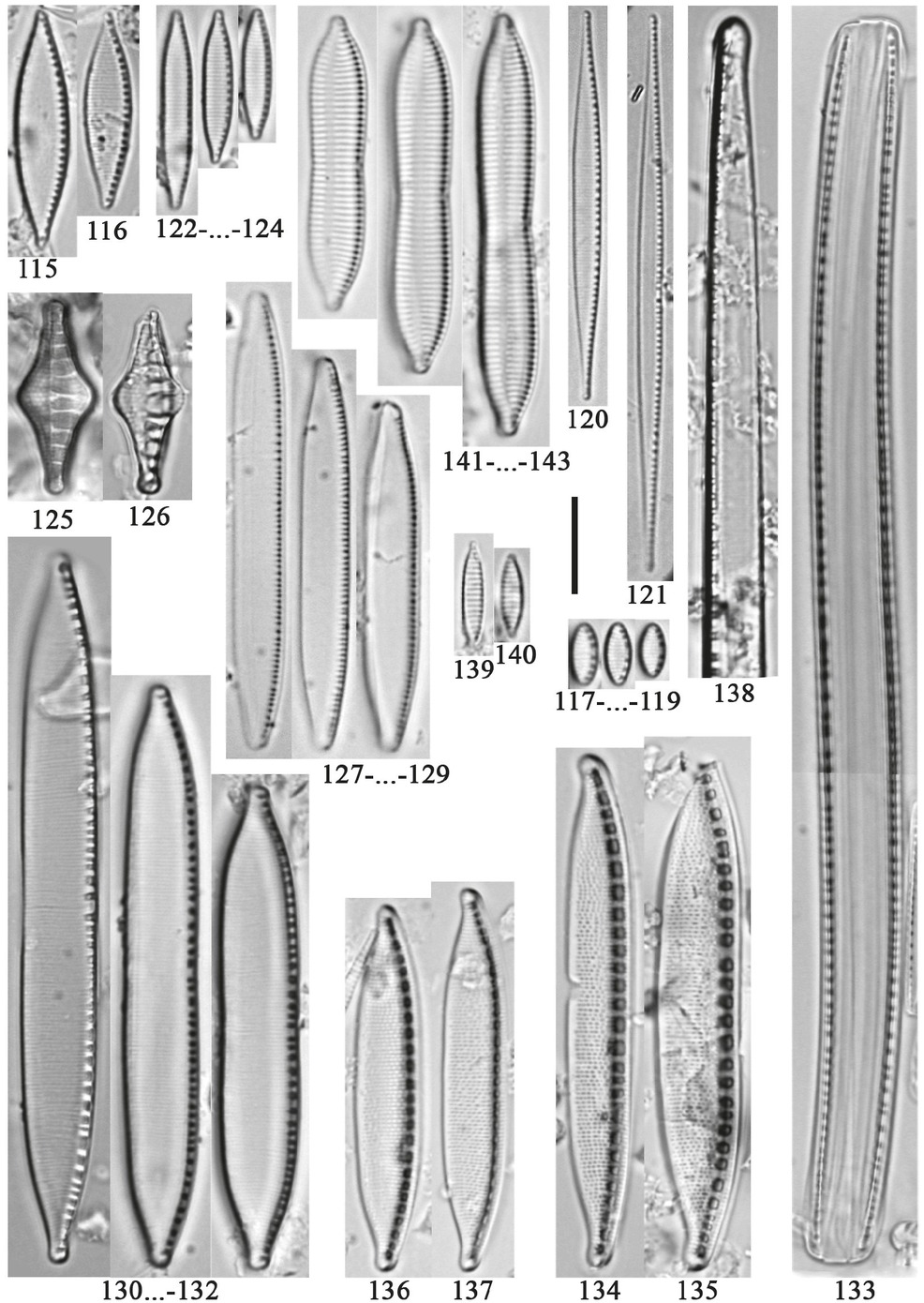
Figure 6
115–116– Nitzschia solita Hustedt; 117–119– N.soratensis Morales & Vis; 120 – N.subacicularis Hustedt; 121 –N.subtilis (Grunow) Hustedt; 122–124 – N. supralitorea Lange-Bertalot; 125, 126 – N. tabellaria (Grunow) Grunow; 127–129 – N. thermaloides Hustedt; 130–132 – N. umbonata (Ehrenberg) Lange-Bertalot; 133 – N. vermicularis (Kützing) Hantzsch; 134, 135 – N. vitrea Norman; 136, 137 – N. vitrea var. salinarum Grunow; 138 – N. wuellerstorffii Grunow; 139, 140 – Simonsenia delognei (Grunow) Lange-Bertalot; 141–143 – Tryblionella apiculata W.Gregory. Scale bar: 10 μm
Ref. Krammer & Lange-Bertalot 1991 (p. 99, pl. 71: 1–12).
Dimensions of the examined specimens. 20.1–24.7 μm long; 4.7–5.1 μm wide; 27 striae and 12–13 fibulae in 10 μm.
Distribution and ecology in Kütahya waters. K5, K6, K8, K9. The species was found in several samples characterized by moderate to high electrolyte content (478–634 μS cm–1).
Distribution in Turkey. The taxon was found only in Inner Anatolia (Hafik & Tödürge Lakes by Sıvacı et al. 2007) and the Mediterranean region (Andık Stream by Kalyoncu et al. 2014).
Nitzschia soratensis Morales & Vis; Fig. 6: 117–119
Ref. Trobajo et al. 2013 (p. 47, figs 28–35).
Dimensions of the examined specimens. 5.5–7.5 μm long; 2.6–3.1 μm wide; 12–14 striae and 5–7 fibulae in 10 μm.
Distribution in Kütahya waters. K9, K35. The species was found in two samples characterized by high electrolyte content (609–634 μS cm–1).
Distribution in Turkey. This is the first record of the species for the Turkish freshwater diatom flora.
Nitzschia subacicularis Hustedt; Fig. 6: 120
Ref. Hofmann et al. 2011 (p. 462, pl. 107: 20–24).
Dimensions of the examined Turkish specimens. 39.9 um long; 2.9 um wide; 29 striae and 13 fibulae in 10 μm.
Distribution and ecology in Kütahya waters. K5. The species was found in one sample characterized by high electrolyte content (515 μS cm–1).
Distribution in Turkey. The taxon was found only in the western Black Sea region (Acarlar floodplain by Tunca et al. 2014).
Nitzschia subtilis (Grunow) Hustedt; Fig. 6: 121
Basionym. Synedra subtilis Grunow
Ref. Krammer & Lange-Bertalot 1991 (p. 70, pl. 55: 7–10).
Dimensions of the examined specimens. 44.4–56.9 μm long; 2.5–3.5 μm wide; 15–16 fibulae in 10 μm.
Distribution and ecology in Kütahya waters. K17.
The species was found in one sample characterized by high electrolyte content (751 μS cm–1).
Distribution in Turkey. This is the first record of the species for the Turkish freshwater diatom flora.
Nitzschia supralitorea Lange-Bertalot; Fig. 6: 122–124
Ref. Krammer & Lange-Bertalot 1991 (p. 97, pl. 70: 14–21), Hofmann et al. 2011 (p. 464, pl. 112: 66–71).
Dimensions of the examined specimens. 12.4–20.2 μm long; 2.7–3.9 μm wide; 24–27 striae and 13–16 fibulae in 10 um.
Distribution and ecology in Kütahya waters. K7, K17, K29, K42, K45. The species was found in several samples characterized by high to very high electrolyte content (541–1502 μS cm–1).
Distribution in Turkey. The taxon was found in the Inner Anatolia region (Karagöl by Açıkgöz et al. 2005).
General distribution and ecology. The species is cosmopolitan, particularly common in eutrophic waters with moderate and high conductivity (Krammer & Lange-Bertalot 1988), According to Van Dam et al. (1994), it is a neutrophilous, α-mesosaprobous, eutraphentic, aerophilous and fresh-brackish water species.
Nitzschia tabellaria (Grunow) Grunow; Fig. 6: 125, 126
Basionym. Denticula tabellaria Grunow
Ref. Krammer & Lange-Bertalot 1991 (p. 53, pl. 39: 10–13), Hofmann et al. 2011 (p. 464, pl. 117: 1–5), Bąk et al. 2012 (p. 260, pl. 76).
Dimensions of the examined specimens. 19.1–20.0 μm long; 7.2–7.8 μm wide; 21–23 striae and 6 fibulae in 10 μm.
Distribution and ecology in Kütahya waters. K16. The species was found in one sample characterized by moderate electrolyte content (405 μS cm–1).
Distribution in Turkey. The taxon is widespread in Turkey (Gönülol 2017). General distribution and ecology. The species is cosmopolitan (Krammer & Lange-Bertalot 1988). According to Van Dam et al. (1994), it is a neutrophilous, β-mesosaprobous, mesotraphentic and freshwater species.
Nitzschia thermaloides Hustedt; Fig. 6: 127-129
Ref. Krammer & Lange-Bertalot 1991 (p. 59, pl. 44: 1–7).
Dimensions of the examined specimens. 15.3–48.9 μm long; 3.4–5.8 μm wide; 16–20 fibulae in 10 μm.
Distribution and ecology in Kütahya waters. K29, K42, K44, K45, K48. The species was found in several samples characterized by moderate to very high electrolyte content (338–1502 μS cm–1).
Distribution in Turkey. The taxon is widespread in Turkey (Gönülol 2017).
Nitzschia umbonata (Ehrenberg) Lange-Bertalot; Fig. 6: 130–132
Basionym: Navicula umbonata Ehrenberg
Ref. Krammer & Lange-Bertalot 1991 (p. 65, pl. 51: 1–6A), Hofmann et al. 2011 (p. 467, pl. 105: 4–8).
Dimensions of the examined specimens. 58.1–71.5 μm long; 8.0–8.2 μm wide; 6–8 fibulae in 10 μm.
Distribution and ecology in Kütahya waters. K3, K4, K25, K26, K30, K31, K32, K33, K44. The species was commonly found in samples characterized by high to very high electrolyte content (539–1365 μS cm–1).
Distribution in Turkey. The taxon is widespread in Turkey (Gönülol 2017).
Nitzschia vermicularis (Kützing) Hantzsch; Fig. 6: 133
Basionym: Frustulia vermicularis Kützing
Ref. Krammer & Lange-Bertalot 1991 (p. 14, pl. 4: 4, 5), Hofmann et al. 2011 (p. 468, pl. 115: 1–3).
Dimensions of the examined specimens. 132.2 μm long; 5.2 μm wide; 8 fibulae in 10 μm.
Distribution and ecology in Kütahya waters. K9, K25. The species was found in two samples characterized by high electrolyte content (539–634 μS cm–1).
Distribution in Turkey. The taxon is widespread in Turkey (Gönülol 2017). Most of the data on the distribution of the species come from Turkish lakes (Solak et al. 2002).
General distribution and ecology. The species is cosmopolitan, occurring in oligotrophic and slightly eutrophic waters with moderate or high conductivity (Krammer & Lange-Bertalot 1988). According to Van Dam et al. (1994), it is an alkaliphilous, β-mesosaprobous, eurytraphentic and fresh-brackish water species.
Nitzschia vitrea Norman; Fig. 6: 134, 135
Ref. Krammer & Lange-Bertalot 1991 (p. 72, pl. 56: 1, 2).
Dimensions of the examined specimens. 51.7–52.8 μm long; 6.9–8.9 μm wide; 23–24 striae and 5–6 fibulae in 10 μm.
Distribution and ecology in Kütahya waters. K7, K48. The species was found in two samples characterized by moderate to high electrolyte content (338–541 μS cm–1).
Distribution in Turkey. The taxon is widespread in Turkey (Gönülol 2017).
Nitzschia vitrea var. salinarum Grunow; Fig. 6: 136, 137
Ref. Krammer & Lange-Bertalot 1991 (p. 73, pl. 56: 3–5).
Dimensions of the examined specimens. 37.5–38.9 μm long; 5.8–6.7 μm wide; 24–26 striae and 7–8 fibulae in 10 μm.
Distribution and ecology in Kütahya waters. K48. The species was found in samples characterized by moderate electrolyte content (338 μS cm–1).
Distribution in Turkey. The taxon was found only in the Aegean region (Kütahya lotic waters by Solak et al. 2016).
Nitzschia wuellerstorffii Grunow; Fig. 6: 138
Ref. Krammer & Lange-Bertalot 1991 (p. 13, pl. 6: 1–6), Hofmann et al. 2011 (p. 468, pl. 114: 1–4).
Dimensions of the examined specimens. 6.7–7.7 μm wide; 5.5–6.0 fibulae in 10 μm.
Distribution and ecology in Kütahya waters. K5, K24. The species was found in two samples characterized by moderate to high electrolyte content (435–515 μS cm–1).
Distribution in Turkey. The taxon was found only in the western Black Sea region (Abant Lake by Çelekli & Külköylüoğlu 2006).
Simonsenia delognei (Grunow) Lange-Bertalot; Fig. 6: 139, 140
Basionym: Nitzschia delognei Grunow in Van Heurck
Ref. Krammer & Lange-Bertalot 1991 (p. 135, pl. 84: 13–19), Hofmann et al. 2011 (p. 540, pl. 47–50).
Dimensions of the examined specimens. 8.5–17.2 μm long; 1.2–2.5 μm wide; 17–21 striae in 10 μm.
Distribution and ecology in Kütahya waters. K7, K17, K18, K50. The species was found in several samples characterized by moderate to high electrolyte content (362–751 μS cm–1).
Distribution in Turkey. The taxon was found only in
the Black Sea (Sarıkum Lagoon by Sıvacı et al. 2008), Marmara and Aegean regions (Türkmen Mountain springs and Yalova lotic waters by Witkowski et al. 2016).
General distribution and ecology. According to Van Dam et al. (1994), it is an α-mesosaprobous, eutraphentic and brackish-freshwater species.
Tryblionella apiculata W.Gregory; Fig. 6: 141–143
Ref. Krammer & Lange-Bertalot 1991 (p. 43, pl. 35: 1–6).
Dimensions of the examined specimens. 27.3–46.6 μm long; 5.3–6.5 μm wide; 15–16 fibulae in 10 μm.
Distribution and ecology in Kütahya waters. K2, K5, K7, K9, K10, K15, K16, K19, K28, K31, K32, K33, K36, K43, K45, K51 The species was commonly found in samples characterized by moderate to very high electrolyte content (118–1502 μS cm–1).
Distribution in Turkey. The taxon is widespread in Turkey (Gönülol 2017).
Tryblionella calida (Grunow) D.G.Mann; Fig. 7: 144, 145
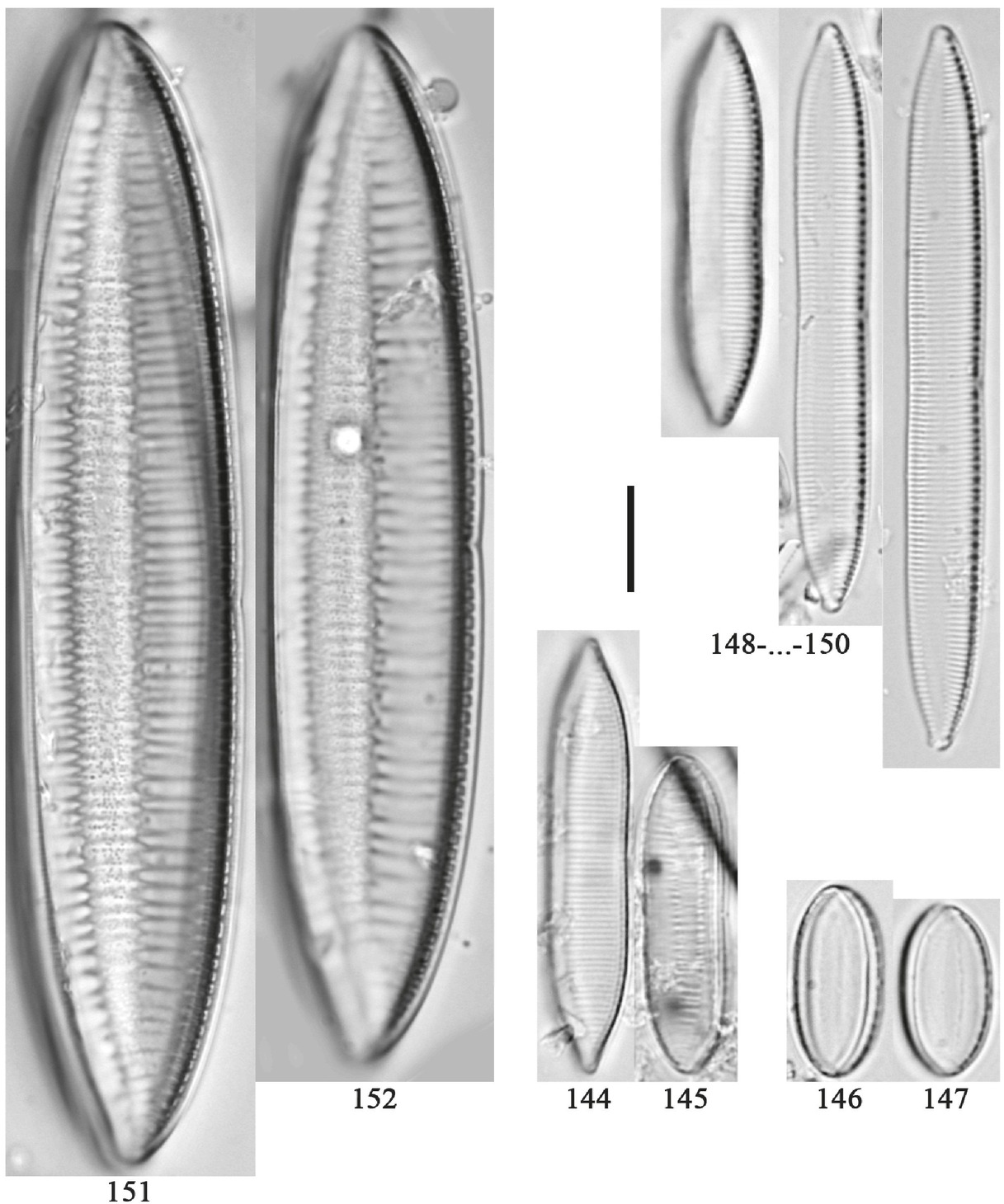
Figure 7
144, 145 – Tryblionella calida (Grunow) D.G.Mann; 146, 147 – T. debilis Arnott ex O'Meara; 148–150 – T. hungarica (Grunow) Frenguelli; 151, 152– Tryblionella sp. Scale bar: 10 μm
Basionym: Nitzschia calida Grunow
Ref. Krammer & Lange-Bertalot 1991 (p. 40, pl. 30: 1–5), Hofmann et al. 2011 (p. 437, pl. 103: 5–8).
Dimensions of the examined specimens. 37.3–47.9 μm long; 7.8–8.2 μm wide; 6–8 fibulae in 10 μm.
Distribution and ecology in Kütahya waters. K8, K9, K10, K14, K15, K33. The species was found in samples characterized by moderate to high electrolyte content (405–834 μS cm–1).
Distribution in Turkey. The taxon was found only in the western Black Sea region (Karagöl-Aksaz marsh by Sıvacı 2013).
Tryblionella debilis Arnott ex O'Meara; Fig. 7: 146, 147
Ref. Krammer & Lange-Bertalot 1991 (p. 39, pl. 27: 9–11), Hofmann et al. 2011 (p. 440, pl. 102: 12–17).
Dimensions of the examined specimens. 15.8–20.9 μm long; 6.8–8.0 μm wide; 8 fibulae in 10 μm.
Distribution and ecology in Kütahya waters. K7, K12, K20, K51. The species was found in several samples characterized by low to high electrolyte content (88–758 μS cm–1).
Distribution in Turkey. The taxon is widespread in Turkey (Gönülol 2017).
Tryblionella hungarica (Grunow) Frenguelli; Fig. 7: 148–150
Basionym: Nitzschia hungarica Grunow
Ref. Krammer & Lange-Bertalot 1991 (p. 37, pl. 34: 1–3), Hofmann et al. 2011 (p. 449, pl. 104: 3–7).
Dimensions of the examined specimens. 32.3–62.0 μm long; 7.7–8.5 μm wide; 10–12 fibulae in 10 μm.
Distribution and ecology in Kütahya waters. K7, K9, K10, K17, K28, K30, K32, K33, K35, K36, K42. The species was commonly found in samples characterized by low to very high electrolyte content (118–1449 μS cm–1).
Distribution in Turkey. The taxon is widespread in Turkey (Solak & Wojtal 2012; Gönülol 2017). Most of the data on the distribution of the species come from Turkish lakes (Solak et al. 2002).
General distribution and ecology. The species is cosmopolitan, common in brackish water, up to α-mesosaprobic (Krammer & Lange-Bertalot 1988). According to Van Dam et al. (1994), an alkaliphilous, α-mesosaprobous, eutraphentic, strictly aquatic and brackish-freshwater species.
Tryblionella sp.; Fig. 8: 151, 152
Dimensions of the examined Turkish specimens. 72.3–115.0 μm long; 18.9–21.7 μm wide; 7–8 fibulae in 10 μm.
Distribution and ecology in Kütahya waters. K42. The species was found in samples characterized by a very high electrolyte content (1449 μS cm–1).
Remarks. The species is morphologically similar to N. tryblionella. The central area in N. tryblionella is straight, but appears as a visible "knob-like" shape in the central part of a hitherto unknown species. Nitzschia tryblionella has more visible ridges on the valve face. The taxon is also morphologically similar to Nitzschia littoralis Grunow. However, our unidentified taxon is larger in size and has visible ridges on the valve face.
Discussion
This study reports a total of 65 taxa belonging to six genera of the order Bacillariaceae: Cylindrotheca, Denticula, Hantzschia, Nitzschia, Simonsenia and Tryblionella. Given the large number of described species in Nitzschia – DiatomBase reports over 2800 described names in this genus (Kociolek et al. 2018), which makes it by far the largest genus in the order, it is not surprising that 52 of the 65 taxa identified areclassified into Nitzschia. Krammer and Lange-Bertalot (1991) recognized about 15 subgroups within Nitzschia, eight of which are represented in the watersheds of the Kütahya region. Species representing the groups: Nitzschiellae (N. acicularis), Dissipatae (N. dissipata), Obtusae (N. clausii), Dubiae (N. dubia), Sigmoideae (N. sigma), Grunowiae (N. tabellaria), Lanceolatae (N. palea) and Lineares (N. linearis) were found in the study region.
Almost all taxa found during this study were characterized as benthic taxa (Hustedt 1930; Krammer & Lange-Bertalot 1991) and their presence in the collections from the Kütahya region reflects the slow current of most of its water bodies. In addition, several of these taxa were found in warm or hot waters, as some of the surveyed locations contained wastewater from health resorts (e.g. K42-Naşa thermal waters or K32-Eynal thermal waters). These locations were characterized by high species richness of Bacillariaceae. Members of this group are known to occur in thermal springs (Nikulina & Kociolek 2011).
Finally, we have recorded nearly 20% (15 out of a total of 65 taxa) of the species reported in the first reports for Turkey, even though they are well-known taxa. This demonstrates that our knowledge of the Turkish freshwaters is still in its infancy.
Future work on the freshwater diatom flora of Turkey should involve studies of specific characteristic features of species, such as striae patterns, areolae, the keel raphe system and others, of the new species and of the first records using a scanning electron microscope. Such research will certainly contribute to the identification of species groups based on morphology, the identification of keystone species from those previously described, some cryptic species (difficult to identify) such as Nitzschia palea or N. amphibia, and a more accurate assessment of the identity of taxa present in the Turkish flora. We expect to identify additional members of this taxonomically challenging group and to describe taxa that are new to science.
Acknowledgements
The authors would like to thank Prof. Dr. Patrick Kociolek for his valuable comments and linguistic corrections and Dr. Łukasz Peszek for helping with the map of sampling sites. The authors thank the anonymous reviewers for their helpful comments on the manuscript. This study was supported by TÜBİTAK-114Z006 and the Dumlupınar University Foundation (Grant No. 2011–18).