
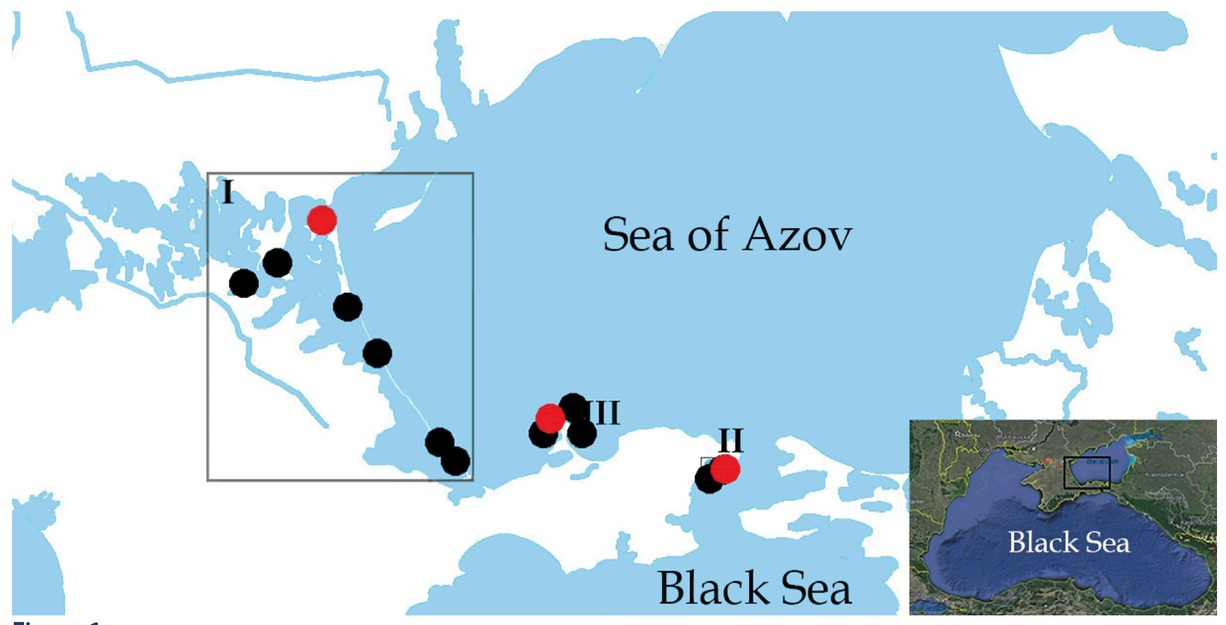
Figure 1
Sampling areas in the western coastal zone of the Sea of Azov. Red dots denote the sampling sites where information for mapping was accumulated, and black dots denote other sampling sites. (I) Sivash Gulf, (II) the Kerch Strait and (III) Kazantip Cape
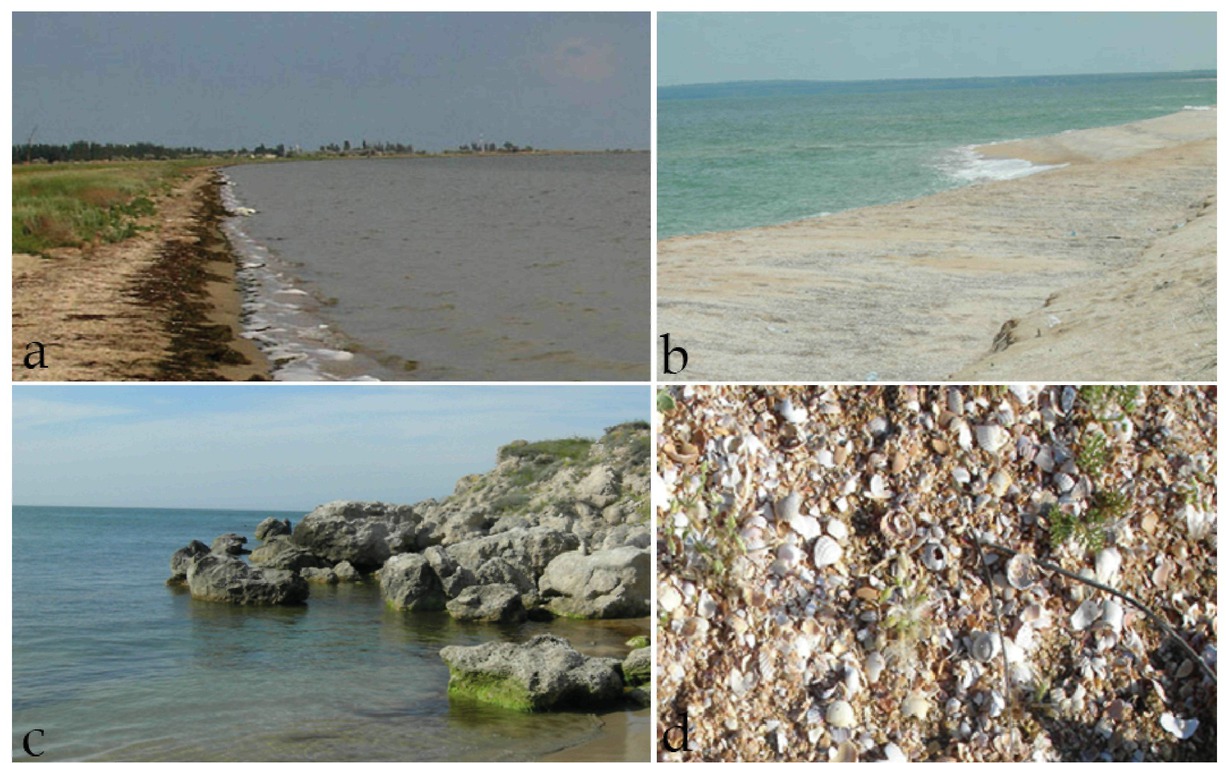
Figure 2
Coastal zone of Sivash Gulf (a) and sandy coast of Cape Kazantip (b). Microphytobenthos habitats in the Kazantip Natural Reserve: submerged stones (c) and shell fouling (d)
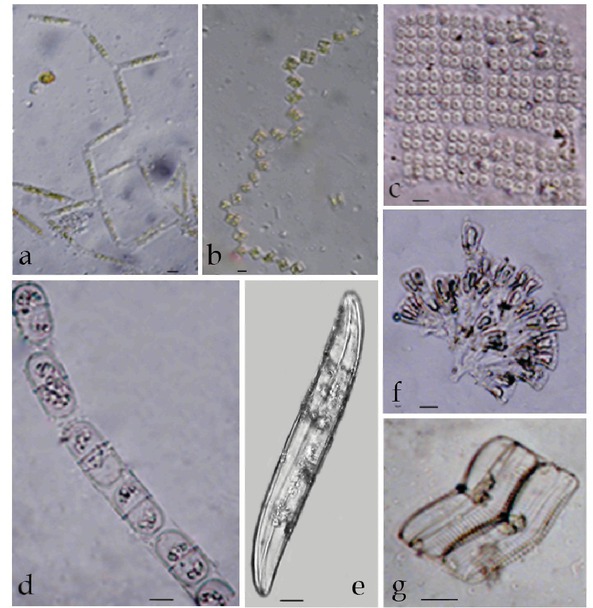
Figure 3
Some indicator species from the western coast of the Sea of Azov: Diatoma tenuis (a), D. vulgaris (b), Merismopedia glauca (c), Melosira lineata (d), Gyrosigma wansbeckii (e), Rhoicosphenia abbreviata (f), Achnanthes brevipes (g), (Scale bar: 10 μm
Table 1
Distribution of microalgae species indicators on different types of substrate and in different study areas in the western coastal zone of the Sea of Azov
| Taxa | EP | EL | SE | Siv | Ker | Kaz | Hab | T | Oxy | pH | Hal | D | Sap | S | Tro | Aut-Het |
|---|---|---|---|---|---|---|---|---|---|---|---|---|---|---|---|---|
| Cyanobacteria | ||||||||||||||||
| Aphanocapsa incerta (Lemmermann) G.Cronberg &Komárek | 1 | 0 | 0 | 0 | 0 | 1 | B-P | – | – | – | i | – | b | 2.2 | me | – |
| Aphanothece stagnina (Sprengel) A.Braun | 1 | 1 | 1 | 1 | 0 | 1 | B-P | – | – | ind | hl | – | b-a | 2.4 | me | – |
| Chamaecalyx swirenkoi (Sirsov) Komárek & Anagnostidis | 0 | 1 | 1 | 1 | 0 | 1 | Ep | – | – | – | – | – | – | – | – | – |
| Chroococcus limneticus Lemmermann | 1 | 0 | 0 | 0 | 1 | 1 | P | – | – | – | – | – | – | – | o-m | – |
| Leptolyngbya foveolara (Gomont) Anagnostidis & Komárek | 1 | 0 | 0 | 0 | 0 | 1 | B, S | – | aer | – | – | – | b-a | 2.4 | – | – |
| Leptolyngbya fragilis (Gomont) Anagnostidis & Komárek | 1 | 0 | 1 | 1 | 0 | 0 | B, S | warm | – | – | ph | – | b-o | 1.7 | – | – |
| Lyngbya aestuarii Liebman ex Gomont | 1 | 0 | 0 | 1 | 0 | 0 | B-P, S | – | – | – | mh | – | o | 1.3 | – | – |
| Lyngbya lutea Gomont ex Gomont | 0 | 0 | 0 | 0 | 1 | 0 | B-P | – | – | – | mh | – | – | – | – | – |
| Lyngbya semiplena J.Agardh ex Gomont | 1 | 0 | 0 | 1 | 0 | 0 | B, S | – | – | – | ph | – | – | – | – | – |
| Merismopedia glauca (Ehrenberg) Kützing | 0 | 0 | 1 | 1 | 0 | 0 | B-P | – | – | ind | i | – | b-o | 1.75 | o-m | – |
| Microcystis aeruginosa (Kützing) Kützing | 1 | 1 | 1 | 0 | 0 | 1 | P | – | – | – | hl | – | b | 2.1 | e | - |
| Microcystis pulverea (H.C.Wood) Forti | 1 | 0 | 1 | 0 | 0 | 1 | B-P, S | – | – | – | i | – | o-b | 1.5 | – | – |
| Microcystis wesenbergii (Komárek) Komárek ex Komárek | 1 | 0 | 1 | 0 | 1 | 1 | P | – | – | – | – | – | o-a | 1.9 | e | – |
| Nodularia harveyana Thuret ex Bornet & Flahault | 1 | 0 | 0 | 0 | 0 | 1 | B, S | – | – | – | mh | – | o | 1.2 | – | – |
| Oscillatoria nitida Schkorbatov | 1 | 0 | 0 | 0 | 0 | 1 | P | – | st-str | – | i | – | – | – | – | – |
| Phormidium breve (Kützing ex Gomont) Anagnostidis & Komárek | 1 | 0 | 0 | 1 | 0 | 0 | B-P S | – | st,aer | – | – | – | a | 3.1 | – | – |
| Phormidium puteale (Montagne ex Gomont) Anagnostidis & Komárek | 0 | 1 | 0 | 0 | 0 | 1 | B, S | – | st-str | – | – | – | – | – | – | – |
| Pleurocapsa minor Hansgirg | 0 | 1 | 0 | 0 | 1 | 0 | B | – | st-str | – | – | – | x-b | 0.9 | o | – |
| Spirulina tenuissima Kützing | 1 | 0 | 1 | 1 | 0 | 1 | B | – | st-str | – | – | – | o-b | 1.4 | – | – |
| Bacillariophyta | ||||||||||||||||
| Achnanthes brevipes C.Agardh var. brevipes | 1 | 1 | 1 | 1 | 1 | 1 | B | – | – | alf | hl | – | b | 2.0 | me | – |
| Achnanthes brevipes var. intermedia (Kützing) Cleve | 0 | 1 | 1 | 0 | 1 | 0 | B | – | st | – | mh | – | – | – | – | – |
| Achnanthes longipes C.Agardh | 1 | 1 | 1 | 1 | 1 | 1 | B | – | – | – | hl | – | – | – | – | – |
| Amphora commutata Grunow in Van Heurck | 1 | 0 | 0 | 1 | 0 | 0 | B | – | – | – | mh | – | – | – | e | – |
| Amphora delicatissima Krasske | 1 | 1 | 0 | 0 | 0 | 1 | B | – | – | – | mh | – | – | – | – | – |
| Amphora ovalis (Kützing) Kützing | 0 | 0 | 1 | 1 | 0 | 1 | B | temp | st-str | alf | i | sx | o-b | 1.5 | me | ate |
| Bacillaria paxillifera (O.F.Müller) T.Marsson | 1 | 1 | 1 | 0 | 1 | 1 | B-P | – | – | ind | hl | es | b | 2.3 | me | ate |
| Berkeleya rutilans (Trentepohl ex Roth) Grunow | 1 | 1 | 1 | 0 | 1 | 1 | B | – | – | alf | hl | – | – | – | – | – |
| Cocconeis costata Gregory | 1 | 1 | 1 | 0 | 1 | 1 | B | – | – | alf | hl | – | b | 2.0 | – | – |
| Cocconeis disculus (Schumann) Cleve | 1 | 1 | 1 | 1 | 1 | 1 | B | – | st | alf | i | es | o-x | 0.7 | me | – |
| Cocconeis pediculus Ehrenberg | 1 | 0 | 0 | 1 | 0 | 0 | B | – | st-str | alf | i | sx | o-a | 1.8 | me | ate |
| Cocconeis placentula var. intermedia (Héribaud-Joseph & M.Peragallo) Cleve | 1 | 1 | 1 | 1 | 1 | 1 | B | – | st-str | alf | i | – | o-b | 1.4 | ot | ate |
| Cocconeis scutellum Ehrenberg | 1 | 1 | 1 | 1 | 1 | 1 | B | – | – | alf | hl | – | b | 2.0 | me | – |
| Ctenophora pulchella (Ralfs ex Kützing) D.M.Williams & Round | 0 | 0 | 1 | 0 | 1 | 0 | B-P | – | st-str | alf | i | – | b | 2.3 | o-m | ate |
| Cylindrotheca closterium (Ehrenberg) Reimann & J.C.Lewin | 1 | 1 | 0 | 0 | 1 | 1 | B | – | – | alf | I | – | b | 2.0 | – | – |
| Diatoma tenuis C.Agardh | 1 | 1 | 0 | 0 | 0 | 1 | B-P | – | st-str | ind | hl | sx | o | 1.3 | e | ate |
| Diatoma vulgaris Bory | 1 | 0 | 0 | 0 | 0 | 1 | B-P | – | st-str | ind | i | sx | b | 2.2 | me | ate |
| Diploneis didyma (Ehrenberg) Ehrenberg | 0 | 0 | 1 | 0 | 0 | 1 | B | – | – | – | mh | – | b | 2.0 | – | – |
| Entomoneis alata (Ehrenberg) Ehrenberg | 0 | 0 | 1 | 1 | 0 | 0 | B-P | – | st | alf | mh | – | b | 2.0 | – | – |
| Entomoneis paludosa (W.Smith) Reimer | 1 | 1 | 1 | 0 | 1 | 1 | B-P | – | – | alf | hl | – | b-a | 2.5 | m | – |
| Fallacia pygmaea (Kützing) A.J.Stickle & D.G.Mann | 0 | 1 | 0 | 0 | 1 | 0 | B-P | – | st-str | alf | mh | es | a-o | 2.7 | e | hne |
| Fragilaria capucina Desmazières | 1 | 1 | 1 | 0 | 1 | 1 | B-P | – | – | ind | i | es | b-o | 1.6 | m | – |
| Fragilaria crotonensis Kitton | 1 | 0 | 0 | 0 | 1 | 1 | P | – | st-str | alf | I | es | o-b | 1.5 | m | ate |
| Fragilariforma virescens (Ralfs) D.M.Williams & Round | 1 | 1 | 1 | 0 | 1 | 1 | B-P | – | st | ind | i | es | x-o | 0.4 | o-m | ats |
| Gyrosigma acuminatum (Kützing) Rabenhorst | 1 | 0 | 1 | 1 | 0 | 1 | B | – | – | – | – | es | – | – | – | – |
| Gyrosigma balticum (Ehrenberg) Rabenhorst | 1 | 0 | 1 | 1 | 0 | 0 | B | – | – | – | hl | – | – | – | e | – |
| Gyrosigma fasciola (Ehrenberg) J.W.Griffith & Henfrey | 0 | 0 | 1 | 1 | 0 | 0 | B | – | – | alf | mh | – | o | 1.0 | – | – |
| Gyrosigma scalproides (Rabenhorst) Cleve | 1 | 0 | 1 | 1 | 0 | 1 | B | – | – | alf | i | es | b | 2.2 | – | – |
| Gyrosigma wansbeckii (Donkin) Cleve | 0 | 0 | 1 | 1 | 0 | 0 | B | – | st-str | alf | mh | es | b | 2.0 | e | – |
| Halamphora acutiuscula (Kützing) Levkov | 1 | 1 | 1 | 0 | 1 | 1 | B-P | warm | – | alf | mh | sp | b | 2.0 | – | – |
| Halamphora coffeiformis (C.Agardh) Levkov | 1 | 1 | 1 | 1 | 1 | 1 | B | – | st-str | alf | mh | – | a | 3.0 | e | ate |
| Haslea spicula (Hickie) L.Bukhtiyarova | 0 | 1 | 0 | 0 | 0 | 1 | B-P | – | – | – | mh | – | – | – | – | – |
| Hippodonta capitata (Ehrenberg) Lange-Bertalot, Metzeltin & Witkowski | 0 | 1 | 1 | 0 | 0 | 1 | B | temp | st-str | alf | hl | es | b | 2.1 | me | ate |
| Hyalodiscus scoticus (Kützing) Grunow | 1 | 0 | 0 | 0 | 1 | 0 | – | – | – | alf | i | – | b | 2.0 | – | – |
| Mastogloia smithii Thwaites ex W.Smith | 1 | 0 | 1 | 1 | 0 | 1 | B | – | – | alf | mh | sx | o | 1.3 | me | – |
| Melosira lineata (Dillwyn) C.Agardh | 1 | 0 | 0 | 0 | 1 | 0 | B-P | cool | – | alf | mh | es | o-a | 1.8 | e | ats |
| Melosira moniliformis (O.F.Müller) C.Agardh var. moniliformis | 1 | 1 | 1 | 1 | 1 | 1 | B-P | – | str | alf | hl | – | b | 2.0 | – | – |
| Melosira moniliformis var. octogona (Grunow) Hustedt | 1 | 0 | 1 | 0 | 1 | 0 | B-P | – | – | – | hl | – | – | – | – | – |
| Melosira moniliformis var. subglobosa (Grunow) Hustedt | 1 | 0 | 0 | 0 | 1 | 0 | B-P | – | str | alf | hl | – | b | 2.0 | – | – |
| Navicula ammophila Grunow | 1 | 1 | 1 | 1 | 1 | 1 | B | – | – | – | hl | – | – | – | – | – |
| Navicula cancellata Donkin | 1 | 1 | 1 | 0 | 1 | 1 | B | – | – | – | hl | – | – | – | – | – |
| Navicula cryptocephala Kützing | 1 | 0 | 0 | 1 | 0 | 0 | B-P | temp | st-str | ind | i | es | b | 2.1 | o-e | ate |
| Navicula digito-radiata (Gregory) Ralfs | 1 | 1 | 0 | 1 | 1 | 1 | B | – | – | alf | I | es | b | 2.0 | me | – |
| Navicula lanceolata var. tenuirostris Skvortzov | 1 | 0 | 0 | 0 | 0 | 1 | B | – | – | alf | i | – | – | – | – | – |
| Navicula peregrina (Ehrenberg) Kützing | 1 | 0 | 1 | 1 | 1 | 1 | B-P | – | – | alf | mh | es | o-b | 1.5 | o-m | – |
| Navicula ramosissima (C.Agardh) Cleve | 1 | 1 | 1 | 1 | 1 | 1 | B | – | – | – | ph | – | – | – | – | – |
| Navicula radiosa Kützing | 1 | 0 | 0 | 1 | 0 | 0 | B | temp | st-str | ind | i | es | o | 1.3 | me | ate |
| Navicula salinarum Grunow | 1 | 1 | 0 | 1 | 0 | 1 | B-P | – | st-str | ind | mh | – | b | 2.1 | me | ate |
| Navicula veneta Kützing | 1 | 1 | 0 | 0 | 0 | 1 | B | – | – | alf | hl | es | a-o | 2.7 | – | – |
| Nitzschia amphibia Grunow | 1 | 0 | 0 | 0 | 1 | 0 | B-P, S | temp | st-str | alf | i | sp | b | 2.1 | e | hne |
| Nitzschia dissipata (Kützing) Rabenhorst | 1 | 0 | 1 | 1 | 1 | 1 | B | – | st-str | alf | i | sx | b-o | 1.7 | me | ate |
| Nitzschia gracilis Hantzsch | 1 | 0 | 1 | 1 | 0 | 0 | B-P | temp | st-str | ind | i | sp | o-a | 1.8 | m | – |
| Nitzschia holsatica Hustedt | 1 | 0 | 1 | 1 | 0 | 0 | B-P | – | – | ind | i | es | b | 2.3 | – | – |
| Nitzschia lanceolata W.Smith | 1 | 1 | 1 | 0 | 1 | 1 | B | – | – | alf | hl | – | b | 2.0 | e | – |
| Nitzschia linearis W.Smith | 1 | 0 | 0 | 0 | 1 | 0 | B | temp | st-str | alf | i | es | b-o | 1.7 | me | ate |
| Nitzschia macilenta Gregory | 0 | 0 | 1 | 1 | 0 | 0 | – | – | – | – | hl | – | – | – | – | – |
| Nitzschia obtusa W.Smith | 1 | 1 | 0 | 1 | 1 | 1 | B | – | – | – | hl | es | b-a | 2.4 | m | – |
| Nitzschia recta Hantzsch ex Rabenhorst | 1 | 0 | 0 | 1 | 0 | 0 | B | – | st | ind | i | es | o-b | 1.5 | o-m | ate |
| Nitzschia scalpelliformis Grunow | 1 | 0 | 0 | 0 | 0 | 1 | B | – | – | alf | hl | sp | b | 2.0 | me | – |
| Nitzschia sigma (Kützing) W.Smith | 1 | 1 | 1 | 1 | 1 | 1 | B | temp | st-str | alf | mh | es | a | 3.0 | e | ate |
| Nitzschia sigmoidea (Nitzsch) W.Smith | 1 | 1 | 1 | 1 | 1 | 1 | B-P | – | st-str | alf | i | – | b-a | 2.5 | e | ate |
| Nitzschia vermicularis (Kützing) Hantzsch | 1 | 1 | 0 | 1 | 0 | 1 | B-P | – | str | alf | i | – | b | 2.2 | m | – |
| Odontella aurita (Lyngbye) Agardh | 0 | 1 | 1 | 1 | 1 | 0 | – | – | – | alf | mh | – | b | 2.0 | – | – |
| Petroneis humerosa (Brébisson ex W.Smith) A.J.Stickle & D.G.Mann | 0 | 0 | 1 | 0 | 0 | 1 | B | – | – | – | mh | – | – | – | – | – |
| Petroneis marina (Ralfs) D.G.Mann | 0 | 0 | 1 | 1 | 0 | 0 | B | – | – | – | mh | – | – | – | – | – |
| Plagiotropis lepidoptera (Gregory) Kuntze | 1 | 1 | 1 | 1 | 1 | 0 | B | – | – | – | i | – | – | – | – | – |
| Planothidium delicatulum (Kützing) Round & Bukhtiyarova | 1 | 0 | 0 | 1 | 0 | 0 | B-P | – | – | alb | hl | es | b | 2.0 | o-m | – |
| Planothidium haukianum (Grunow) Round & Bukhtiyarova | 1 | 0 | 0 | 0 | 0 | 1 | B-P | – | – | alf | hl | – | o | 1.0 | o-m | – |
| Pleurosigma angulatum (J.T.Queckett) W.Smith | 1 | 0 | 1 | 1 | 1 | 1 | B | – | – | alf | hl | – | b | 2.0 | – | – |
| Pleurosigma elongatum W.Smith | 1 | 1 | 1 | 1 | 1 | 1 | B | – | – | alf | mh | – | b | 2.0 | – | – |
| Pseudostaurosira brevistriata (Grunow) D.M.Williams & Round | 1 | 1 | 0 | 0 | 0 | 1 | B-P | – | st-str | alf | i | – | o | 1.2 | ot | – |
| Rhoicosphenia abbreviata (C.Agardh) Lange-Bertalot | 1 | 1 | 1 | 0 | 0 | 1 | B | – | st-str | alf | i | es | o-a | 1.9 | me | ate |
| Rhoicosphenia marina (Kützing) M.Schmidt | 1 | 1 | 1 | 1 | 1 | 1 | B | – | – | – | hl | – | – | – | – | – |
| Rhopalodia gibberula (Ehrenberg) Otto Müller | 0 | 0 | 1 | 1 | 0 | 0 | B | temp | str | alf | mh | es | b | 2.0 | me | – |
| Rhopalodia musculus (Kützing) Otto Müller | 0 | 0 | 1 | 1 | 0 | 0 | B-P, S | – | str | alb | mh | – | o | 1.0 | – | – |
| Skeletonema subsalsum (A.Cleve) Bethge | 1 | 0 | 0 | 0 | 0 | 1 | P | – | – | ind | i | – | o | 1.0 | me | – |
| Surirella ovalis Brébisson | 1 | 0 | 1 | 1 | 0 | 1 | B-P | – | st-str | alf | I | es | a | 3.0 | me | ate |
| Tabularia fasciculata (C.Agardh) D.M.Williams & Round | 1 | 0 | 0 | 0 | 0 | 1 | B-P | – | st | ind | mh | es | b-a | 2.5 | e | ate |
| Tabularia parva (Kützing) Williams et Round | 1 | 1 | 1 | 1 | 1 | 1 | – | – | – | alf | mh | – | a | 3.0 | m | – |
| Thalassionema nitzschioides (Grunow) Mereschkowsky | 1 | 1 | 1 | 0 | 1 | 1 | P | – | – | – | i | – | – | – | – | – |
| Thalassiosira eccentrica (Ehrenberg) Cleve | 1 | 0 | 1 | 1 | 1 | 1 | P | – | – | ind | i | – | – | – | – | – |
| Tryblionella acuminata W.Smith | 1 | 1 | 0 | 1 | 1 | 0 | B | – | st | alf | hl | sx | a-o | 2.9 | me | – |
| Tryblionella apiculata Gregory | 0 | 0 | 1 | 1 | 0 | 0 | B | – | – | alf | hl | es | a-o | 2.7 | e | – |
| Tryblionella granulata (Grunow) D.G.Mann | 0 | 0 | 1 | 1 | 0 | 0 | B | – | – | alf | hl | – | – | – | – | – |
| Tryblionella hungarica (Grunow) Frenguelli | 1 | 1 | 1 | 1 | 1 | 1 | B-P | – | – | alf | mh | sp | a-o | 2.9 | e | ate |
| Tryblionella levidensis W.Smith | 0 | 1 | 1 | 0 | 1 | 1 | B-P | – | st-str | ind | mh | sp | a-o | 2.6 | e | ate |
| Tryblionella punctata W.Smith | 1 | 0 | 1 | 1 | 0 | 0 | B | eterm | – | – | mh | – | – | – | – | – |
| Chrysophyta | ||||||||||||||||
| Chrysococcus sp. | 1 | 0 | 0 | 0 | 0 | 1 | P | – | – | – | – | – | o-b | 1.4 | – | – |
| Chlorophyta | ||||||||||||||||
| ChlorellavulgarisBeyerinck | 1 | 0 | 0 | 0 | 0 | 1 | B-P, pb, S | – | – | – | hl | – | a | 3.1 | – | – |
| Total number of taxa | 84 | 48 | 65 | 58 | 50 | 70 | ||||||||||
[i] Note: EP – epiphyton, EL – epilithon, SE –sediments, Siv – Sivash, Ker– Kerch, Kaz – Kazantip. Indicators of habitat preferences: P – planktic, B-P – bentho–planktic, B – benthic, wide range, need some substrate; S–soil; pb–phycobiont. Indicators of water temperature preferences: warm–warm–water inhabitants; cool –cool–water inhabitants; temp–temperate water temperature inhabitants or indifferent. Oxygenation indicators: st –standing water, str–streaming water, st-str– low streaming water; aer– aerophile. Salinity: i – oligohalobes-indifferents, mh – mesohalobes, hl – halophiles; ph – polyhalobes. Watanabe indicators of organic pollution: sx – saproxene; es – eurysaprobe; sp – saprophile. Sap – self-purification zone, x-b – xeno-beta-mesosaprobes; o – oligosaprobes; o-a – oligo-alpha-mesosaprobes; x-o – xeno-oligosaprobes; o-x - oligo-xenosaprobes; o-b – oligo-beta-mesosa probes; b-o – beta-oligosaprobes; b-a – beta-alpha-mesosaprobes; b – beta-mesosaprobes; a-o– alpha-oligosaprobes; a –alpha-mesosaprobes. Index S, S –species-specific index of saprobity according to Sládeček. Nitrogen uptake metabolism indicators: ats – nitrogen-autotrophic taxa, tolerating very small concentrations of organically bound nitrogen; ate – nitrogen-autotrophic taxa, tolerating elevated concentrations of organically bound nitrogen; hne –facultatively nitrogen-heterotrophic taxa, periodically requiring elevated concentrations of organically bound nitrogen. Trophic state indicators: ot – oligotraphentic; o–m – oligo-mesotraphentic; m – mesotraphentic; me – meso-eutraphentic; e – eutraphentic; o-e – oligo- to eutraphentic (hypereutraphentic)
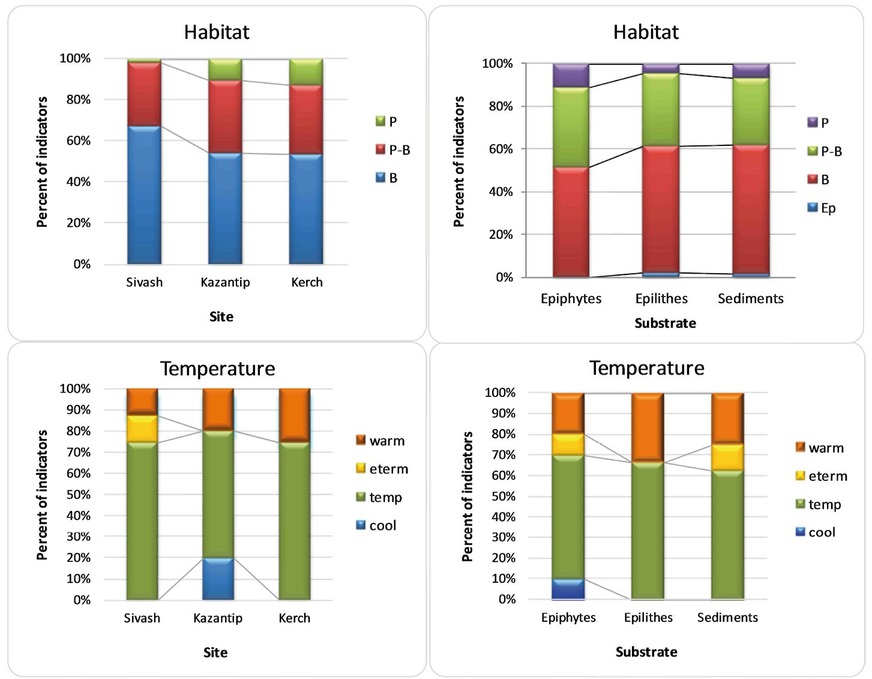
Figure 4
Percentage distribution of species indicators of natural habitat preferences and water temperature over different substrates and regions under study in the western coastal zone of the Sea of Azov. Abbreviations of the ecological groups are as in Table 1.
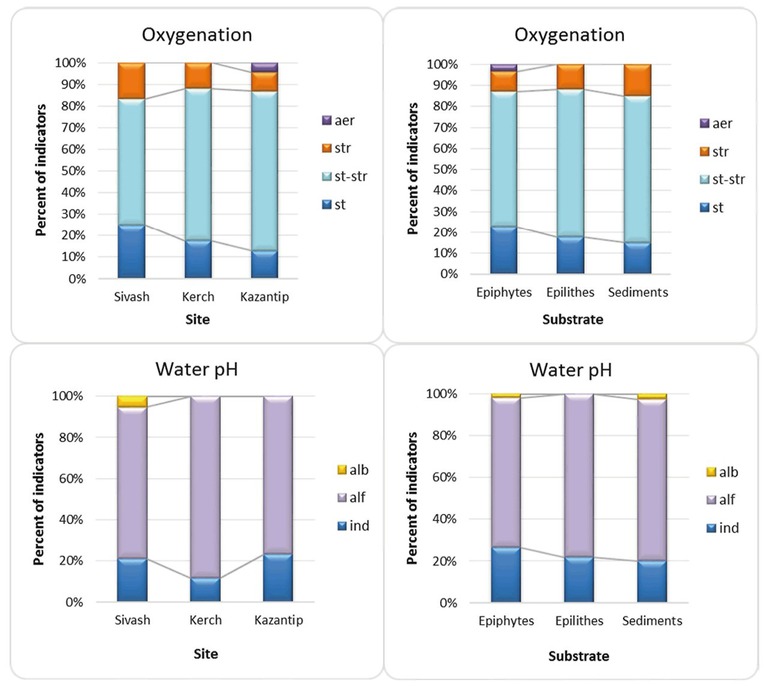
Figure 5
Percentage distribution of water oxygenation and pH indicators over different substrates and regions under study in the western coastal zone of the Sea of Azov. Abbreviations of the ecological groups are as in Table 1.
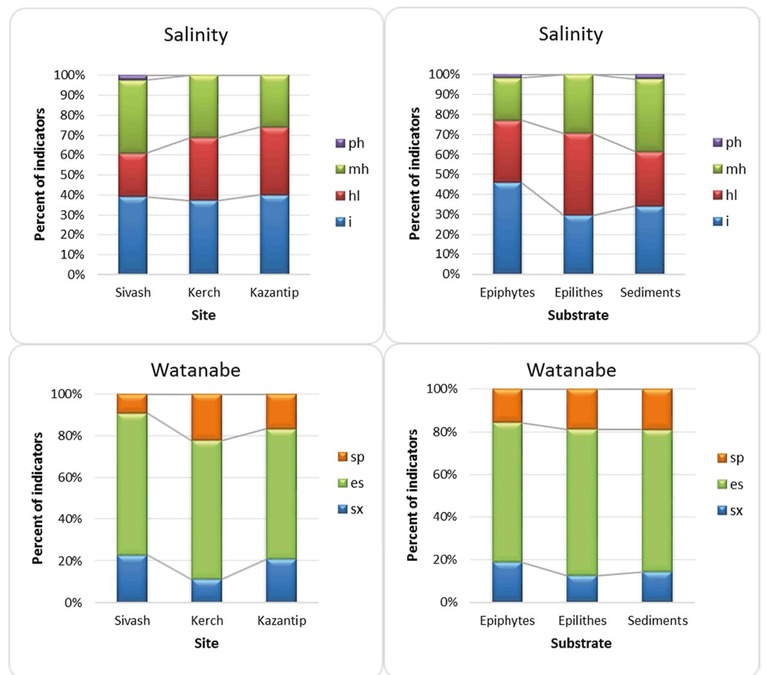
Figure 6
Percentage distribution of salinity and Watanabe organic pollution indicators over different substrates and regions under study in the western coastal zone of the Sea of Azov. Abbreviations of the ecological groups are as in Table 1.
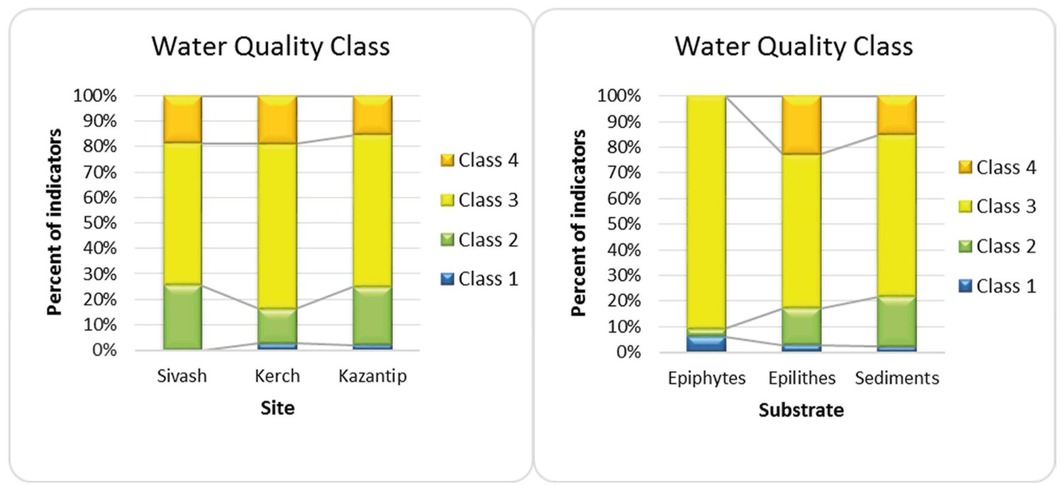
Figure 7
Percentage distribution of saprobity indicators related to the water quality classes over different substrates and regions under study in the western coastal zone of the Sea of Azov with EU color codes
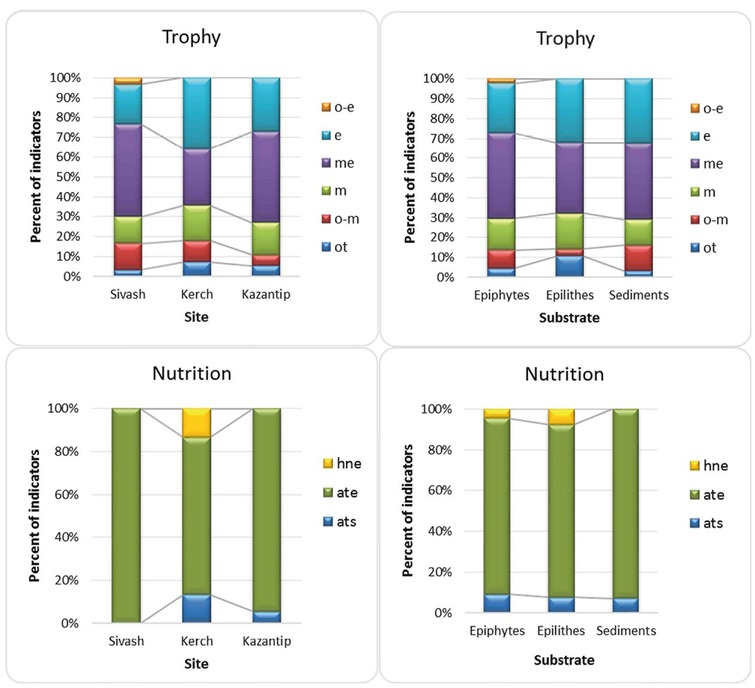
Figure 8
Percentage distribution of species indicators of the trophic state and the type of algae nutrition over different substrates and regions under study in the western coastal zone of the Sea of Azov. Abbreviations of the ecological groups are as in Table 1.
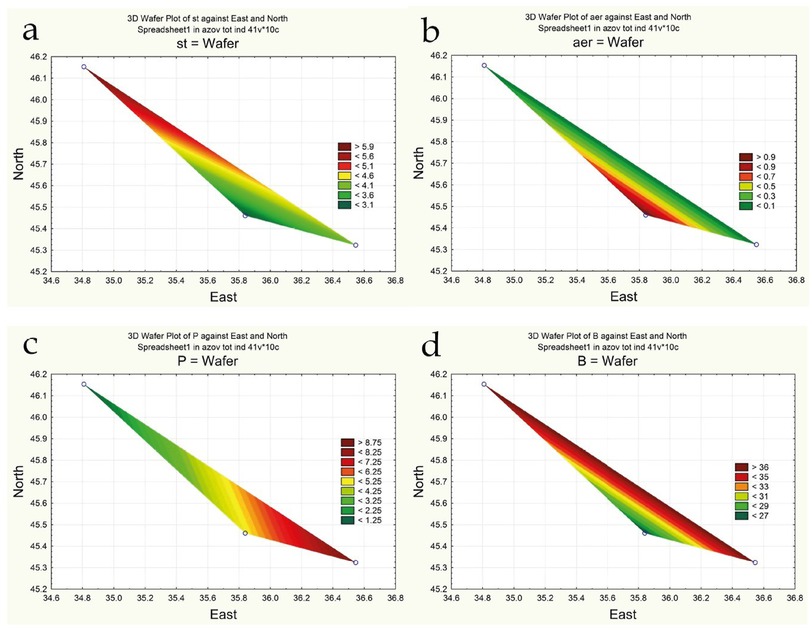
Figure 9
Statistically generated maps of water flow and oxygen saturation indicators (a – standing water inhabitants, b– aerophilic species) and substrate preferences (c– planktic, d– benthic species) in the western coastal zone of the Sea of Azov. Abbreviations of the ecological groups are as in Table 1.
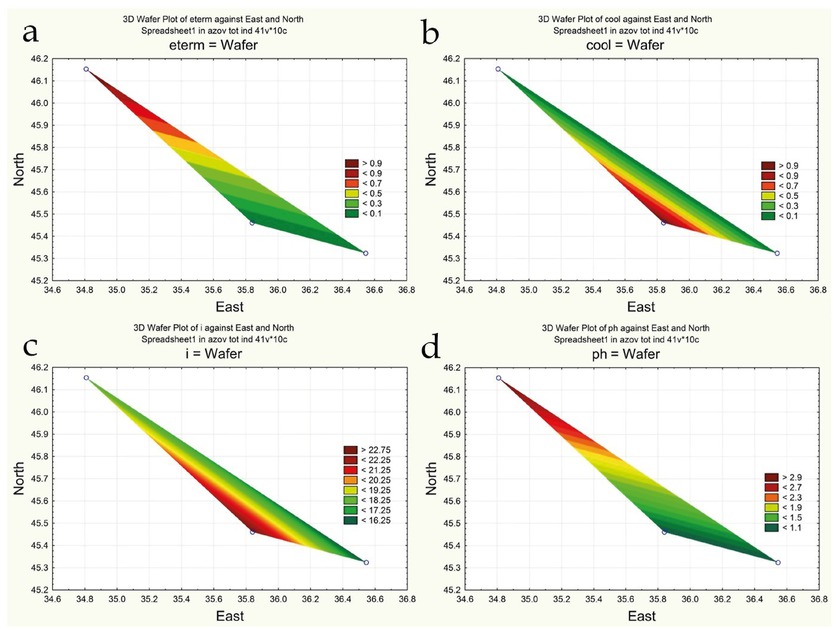
Figure 10
Statistically generated maps of water temperature indicators (a – eurythermic, b– cold water) and water pH indicators (c – indifferents, d – polyhalobes) in the western coastal zone of the Sea of Azov. Abbreviations of the ecological groups are as in Table 1.
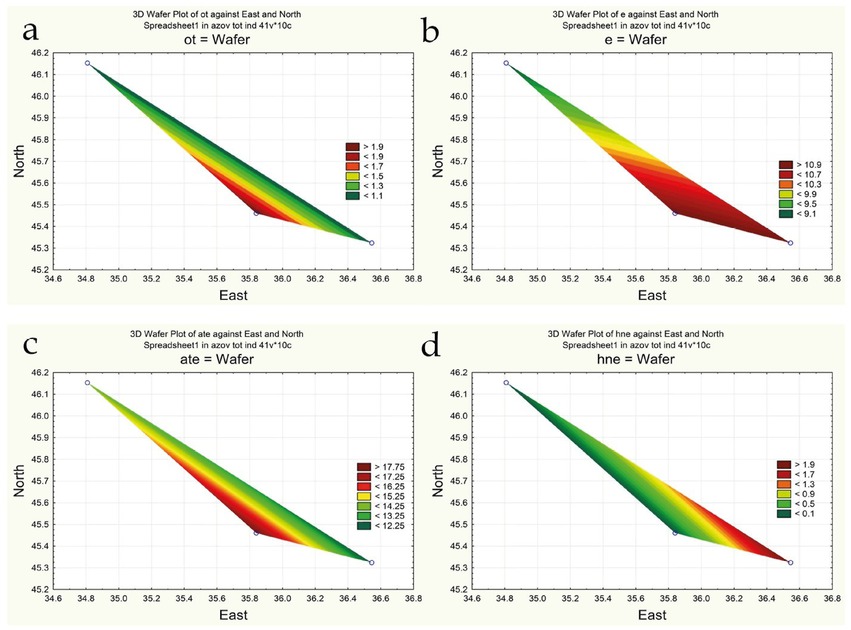
Figure 11
Statistically generated maps of organic trophic state indicators (a – oligotraphents, b– eutraphents) and indicators of algae nutrition types (c – autotrophs, d– heterotrophs) in the western coastal zone of the Sea of Azov. Abbreviations of the ecological groups are as in Table 1.
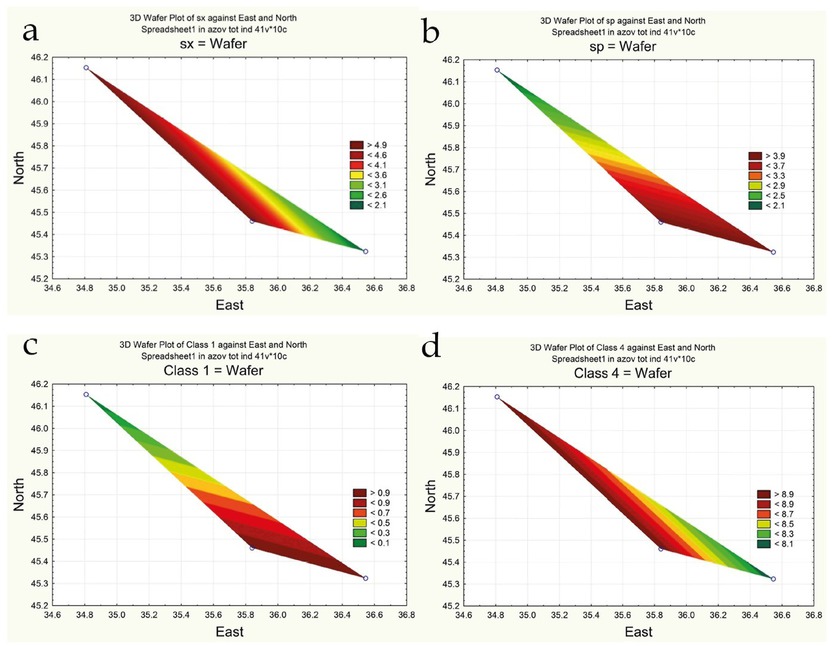
Figure 12
Statistically generated maps of organic pollution indicators: according to Watanabe (a – saproxenes, b– saprophiles), and according to Sládeček (c – Class 1, d– Class 4) in the western coastal zone of the Sea of Azov. Abbreviations of the ecological groups are as in Table 1.