
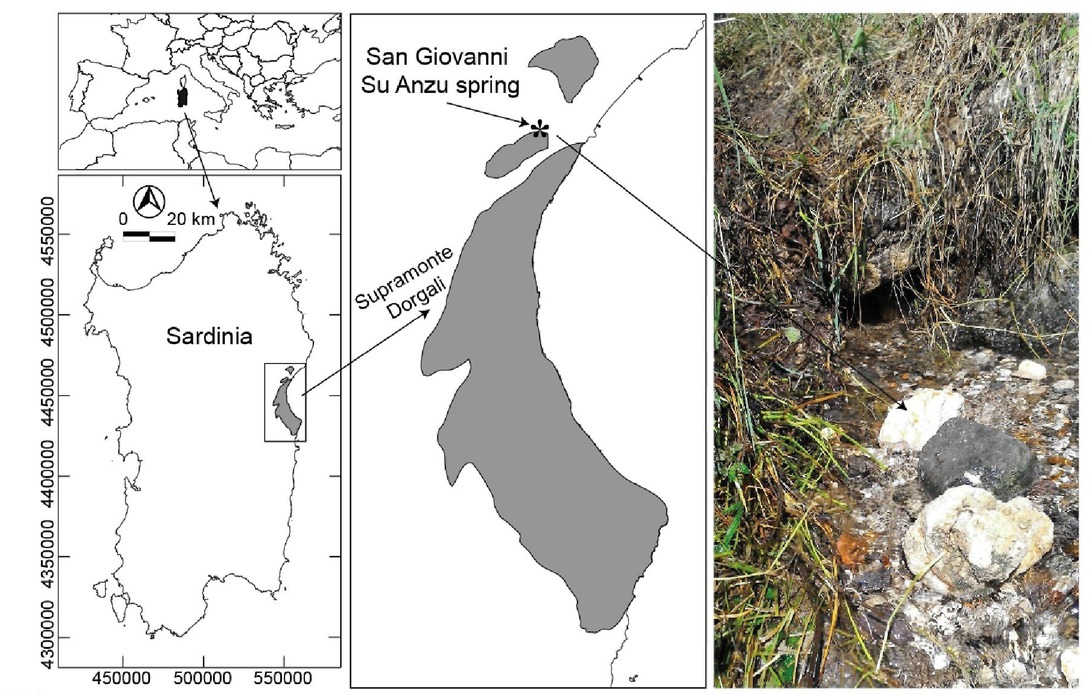
Figure 1
Geographic location and photo of the San Giovanni Su Anzu thermo-mineral spring (Sardinia, Italy)
Table 1
Main characteristics and the type locality of Navicula thermophila and Navicula tongatensis reported in the original descriptions of the species
| Navicula thermophila Manguin in Bourrelly & Manguin 1952 | Navicula tongatensis Hustedt 1962 | |
|---|---|---|
| Valve outline | elliptic | linear-elliptic |
| Ends | capitate | sub-capitate |
| Raphe | straight, filiform | |
| Striae | radiate, more spaced in the middle | slightly radiate, more spaced in the middle |
| Central area | sub-quadratic | |
| Length (μm) | 7.2–8.0 | 6.0–8.0 |
| Width (μm) | 2.5–3.0 | 2.5 |
| Striae/10 μm | 29–30 | 26–28 |
| Type locality | hot-salt spring | thermal well |
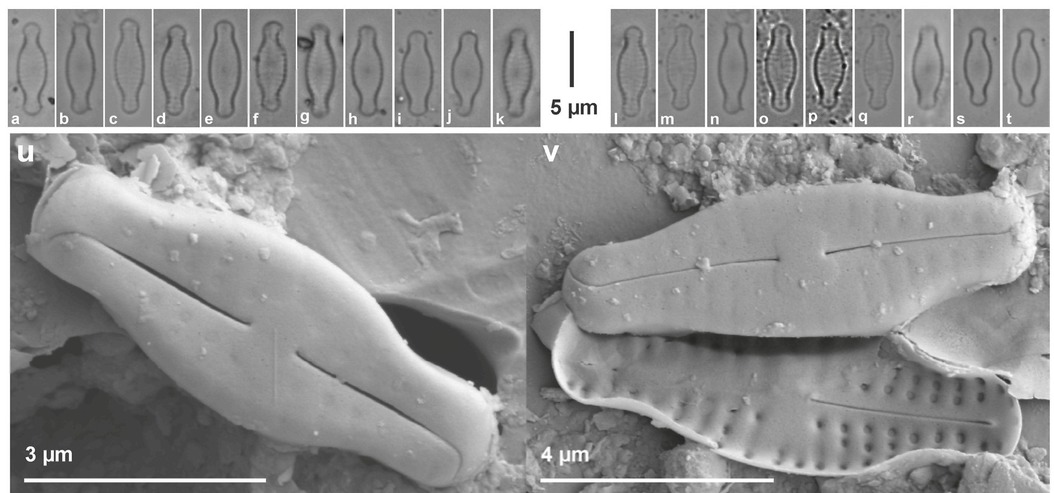
Figure 2(a–v)
Fig. 2(a–t). Light microscopy (LM). Chamaepinnularia thermophila from the San Giovanni Su Anzu spring. Fig. 2(u–v). Scanning electron microscopy (SEM). Chamaepinnularia thermophila from the San Giovanni Su Anzu spring. Fig. 2(u–v): external views. Valves showing the straight raphe, with distal ends bent toward the same side, the central silica nodule and striae slightly radiate. Fig. 2v: internal view. Valve showing three large areolae interrupted by the silica deposition along the apical plane
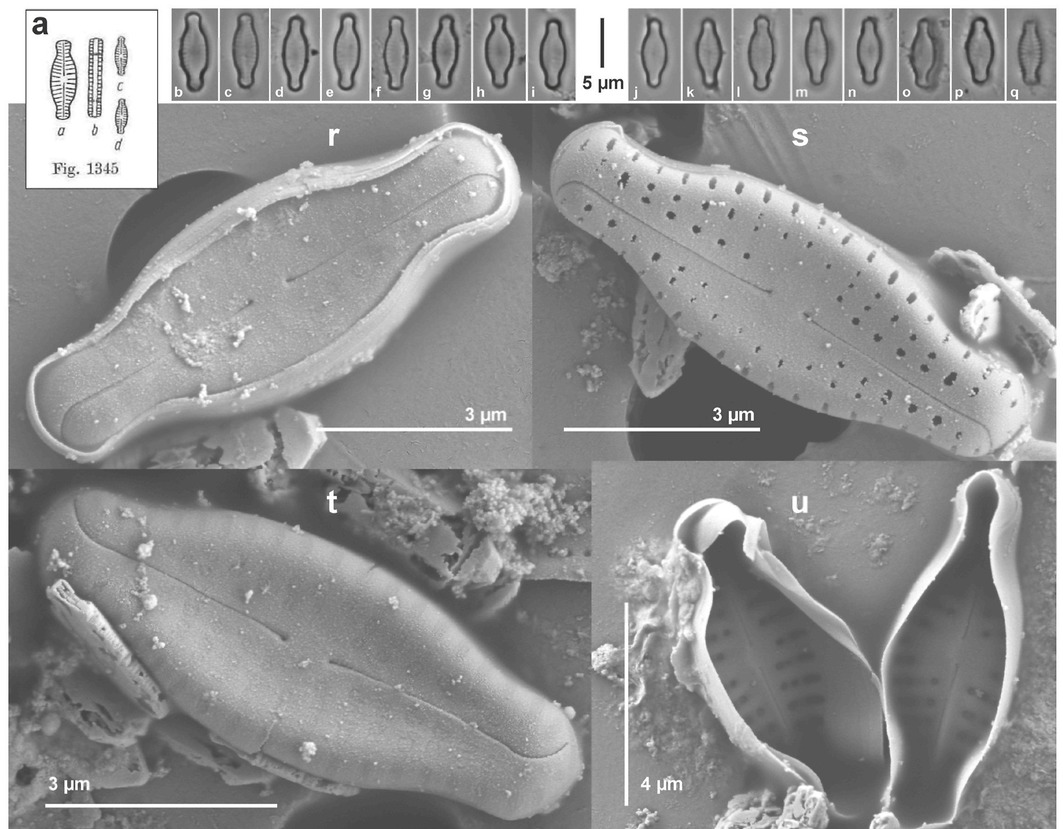
Figure 3(a–u)
Fig. 3a: Reproduction of the holotype material illustrated in Hustedt (1962) – Fig. 1345: a, b 2000/1, c, d 1000/1. Fig. 3(b–q): Light microscopy (LM). Navicula tongatensis Hustedt 1962 from his original material. Fig. 3(r–u): Scanning electron microscopy (SEM). Navicula tongatensis Hustedt 1962 from his original material. Fig. 3r: external view. Frustule showing unperforated girdle bands. Fig. 3(s–t): external views. Valves showing the radiate striae composed of three or four areolae and the straight raphe, with distal ends bent toward the same side. Fig. 3u: internal views. Valves showing the areolae interrupted by the silica deposition along the apical plane
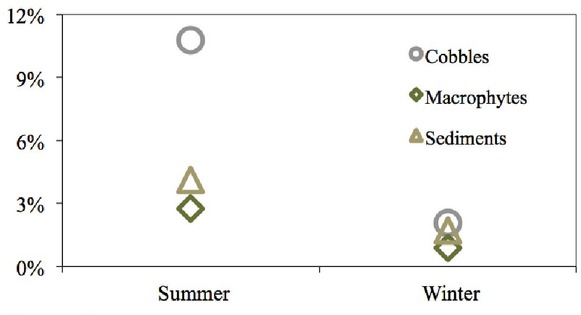
Figure 4
Seasonal abundance of Chamaepinnularia thermophila on the three investigated substrates from the San Giovanni Su Anzu spring (Sardinia, Italy)
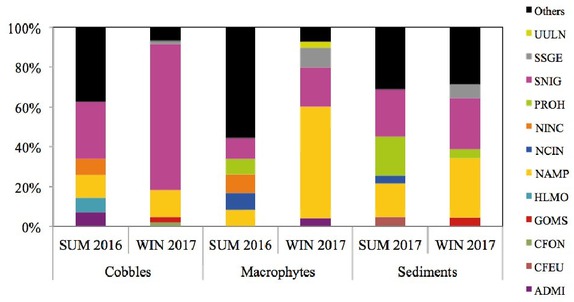
Figure 5
Species composition based on five most abundant taxa associated with Chamaepinnularia thermophila for each substrate and season. Acronyms of the species: ADMI = Achnanthidium minutissimum (Kützing) Czarnecki; CFEU = Cocconeis feuerbornii Hustedt; CFON = Caloneis fontinalis (Grunow) Cleve-Euler; GOMS = Gomphonema sp.; HLMO = Halamphora montana (Krasske) Levkov; NAMP = Nitzschia amphibia Grunow; NCIN = Navicula cincta (Ehrenberg) Ralfs; NINC = Nitzschia inconspicua Grunow; PROH = Planothidium rostratoholarcticum Lange-Bertalot & Bąk; SNIG = Sellaphora nigri (De Notaris) C.E.Wetzel & Ector; SSGE = Sellaphora saugerresii (Desmazières) C.E.Wetzel & D.G.Mann; UULN = Ulnaria ulna (Nitzsch) Compère
Table 2
Physical and chemical variables of the sites with Chamaepinnularia thermophila (including the new site of the San Giovanni Su Anzu spring in Sardinia, Italy), relative abundance of the species and occurrence on different substrates
| Variables | Units | Country | |||
|---|---|---|---|---|---|
| Guadalupe | Martinique | Sardinia | |||
| Spring sites | |||||
| Chute du Carbet | La Lise | Sucrerie | San Giovanni Su Anzu | ||
| Temperature | °C | 44.9 | 44.9 | 26.4 | 29.3–30 |
| Discharge | Is- 1 | 0.489–0.651 | |||
| Mean water depth | cm | 6–7.3 | |||
| pH | 6.51 | 7.33 | 7.92 | 7.26–7.30 | |
| Alkalinity | meq l-1 | 3.8–4.7 | |||
| Conductivity | μS cm-1 | 1558 | 570–590 | ||
| Dissolved Oxygen | 7.07 | 7.2–8.7 | |||
| Oxygen saturation | % saturation | 89.2 | 95–114 | ||
| BOD5 | mg O2 l-1 | 1.0–3.3 | |||
| Cl | 368 | 27.5 | 42.5–46.1 | ||
| Total hardness | mg CaCO3 l-1 | 235–235 | |||
| Reactive phosphorus | 16–24 | ||||
| Total phosphorus | μg P l-1 | 37–78 | |||
| N-NO2- | μg N l–1 | 4–6 | |||
| N-NO3 | 200 | 1140 | 2448–2932 | ||
| N-NH4 | 3–8 | ||||
| Total nitrogen | 3743–6244 | ||||
| Reactive silica | mg Si l–1 | 110 | 72 | 7.53–8.65 | |
| Suspended solids | mg l–1 | 0–1.8 | |||
| Br- | < D.L.0.4 | ||||
| Ca2+ | 188 | 13.4 | 44–44 | ||
| F | <D.L.–0.1 | ||||
| Fe2+ | 0.04–0.04 | ||||
| HCO3- | 125 | 132 | 254.4–274.5 | ||
| K+ | 24 | 3.89 | 1.7–2.2 | ||
| Mg2 + | 64.9 | 4.84 | 30.4–30.9 | ||
| Mn2 + | n.d. | 0.011 | 0.04–0.05 | ||
| Na+ | 116.2 | 41.9 | 26–27.3 | ||
| SO42 - | 303 | 5.69 | 8.0–9.8 | ||
| % C. thermophila | 10–50% | < 10% | 55 | 0.9–10.8 | |
| Substrate | cob | cob/mac/sed | |||
[i] ** D.L. = Detection Limit. Abbreviations: cob = cobbles; mac = macrophytes; sed = sediments. Source of information and data on the spring sites in the French Antilles (Guadalupe and Martinique): Brombach et al. 2000; ASCONIT Consultants 2015; Eulin-Garrigue et al. 2017
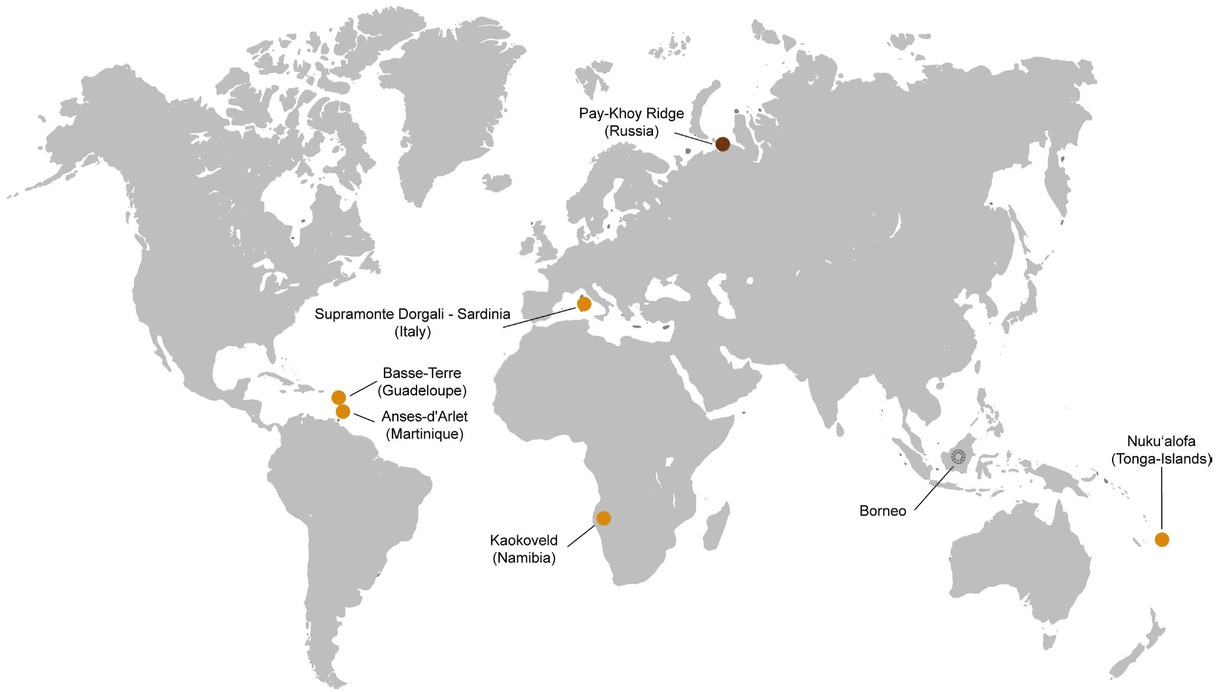
Figure 6
Map of Chamaepinnularia thermophila sites in various parts of the world. Brown circles: Quaternary sections; orange circles: thermal waters (springs and well); uncolored circles: unknown type