
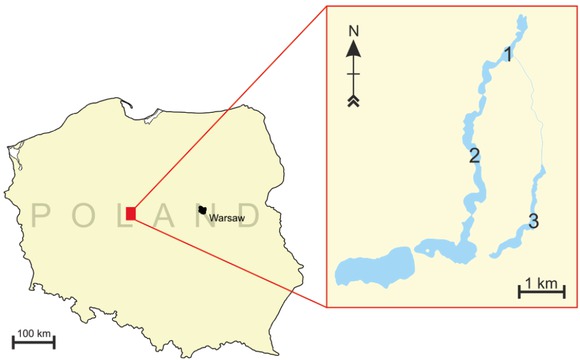
Figure 1
Study area (1 – Lake Ślesińskie, 2 – Lake Mikorzyńskie, 3 – Lake Licheńskie)
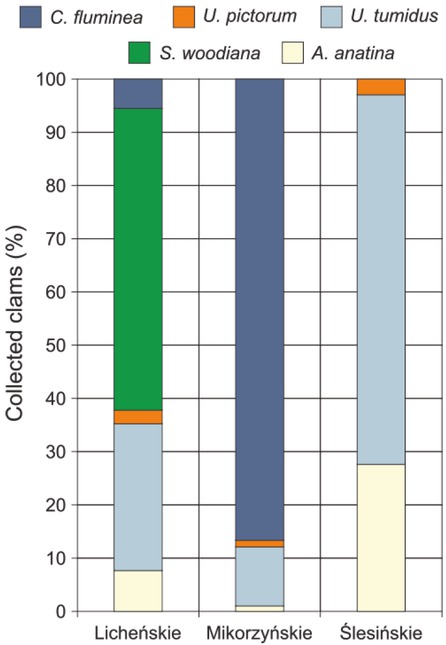
Figure 2
Species diversity of host bivalves from the thermally polluted lakes
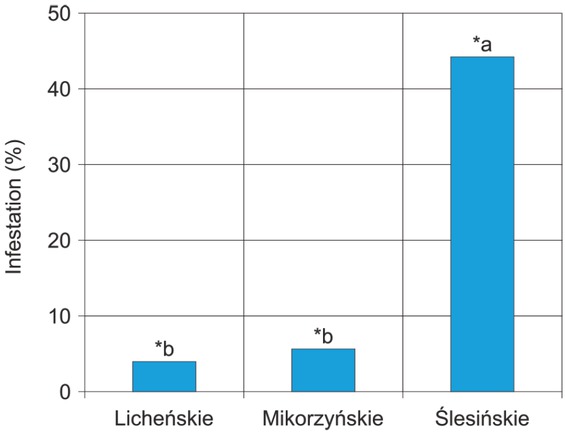
Figure 3
Infestation of various Bivalvia species by Dreissena polymorpha [* – statistical significant differences (Chi2, p < 0.05), a,b – “a” was significantly more often colonized by zebra mussels than “b” (SR)]
Table 1
Quantitative data on native and alien Bivalvia species and Dreissena polymorpha individuals covering their shells
| A. anatina | U. tumidus | U. pictorum | S. woodiana | C. fluminea | |
|---|---|---|---|---|---|
| Number of D. polymorpha individuals ± SD | 13.6 ± 13 | 6.2 ± 6.2 | 9.6 ± 7.5 | 3.2 ± 2.1 | 2.0 ± 0.0 |
| Wet weight of D. polymorpha colonies (g) ± SD | 4.8 ± 5.8 | 1.8 ± 2.2 | 2.5 ± 0.7 | 1.7 ± 1.3 | 1.2 ± 0.8 |
| Wet weight of inhabited mussels (g) ± SD | 38.2 ± 16.2 | 32.6 ± 13.7 | 23.3 ± 8.8 | 183.1 ± 80.2 | 11.3 ± 0.1 |
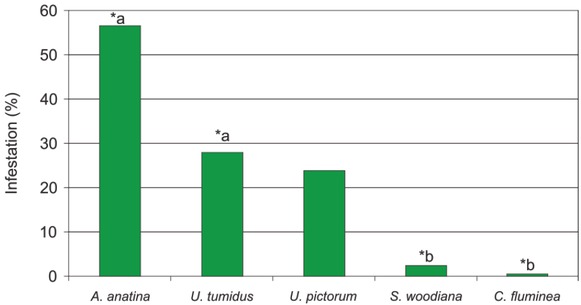
Figure 4
Infestation by Dreissena polymorpha in the thermally polluted lakes [* – statistical significant differences (Chi2, p <0.05), a,b – “a” was significantly more often colonized by zebra mussels than “b” (SR)]