
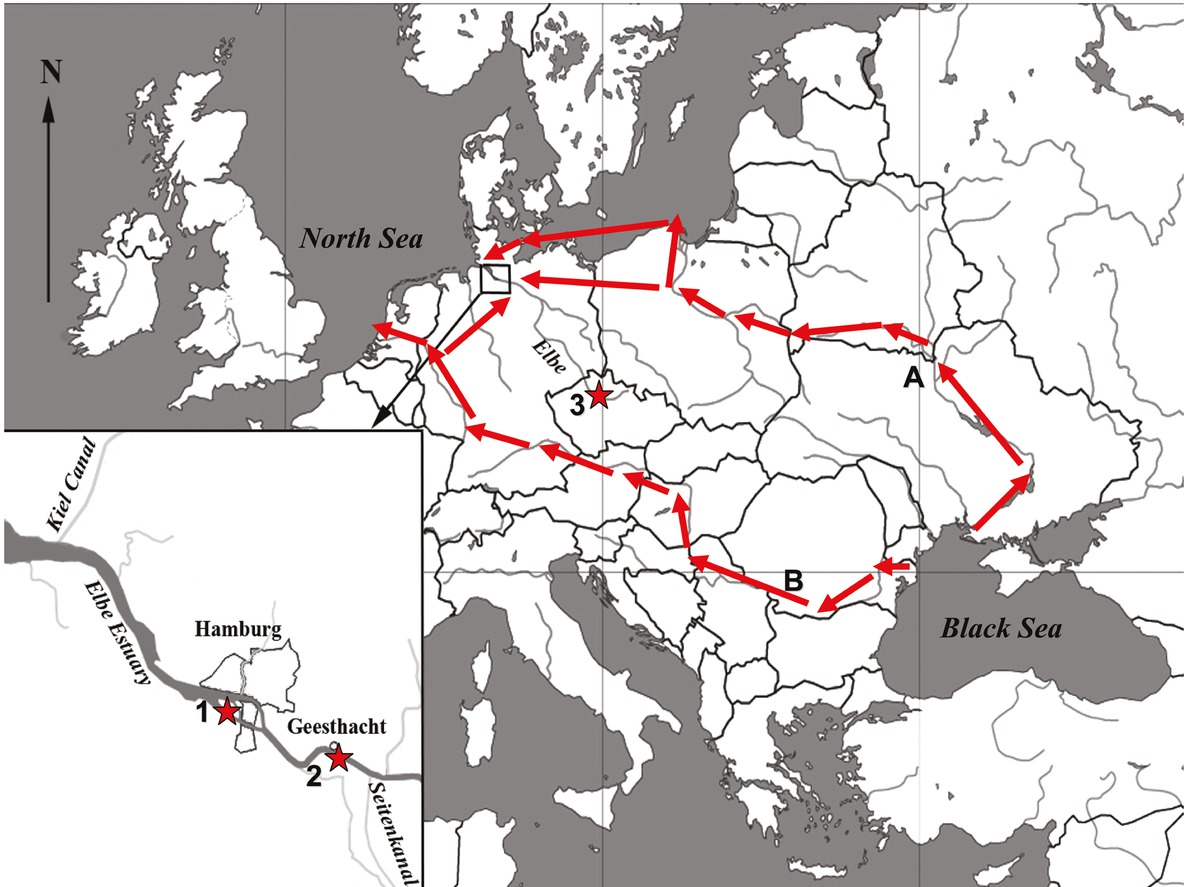
Figure 1
Map of the sampling area in the Elbe River with the Aquatic Invasion corridors: A – Central Corridor, B – Southern Corridor. Sampling localities are marked by stars: 1 – the Süderelbe, 2 – Geesthacht, 3 – Ústí nad Labem
Table 1
The number of fish examined (n) with mean standard (SL, mm) and total (TL, mm) length (means and standard deviation)
| Süderelbe | Geesthacht | Ústi nad Labem | |
|---|---|---|---|
| n | 23 | 20 | 53 |
| SL | 70.8 ± 9.4 | 101.0 ± 8.3 | 69.7 ± 6.5 |
| TL | 84.2 ± 10.3 | 118.1 ± 9.1 | 82.5 ± 7.6 |
Table 2
Parasite community of round goby (Neogobius melanostomus) from the Elbe River, showing prevalence (P, %), mean intensity (MI±SD), intensity range (min.–max) and mean abundance (A)
| Parasite species | Site | Süderelbe | Geesthacht | Ústi nad Labem* | ||||||
|---|---|---|---|---|---|---|---|---|---|---|
| P | MI ± SD (min.–max) | A | P | MI ± SD (min.–max) | A | P | MI ± SD (min.–max) | A | ||
| Microsporidia | ||||||||||
| Microsporidium sp. | mesentery | 13.0 | 4.3 ± 1.5 (3–6) | 0.6 | 20.0 | 3.5 ± 2.1 (1–6) | 0.7 | |||
| Oligohymenophorea | ||||||||||
| Trichodina spp. | gills | 4.3 | 10.0 | 0.4 | 10.0 | 50.5 ± 70.0 (1-100) | 5.1 | 1.9 | 1.0 | 0.02 |
| Ichthyophthirius multi filiis Fouquet, 1876 | gills | 4.3 | 1.0 | 0.04 | 1.9 | 1.0 | 0.02 | |||
| Myxozoa | ||||||||||
| Myxosporea cl. spp. | gills | 4.3 | 1.0 | 0.04 | ||||||
| Digenea | ||||||||||
| Diplostomum spp. metacercariae | eye | 5.0 | 1.0 | 0.1 | 11.3 | 1.7 ± 1.0 (1–3) | 0.2 | |||
| Acanthocephala | ||||||||||
| Acanthocephalus lucii (Müller, 1776) | intesti ne | 5.0 | 1.0 | 0.1 | ||||||
| Acanthocephalus rhinensis Amin et al., 2008 | intesti ne | 5.0 | 1.0 | 0.1 | ||||||
| Pomphorhynchus laevis (Zoega, 1776) cystacanths | mesentery | 20.0 | 1.0 ± 0.0 | 0.2 | 96.2 | 21.5 ± 21.6 (1–82) | 20.7 | |||
| Nematoda | ||||||||||
| Anguillicola crassus (Kuwahara et al., 1974) larvae | mesentery gut walls | 56.5 | 3.6 ± 2.9 (1–10) | 2.0 | 3.8 | 1.0 ± 0.0 (1) | 0.04 | |||
| Raphidascaris acus (Bloch, 1779) larvae | mesentery liver | 43.5 | 1.5 ± 0.5 (1–2) | 0.7 | 15.0 | 1.3 ± 0.6 (1–2) | 0.2 | |||
| Contracaecum rudolphii Hartwich, 1964 larvae | mesentery | 1.9 | 1.0 | 0.02 | ||||||
| Arachnida | ||||||||||
| Hydrachna sp. nymph | gills | 5.0 | 1.0 | 0.1 | ||||||
| Bivalvia | ||||||||||
| Anodonta sp. glochidia | 23.3 | 1.4 ± 0.8 (1–3) | 0.3 | |||||||
| Unio sp. glochidia | gills | 30.0 | 3.0 ± 0.9 (2–4) | 0.9 | ||||||
[i] * Kvach et al. (2017)
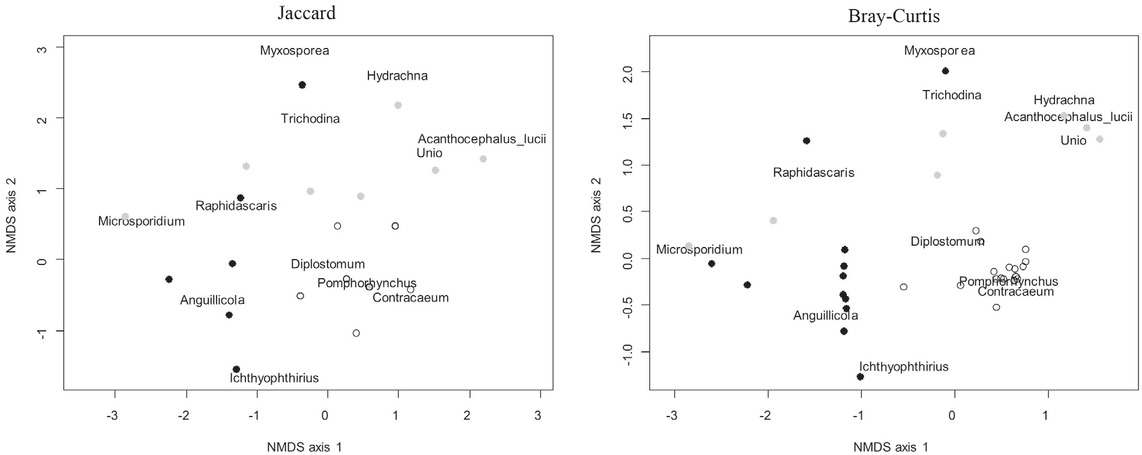
Figure 2
Non-metric multidimensional scaling (NMDS) based on Jaccard and Bray-Curtis dissimilarities in parasite communities found in round goby (Neogobius melanostomus) from the Süderelbe (black points), Geesthacht (gray points) and Ústí nad Labem (open points). Fish with parasite assemblages too distant from all other fish are not presented (i.e. fish with no parasites or with only one specimen not present in any other fish)
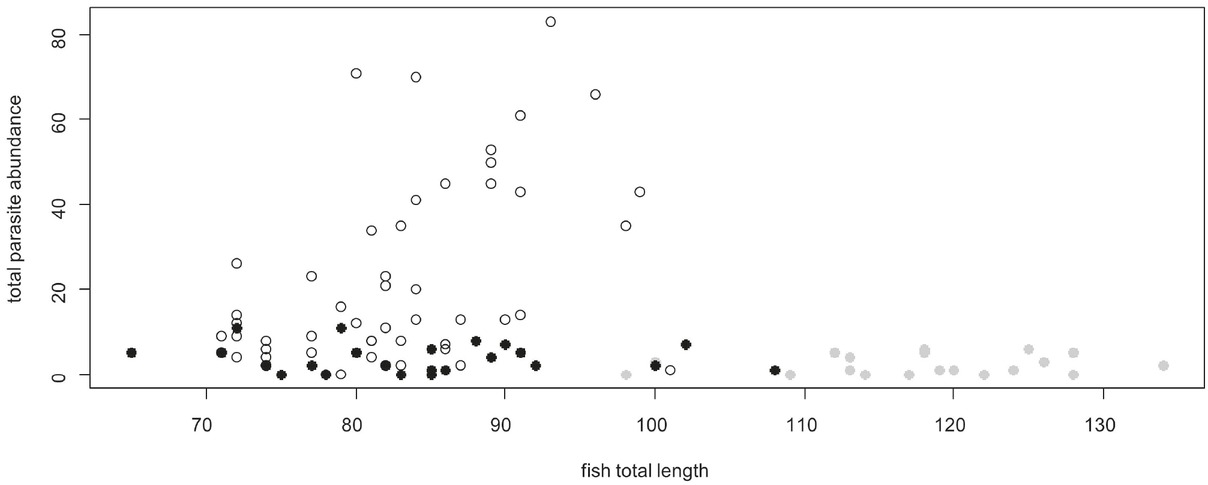
Figure 3
Total parasite abundance in round goby from the Süderelbe (black points), Geesthacht (gray points) and Ústí nad Labem (open points) in relation to fish size