
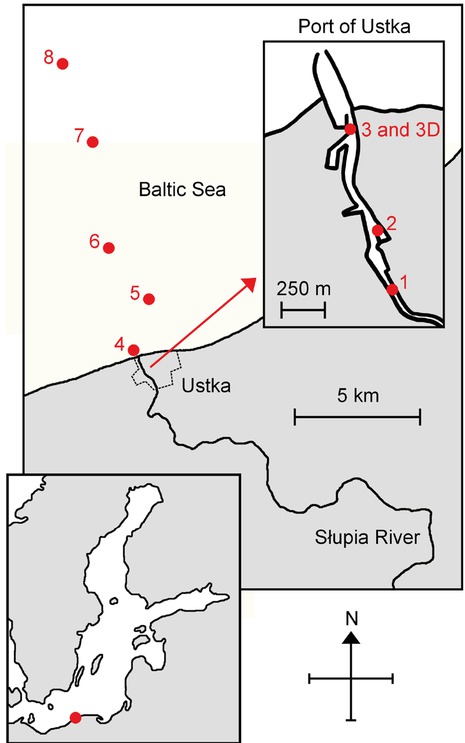
Figure 1
Location of sampling sites near the town of Ustka. Samples were collected on 18 July 2014 from the Słupia River (sample 1), the port of Ustka (samples 2, 3, and 3D) and from Baltic Sea waters (samples 4–8). Samples 1–8 were collected from the surface zone. Sample 3D was collected from the near-bottom zone.
Table 1
Parameters measured in two water masses separated along the transect between the Słupia River mouth and offshore waters. Less saline water was observed in the river mouth and in the surface layer in the port (samples 1–3), whereas more saline water was observed in the near-bottom zone in the port (sample 3D) and outside the port (samples 4–8). Obviously, Secchi depth was not determined at near-bottom sampling site 3D. Statistically significant differences between the two separate water masses were demonstrated for each parameter.
| Parameter | Samples 1–3 | Samples 3D, 4–8 | Statistical significance according to Mann-Whitney U test |
|---|---|---|---|
| Salinity (PSU) | 0.21–0.87 | 6.61–7.80 | p = 0.03 |
| Secchi depth (m) | 2.5–3.0 | 5.0–7.5 | p = 0.03 |
| Bacterial abundance (106 ml−1) | 5.51–6.16 | 0.99–2.14 | p = 0.03 |
| Ciliate abundance (cells ml−1) | 0.34–0.90 | 2.65–5.40 | p = 0.03 |
| Ciliate biomass (ng C ml−1) | 0.27–0.75 | 1.46–4.40 | p = 0.03 |
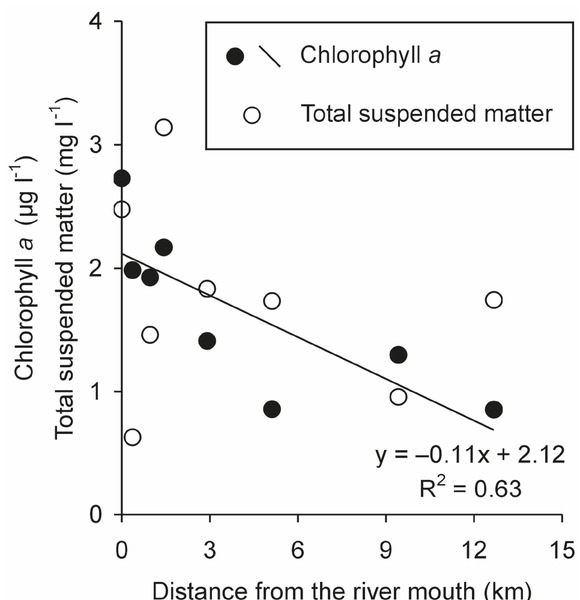
Figure 2
Changes in chlorophyll a (black dots) and total suspended matter (circles) concentrations in surface waters (excluding sample 3D) along the transect between the Słupia River mouth and offshore waters. The correlation between the distance and chlorophyll a is statistically significant (trend line, R2 = 0.63, p = 0.02). The highest concentration of total suspended matter was encountered close to the entrance to the port of Ustka (station 4, 1.43 km from the river mouth, value 3.14 mg l−1; Fig. 1).
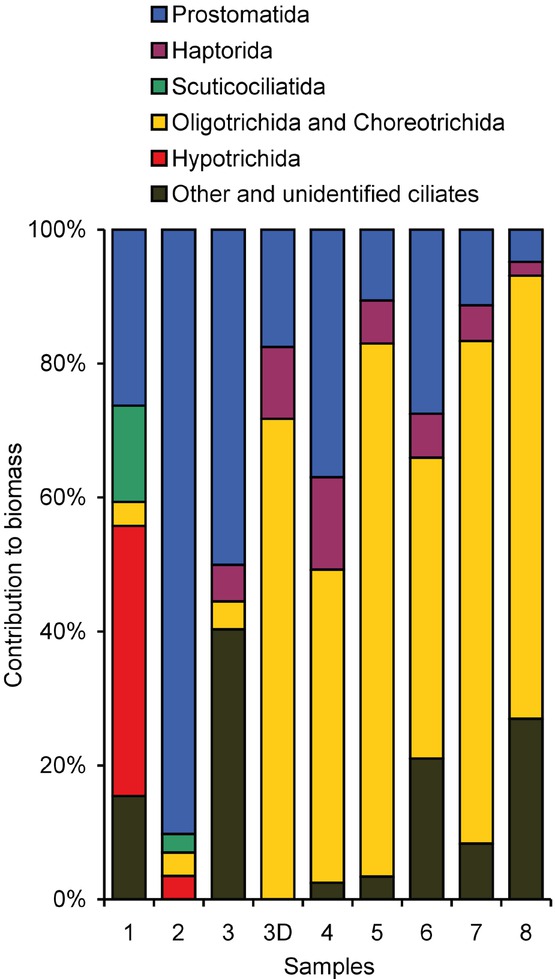
Figure 3
Taxonomic composition of ciliate communities observed along the transect between the Słupia River mouth and offshore waters. Samples 1–8 were collected from surface waters and sample 3D was collected from the near-bottom zone at sampling site 3. The main difference between less saline waters (samples 1–3) and more saline waters (samples 3D and 4–8) was the occurrence of ciliates from the orders Oligotrichida and Choreotrichida, which constituted 3–4% of the ciliate biomass in less saline waters and 45–80% of its biomass in more saline waters. The difference is statistically significant (U test, p = 0.03).
Abundance, biomass and composition of ciliate communities studied on 18 July 2014
| Group | Abundance (cells ml−1) | Biomass (ng C ml−1) | Composition |
|---|---|---|---|
| Sample 1 – the Słupia River mouth | |||
| Prostomatida | 0.24 | 0.07 | Urotricha sp., Prorodon sp. |
| Scuticociliatida | 0.24 | 0.04 | Cyclidium glaucoma |
| Oligotrichida and Choreotrichida | 0.06 | 0.01 | Rimostrombidium sp. |
| Hypotrichida | 0.18 | 0.11 | Unidentified |
| Other and unidentified ciliates | 0.18 | 0.04 | Hymenostomatid ciliates, unidentified |
| Total | 0.90 | 0.27 | |
| Sample 2 – surface waters in the Port of Ustka | |||
| Prostomatida | 0.33 | 0.32 | Urotricha spp., Prorodon sp., Holophrya sp. |
| Scuticociliatitida | 0.03 | 0.01 | Cyclidium sp. |
| Oligotrichida and Choreotrichida | 0.07 | 0.01 | Rimostrombidium sp. |
| Hypotrichida | 0.03 | 0.01 | Unidentified |
| Total | 0.47 | 0.35 | |
| Sample 3 – surface waters in the Port of Ustka | |||
| Prostomatida | 0.14 | 0.37 | Urotricha sp., Holophrya spp. |
| Haptorida | 0.05 | 0.04 | Askenasia sp., Mesodinium sp. (heterotrophic) |
| Oligotrichida and Choreotrichida | 0.05 | 0.03 | Rimostrombidium sp. |
| Unidentified | 0.10 | 0.30 | Unidentified |
| Total | 0.34 | 0.75 | |
| Sample 3D – near-bott om waters in the Port of Ustka | |||
| Prostomatida | 2.60 | 0.52 | Balanion comatum, Urotricha sp. |
| Haptorida | 0.70 | 0.32 | Mesodinium rubrum, Askenasia sp., Mesodinium sp. (heterotrophic) |
| Oligotrichida and Choreotrichida | 1.10 | 2.14 | Rimostrombidium sphaericum, Strombidium spp. |
| Total | 4.40 | 2.98 | |
| Sample 4 – surface waters outside the port of Ustka | |||
| Prostomatida | 3.30 | 0.54 | Balanion comatum, Urotricha spp., Holophrya sp. |
| Haptorida | 0.80 | 0.20 | Mesodinium rubrum, Mesodinium sp. (heterotrophic), Askenasia sp. |
| Oligotrichida and Choreotrichida | 1.10 | 0.68 | Rimostrombidium sphaericum, Strombidium spp., Strobilidium sp. |
| Unidentified | 0.20 | 0.04 | Unidentified |
| Total | 5.40 | 1.46 | |
| Sample 5 – surface of shore waters | |||
| Prostomatida | 1.84 | 0.35 | Balanion comatum, Urotricha sp. |
| Haptorida | 0.32 | 0.22 | Mesodinium rubrum/major, Mesodinium sp. (heterotrophic), Askenasia sp. |
| Oligotrichida and Choreotrichida | 1.28 | 2.67 | Rimostrombidium sphaericum, Pelagostrobilidium spirale, Strombidium sp. |
| Unidentified | 0.56 | 0.11 | Unidentified |
| Total | 4.00 | 3.35 | |
| Sample 6 – surface of shore waters | |||
| Prostomatida | 2.64 | 0.57 | Balanion comatum, Urotricha sp. |
| Haptorida | 0.40 | 0.14 | Mesodinium rubrum, Askenasia sp. |
| Oligotrichida and Choreotrichida | 0.88 | 0.93 | Rimostrombidium sphaericum, Strombidium spp., Lohmanniella oviformis |
| Peritrichida | 0.24 | 0.35 | Vaginicola sp. |
| Unidentified | 0.56 | 0.08 | Unidentified |
| Total | 4.72 | 2.06 | |
| Sample 7 – surface offshore waters | |||
| Prostomatida | 2.12 | 0.37 | Balanion comatum, Urotricha sp. |
| Haptorida | 0.52 | 0.18 | Mesodinium sp. (heterotrophic), Mesodinium rubrum/major, Askenasia sp. |
| Oligotrichida and Choreotrichida | 1.00 | 2.45 | Rimostrombidium sphaericum, Pelagostrobilidium spirale, Strombidium spp., others |
| Peritrichida | 0.12 | 0.18 | Vaginicola sp. |
| Unidentified | 0.56 | 0.09 | Unidentified |
| Total | 4.32 | 3.27 | |
| Sample 8 – surface of shore waters | |||
| Prostomatida | 0.88 | 0.21 | Urotricha sp., Balanion comatum, Holophrya sp. |
| Haptorida | 0.19 | 0.09 | Mesodinium rubrum |
| Oligotrichida and Choreotrichida | 1.45 | 2.91 | Rimostrombidium sphaericum, Tinti nnopsis sp., Lohmanniella oviformis |
| Peritrichida | 0.06 | 1.17 | Vorti cella sp. |
| Unidentified | 0.06 | 0.02 | Unidentified |
| Total | 2.65 | 4.40 | |