
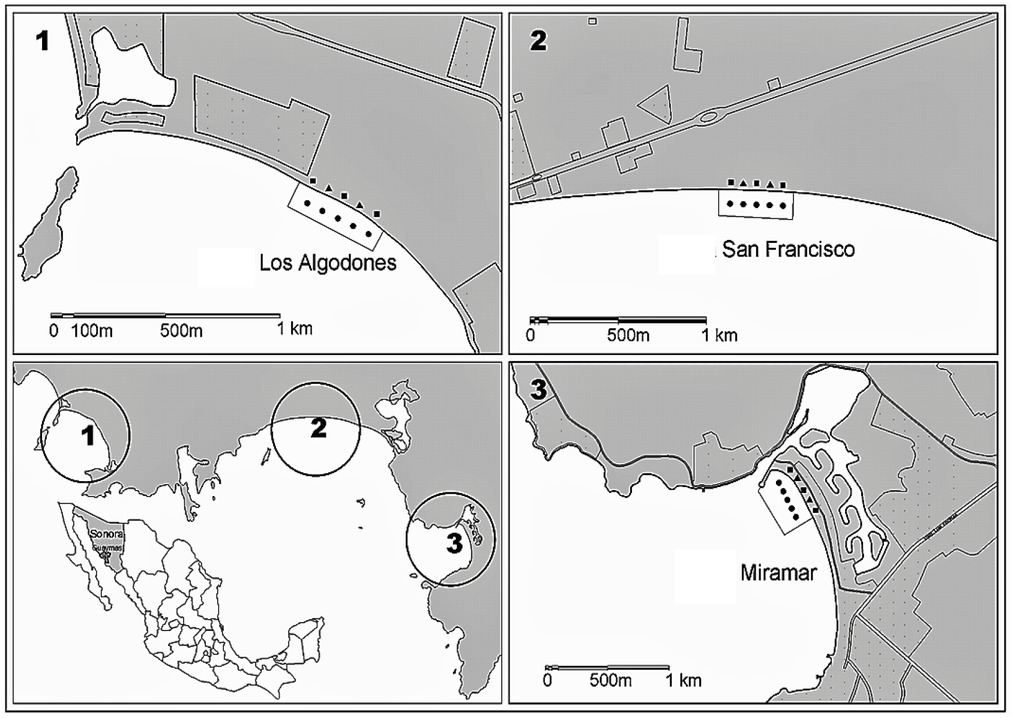
Figure 1
Location of the studied beaches (Los Algodones, San Francisco and Miramar) and sampling sites (dots) at each of them
Table 1
Summary of the main features and environmental characteristics of the studied beaches
| Feature | Beaches | ||
|---|---|---|---|
| Los Algodones | San Francisco | Miramar | |
| Type of site | Bay | Open beach | Bay |
| Beach length used | ~1.8 km | ~1.5 km | ~1 km |
| Beach area used | ~9000 m2 | ~7500 m2 | ~5000 m2 |
| Coast type | Micromareal (tidal range < 1 m) | Micromareal (tidal range < 1 m) | Micromareal (tidal range < 1 m) |
| Wave height | < 1 m | < 1 m | <1 m |
| Surrounding land | Shrubs Sand dunes | Shrubs Sand dunes | Mangrove forest Urban development |
| Residential | Residential | Residential | |
| Human activity | Hotel | Trails | Hotel |
| Trails | Streets | ||
| Commerce | Commerce | ||
| Domestic animals | Domestic animals | Domestic animals | |
| Animals | Sea birds | Sea birds | Sea birds |
| Horses | |||
| Summertime: Southeast | Summertime: Southeast | Summertime: Southeast | |
| Prevailing winds | Wintertime: Northwest | Wintertime: Northwest | Wintertime: Northwest |
| Summertime: Southeast | Summertime: Southeast | Summertime: Southeast | |
| Prevailing coastal currents | Wintertime: Northwest | Wintertime: Northwest | Wintertime: Northwest |
| < 300 mm yr−1 | < 300 mm yr−1 | < 300 mm yr−1 | |
| Annual rainfall and seasonal distribution | Mostly summertime | Mostly summertime | Mostly summertime |
| Sewage discharges identified | No | No | Yes |
| Stormwater mixed with wastewater | Likely influence | Likely influence | Yes |
| Ships | Occasional | Occasional | Occasional |
Table 2
Water quality criteria for primary contact recreational use established by the World Health Organization
| 95th percentile value of intestinal enterococci/100 ml (rounded values) | Estimated risk per exposure |
|---|---|
| 0–40 | < 1% GI disease risk/< 0.3 AFRI risk |
| 41–200 | 1–5% GI disease risk/0.3–1.9% AFRI risk |
| 201–500 | 5–10% GI disease risk/1.9–3.9% AFRI risk |
| > 500 | > 10% GI disease risk/> 3.9% AFRI risk |
| GI: Gastrointestinal, AFRI: Acute febrile respiratory illness | |
Table 3
Water environmental variables recorded at the three studied beaches: Los Algodones, San Francisco, and Miramar
| Los Algodones | San Francisco | Miramar | |||||||
|---|---|---|---|---|---|---|---|---|---|
| Min.–Max | Average | SD | Min.–Max | Average | SD | Min.–Max | Average | SD | |
| Temperature (°C) | 17.6–31.5 | 21.50 | 4.74 | 18.3–31.5 | 21.81 | 4.23 | 17.2–30.4 | 21.53 | 4.41 |
| Salinity (PSU) | 30.3–36.8 | 35.08 | 1.93 | 29.7–36.8 | 34.97 | 1.84 | 30.4–36.9 | 35.13 | 1.89 |
| Dissolved oxygen (mgl−1) | 3.2–7.5 | 6.19 | 1.38 | 3.4–7.7 | 6.26 | 1.26 | 5.8–8.1 | 7.04 | 0.71 |
| pH | 7.8–8.6 | 8.28 | 0.25 | 7.8–8.7 | 8.32 | 0.30 | 7.4–8.7 | 8.31 | 0.33 |
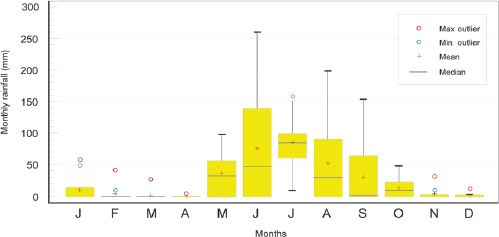
Figure 2
Mean monthly rainfall (2004–2014) in the area where the studied beaches (Los Algodones, San Francisco and Miramar) are located
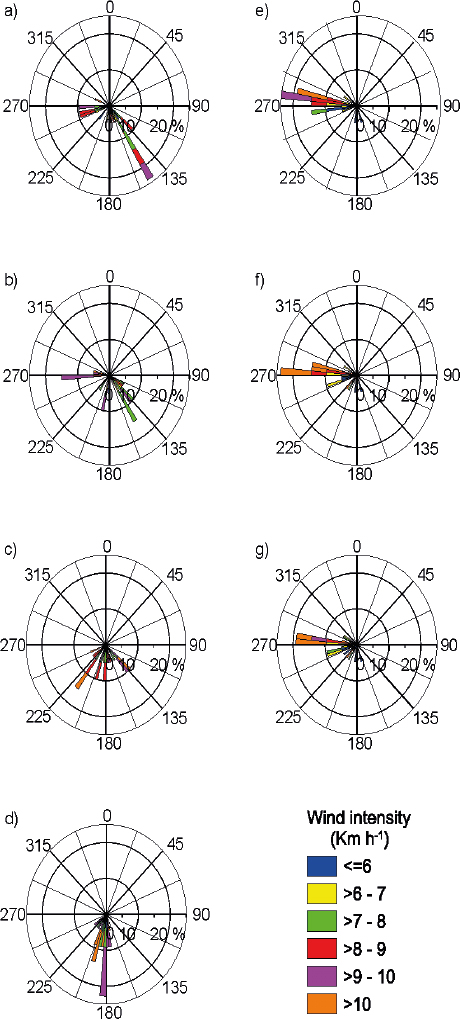
Figure 3
Wind direction and speed during 20 days prior to the sampling campaigns: a) March 16–April 6, b) 1–21 April, c) April 26–May 17, d) May 22–June 14, e) 9–30 January, f) January 15–February 5, g) January 22–February 12
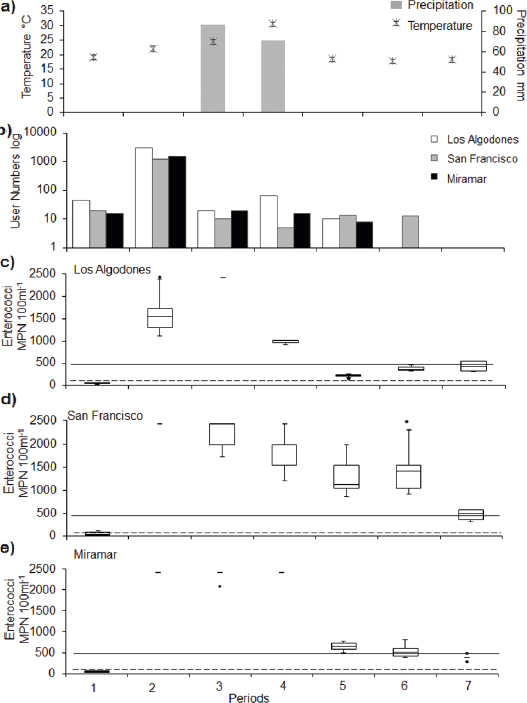
Figure 4
a) Rainfall during the three weeks prior to each sampling campaign and sea surface temperature at the time of sampling, b) Influx of users at the time of sampling, c–e) Concentration of enterococci in water: before (1), during (2), after the Easter Week (3 and 4), and in the wintertime (5, 6 and 7) at the three studied beaches: c) Los Algodones, d) San Francisco, and e) Miramar. The dotted line indicates the maximum concentration of enterococci (100 MPN 100 ml−1) allowed for the sustainability of beaches in Mexico (SE 2016). The continuous line indicates the reference value for public health risks by the World Health Organization (WHO 2003).
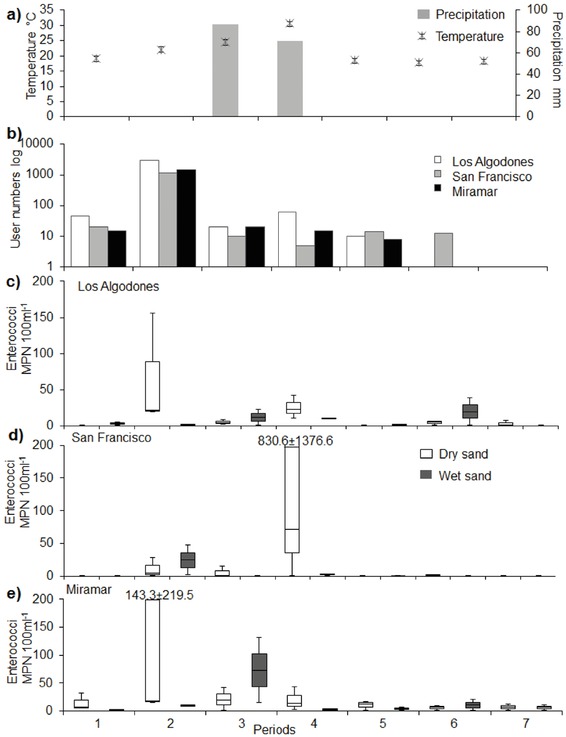
Figure 5
a) Rainfall during the three weeks prior to each sampling campaign and sea surface temperature at the time of sampling, b) Influx of users at the time of sampling, c–e) Concentration of enterococci in dry and wet sand: before (1), during (2), after the Easter Week (3 and 4), and in the wintertime (5, 6 and 7) at the three studied beaches: c) Los Algodones, d) San Francisco, and e) Miramar