
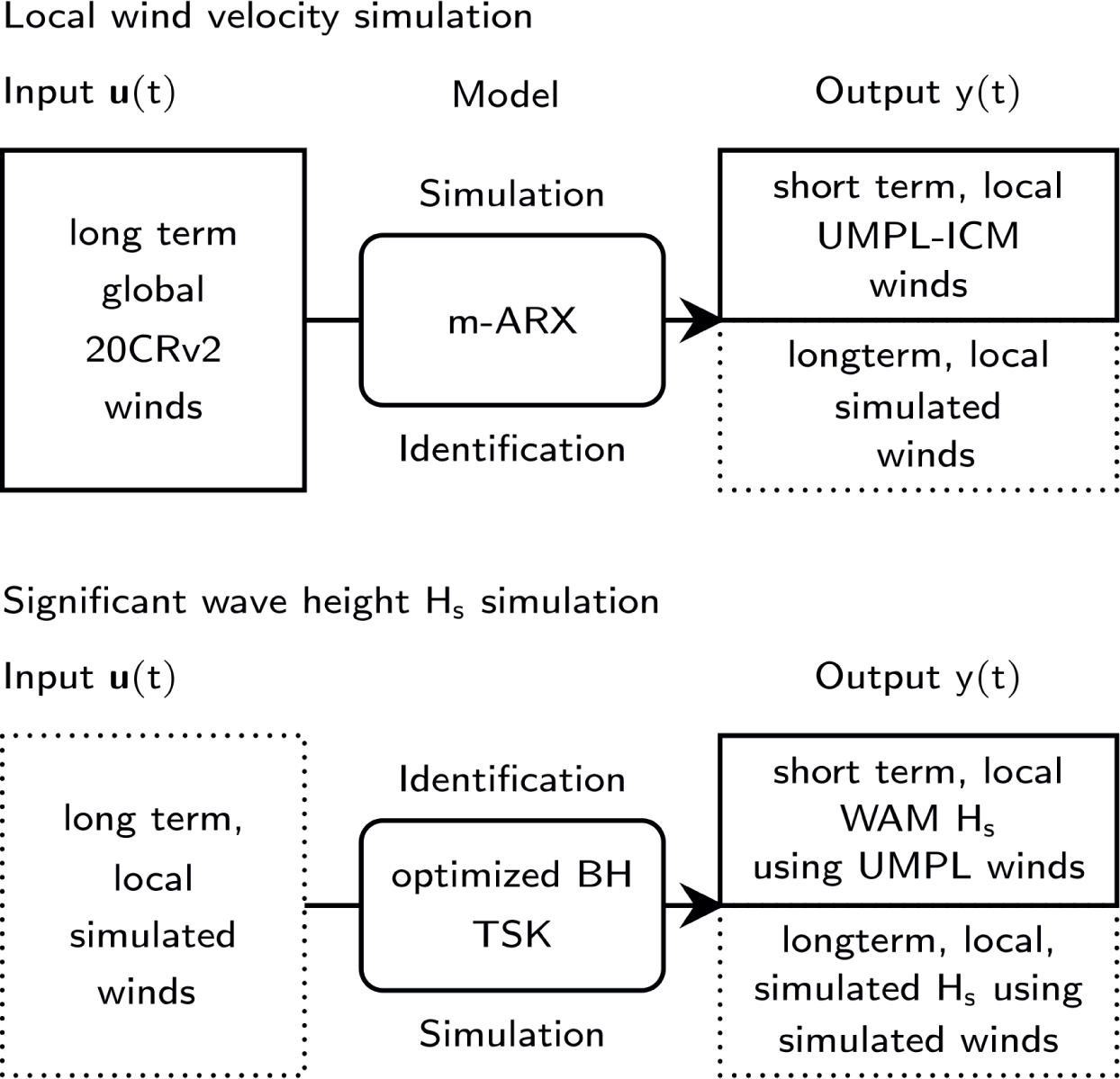
Figure 1
Flow diagram for wind velocity and significant wave height simulations. Non-simulated data, used for model identification and simulation, are included in solid-line rectangles. The simulated data are denoted by dotted-line rectangles; rectangles with rounded corners represent models. Dataset descriptions are provided in Table 1.
Table 1
Datasets used for identification, validation and simulation of local wind velocity and significant wave height Hs
| Data set Used… | Description |
|---|---|
| UMPL-ICM winds … to run the WAM model. As an input for the identification of wind scaling models. Half of data used for the verification. | 9 NM, 3 h, interpolated into 1 NM, 1 h grid, 1998–2001, 28 storms |
| 20CRv2 winds … as an input for the identification and validation of wind scaling models. | 120 NM, 3 h, means interpolated into 1NM 1 h grid, 1871–2008 |
| Simulated winds … for Hs simulation. Generated using scaling models with 20CRv2 data as an input. | 1 NM, 1 h, 1871–2008 |
| WAM Hs … to identify Hs simulation models. Half of data used for verification. Generated using a locally nested WAM model and UMPL-ICM winds. | 1 NM, 3 h, 1998–2001, 28 storms |
| Simulated Hs … to generate the number of hours with Hs exceeding a given threshold. Simulated using previously identified Hs models and simulated winds. | 1 NM, 1 h, 1871–2008 |
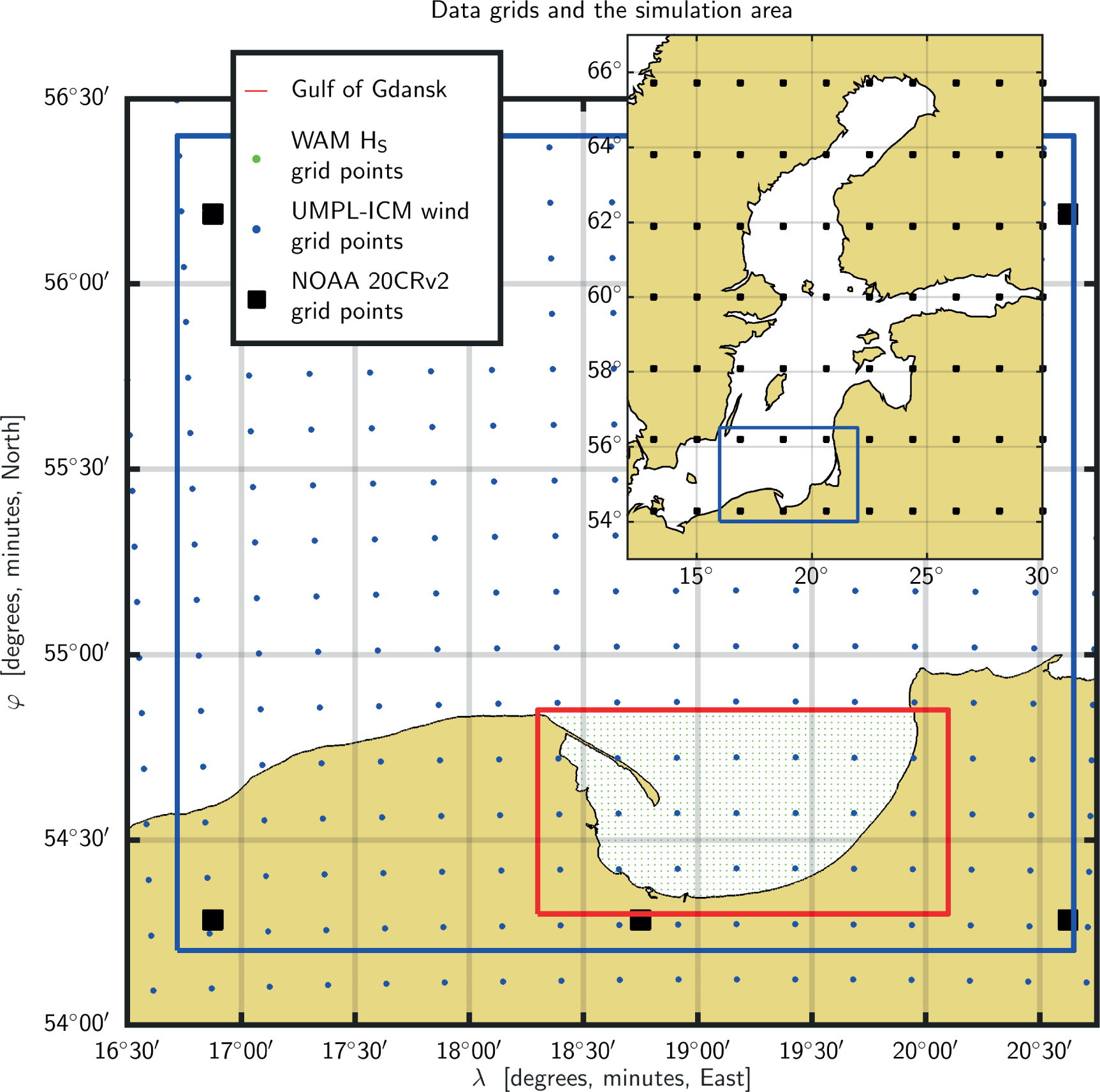
Figure 2
Data grids: NOAA 20CRv2 (black squares), UMPL-ICM (blue dots) and 1 NM nested WAM grid (small green dots)
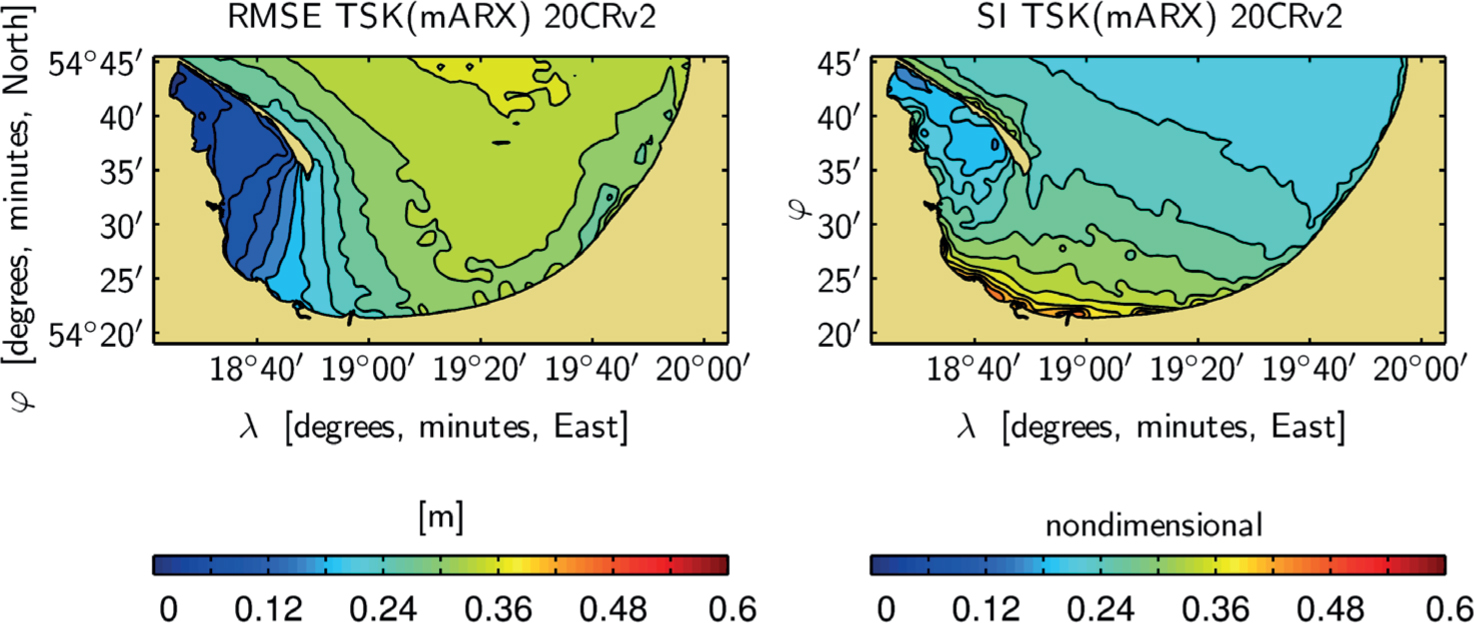
Figure 3
Root Mean Square Error (left) and scatter index (right) values for significant wave height simulation using the Takagi-Sugeno-Kang simulation method with m-ARX downscaled winds
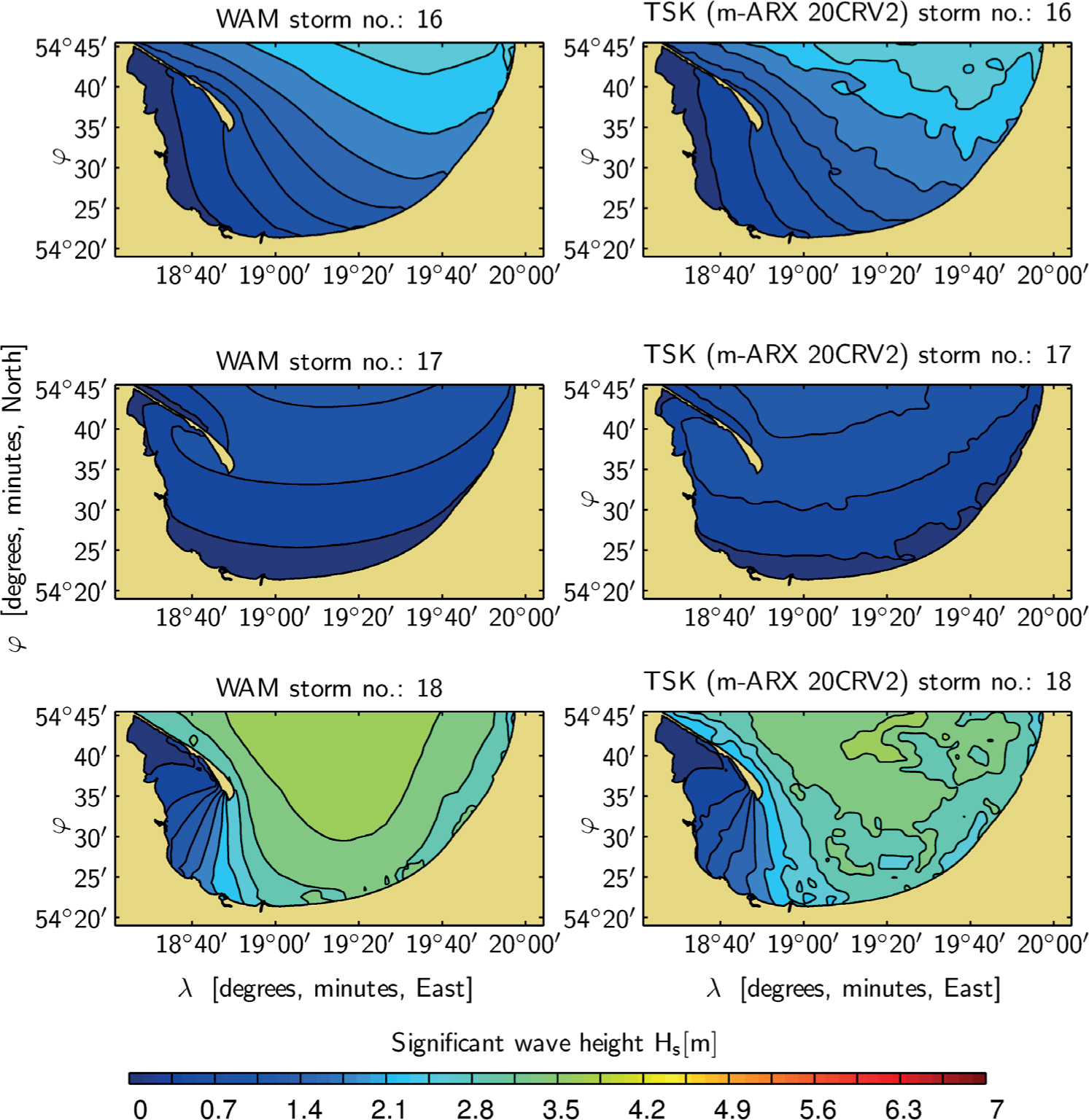
Figure 4
Significant wave height: Takagi-Sugeno-Kang simulated using downscaled winds (right) and WAM modeled with UMPL-ICM winds (left). Peaks of validation storms no. 16–18
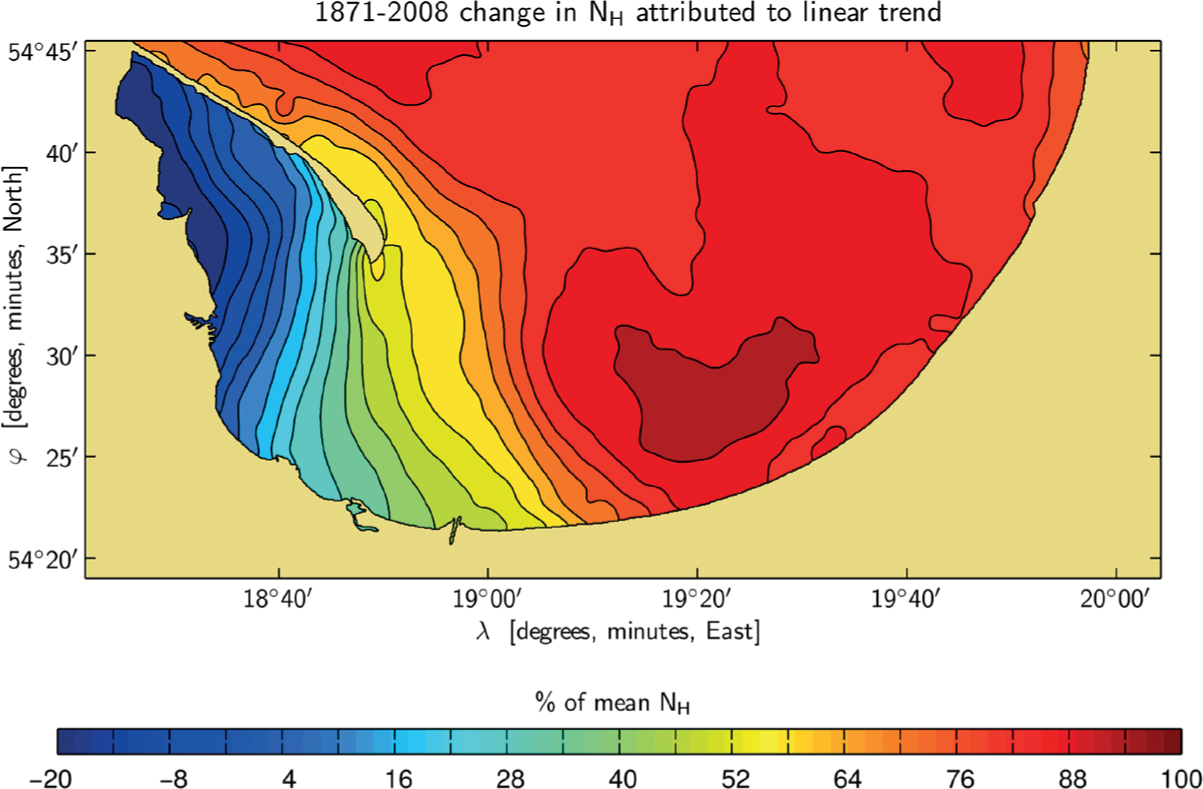
Figure 5
NH cumulative change due to the linear trend over the simulation period expressed as a percentage of NH mean