
Introduction
The genus Gomphonema is one of the most common found in assemblages of freshwater benthic diatoms. Gomphonema cells often form colonies and branched mucilage stalks, attached to solid substrates. Cells are heteropolar and cuneate in girdle view, however, valves are more or less clavate, symmetrical to the apical axis (Krammer & Lange-Bertalot 1986; Round et al. 1990; Hofmann et al. 2011; Bąk et al. 2012). The species type for this genus is Gomphonema acuminatum Ehrenberg (1832). Taxonomic revision of various species from this genus was presented in the studies by Reichardt (1997, 1999, 2001, 2015) and Reichardt & Lange-Bertalot (1991), where many species were described as “new”. The recently published extensive monograph by Levkov et al. (2016) on the Gomphonema genus from Macedonia contains descriptions of 30 taxa new to science.
Many species of Gomphonema are known from Poland (Siemińska 1964; Rakowska 2001; Siemińska & Wołowski 2003). Rare and new taxa in the Polish flora were reported from i.a. the Kraków-Częstochowa Upland (Wojtal 2003, 2009). To date, no diatomological research has been conducted in SE Poland, except for individual studies related to the mass occurrence of Didymosphenia geminata (Lyngbye) M. Schmidt in the San River (Kawecka & Sanecki 2003). In recent years, research on the diversity of diatom assemblages were conducted in SE Poland, and Gomphonema represents one of the largest genera (Noga et al. 2014).
The aim of this work was to present morphological descriptions and ecological characteristics of rare species from the Gomphonema genus, mostly new to Poland, which prefer calcium-rich waters: G. cuneolus E. Reichardt, G. drutelingense E. Reichardt, G. innocens E. Reichardt, G. lateripunctatum E. Reichardt & Lange-Bertalot, G. lippertii E. Reichardt & Lange-Bertalot and G. calcifugum Lange-Bertalot & E. Reichardt, as well as their new sites.
Materials and methods
Study area
The research was conducted in the lotic waters of SE Poland. The area is drained by two large rivers – the San and the Wisłoka, the right-bank tributaries of the Vistula River that belongs to the Baltic Sea catchment area (Fig. 1). The San is the largest Carpathian river, with a length of 443.4 km. Its sources are in Ukraine. The upper basin section of this river is one of the most valuable natural areas in Poland and covers over 90 km of the river, from its source to the dam reservoir in the Solina village. For the first 50 kilometres, it is a foothill river, then having the features of a mountain river. The San River valley is characterized by shallow, steep banks and a broad riverbed consisting of typical Carpathian flysch strata (Kukuła 2002; Sieradzki 2002). One of the major tributaries of the upper San River is the Wołosaty stream, which flows through the area of Bieszczady National Park (BdNP).
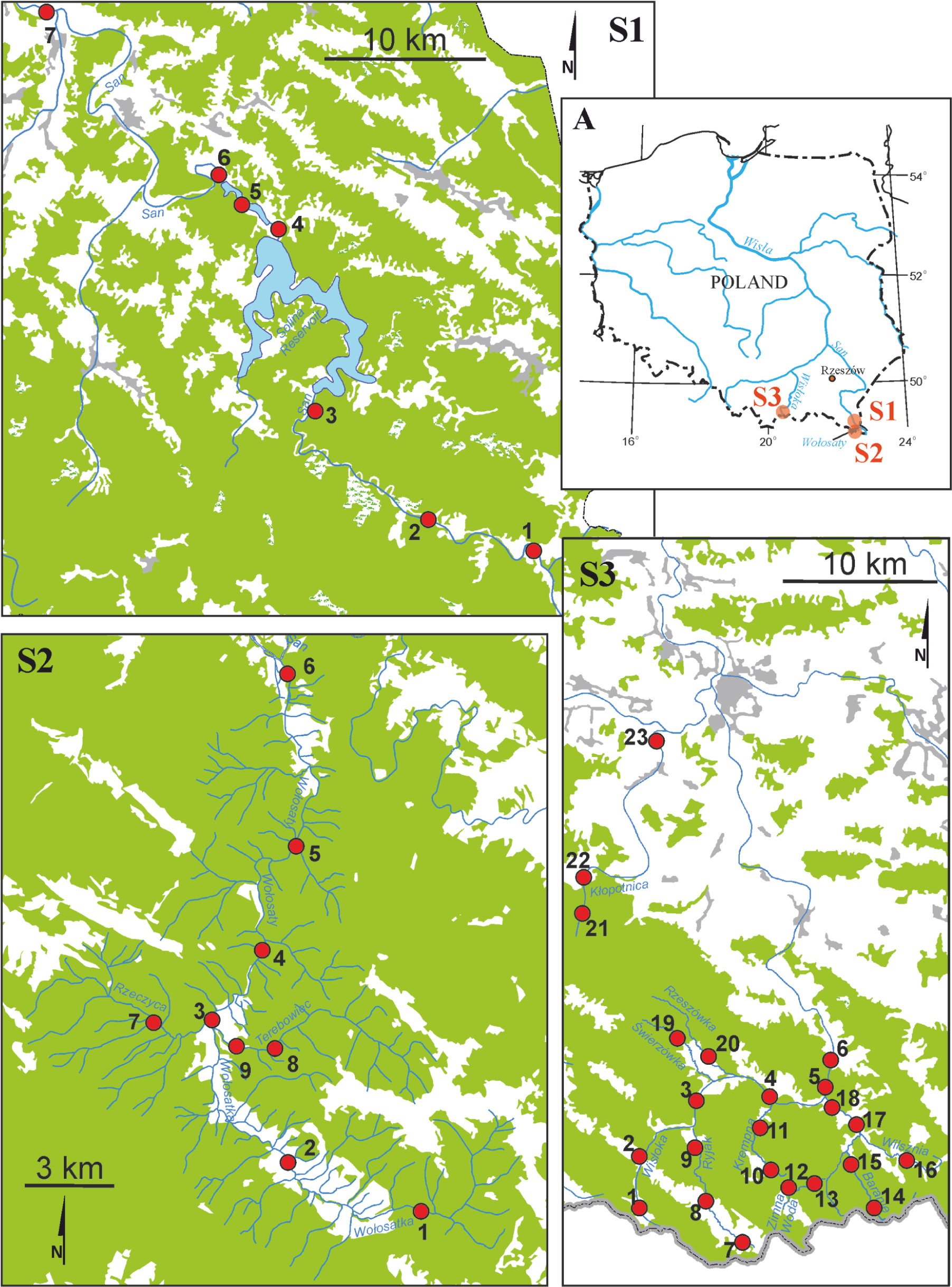
Figure 1
Location of the study sites where species from the Gomphonema genus were identified: A – Study area in SE Poland; SI – Sampling sites in the San River (1–7); S2 – Sampling sites in the Wołosaty stream and tributaries (1–9) in Bieszczady National Park; S3 – Sampling sites on the Wisłoka River and tributaries (1–23) in Magura National Park
Study sites were designated in the San River (Fig. 1, S1) and in the Wołosaty stream with tributaries (Terebowiec and Rzeczyca) – Fig. 1, S2.
The sources of the Wisłoka River are in the Low Beskids area, at an altitude of 664 m a.s.l. The length of the river is 164 km and the basin area is 4110 km2. The upper and middle parts of the catchment area are mainly composed of Cretaceous and Tertiary flysch strata, the same as the San River (Buszko & Kiryk 1995; Boratyn & Brud 1996). Large water-level fluctuations are typical for mountain rivers. In rainless periods, the flows in streams are very low and in summer, the water temperature in shallow and wide channels is high (Soja 2009). The study sites were designated on the Wisłoka River and its tributaries (Wilsznia, Kłopotnica, Ryjak, Krempna, Rzeszówka, Świerzówka, Zimna Woda and Baranie), mainly in the area of Magura National Park (MNP) and the buffer zone (Fig. 1, S3).
The study area is not subject to strong human impact due to the existence of two national parks (BdNP and MNP). The area is sparsely populated with low tourist traffic and small, single farms outside the park.
Both rivers (the San and the Wisłoka) and their tributaries are characterized by rocky bottoms, with a predominance of medium stones. The study sites on the San and the Wisłoka were usually well sunlit, while the sites on the tributaries of these rivers were mostly shaded by trees and shrubs growing in the vicinity.
Field works
The material for analysis was collected from 8 sites in the upper reaches of the San River in 2010–2011, in the Wisłoka River (6 sampling sites) and its selected tributaries (streams: Ryjak, Wilsznia, Kłopotnica, Rzeszówka, Świerzówka, Krempna, Zimna Woda and Baranie – 17 sampling sites in total) in 2013–2014 and from 9 sites in the Wołosaty stream and its tributaries (Rzeczyca and Terebowiec) in 2013–2015. Samples were collected twice per year – in spring (April and May) and autumn (September and October) from all available habitats (stones, mud and aquatic plants). At the same time, temperature, pH, dissolved oxygen and electrolytic conductivity were measured in situ, and water for chemical analysis was also collected.
Laboratory works
Chemical analyses were conducted using a Thermo Scientific DIONEX ICS-5000 + DC Chromatograph device at the Faculty Laboratory for Analysis of Environment Health and Materials of Agricultural Origin at the University of Rzeszów.
The laboratory analysis of diatoms was carried out according to methods presented in the study by Kawecka (1980) on river algae. To obtain pure diatom valves, a portion of each sample was macerated in cleaning chromic mixture (mixture of sulfuric acid and potassium dichromate) and washed in a centrifuge (at 2500 rpm). Permanent diatom slides were mounted in Pleurax resin (refractive index 1.75).
Diatoms were identified and counted under a Carl Zeiss Axio Imager A2 light microscope (LM) equipped with a 100× Plan Apochromatic objective with differential interference contrast (DIC) for oil immersion (NA 1.4). For scanning electron microscope (SEM) observations, samples were coated with 20 nm of gold using a Turbo-Pumped Sputter Coater Quorum Q 150OT ES and observed under a Hitachi SU 8010 microscope at the Podkarpacie Innovative-Research Center of Environment at the University of Rzeszów.
Diatoms were identified according to: Krammer and Lange-Bertalot (1986), Reichardt (1999), Hofmann et al. (2011) and Levkov et al. (2016). The abundance of species in assemblages was determined by counting specimens within randomly selected microscope fields of view up to a total of 400 valves. Species with a content above 5% in a given diatom assemblage were defined as the most abundant (dominant taxa).
Results and discussion
The studied rivers and streams in SE Poland were characterized by mostly alkaline or close to neutral pH of water. Weak acidic pH (6.0–6.5) was recorded mainly during spring periods with elevated water levels due to snow melting. Water at the study sites had low or medium conductivity values, i.e. the lowest values were measured in the upper reaches of the studied watercourses, while the highest ones – during the low water level in autumn. The content of nutrients (mainly phosphates) was low or very low, often below the limit of detection. Increased values of nitrates were recorded only at some sites (usually in MNP) in the spring season. The investigated waters were also characterized by a relatively high content of calcium ions – usually in the range of 40 to more than 70 mg l-1. Values below 20 mg l-1 Ca2+ were recorded only in spring, during elevated water levels in the upper reaches of rivers and streams (Tables 1 & 2).
Table 1
Physicochemical water parameters measured in the studied rivers and streams with values of medians (given in parentheses)
| River/stream | Temperature (°C) | pH | Conductivity (μS cm–1) | O2 (mg l–1) |
|---|---|---|---|---|
| San | 6.5–14.5 (7.5) | 6.5–8.2 (7.8) | 131–530 (141) | no data |
| Wołosaty | 5.5–12.2 (8.3) | 6.4–8.8 (8.3) | 78–278 (149) | 10.2–11.4 (10.6) |
| Terebowiec | 6.1–9.3 (8.3) | 6.4–8.4 (8.2) | 86–284 (140) | 10.7–11.1 (10.9) |
| Rzeczyca | 7.4–10.0 (7.8) | 6.4–8.4 (7.4) | 97–246 (157) | 10.2–10.6 (10.2) |
| Wisłoka | 8.8–16.5 (9.3) | 6.5–9.6 (7.8) | 92–402 (233) | 8.6–12.3 (10.0) |
| Ryjak | 11.3–12.5 (12.0) | 6.0–7.6 (7.2) | 96–406 (224) | 9.6– 11.2 (10.0) |
| Wilsznia | 10.7–14.0 (12.1) | 6.1– 7.5 (7.2) | 104–420 (293) | 9.6–10.2 (9.9) |
| Kłopotnica | 11.1–16.0 (13.4) | 6.3–7.5 (7.1) | 84–325 (290) | 9.6–10.0 (9.8) |
| Krempna | 9.8–14.8 (12.7) | 6.3–8.6 (7.7) | 161–530 (356) | 7.4–11.7 (9.8) |
| Rzeszówka | 11.6–12.0 (11.8) | 6.0–8.4 (6.9) | 103–315 (212) | 9.0–11.0 (10.1) |
| Świerzówka | 10.8–12.5 (11.2) | 6.3–8.6 (7.0) | 101–313 (209) | 9.0–11.5 (10.5) |
| Zimna Woda | 10.1–13.0 (12.1) | 6.4–8.5 (7.3) | 146–418 (245) | 9.4–9.9 (9.5) |
| Baranie | 10.3–15.9 (10.9) | 6.3–8.5 (7.7) | 78–307 (245) | 9.2–9.7 (9.3) |
Table 2
Concentration of ions measured in the studied rivers and streams with values of medians (given in parentheses)
| River/stream | Cl– (mg l–1) | (mg l–1) | (mg l–1) | (mg l–1) | Ca2+(mg l–1) |
|---|---|---|---|---|---|
| San | 0.8–3.4 (2.24) | 11.4–24.9 (15.83) | 1.0–2.9 (1.45) | <0.001 | 46.4–47.3 (47.1) |
| Wołosaty | 0.4–5.4 (0.88) | 11.1–26.8 (14.68) | 1.7–3.2 (2.18) | <0.001–0.6 | 30.3–41.6 (36.75) |
| Terebowiec | 0.4–5.6 (0.75) | 12.5–27.2 (12.58) | 2.0–2.9 (2.26) | <0.001 | 32.4–35.3 (33.31) |
| Rzeczyca | 0.6–5.3 (0.98) | 16.3–33.3 (16.60) | 1.8–3.2 (2.3) | <0.001 | 38.8–39.7 (39.20) |
| Wisłoka | 0.4–7.2 (5.7) | 3.7–48.7 (29.7) | < 0.1–5.3 (0.5) | <0.001–4.2 (0.1) | 23.3–62.5 (48.9) |
| Ryjak | 0.1–7.0 (2.29) | 2.5–30.8 (18.42) | < 0.1–5.1 (0.1) | 0.03–0.04 (0.01) | 26.0–62.6 (40.89) |
| Wilsznia | 0.3–5.8 (1.41) | 3.4–28.4 (18.09) | < 0.1–5.8 (0.12) | <0.001–0.2 (<0.01) | 15.8–58.1 (38.74) |
| Kłopotnica | 0.4–8.5 (1.37) | 4.3–51.1 (17.74) | 0.4–7.2 (5.15) | 0.01–0.02 (0.01) | 13.4–39.8 (34.6) |
| Krempna | 0.7–1.6 (1.14) | 6.0–46.3 (16.15) | < 0.1–5.4 (1.80) | <0.001–0.07 (0.01) | 33.7–76.4 (54.2) |
| Rzeszówka | 0.8–1.2 (1.0) | 10.1–27.3 (19.30) | < 0.1–4.2 (0.85) | 0.02–0.09 (0.03) | 18.9–43.9 (33.5) |
| Świerzówka | 0.5–1.2 (0.7) | 10.1–27.6 (19.5) | < 0.1–5.0 (0.95) | 0.008–0.03 (0.01) | 18.8–49.1 (42.3) |
| Zimna Woda | 0.6–5.6 (3.35) | 8.8–38.4 (24.73) | 1.2–6.7 (1.4) | 0.01–0.05 (0.02) | 38.6–42.3 (40.07) |
| Baranie | 0.7–4.9 (2.84) | 7.1–24.0 (21.54) | 0.6–10 (1.7) | <0.001–0.02 (0.01) | 12.4–41.1 (38.5) |
The Gomphonema species described in this work have been recorded by many researchers from different types of calcium-rich waters, or from waters on calcareous bedrock (Reichardt 1999; Cantonati et al. 2012; Levkov et al. 2016). Some of the species, such as G. lateripunctatum, are known from a number of sites; others, such as G. lippertii, G. drutelingense and G. innocens, are rarely described from just a few sites.
Gomphonema cuneolus E. Reichard 1997: 123 (Figs 2A–Y, 4A–F)
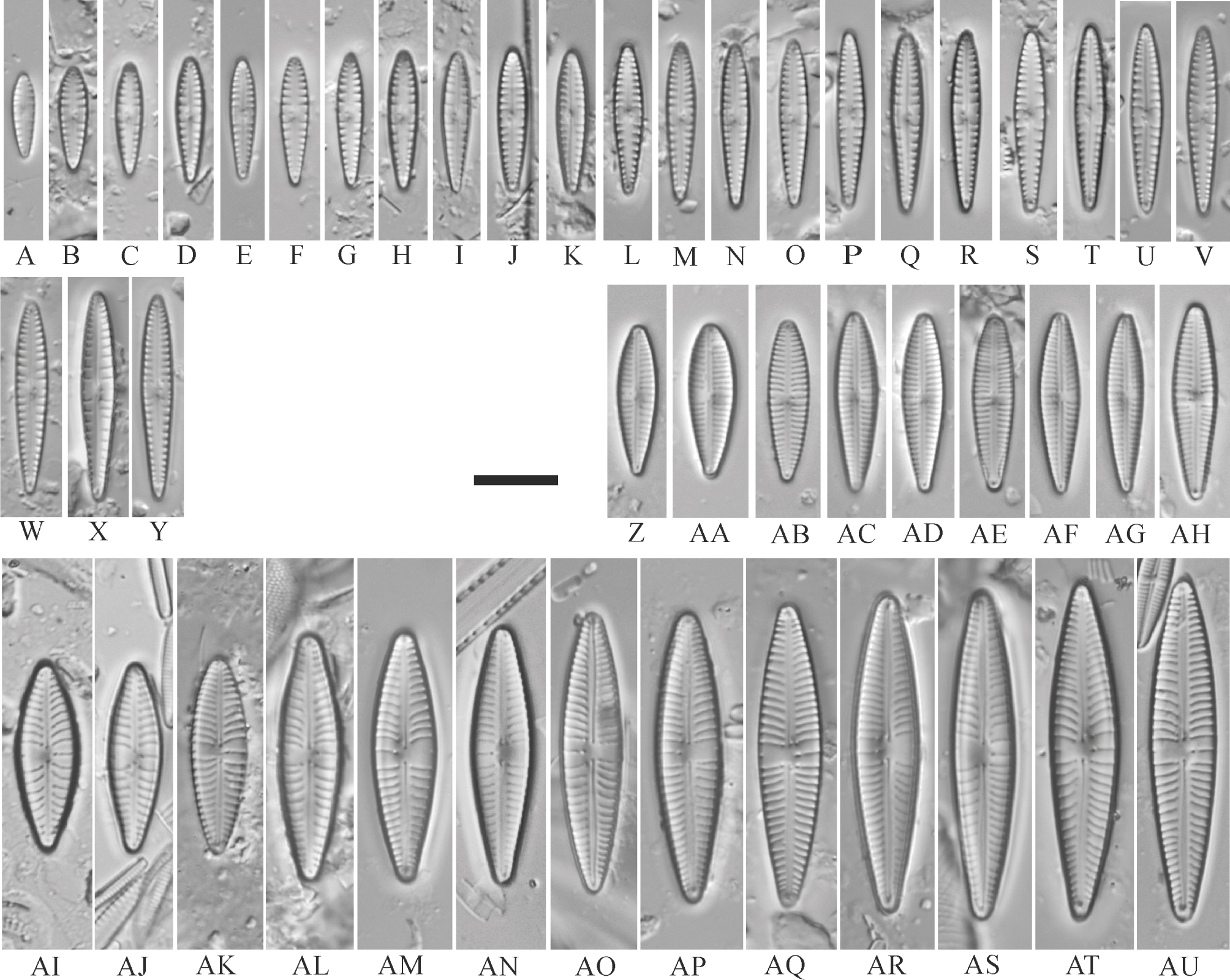
Figure 2
Examples of morphological variation in LM: Gomphonema cuneolus (A–Y); Gomphonema innocens (Z–AH); Gomphonema drutelingense (AI–AU). Scale bar = 10 μm
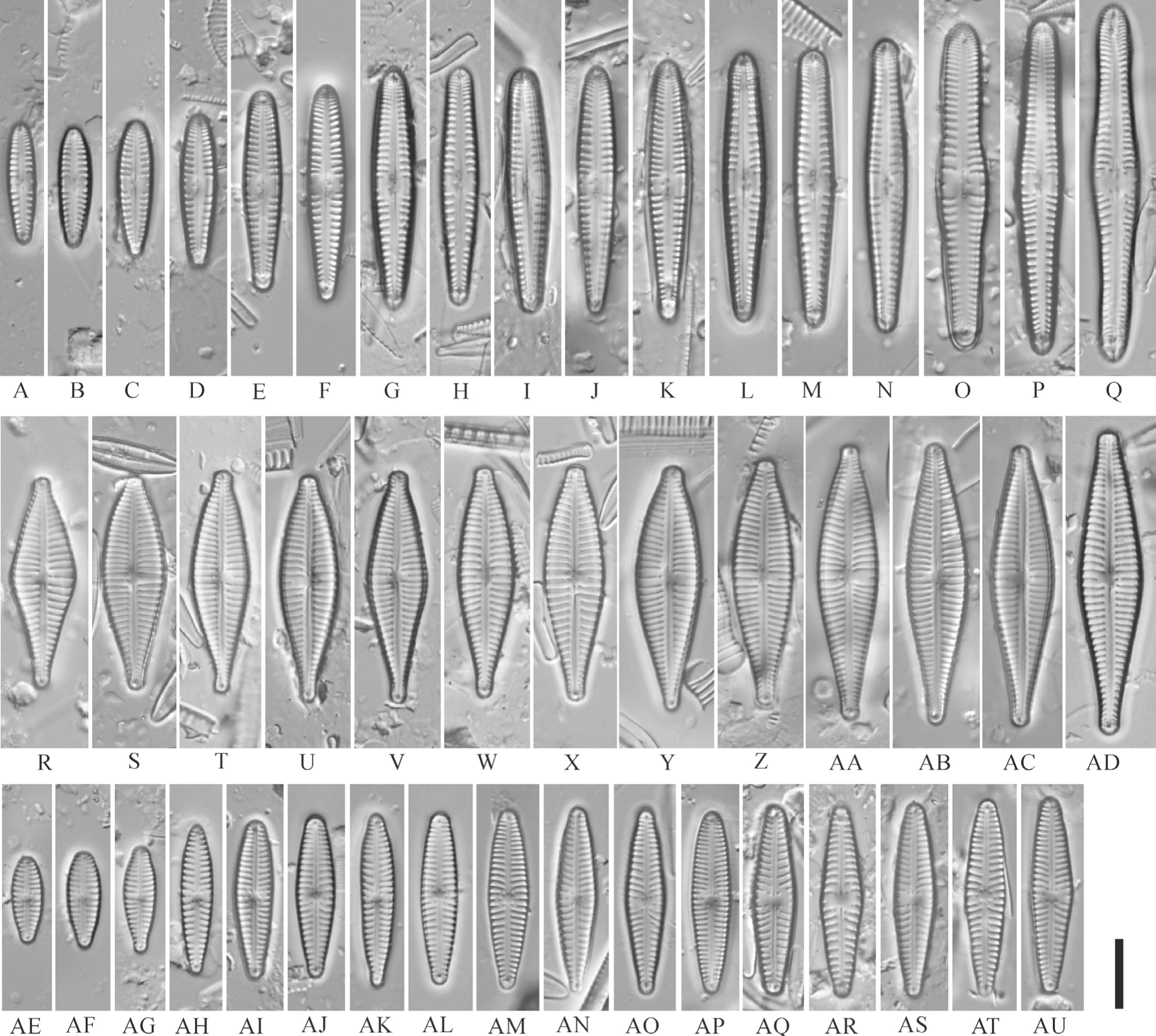
Figure 3
Examples of morphological variation in LM: Gomphonema lateripunctatum (A–Q); Gomphonema lippertii (R–AD); Gomphonema calcifugum (AE–AU). Scale bar = 10 μm
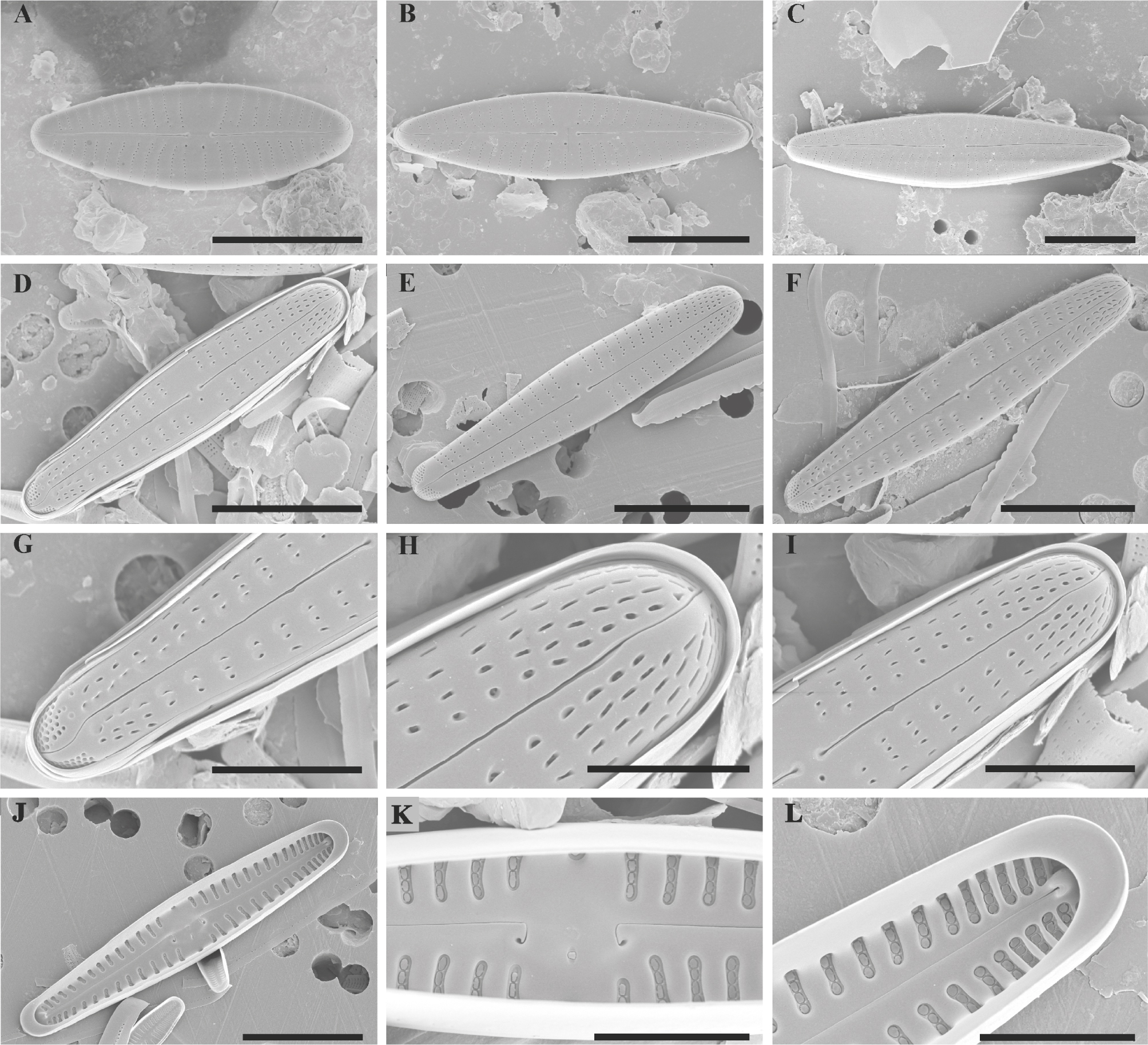
Figure 4
Gomphonema cuneolus SEM: external view of valve (A–E), internal view of valve (F); Gomphonema innocens SEM: external view of raphe (G–I), internal view of raphe (L). Scale bars = 5 μm except for B where scale bar = 10 μm and J & K where scale bar = 3 μm
Dimensions
length 12.7–27.5 μm, width 2.8–4.4 μm, number of striae 10–12 in 10 μm. Individual cells were slightly longer and narrower in relation to the dimensions reported by Reichardt (1997). Longer cells (up to 28.7 μm) were also reported by Ector et al. (2015) from France.
Type of substrate
stones and mosses.
Distribution in SE Poland
The species usually occurred individually at all sites in the Wisłoka River (Fig. 1, S3: 1, 2 & 4–6) and its tributaries: Kłopotnica (Fig. 1, S3: 21 & 22), Świerzówka (Fig. 1, S3: 19), Rzeszówka (Fig. 1, S3: 20), Krempna (Fig. 1, S3: 10 & 11), Zimna Woda (Fig. 1, S3: 12 & 13) and Baranie (Fig. 1, S3: 14 & 15). In the Świerzówka in August 2013, the number of valves increased to 3.2%. Single cells were also observed in the Wołosaty (Fig. 1, S2: 1 & 3) stream and the Terebowiec tributary (Fig. 1, S2: 8 & 9).
Dominant taxa
Achnanthidium pyrenaicum (Hustedt) Kobayasi, Diatoma ehrenbergii Kützing and Encyonopsis subminuta Krammer were most frequent in the Wołosaty and Terebowiec streams, while Achnanthidium pyrenaicum (Hustedt) Kobayasi, Cocconeis pseudolineata (Geitler) Lange-Berta lot, Cocconeis placentula var. lineata (Ehrenberg) Van Heurck and Gomphonema pumilum (Grunow) E. Reichardt & Lange-Bertalot were the most numerous in the Świerzówka stream (MNP).
Distribution in Poland
species new to Poland.
Worldwide distribution
Reported by Cantonati et al. (2016) from springs in Italy and by Ector et al. (2015) from France. Also included on the species list from inland waters in North America (Bahls 2009).
Ecology
There is no detailed information on the ecology of the species. According to Reichardt (1997), it seems to prefer calcium-rich waters.
Gomphonema drutelingense E. Reichardt (1999: 38) (Figs 2AI–AU, 5A–C)
Dimensions
length 22.5–41.0 μm, width 6.6–8.4 μm, number of striae 8–11 in 10 μm.
Type of substrate
It is usually found among mosses, and less often on stones and mud.
Distribution in SE Poland
The species was very rare and occurred in the form of single cells in the Wołosaty stream (BdNP), (Fig. 1, S2: 3) and in the Wisłoka (Fig. 1, S3: 3 & 4) and the Kłopotnica (Fig. 1, S3: 22) (MNP). Individual specimens were also found in the San River (Fig. 1, S1: 2).
Dominant taxa
At sites in the Wisłoka and Kłopotnica rivers, G. drutelingense was accompanied by Achnanthidium minutissimum (Kützing) Czarnecki, Encyonopsis subminuta Krammer, Denticula tenuis Kützing and Diatoma moniliformis (Kützing) D.M. Williams. In the Wołosaty stream, the most common were: Achnanthidium pyrenaicum (Hustedt) Kobayasi, A. minutissimum (Kützing) Czarnecki and Encyonopsis subminuta Krammer & E. Reichardt. In the San River, Achnanthidium pyrenaicum (Hustedt) Kobayasi, A. minutissimum (Kützing) Czarnecki and Fragilaria perminuta (Grunow) Lange-Bertalot dominated.
Distribution in Poland
Species new to Poland, known only from flowing waters in SE Poland (Noga et al. 2016a,b).
Worldwide distribution
Species reported from Europe (Reichardt 1999; Levkov et al. 2016) and North America (Bahls 2009).
Ecology
The species was described by Reichardt (1999) from calcium-rich puddles, where it co-occurred with Gomphonema cymbelliclinum E. Reichardt & Lange-Bertalot. However, Levkov et al. (2016) observed G. drutelingense in the Arachinovo wetland (currently remnants of the ancient Skopsko lake), in eutrophic to hyper-eutrophic conditions.
Gomphonema innocens E. Reichardt (1999: 32) (Figs 2Z–AH, 4G–L)
Dimensions
length 16.7–22.0 μm, width 4.0–5.8 μm, number of striae 13–16 in 10 μm.
Individual cells were narrower and had less dense striae than those described by Reichardt (1999) and Levkov et al. (2016).
Type of substrate
mosses and stones.
Distribution in SE Poland
Individual specimens found only in the upper reaches of the Wisłoka River (Fig. 1, S3: 1) near Castor fiber L. burrows. Since the species was not found at sites where water had a fast current, the authors assume that it prefers habitats with weaker current, or even standing waters.
Dominant taxa
Meridion circulare Agardh var. circulare (68% of the assemblage species composition) in spring 2013.
Distribution in Poland
Reported from springs in central Poland (Żelazna-Wieczorek 2011).
Worldwide distribution
Reported from other European countries more often than from Poland, e.g. SW Serbia (Vidaković et al. 2016), southern and western Bulgaria (Ivanov et al. 2006) and Macedonia (Levkov et al. 2016). The species is also known from inland waters in North America (Kociolek 2005; Bahls 2009).
Ecology
The species was described for the first time from southern Germany, where it was observed in standing waters (fish ponds or backwaters), medium rich in electrolytes, and meso- to eutrophic. The occurrence of the species is not precisely determined (Reichardt 1999; Hofmann et al. 2011). The species was reported from two sites in Macedonia (Bistra mountain), from small oligotrophic ponds located on calcareous bedrock (Levkov et al. 2016).
Gomphonema lateripunctatum E. Reichardt & Lange-Bertalot (1991: 530) (Figs 3A–Q, 5D–L)
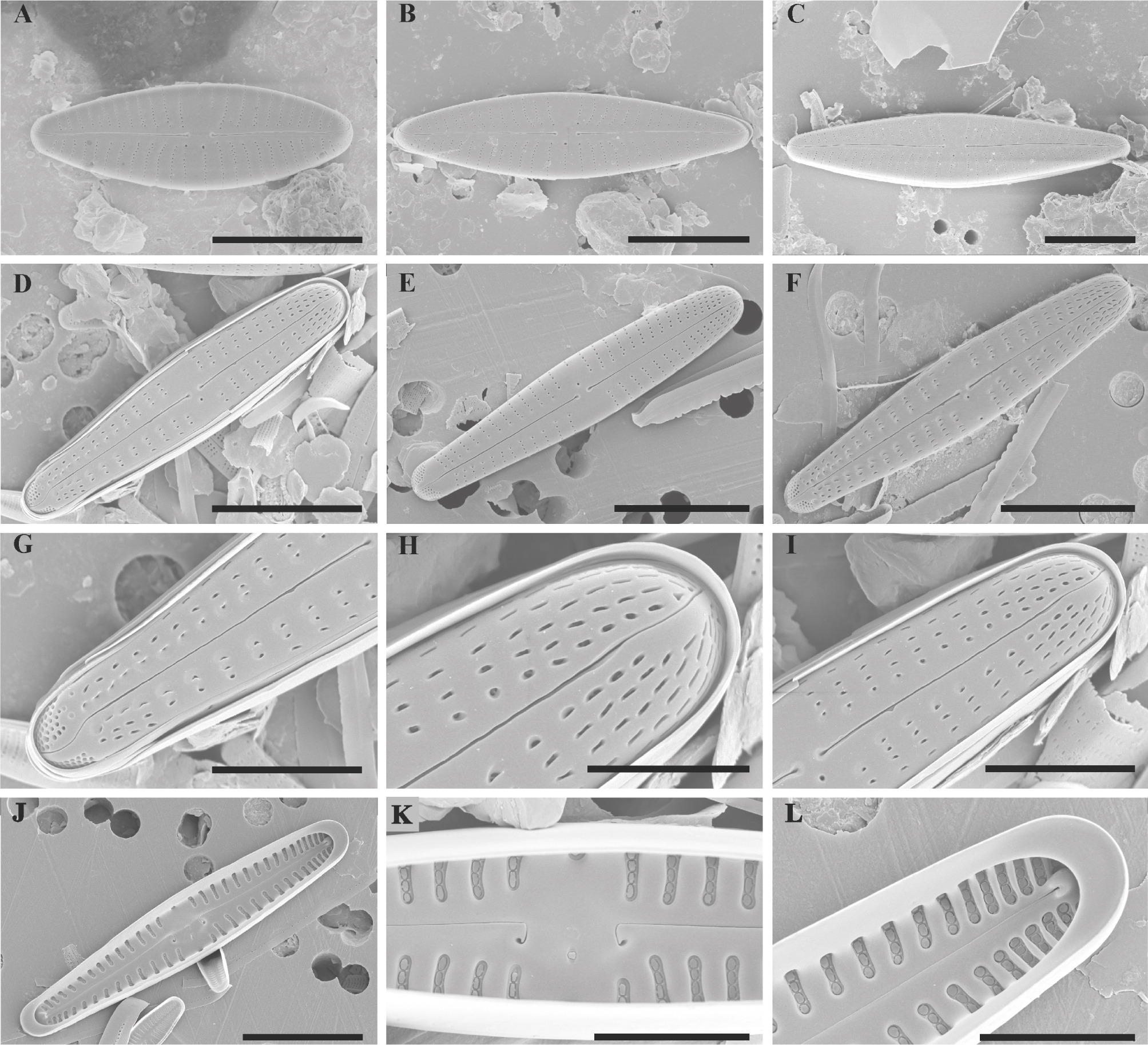
Figure 5
Gomphonema drutelingense: external view of valve (A–C), internal view of valve (D–I), Gomphonema lateripunctatum: external view of valve, and internal valve details (J–L). Scale bars = 10 μm except for G, H, I & L where scale bars = 5 μm and K where scale bar = 4 μm
Dimensions
length 17.2–59.7 μm, width 4.6–7.0 μm, number of striae 9–12 (in central area), 14–18 (closer to the end) in 10 μm. Many cells were narrower than those described by Reichardt and Lange-Bertalot (1991), while observations by Levkov et al. (2016) conducted in Macedonia were consistent with our observations.
Type of substrate
Observed mainly on stones, less often on mud and among mosses.
Distribution in SE Poland
Found in the Wisłoka (Fig. 1, S3: 2–6), the Wilsznia (Fig. 1, S3: 16–18), the Ryjak (Fig. 1, S3: 7) and the Kłopotnica (Fig. 1, S3: 21 & 22) and in the streams: Świerzówka (Fig. 1, S3: 19), Rzeszóowka (Fig. 1, S3: 20), Zimna Woda (Fig. 1, S3: 12 & 13) and Baranie (Fig. 1, S3: 14 & 15), only in the form of single cells. The species was more abundant in the Wisłoka River in October 2013 (accounted for about 1% of the assemblage). In the BdNP area, it was found in the streams Wołosaty (Fig. 1, S2: 1, 3 & 4) and Terebowiec (Fig. 1, S2: 8 & 9), always individually. Gomphonema lateripunctatum occurred most often in the San River (Fig. 1, S1: 1–6), however, it accounted for no more than 1% of the assemblage at all sites.
Dominant taxa
In the Wisłoka River, where G. lateripunctatum was most frequent, Diatoma moniliformis (Kützing) D.M. Williams, Achnanthidium minutissimum (Kützing) Czarnecki, Encyonopsis subminuta Krammer and E. minuta Krammer & E. Reichardt also dominated. Achnanthidium pyrenaicum (Hustedt) Kobayasi, Diatoma ehrenbergii Kützing and Encyonopsis subminuta Krammer were most frequent in the Wołosaty and Terebowiec streams, while Achnanthidium pyrenaicum (Hustedt) Kobayasi, A. minutissimum (Kützing) Czarnecki and Encyonopsis minuta Krammer & E. Reichardt were most abundant in the San River.
Distribution in Poland
Reported from Lake Rosnowskie Duże in the Wielkopolska National Park (Celewicz-Gołdyn 2006) and from springs in central Poland (Żelazna-Wieczorek 2011).
Worldwide distribution
species known i.a. from Austria (Gesierich & Koffler 2010), Germany (Reichardt & Lange-Bertalot 1991; Lange-Bertalot 1996; Täuscher 2014, 2016), Belgium (Denys 2000), Macedonia (Levkov & Williams 2012), Great Britain (Whitton et al. 2003) and North America (Bahls 2009).
Ecology
Studies carried out in lotic waters in SE Poland show that diatoms occur in many places, both in larger rivers (San, Wisłoka) and small tributaries. At each study site, they occurred as single cells, with up to 1% contribution to the assemblage. Most specimens were observed in the San and the Wisłoka, usually in autumn. Water was alkaline (pH 7.3–8.0), with medium or high conductivity, low content of nutrients and high content of calcium (40 to more than 60 mg l-1).
This information is confirmed by literature data where G. lateripunctatum is described as abundant in various types of calcium-rich waters, from poorly alkaline mountain watercourses with average electrolyte content, and limestone streams, to oligo- and mesotrophic lakes. The optimum conditions for the species occurrence are in subalpine and alpine regions. It is considered as indicator of very good water quality (Reichardt 1999; Reichardt & Lange-Bertalot 1991; Hofmann et al. 2011; Bąk et al. 2012; Cantonati et al. 2012). In Macedonia, it is often found in peat bogs, streams and lakes, in oligotrophic, circumneutral or slightly acidic habitats (Levkov et al. 2016).
Gomphonema lippertii E. Reichardt & Lange-Bertalot (1999: 21) (Figs 3R–AD, 6A–F)
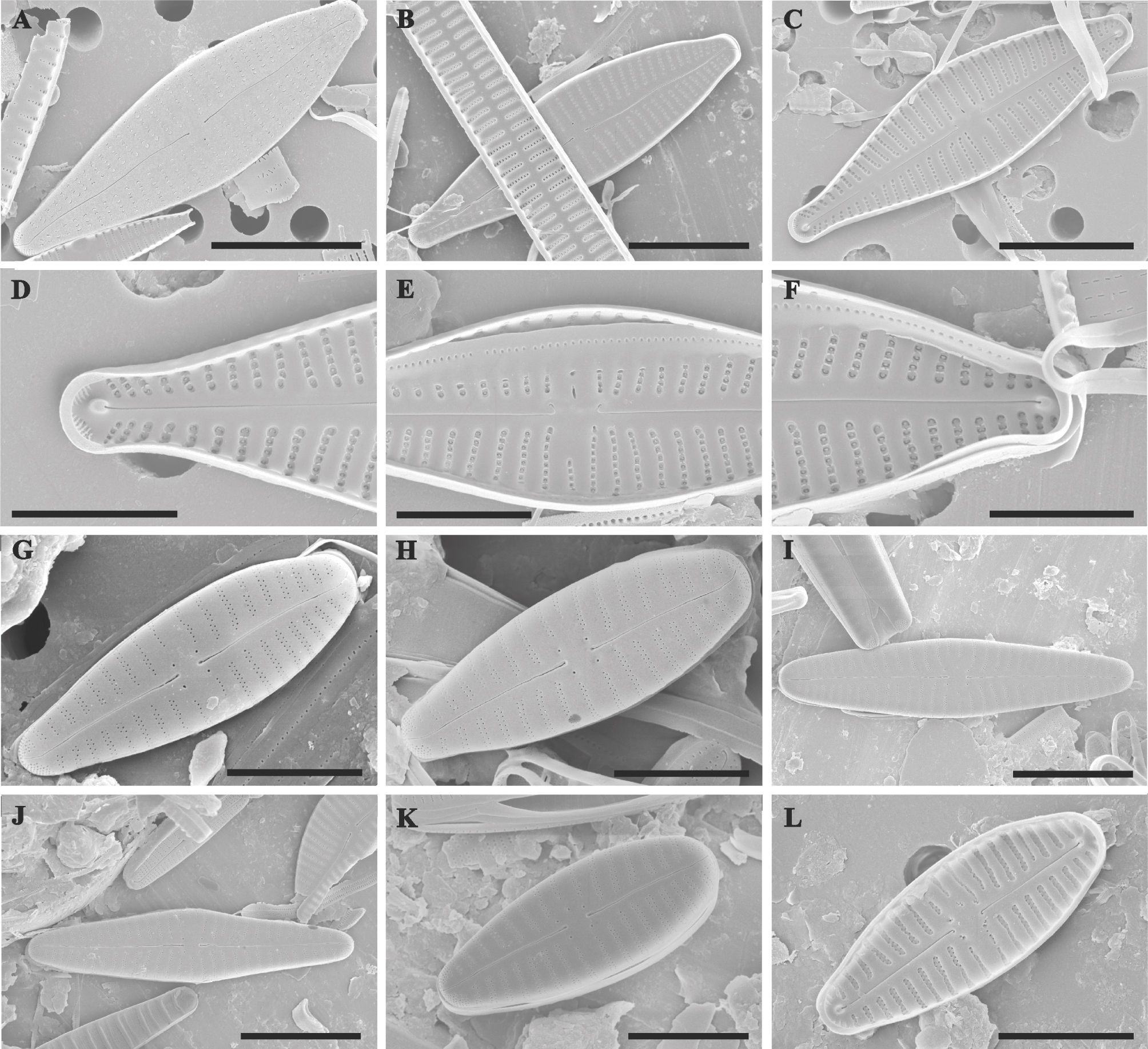
Figure 6
Scanning microscope micrographs of Gomphonema taxa: External valve view of G. lippertii (A & B); Internal valve view of G. lippertii (C–F); External valve view of G. calcifugum (G–K); Internal valve view of G. calcifugum (L). Scale bars = 10 μm except for D, E, G, H & L where scale bar = 5 μm
Dimensions
length 27.0–44.5 μm, width 7.0–9.9 μm, number of striae 10–11 in 10 μm. Individual cells were slightly narrower and had lower striation density compared to those described by Reichardt (1999).
Type of substrate
stones, mud and mosses.
Distribution in SE Poland
In the Low Beskids (MNP), where the species occurred only as single cells, in the Wisłoka (Fig. 1, S3: 2–6), the Wilsznia (Fig. 1, S3: 16 & 17) the Kłopotnica (Fig. 1, S3: 23), the Krempna (Fig. 1, S3: 11), the Świerzówka (Fig. 1, S3: 19) and the Baranie (Fig. 1, S3: 14). In the Bieszczady National Park, where the species occurred individually, in the Wołosaty (Fig. 1, S2: 1 & 3–6) and the Rzeczyca (Fig. 1, S2: 7), and in the San River, where it occurred in the form of single cells, but almost at all sites (Fig. 1, S1: 1, 3 & 5–7).
Dominant taxa
In the Wisłoka River and its tributaries, the most abundant were: Achnanthidium pyrenaicum (Hustedt) Kobayasi, A. minutissimum (Kützing) Czarnecki, A. thienemannii (Hustedt) Lange-Berta lot, Diatoma moniliformis (Kützing) D.M. Williams and Encyonopsis subminuta Krammer. In the Wołosaty stream and the Rzeczyca tributary, the most abundant were: Achnanthidium pyrenaicum (Hustedt) Kobayasi, A. minutissimum (Kützing) Czarnecki, Diatoma ehrenbergii Kützing, Encyonopsis subminuta Krammer & E. Reichardt and Cymbella parva (W. Smith) Kirchner. In the San River, the most abundant were: Achnanthidium pyrenaicum (Hustedt) Kobayasi, A. minutissimum (Kützing) Czarnecki, Encyonopsis subminuta Krammer & E. Reichardt and Fragilaria perminuta (Grunow) Lange-Bertalot.
Distribution in Poland
species new to Poland.
Worldwide distribution
Reported from Central Europe and the Balkans (Reichardt 1999, 2015; Hofmann et al. 2011).
Ecology
Rarely reported, mainly from calcium-rich waters in alpine areas, especially in lakes in the limestone Alps of Central Europe and from the Balkans. The species is widespread in calcareous waters of Central Europe (Reichardt 1999; Hofmann et al. 2011), but according to Reichardt (2015), some specimens may be confused with G. gracile Ehrenberg.
Gomphonema calcifugum Lange-Bertalot & E. Reichardt in Lange-Bertalot & Genkal (1999: 53) (Figs 3AE–AU, 6G–L)
Synonym
Gomphonema olivaceum var. minutissimum Hustedt 1930
Dimensions
length 10.5–36.1 μm, width 4.6–6.7 μm, number of striae 10–15 in 10 μm.
Many cells were much longer and wider than those described in the literature. Large cells had often fewer striae per 10 μm (10–11) (Hofmann et al. 2011; Bąk et al. 2012; Levkov et al. 2016).
Type of substrate
Most abundant on stones, single specimens on mud and mosses.
Distribution in SE Poland
In Magura National Park, the species was described at most study sites, both in the Wisłoka River (Fig. 1, S3: 1, 2 & 4–6) and its tributaries: Wilsznia (Fig. 1, S3: 116 & 17), Kłopotnica (Fig. 1, S3: 21–23), Krempna (Fig. 1, S3: 10 & 11), Rzeszówka (Fig. 1, S3: 20), Zimna Woda (Fig. 1, S3: 12 & 13) and Baranie (Fig. 1, S3: 14 & 15). It usually occurred alone. It reached larger numbers (2–3%) only in spring in the source reaches of the Wisłoka (Fig. 1, S3: 1–3), the Krempna (Fig. 1, S3: 10) and the Wilsznia (Fig. 1, S3: 16), and about 8% in the sources of the Baranie stream (Fig. 1, S3: 14). In the Bieszczady National Park, the taxon was observed individually at all sites (Fig. 1, S2: 1–9). Larger populations were observed only in the spring season in the Terebowiec stream (2–3%), (Fig. 1, S2: 8 & 9).
Dominant taxa
In the Wisłoka River and its tributaries (MNP), where G. calcifugum was most abundant, the accompanying species included: Achnanthidium pyrenaicum (Hustedt) Kobayasi, A. minutissimum (Kützing) Czarnecki, A. thienemannii (Hustedt) Lange-Bertalot, A. lineare W. Smith and Gomphonema pumilum (Grunow) E. Reichardt & Lange-Bertalot. In the Wołosaty stream and its tributaries, the most abundant accompanying species were: Achnanthidium pyrenaicum (Hustedt) Kobayasi, A. minutissimum (Kützing) Czarnecki, Diatoma ehrenbergii Kützing, Encyonopsis subminuta Krammer & E. Reichardt and Cymbella parva (W. Smith) Kirchner.
Distribution in Poland
Reported from over a dozen sites in Poland as G. olivaceum var. minutissimum, from lotic and lentic waters (Siemińska & Wołowski 2003), and from only single sites in SE Poland as G. calcifugum (Noga et al. 2013; 2016a).
Worldwide distribution
For the past several years, the species has been described from various places around the world, e.g. oligotrophic mountain rivers in Europe (often from upper reaches) and Canadian rivers, the Himalayas and New Zealand (Cantonati et al. 2001; Werum & Lange-Bertalot 2004; Goma` et al. 2005; Dohet et al. 2008; Gesierich & Rott 2012; Harper et al. 2012; Levkov et al. 2016).
Ecology
Scattered, occurring in waters poor in electrolytes and calcium, circumneutral to slightly acidic. Further research is needed to better understand the autecology of this species (Hofmann et al. 2011; Bąk et al. 2012). Levkov et al. (2016) often observed G. calcifugum in material from oligotrophic, mountain streams in Macedonia, however, in small numbers. According to Rott et al. (1999), it is an oligo-mesotraphentic diatom. The species occurred in large numbers in the Prava River (the Nida Mountains) on sandy ground and in the source area of the Brajcinska River (Pelister Mountain) among mosses (Levkov et al. 2016).
Conclusions
All the described species from the genus Gomphonema were found in habitats with other species typical of alkaline, calcium rich, most often oligo- and mesotrophic waters, such as Achnanthidium pyrenaicum (Hustedt) Kobayasi, A. thienemannii (Hustedt) Lange-Bertalot, A. lineare W. Smith, Cymbella parva (W. Smith) Kirchner, Diatoma ehrenbergii Kützing, Encyonopsis subminuta Krammer & Reichardt and Fragilaria perminuta (Grunow) Lange-Bertalot (Krammer & Lange-Bertalot 1991a,b; Van Dam et al. 1994; Potapova 2006; Hofmann et al. 2011; Bąk et al. 2012). Achnanthidium pyrenaicum was particularly abundant in all the studied rivers and streams. In many locations, it accounted for about 50% of the diatom assemblage, while in the Wołosaty stream and the tributaries (BdNP) its abundance often exceeded 90%. The structure of diatom dominance and chemical parameters indicate the alkaline pH value of the investigated waters, with medium to high content of calcium. On the other hand, the low biogenic content usually indicates the mesotrophic nature of water, corresponding to good or very good water quality.
Based on the literature data, it appears that G. calcifugum (the last species presented in this paper) avoids alkaline waters rich in calcium and electrolytes. However, some authors emphasize that further research is needed to better understand the ecology of this species (Hofmann et al. 2011; Bąk et al. 2012). According to Rott et al. (1999), it is an oligo-mesotraphentic species. Over the past several years, the species has been described from various places around the world. In Europe, it was mainly found in oligotrophic mountain rivers, often in source sections or in springs, with low or medium content of electrolytes (Werum & Lange-Bertalot 2004; Gomà et al. 2005; Dohet et al. 2008; Levkov et al. 2016). Studies conducted in SE Poland confirm that G. calcifugum prefers oligotrophic or oligo- to mesotrophic waters, with average or low content of electrolytes. It occurred at most of the investigated sites, but more abundant populations (2–3%) were observed in small streams (tributaries of larger rivers) with a mountain or sub-mountain character. More abundant populations (about 8%) were observed only in the Baranie stream in spring, at pH = 7 and low conductivity (78–84 mg l-1). At most sites, however, the water was alkaline (usually in the range of 7.0–8.0) and the calcium content was average or high (30–76.4 mg l-1). Many of the G. calcifugum cells were larger than those described in the literature, among others, by Hofmann et al. (2011), Bąk et al. (2012) and Levkov et al. (2016), which may indicate that the species found favorable conditions to grow. Furthermore, very large development of Achnanthidium pyrenaicum at each site also indicates alkaline reaction of the water and high content of calcium. Therefore, it seems that G. calcifugum can develop in a wide range of pH and calcium-rich waters, but it does not form large populations. In colder periods (mainly in early spring), pH close to or slightly above 7, and medium or low content of electrolytes may favor abundant development of this species. Also, small streams with swift currents and rocky bottoms were habitats where G. calcifugum developed more frequently and more often than in larger rivers.
The valuable places in SE Poland, mentioned in the presented paper, provide many interesting facts about habitats of calciphilous species, useful for a better understanding of their ecology.
Acknowledgements
The authors wish to thank David Duffy for a proofreading of the manuscript and anonymous reviewers for their comments, who helped to improve this manuscript. Many thanks to Natalia Kochman-Kędziora for her help with figures.