
Introduction
The Mediterranean Sea is a peculiar basin regarding marine animal species composition. Many Indo-Pacific species with established populations in the Levantine Sea have passed via the Suez Canal and mixed with autochthonous species (Golani 2002; Galil, Zenetos 2002). Although the range of several species has expanded and reached the Northeastern Sea and the Sea of Marmara, the Turkish Levantine coast has been the most affected area. As a result of this phenomenon, the Eastern Mediterranean Sea is characterized by increasing faunal divergence (Golani, Ben-Tuvia 1995; Golani 2002). The introduction of alien species into the Eastern Mediterranean Sea is a dynamic and ongoing process and should be continuously monitored.
The Levantine Sea and the Northeastern Aegean Sea are two important areas of the Mediterranean Sea (Bianchi 2007). Most of the Aegean Sea has a narrow continental shelf and about 2000 small islands. This sea was considered as an area of low biological productivity (Kallianiotis et al. 2000). The southern Aegean Sea has unique topographic and bathymetric features with numerous islands, which is one of the main reasons of its zoogeographical distinction from the Northeastern Aegean Sea (Gertman et al. 2006).
Depth is generally the main gradient factor with respect to changes in the faunal composition of fauna, thus knowledge of the bathymetric distribution of benthic species is of great importance (Katsanevakis, Maravelias 2009).
There are no detailed studies on the bathymetric distribution of invertebrate species for any of the areas, i.e. the Northeastern Levantine Sea or the Northeastern Aegean Sea. Most studies conducted within this bathymetric zone have focused on fish species and stock assessments.
This study is intended to provide an overview of the bathymetric distribution and composition of invertebrate species occurring in the Northeastern Levantine Sea and the Northeastern Aegean Sea. This study is also the first comprehensive attempt to study the composition and distribution of invertebrates, ranging from shallow waters to the deepest zones of the East Mediterranean Sea.
Materials and methods
A total of 157 trawl hauls were carried out seasonally (from June to September 2014 as well as from January to April and from June to September 2015): 83 hauls (37 at a depth of 30-100 m; 24 at 100-200 m; 11 at 200-300 m; 11 at 300-410 m) in the Northeastern Aegean Sea and 74 hauls (36 at 30-100 m; 23 at 100-200 m; 9 at 200-300 m; 6 at 300-410 m) in the Northeastern Levantine Sea (Fig. 1). Samples were collected by commercial trawlers with 44 mm cod-end mesh size at depths of 30-410 m in both areas.The duration of each trawl ranged from 10 to 20 minutes and the average towing speed was about 2.5 knots, depending on the sea conditions.
Fieldwork included recording of the faunistic composition of the whole catch, sorted as fish (vertebrates) and invertebrates.
Macroinvertebrates in the collected samples were identified to the lowest possible taxonomic level by visual inspection on the desk. Next, all specimens of the identified species were counted to estimate diversity indices. The abundance of species was estimated for each depth range and each area. Percentages within bathymetric ranges and percentage occurrence in all samples were calculated for each invertebrate species. The similarity between areas was assessed using Bray-Curtis’ (1957) similarity index. The analysis was carried out using mean species abundance in depth stratum matrices in order to summarize information according to the sampling scheme (four depth strata: 30-100 m; 100-200 m; 200-300 m; 300-410 m) and to determine the relationship between species assemblages and distributions. Shannon-Weaver’s (1949) diversity index (H) was calculated to describe the community structure. Similarity percentage analysis (SIMPER) was also applied to determine the contribution of each invertebrate species to the similarity or dissimilarity in the community structure. Cluster analysis based on presence/absence data for the Northeastern Levantine Sea and the Northeastern Aegean Sea was performed to show the invertebrate assemblage composition. Data analysis was carried out using the PRIMER software (Clarke, Warwick 2001).
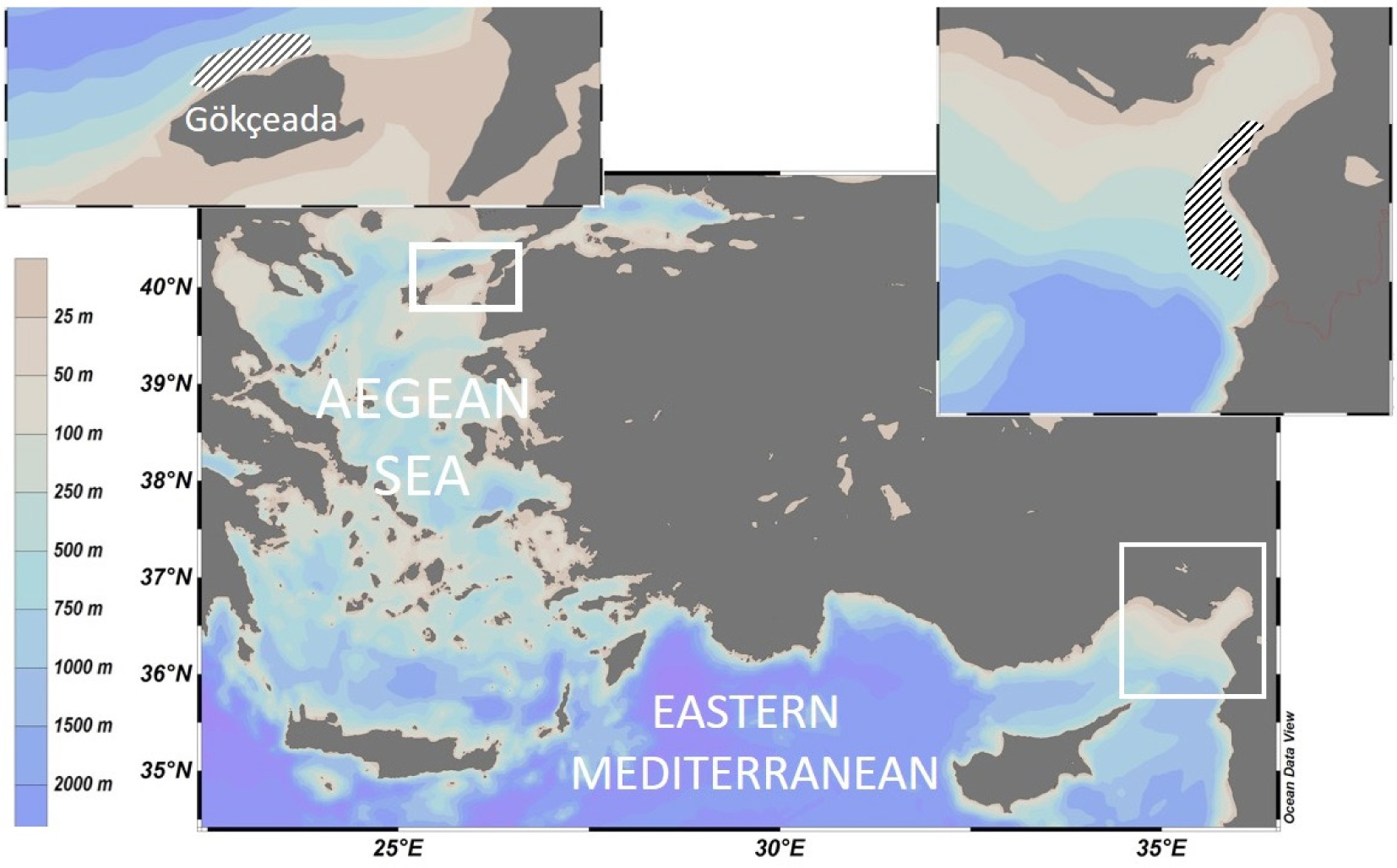
Figure 1
Sampling areas
Results
A total of 149 invertebrate species, including 6 pelagic ones, were collected from the Northeastern Levantine Sea and the Northeastern Aegean Sea (Table 1). Ninety five species were found in the Northeastern Aegean Sea and 100 species were found in the Northeastern Levantine Sea. Forty three species were common to the two studied areas.
Table 1
List of invertebrate species by depth zone
| The Northeastern Aegean | The Northeastern Levantine | ||||||||
|---|---|---|---|---|---|---|---|---|---|
| Phylum/Species | Depth Stratum (m) | Phylum/Species | Depth Stratum (m) | ||||||
| 30-100 | 100-200 | 200-300 | 300-410 | 30-100 | 100-200 | 200-300 | 300-410 | ||
| PORIFERA | |||||||||
| Aplysina aerophoba (Nardo, 1833) | x | Porifera spp. | x | x | |||||
| Porifera spp. | x | x | |||||||
| CNIDARIA | |||||||||
| Alcyonium sp. | x | Alcyonium sp. | x | x | x | ||||
| Caryophyllia sp. | x | Alicia mirabilis Johnson, 1861 | x | x | |||||
| Pennatula phosphorea Linnaeus, 1758 | x | x | 2Funiculina quadrangularis (Pallas, 1766) | x | |||||
| 2Lytocarpiamyriophyllum (Linnaeus, 1758) | x | x | x | ||||||
| Phyllorhiza punctata von Lendenfeld, 1884 | pelagic | ||||||||
| Pennatula phosphorea Linnaeus, 1758 | x | x | |||||||
| BRYOZOA | |||||||||
| Bryozoa spp. | x | Bryozoa spp. | x | ||||||
| BRANCHIPODA | |||||||||
| 2Gryphus vitreus (Born, 1778) | x | x | x | ||||||
| ANNELIDA | |||||||||
| 3Hermodice carunculata (Pallas, 1766) | x | Hermodice carunculata (Pallas, 1766) | x | x | |||||
| Pontobdella muricata (Linnaeus, 1758) | x | 2Pontobdella muricata (Linnaeus, 1758) | x | ||||||
| MOLLUSCA | |||||||||
| Acanthocardia sp. | x | Abra sp. | x | ||||||
| Aequipecten opercularis (Linnaeus, 1758) | x | Acanthocardia sp. | x | ||||||
| Calyptraea chinensis (Linnaeus, 1758) | x | Aporrhais pespelecani (Linnaeus, 1758) | x | ||||||
| Diodora sp. | x | Argonauta argo Linnaeus, 1758 | pelagic | ||||||
| Cymbulia peronii Blainville, 1818 | pelagic | Bolinus brandaris (Linnaeus, 1758) | x | x | |||||
| Eledone cirrhosa (Lamarck, 1798) | x | x | x | 1Conomurex persicus (Swainson, 1821) | x | x | |||
| Euspira fusca (Blainville, 1825) | x | Cypraeidae sp. | x | ||||||
| Galeodeaechinophora (Linnaeus, 1758) | x | 1Diodora ruppellii (G. B. Sowerby I, 1835) | x | ||||||
| Illex coindetii (Vérany, 1839) | x | x | x | x | Eledone cirrhosa (Lamarck, 1798) | x | x | ||
| Loligo vulgaris Lamarck, 1798 | x | x | Ensis ensis (Linnaeus, 1758) | x | |||||
| Nudibranchia spp. | x | Illex coindetii (Vérany, 1839) | x | x | x | x | |||
| Octopus salutii Vérany, 1836 | x | Loligo vulgaris Lamarck, 1798 | x | x | x | ||||
| Octopus vulgaris Cuvier, 1797 | x | x | Muricidae sp. | x | |||||
| Pleurobranchus testudinarius Cantraine, 1835 | x | x | Naticarius stercusmuscarum (Gmelin, 1791) | x | x | ||||
| Pseudamussium clavatum (Poli, 1795) | x | Nudibranchia spp. | x | x | |||||
| Rossia macrosoma (Delle Chiaje, 1830) | x | x | x | Callistoctopus macropus (Risso, 1826) | x | ||||
| Sepia elegans Blainville, 1827 | x | x | Octopus vulgaris Cuvier, 1797 | x | x | x | |||
| Sepia officinalis Linnaeus, 1758 | x | x | Semicassis granulata (Born, 1778) | x | |||||
| Sepia orbignyana Férussac [in d’Orbigny], 1826 | x | x | Pleurobranchaea meckeli (Blainville, 1825) | x | |||||
| Solen marginatus Pulteney, 1799 | x | Plocamopherus tilesii Bergh, 1877 | x | ||||||
| Todarodes sagittatus (Lamarck, 1798) | x | Rondeletiola minor (Naef, 1912) | x | x | x | x | |||
| Rossia macrosoma (Delle Chiaje, 1830) | x | x | |||||||
| Sepia elegans Blainville, 1827 | x | x | x | ||||||
| Sepia officinalis Linnaeus, 1758 | x | x | x | ||||||
| Sepia orbignyana Férussac [in d’Orbigny], 1826 | x | x | |||||||
| Tonna galea (Linnaeus, 1758) | x | ||||||||
| Tylodina perversa (Gmelin, 1791) | x | ||||||||
| ARTHROPODA | |||||||||
| Aegeon lacazei (Gourret, 1887) | x | x | x | Aegaeon cataphractus | x | ||||
| Alpheus sp. | x | Aegeon lacazei (Gourret, 1887) | x | x | x | ||||
| Calappa granulata (Linnaeus, 1758) | x | Anapagurus spp. | x | ||||||
| Chlorotocus crassicornis (A. Costa, 1871) | x | 1Atergatis roseus (Rüppell, 1830) | x | ||||||
| Galathea bolivari Zariquiey Álvarez, 1950 | x | x | 1Carupa tenuipes Dana, 1852 | x | x | ||||
| Inachus communissimus Rizza, 1839 | x | 1Charybdis longicollis Leene, 1938 | x | x | |||||
| Inachus dorsettensis (Pennant, 1777) | x | 1Clorida albolitura Ahyong & Naiyanetr, 2000 | x | x | |||||
| Latreillia elegans Roux, 1830 | x | x | 1Erugosquilla massavensis (Kossmann, 1880) | x | x | ||||
| Liocarcinus depurator (Linnaeus, 1758) | x | x | Ethusa mascarone (Herbst, 1785) | x | x | ||||
| Macropodia linaresi Forest & Zariquiey-Álvarez, 1964 | x | x | Goneplax rhomboides (Linnaeus, 1758) | x | |||||
| Macropodia longirostris (Fabricius, 1775) | x | Homola barbata (Fabricius, 1793) | x | x | |||||
| Macropodia rostrata (Linnaeus, 1761) | x | Inachus communissimus Rizza, 1839 | x | x | |||||
| Maja squinado (Herbst, 1788) | x | 1Ixa monodi Holthuis & Gottlieb, 1956 | x | x | |||||
| Medorippe lanata (Linnaeus, 1767) | x | x | Latreillia elegans Roux, 1830 | x | x | x | |||
| Munida sp. | x | x | x | Liocarcinus depurator (Linnaeus, 1758) | x | ||||
| Nephrops norvegicus (Linnaeus, 1758) | x | Macropodia linaresi Forest & Zariquiey-Álvarez, 1964 | x | x | |||||
| Paguristes eremita (Linnaeus, 1767) | x | Macropodia longipes (A. Milne-Edwards & Bouvier, 1899) | x | x | |||||
| Pagurus prideaux Leach, 1815 | x | x | Macropodia longirostris (Fabricius, 1775) | x | x | ||||
| Pandalina brevirostris (Rathke, 1843) | x | Macropodia rostrata (Linnaeus, 1761) | x | ||||||
| Pasiphaea sivado (Risso, 1816) | x | Macropodia tenuirostris (Leach, 1814) | x | ||||||
| Parapenaeus longirostris (Lucas, 1846) | x | x | x | x | Medorippe lanata (Linnaeus, 1767) | x | x | x | |
| Phrosina semilunata Risso, 1822 | pelagic | Metapenaeus monoceros (Fabricius, 1798) | x | x | |||||
| Pilumnus hirtellus (Linnaeus, 1761) | x | Monodaeus couchii (Couch, 1851) | x | x | |||||
| Pilumnus minutus De Haan, 1835 | x | Munida sp. | x | ||||||
| Pisa armata (Latreille, 1803) | x | Pagurus chevreuxi (Bouvier, 1896) | x | ||||||
| Pisa nodipes Leach, 1815 | x | Pagurus prideaux Leach, 1815 | x | x | |||||
| Plesionika edwardsii (Brandt, 1851) | x | x | x | x | Parapenaeus longirostris (Lucas, 1846) | x | x | x | x |
| Plesionika martia (A. Milne-Edwards, 1883) | x | Pasiphaea sivado (Risso, 1816) | x | ||||||
| Polycheles typhlops Heller, 1862 | x | x | x | Penaeus kerathurus (Forskål, 1775) | x | ||||
| Scalpellum scalpellum (Linnaeus, 1767) | x | x | 1Penaeus japonicus Spence Bate, 1888 | x | |||||
| Solenocera membranacea (Risso, 1816) | x | 1Penaeussemisulcatus De Haan, 1844 | x | x | |||||
| Squilla mantis (Linnaeus, 1758) | x | x | Pisa armata (Latreille, 1803) | x | x | ||||
| Xantho poressa (Olivi, 1792) | x | Pisa nodipes Leach, 1815 | x | ||||||
| Plesionika edwardsii (Brandt, 1851) | x | x | x | x | |||||
| Pilumnus hirtellus (Linnaeus, 1761) | x | ||||||||
| Polycheles typhlops Heller, 1862 | x | ||||||||
| Processa canaliculata Leach, 1815 | x | ||||||||
| 2Scalpellum scalpellum (Linnaeus, 1767) | x | ||||||||
| Sicyonia carinata (Brünnich, 1768) | x | x | |||||||
| 1Sicyonia lancifer (Olivier, 1811) | x | ||||||||
| Solenocera membranacea (Risso, 1816) | x | ||||||||
| Spinolambrus macrochelos (Herbst, 1790) | x | ||||||||
| Squilla mantis (Linnaeus, 1758) | x | ||||||||
| Synalpheus africanus Crosnier & Forest, 1965 | x | ||||||||
| 1Thalamita poissonii (Audouin, 1826) | x | ||||||||
| ECHINO | DERMATA | ||||||||
| Anseropodaplacenta (Pennant, 1777) | x | Antedon mediterranea (Lamarck, 1816) | x | x | x | ||||
| Antedon mediterranea (Lamarck, 1816) | x | x | Astropecten irregularis (Pennant, 1777) | x | x | ||||
| Astropecten aranciacus (Linnaeus, 1758) | x | Astropecten sp. | x | x | x | ||||
| Astropecten irregularis (Linnaeus, 1758) | x | Brissopsis lyrifera (Forbes, 1841) | x | x | |||||
| Astropecten jonstoni (Delle Chiaje, 1827) | x | Centrostephanus longispinus (Philippi, 1845) | x | ||||||
| Astropecten sp. | x | x | x | Cidaris cidaris (Linnaeus, 1758) | x | x | |||
| Astropecten spinulosus (Philippi, 1837) | x | Echinaster sepositus (Retzius, 1783) | x | ||||||
| Brissopsis lyrifera (Forbes, 1841) | x | Echinus melo Lamarck, 1816 | x | ||||||
| Centrostephanus longispinus (Philippi, 1845) | x | 2Hymenodiscus coronata (Sars G.O., 1872) | x | ||||||
| Cidaris cidaris (Linnaeus, 1758) | x | x | x | x | Luidia sarsii Düben & Koren in Düben, 1845 | x | x | ||
| Echinaster sepositus (Retzius, 1783) | x | x | Marthasterias glacialis (Linnaeus, 1758) | x | |||||
| Echinus melo Lamarck, 1816 | x | Ophiothrix fragilis (Abildgaard in O.F. Müller, 1789) | x | ||||||
| Genocidaris maculata A. Agassiz, 1869 | x | Paracentrotus lividus (Lamarck, 1816) | x | ||||||
| Holothuria sp. | x | ||||||||
| Luidia ciliaris (Philippi, 1837) | x | ||||||||
| Luidia sarsii Düben & Koren in Düben, 1845 | x | x | |||||||
| Marthasterias glacialis (Linnaeus, 1758) | x | x | |||||||
| Ophiacantha setosa (Bruzelius, 1805) | x | ||||||||
| Ophiactis kroeyeri Lütken, 1856 | x | ||||||||
| Ophiothrix fragilis (Abildgaard in O.F. Müller, 1789) | x | ||||||||
| Ophiura ophiura (Linnaeus, 1758) | x | x | |||||||
| Parastichopus regalis (Cuvier, 1817) | x | x | x | ||||||
| Peltaster placenta (Müller & Troschel, 1842) | x | ||||||||
| Ova canaliferus (Lamarck, 1816) | x | ||||||||
| Sphaerechinus granularis (Lamarck, 1816) | x | x | |||||||
| CHORDATA (SUBPHYLUM) TUNICATA | |||||||||
| Aplidium sp. | x | Ascidiidae spp. | x | x | |||||
| Ascidiidae spp. | x | Ciona intestinalis (Linnaeus, 1767) | x | ||||||
| Ciona intestinalis (Linnaeus, 1767) | x | x | x | Molgula manhattensis (De Kay, 1843) | x | ||||
| Halocynthia papillosa (Linnaeus, 1767) | x | x | 4Pyrosoma atlanticum Péron, 1804 | pelagic | |||||
| Polyclinella (cf) azemai Harant, 1930 | x | ||||||||
| Phallusia mammillata (Cuvier, 1815) | x | x | |||||||
| Thalia democratica (Forskål, 1775) | pelagic | ||||||||
While six species were reported for the first time from the Turkish Levantine coast [Funiculina quadrangularis (Pallas, 1766), Gryphus vitreus (Born, 1778), Hymenodiscus coronata (Sars G.O., 1872), Pontobdella muricata (Linnaeus, 1758), Lytocarpia myriophyllum (Linnaeus, 1758) and Scalpellum scalpellum (Linnaeus, 1767)], only one species – Hermodice carunculata (Pallas, 1766) – was reported for the first time from the Aegean Sea coast of Turkey. Twelve alien species were encountered in the Northeastern Levantine Sea and no alien species were found in the Northeastern Aegean Sea during the study period (Table 1).
Pyrosoma atlanticum was recorded for the first time on the Turkish coast (Fig. 2). Although the species had been considered absent in the Eastern Mediterranean (Furnestin 1979; Por, Dimentman 1989), it was recorded there during mesopelagic surveys (Godeaux 1990). Later, Galil & Goren (1994) caught three colonies of P. atlanticum below 1400 m in the Southern Levantine Sea. It was also collected in small numbers at The Northeast of Cyprus (Weikert, Godeaux 2008).
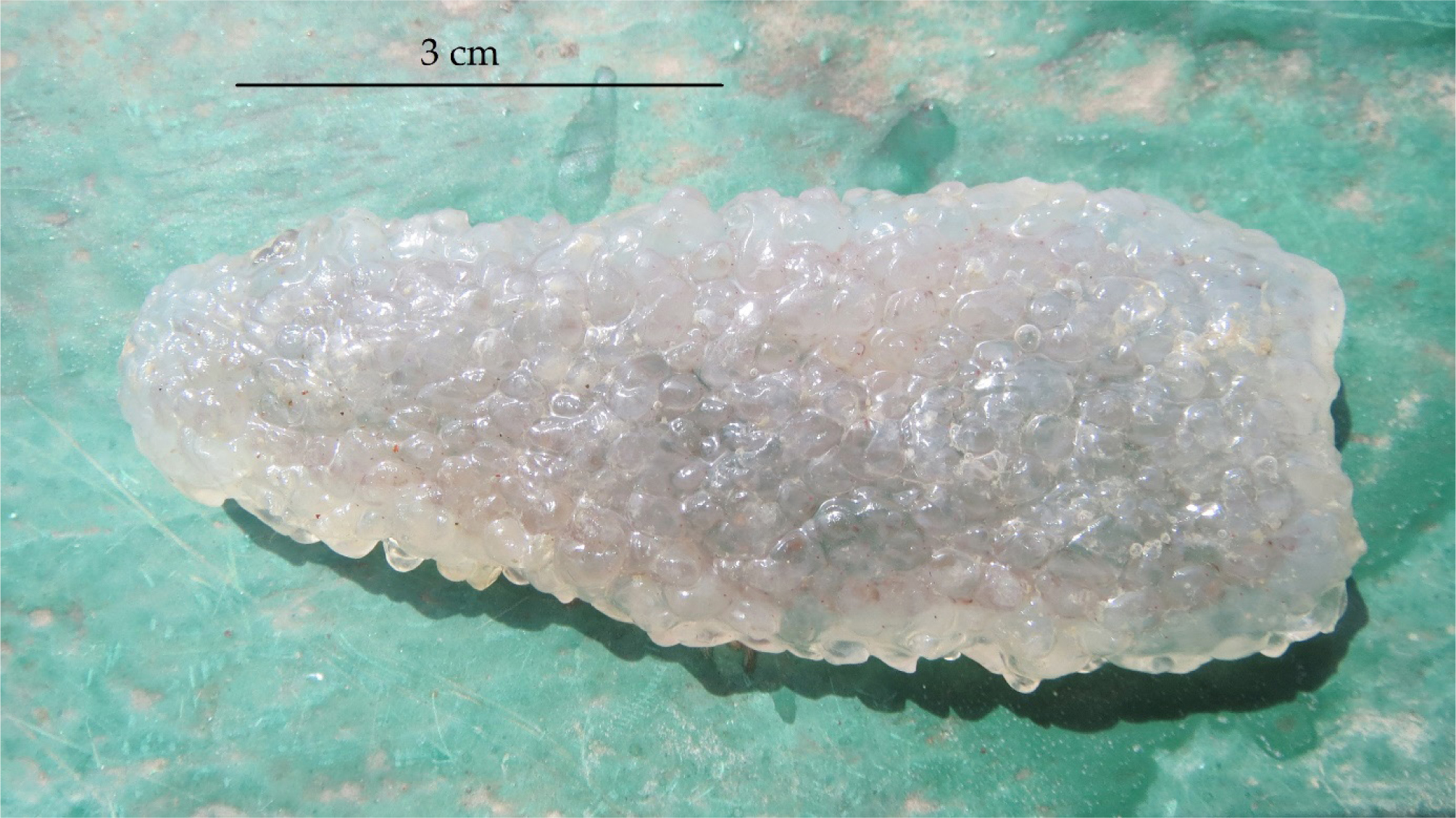
Figure 2
Pyrosoma atlanticum
In the Northeastern Aegean Sea, the Shannon-Weaver diversity index (H’) showed significant differences between the depth ranges, and its values ranged from 1.002 to 4.16. The index increased with depth between 30 and 200 m, and decreased at 410 m. In the Northeastern Levantine Sea, the highest index value was calculated for a depth ranging from 30 to 100 m and the minimum index value of 1.331 was determined for a depth of 200-300 m (Table 2).
Table 2
Result of SIMPER analysis
| Depth (m) | S | N | d | J′ | H′ | 1-Lambda′ |
|---|---|---|---|---|---|---|
| The Northeastern Aegean Sea | ||||||
| 30-100 | 46 | 586 | 7.061 | 0.7002 | 3.868 | 0.8892 |
| 100-200 | 63 | 1174 | 0.772 | 0.6959 | 4,16 | 0.9016 |
| 200-300 | 37 | 3346 | 4.436 | 0.4274 | 2.226 | 0.6325 |
| 300-410 | 46 | 6685 | 5.109 | 0.1814 | 1.002 | 0.238 |
| The Northeastern Levantine Sea | ||||||
| 30-100 | 36 | 673 | 5.375 | 0.5901 | 3.051 | 0.7643 |
| 100-200 | 64 | 2751 | 7.955 | 0.3988 | 2.393 | 0.559 |
| 200-300 | 56 | 7503 | 6.164 | 0.2292 | 1.331 | 0.3411 |
| 300-410 | 47 | 4336 | 5.493 | 0.3651 | 2.028 | 0.5724 |
SIMPER analysis was applied to compare the Northeastern Aegean Sea and the Northeastern Levantine Sea. The result revealed clear differences between the two surveyed areas except for the 300-410 m depth range (Fig. 3). The average similarity for this depth range is 52.12%. Parapenaeus longirostris contributed 47.17% to the total similarity, and was followed by Plesionika edwardsii and Illex coindetii with 15.34% and 11.02%, respectively. P. longirostris and I. coindetii are also the most contributing species to the total similarity at the other depth ranges (Table 3).
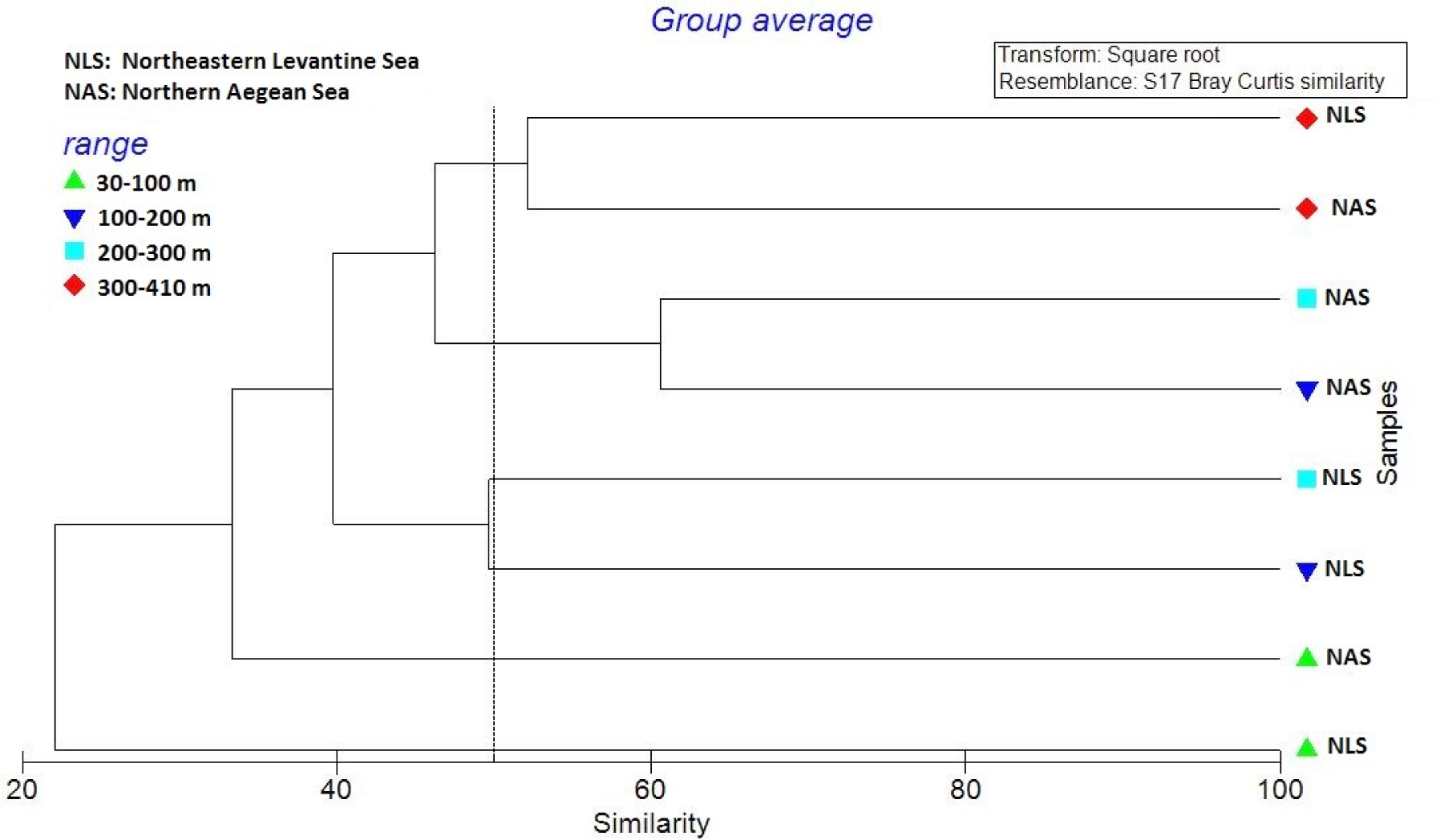
Figure 3
Cluster analysis based on presence/absence data from samples collected in the Northeastern Levantine Sea and the Northeastern Aegean Sea
Table 3
Results of the SIMPER routine analyzing the similarity between depth ranges for macroinvertebrate fauna
| Group 30-100 m | Group 100-200 m | ||||||
|---|---|---|---|---|---|---|---|
| Average similarity: 14.14 | Average similarity: 35.67 | ||||||
| Species | Av.Abund | Av.Sim | Contrib% | Species | Av.Abund | Av.Sim | Contrib% |
| Parapenaeus longirostris | 12.67 | 7.1 | 50.19 | Parapenaeus longirostris | 28.81 | 7.35 | 20.62 |
| Illex coindetii | 3.1 | 1.55 | 10.95 | Illex coindetii | 10.98 | 5.05 | 14.16 |
| Porifera sp | 2.67 | 1.55 | 10.95 | Sepia officinalis | 8.8 | 4.21 | 11.8 |
| Echinaster sepositus | 3.05 | 1.26 | 8.94 | ||||
| Luidia sarsii | 1 | 0.89 | 6.32 | ||||
| Group 200-300 m | Group 300-410 m | ||||||
| Average similarity: 45.55 | Average similarity: 52.12 | ||||||
| Species | Av.Abund | Av.Sim | Contrib% | Species | Av.Abund | Av.Sim | Contrib% |
| Parapenaeus longirostris | 60.37 | 19.39 | 42.58 | Parapenaeus longirostris | 64.3 | 24.59 | 47.17 |
| Illex coindetii | 22.13 | 6.99 | 15.35 | Plesionika edwardsii | 19.15 | 8 | 15.34 |
| Sepia elegans | 11.19 | 4.31 | 9.47 | Illex coindetii | 12.39 | 5.74 | 11.02 |
| Sepia officinalis | 13.64 | 4.22 | 9.26 | ||||
Discussion
Alien species have become very important components of benthic communities in the Levantine basin. Most of the studies carried out in the area included only new records of alien species, whereas data on the abundance and biomass of alien species in this area are comparatively scarce. In addition, trawl surveys focused mainly on fish species distribution, neglecting invertebrate species in both areas, i.e. the Northeastern Levantine and the Northeastern Aegean Sea. Nevertheless, this study has determined the diversity and bathymetric distribution of invertebrate species in both areas.
Albayrak (2010) reported that alien species in Iskenderun Bay accounted for 14.3% of the total number of bivalve species and 7.7% of the total number of bivalve individuals between 2 m and 30 m depth. However, Mollusca is the richest group (Çınar et al. 2011) among alien species in the Mediterranean. Although Bakir et al. (2012) reported 286 mollusk species, including 78 alien species from the Iskenderun Bay between 0 m and 100 m depth, no alien mollusk species have been recorded from the Northeastern Levantine Sea in this study. Depth seems the only possible factor causing this differentiation.
Özcan et al. (2005) conducted research surveys along the coast of the Iskenderun Bay at depths ranging from 4 to 50 m. Twenty different brachyuran crab species were identified. In addition, alien species: Charybdis longicollis, Portunus pelagicus and Callinectes sapidus, were most numerous and most often caught in the area. According to Can et al. (2004), Metapenaeus stebbingi had the highest average catch rate (76.9%) in the catch composition of penaeid shrimps from the Iskenderun Bay. The catch ratios for other shrimp species were as follows: Penaeus semisulcatus (18.20%), Metapenaeus monoceros (2.30%), Merlicertus kerathurus (1.50%), and Metapenaeus japonicus (1.20%). In addition, all shrimp species, except for M. kerathurus, are alien.
A bottom trawl haul conducted in Iskenderun Bay at a depth of 30 m revealed that 92% of the total number of specimens and 89% of the total biomass belonged to Lessepsian species. Rhopilema nomadica (58%), Charybdis longicollis (17%), Penaeus semisulcatus (5%) and Equulites klunzingeri (4%) accounted for the prevailing part of the total biomass (84%) in the area and C. longicollis was the most abundant species in the catch (63% of all specimens) (Çınar et al. 2011).
So far, the Northeastern Levant basin has been thoroughly surveyed only by Gücü, Bingel (1994). In that study, 31 invertebrate species and 134 fish species were collected at depths ranging from 8 to 78 m, while fish species accounted for 72.1% of the total biomass. In addition, the biomass of alien species decreased from 65% to 11% at a depth of 55-78 m.
Çınar et al. (2011) reported the highest number of alien species (330) from the Levantine coast of Turkey and 224 of them were invertebrate species. We reported only 12 alien species in the Northeastern Levantine Sea. This result clearly shows that Lessepsian invertebrate species are much less common in deep waters.
Another study of the catch composition and biodiversity of Mersin Bay shows only 23 invertebrate species collected (Gökçe et al. 2016). Çiçek et al. (2014) conducted a bottom trawl fishery along the coasts of Karataş in the 2002-2003 fishing season, where 90 fish species and 20 invertebrate species (5 crustacean species and 5 species of cephalopods) were collected.
Trawl researches in the Turkish seas were mainly focused on demersal fish assemblages. JICA (1993) conducted surveys in territorial waters of Turkey as well as in international waters at a depth of 20-500 m. There were 24 and 20 invertebrate species observed in the Northern Aegean Sea and the South Aegean Sea, respectively. Soykan et al. (2016) conducted studies in Sigacik Bay (Central Aegean Sea) using a commercial trawler, in which a total of 28 invertebrate species, 10 cephalopods, 13 crustaceans, 4 echinoderms and one porifera were captured. Kallianiotis et al. (2000) reported 26 invertebrate species off Heraklion Bay between 50 and 1000 m.
We identified more invertebrate species than other studies for both areas, i.e. the Northeastern Aegean and Northeastern Levantine Sea. The differences in the results were due to the fact that our study was focused on invertebrates species.
The result of SIMPER showed clear differences in the invertebrate species composition between the Northeastern Aegean Sea and the Northeastern Levantine Sea (Fig. 3). The average similarity between the Northeastern Levantine Sea and the Northeastern Aegean Sea is 52.12% for a depth of 300-410 m. P. longirostris, P. edwardsii and I. coindetii contributed 73.5% to the total similarity at this depth range. Similarities of the other depth ranges are below 50%. Lessepsian species are mostly distributed in waters below 70 m due to low temperate (Galil, Zenetos 2002). Because the coast of the Levantine Sea is under the influence of Lessepsian migration, the similarity between the two surveyed areas is very low, especially below 200 m.
This study is the first attempt to determine the invertebrate distributions, ranging from shallow waters to the deepest zones of the Northeastern Levantine Sea and the Northeastern Aegean Sea. The results show the differences in the bathymetric distribution and composition of invertebrate species occurring in the Northeastern Levantine Sea and the Northeastern Aegean Sea.
Acknowledgements
The authors would like to thank Luis Martell and Dr. Noa Shenkar for their assistance in the identification of hydrozoa and tunicate species, respectively. This work was supported by the Scientific Research Projects Coordination Unit of Istanbul University, project no. 53276.