
Table 1
Morphometric characteristics of the studied Masurian lakes.
| Lake | Area (ha) | Max depth (m) | Mean depth (m) | Max length (m) | Max width (m) | Mixing type |
|---|---|---|---|---|---|---|
| Warniak | 38.4 | 3.7 | 1.2 | 1000 | 500 | polymictic |
| Dgat Wielki | 93.9 | 18.8 | 5.7 | 1275 | 1110 | dimictic |
| Dgat Maty | 14.4 | 15.8 | 4.6 | 670 | 295 | dimictic |
Table 2
Chemical parameters during the ice-covered period in the eutrophic Masurian lakes. Mean values with standard deviations and ranges in parentheses.
| Lake | DOC (mg l−1) | POC (mg l−1) | TP (µg l−1) | TN (mg l−1) | Chl a (µg l−1) |
|---|---|---|---|---|---|
| Warniak | 4.78 ± 0.77 (3.75-5.60) | 0.23 ± 0.13 (0.10-0.37) | 63 ± 7 (56-72) | 0.97 ± 0.10 (0.87-1.10) | 3.28 ±1.12 (2.46-4.92) |
| Dgat Wielki | 4.81 ± 0.61 (4.31-5.69) | 0.34 ± 0.16 (0.19-0.57) | 94 ± 19 (75-118) | 1.04 ± 0.15 (0.91-1.22) | 6.45 ± 1.09 (5.2-7.78) |
| Dgat Maty | 5.71 ± 1.62 (4.23-7.50) | 0.45 ± 0.11 (0.29-0.52) | 105 ± 19 (81-128) | 1.24 ± 0.08 (1.12-1.30) | 15.47 ± 8.63 (5.32-24.78) |
DOC: dissolved organic carbon; POC: particulate organic carbon; TP: total phosphorus, TN: total nitrogen, Chl a: chlorophyll a.
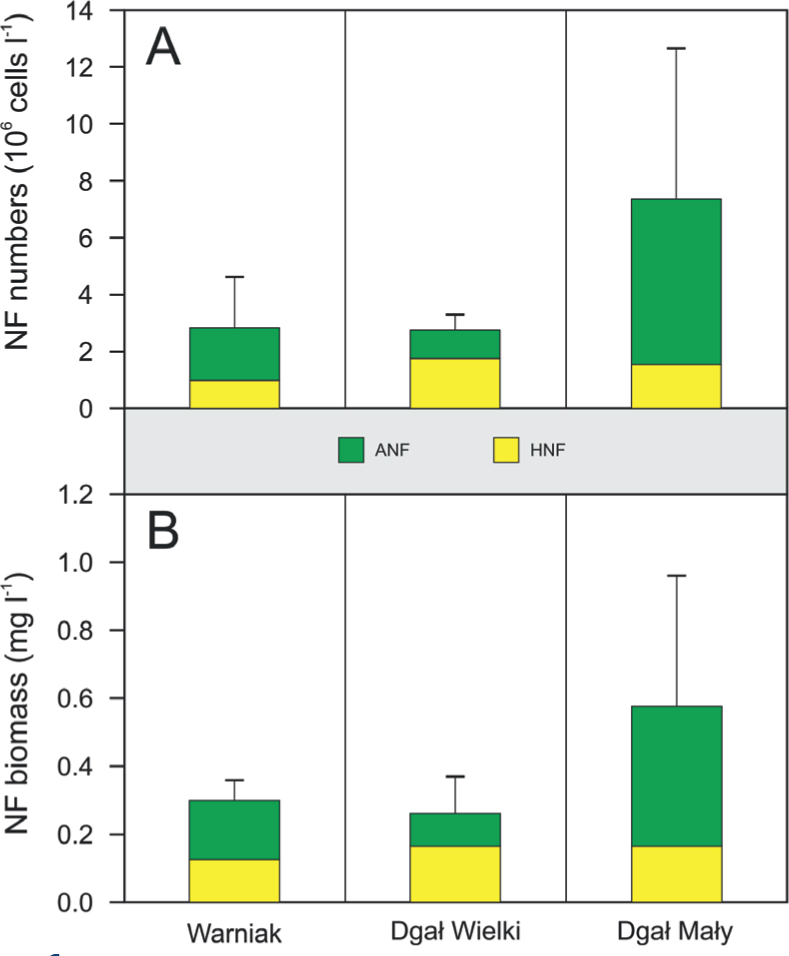
Figure 1
The numbers (A) and biomass (B) of nanoflaagellates, with autotrophic (ANF) and heterotrophic (HNF) cells marked, during the ice-covered period in the eutrophic Masurian lakes. Mean values from four sampling datasets with standard deviations for the total numbers and biomass.
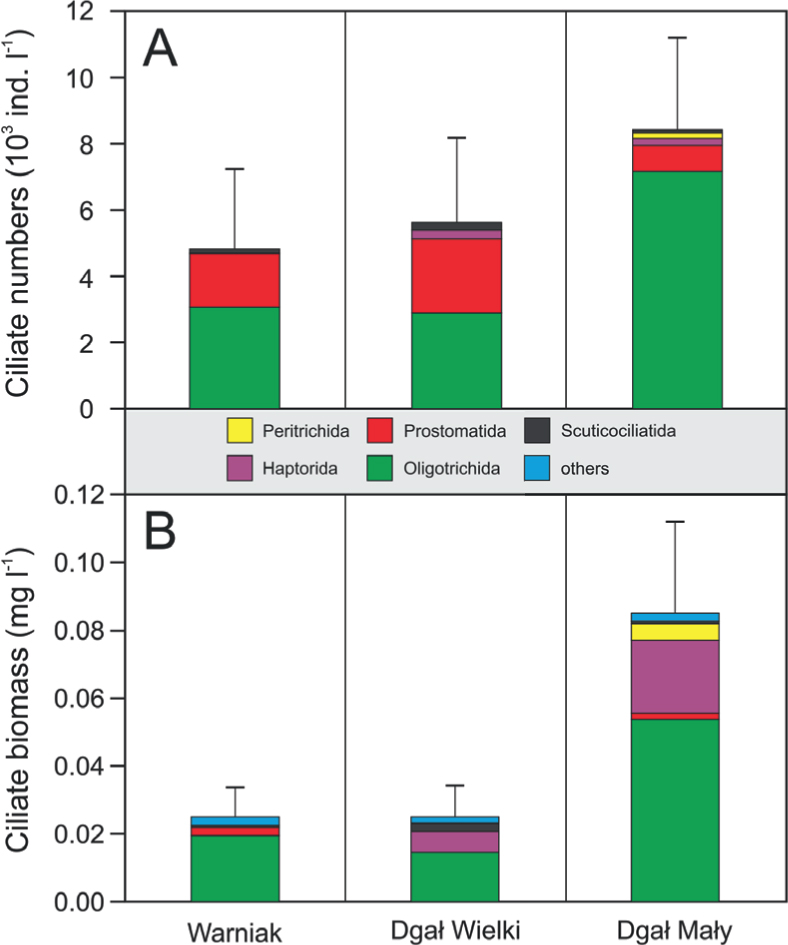
Figure 2
The numbers (A) and biomass (B) of ciliates, with taxonomic groups marked, during the ice-covered period in the eutrophic Masurian lakes. Mean values from four sampling datasets with standard deviations for the total numbers and biomass.
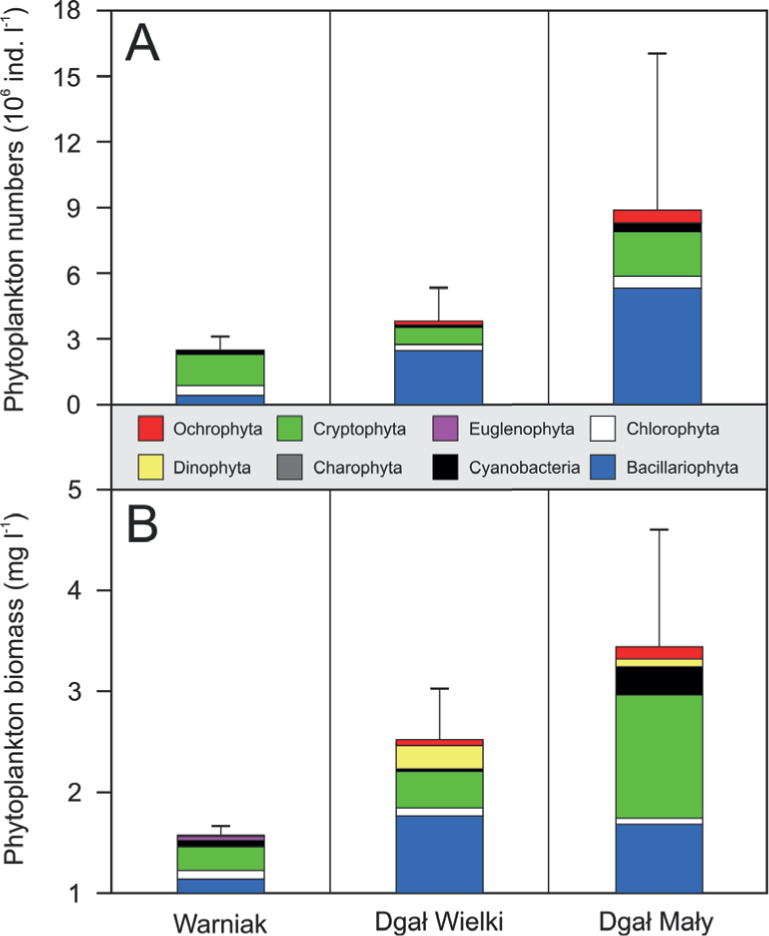
Figure 3
The numbers (A) and biomass (B) of phytoplankton, with taxonomic groups marked, during the ice-covered period in the eutrophic Masurian lakes. Mean values from four sampling datasets with standard deviations for the total numbers and biomass.
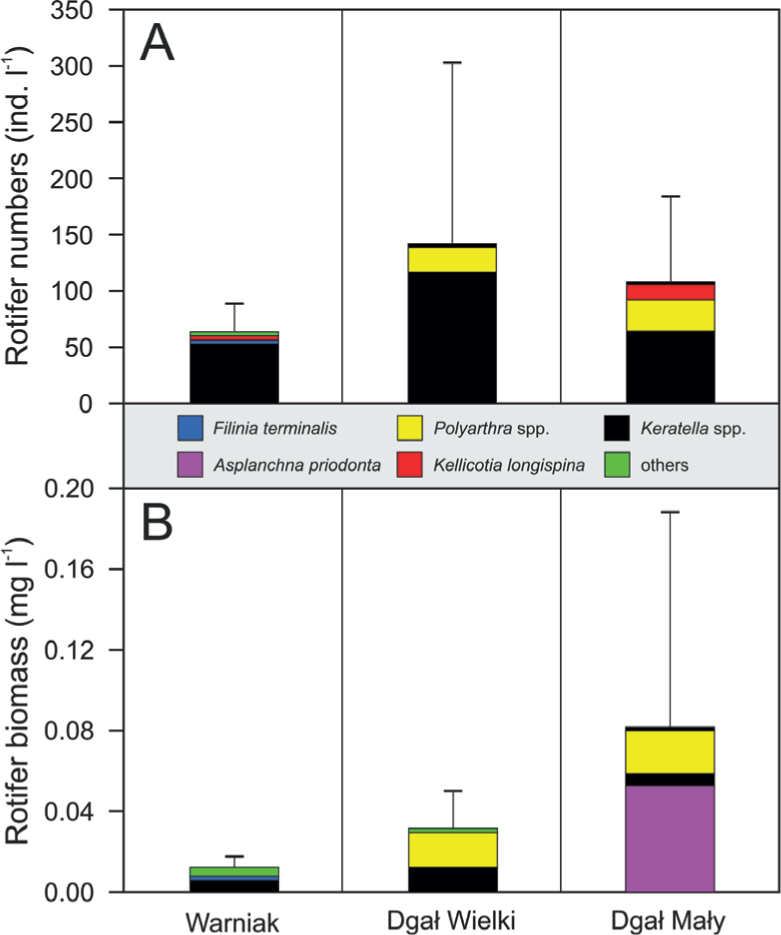
Figure 4
The numbers (A) and biomass (B) of rotifers, with dominant taxa marked, during the ice-covered period in the eutrophic Masurian lakes. Mean values from three sampling datasets with standard deviations for the total numbers and biomass.
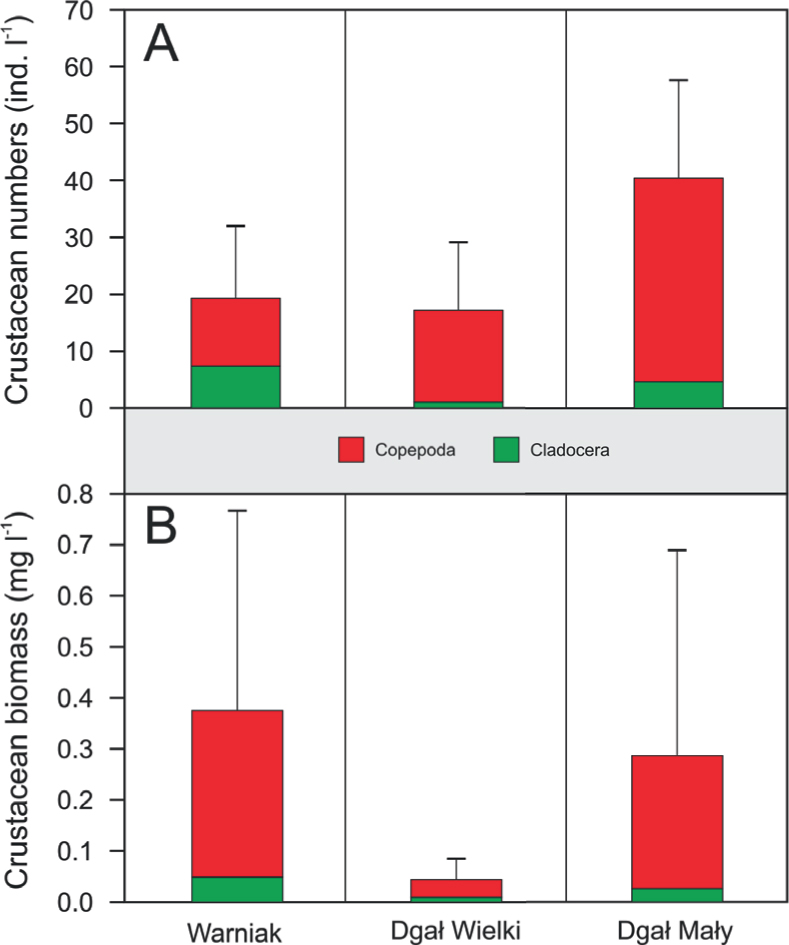
Figure 5
The numbers (A) and biomass (B) of crustaceans, with cladocerans and copepods marked, during the ice-covered period in the eutrophic Masurian lakes. Mean values from three sampling datasets with standard deviations for the total numbers and biomass.
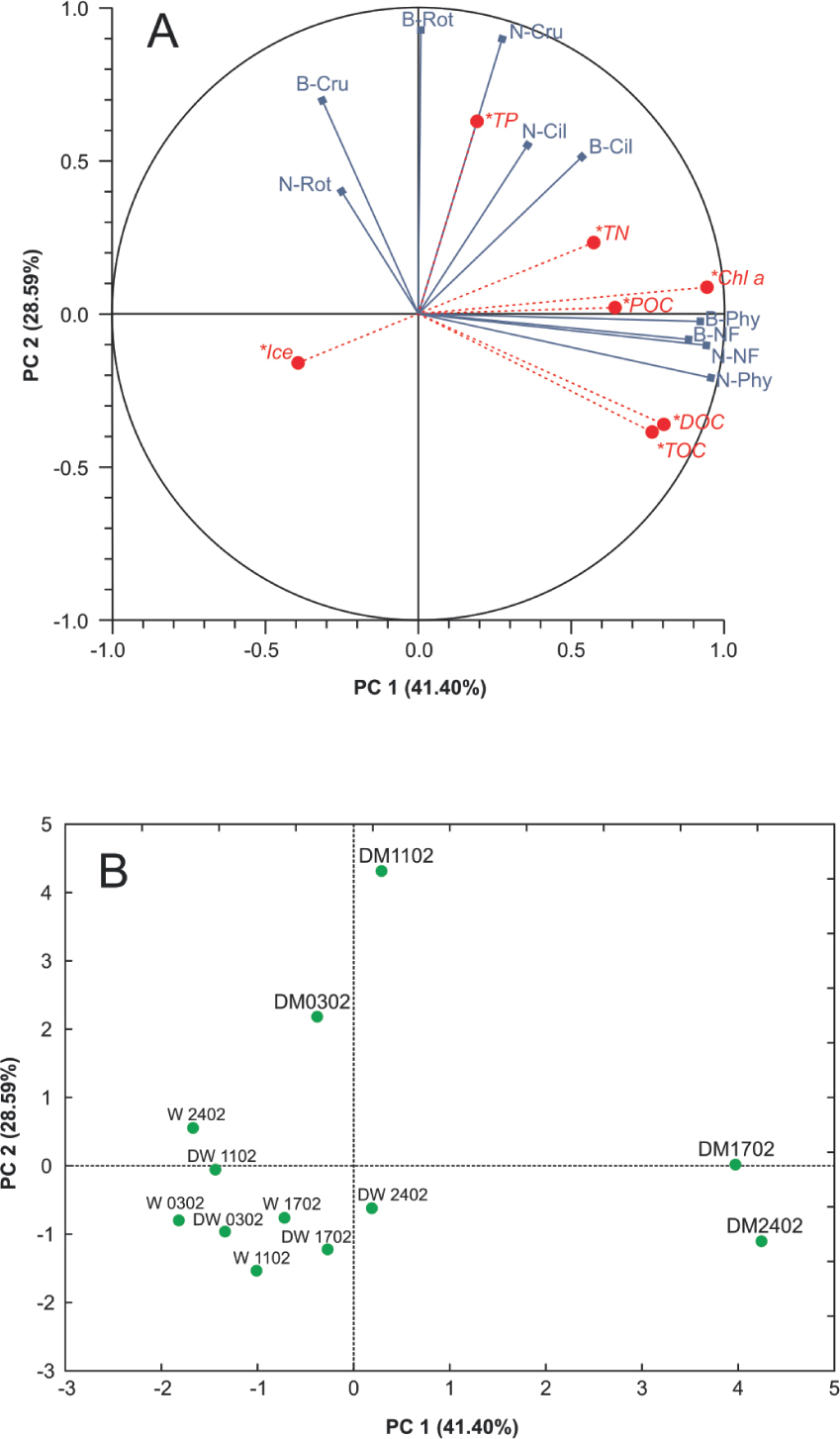
Figure 6
The relationships between abiotic and biotic components based on Principal Component Analysis (PCA). A – ordination diagram, B – classification of samples. Ice – ice cover, DOC, POC, TOC – forms of carbon, TP, TN – total phosphorus and nitrogen, Chl a – chlorophyll a, N-NF, B-NF, N-Cil, B-Cil, N-Phy, B-Phy, N-Rot, B-Rot, N-Cru, B-Cru – the numbers and biomass of nanoflagellates, ciliates, phytoplankton, rotifers, and crustaceans, respectively. W, DW, DM – lakes Warniak, Dgał Wielki and Dgał Mały with sampling dates
Table 3
Mean (from three sampling dates) biomass (in µg C l−1) of autotrophic (A) and heterotrophic (H) organisms during the ice-covered period in the eutrophic Masurian lakes.
| Organisms | Warniak | % | Dgał Wielki | % | Dgał Mały | % |
|---|---|---|---|---|---|---|
| Autotropic biomass | ||||||
| Phytoplankton | 100.7 | 76.2 | 255.5 | 91.5 | 501.6 | 82.3 |
| ANF | 31.4 | 23.8 | 23.6 | 8.5 | 107.6 | 17.7 |
| TOTAL | 132.1 | 279.1 | 609.2 | |||
| Heterotrophic biomass | ||||||
| HNF | 30.8 | 16.0 | 39.8 | 51.3 | 40.2 | 19.6 |
| Ciliates | 5.1 | 2.7 | 5.7 | 7.4 | 13.7 | 6.7 |
| Rotifers | 5.2 | 2.7 | 13.9 | 17.9 | 36.6 | 17.8 |
| Crustaceans | 151.2 | 78.6 | 18.1 | 23.4 | 114.8 | 55.9 |
| TOTAL | 192.3 | 77.5 | 205.3 | |||
| A/H biomass ratio | 0.7 | 3.6 | 3.0 | |||