
Introduction
Ichthyoplankton research plays an essential role in improving our knowledge of the spawning season, abundance and distribution of fish fauna and constituent populations (Kent et al. 2013). Temporal variations of fish eggs and larvae are associated with spawning time and continuance of spawning (Gray & Miskiewicz 2000). Ichthyoplankton surveys are the most effective sampling strategy to understand biological diversity of the early life stages of fishes (Sherman et al. 1983). In addition, ichthyoplankton surveys enable us to investigate the early life stages, regardless of the commercial fishing effort (Govoni 2005). During the last five decades, ichthyoplankton surveys were carried out by several researchers in the Marmara Sea and the Aegean Sea (Somarakis et al. 2000; Turker & Hossucu 2006; Gokturk et al. 2010; Demirel 2004). However, no ichthyoplankton research has been conducted in the Dardanelles Strait. A total of 118 juvenile species have been recorded in the shallow waters of the strait (Ozen 2008).
In this study, temporal variation of the ichthyoplankton community was investigated in the Dardanelles Strait. The main objectives of the present study were (i) to gain knowledge about the ichthyoplankton community structure, (ii) to assess temporal variation in fish eggs and larvae and (iii) to observe the effects of ichthyoplankton abundance and biodiversity in the Marmara Sea on the Aegean Sea via transport through the narrow Dardanelles Strait.
Materials and methods
Ichthyoplankton samples were collected from 3 stations located along the Anatolian coast of the Dardanelles (Figure 1). Sampling was carried out monthly between March 2012 and February 2013. Samples were collected by horizontal and vertical tows, using a WP-2 plankton net with a 500 µm mesh net (57 cm frame diameter, 3 m total length) from all stations. Horizontal samples were collected 0.5 m under the sea surface for a duration of 10 minutes with a vessel speed of 2 knots. Vertical tows were conducted from the upper pycnocline (~20 m) to the sea surface. Due to the low individual abundance values, the results of vertical tows were only used to evaluate biological diversity, whereas the results of horizontal tows were used for both abundance and biological diversity analyses.
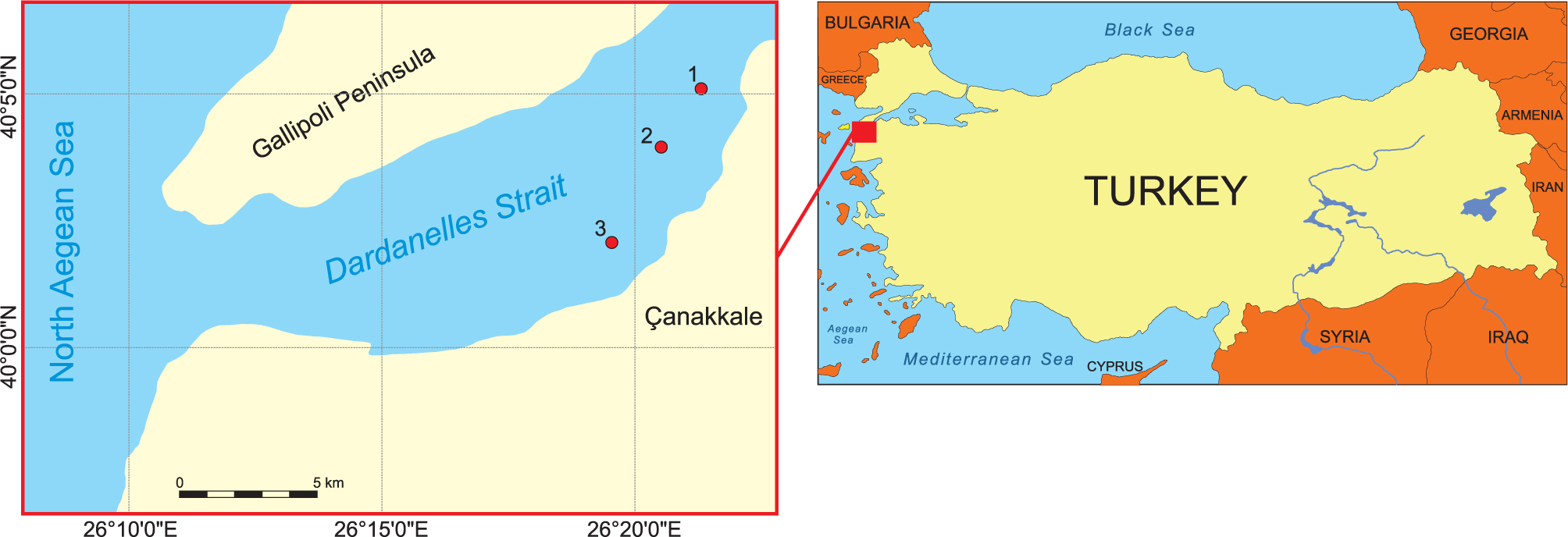
Figure 1
Study area and sampling stations
All tows were conducted during daylight and samples were immediately fixed with 4% formaldehyde-sea water solution on the vessel. Fish eggs and larvae were identified and counted under a dissecting microscope in the laboratory. The keys of Dekhnik (1973), Russell (1976), and Yüksek & Gücü (1994) were used for the identification of fish eggs and larvae. The determination of fish egg stages was conducted with Dekhnik’s (1973) 6-stage development method. The larval stages were determined as prelarvae and postlarvae according to Hubbs (1943). Salinity and temperature were measured using a Yellow Springs Instruments meter (YSI 6600). Biological diversity was calculated for each sample by taking the exponential of the Shannon-Wiener Index H, the Dominance Index, the Margalef diversity Index and Pielou’s evenness component (J’). Calculations of biodiversity indices were conducted with PAST Version 2.17 (Hammer et al. 2001). Densities of fish eggs and larvae (the count per 1000 m3) for horizontal tows were calculated as follows:
where N is the total number of eggs or larvae in each sample and V is the volume of sampled water (m3). Since no flow meter was used in the study, the volume of water that passed through the net, V, was estimated using the following equation:
where v = average speed through the water during a tow (m s−1), Δt = time of the tow (s), and A = cross-sectional area of the net (m2). Densities calculated were considered to represent the minimum ichthyoplankton density per 1000 m3.
Seasons were classified based on mean water temperature, i.e. values below 12°C were classified as winter, and those with mean water temperatures above 20°C were classified as summer. Thus, the winter period included January to March, the spring period included April to May, the summer period included June to September, and the autumn period included October to December.
Results and discussion
Temperature and Salinity
Sea surface temperatures varied between 8.8°C (March 2012) and 23.9°C (July 2012) with an annual average surface temperature of 16.9°C. Salinity values ranged from 22.0 (February 2013) to 25.3 PSU (August 2012) with an annual average of 23.6 PSU.
Abundance of fish eggs and larvae
A total of 7392 eggs and 191 larvae representing 24 families and 50 species were identified (Table 1). The total fish egg abundance was 46 920 ind. 1000 m−3, with the total fish larvae abundance of 1212 ind. 1000 m−3. Mean fish egg abundance was 3910 ind. 1000 m−3 with mean fish larvae abundance of 100 ind. 1000 m−3. S. sprattus (22 761 ind. 1000 m−3) was the most dominant among egg stages, whereas E. encrasicholus (394 ind. 1000 m−3) and S. sprattus (355 ind. 1000 m−3) were the most dominant among larvae.
Table 1
Abundance and seasonal variations of ichthyoplankton species in different embryonic development stages in the Dardanelles between March 2012 and February 2013
| SPECIES | SEASON | |||||||||||
|---|---|---|---|---|---|---|---|---|---|---|---|---|
| SPRING | SUMMER | AUTUMN | WINTER | |||||||||
| EGG | PR | PL | EGG | PR | PL | EGG | PR | PL | EGG | PR | PL | |
| Arnoglossus laterna | 100 | 5 | 5 | 20 | 0 | 0 | 10 | 0 | 0 | 51 | 0 | 0 |
| Blennius ocellatus | 0 | 0 | 10 | 0 | 0 | 0 | 0 | 0 | 0 | 0 | 0 | 0 |
| Boops boops | 110 | 0 | 10 | 0 | 0 | 0 | 0 | 0 | 0 | 780 | 0 | 0 |
| Buglossidium luteum | 10 | 0 | 0 | 40 | 0 | 0 | 0 | 0 | 0 | 20 | 0 | 0 |
| Callionymus lyra | 20 | 0 | 30 | 0 | 0 | 10 | 0 | 0 | 0 | 20 | 0 | 0 |
| Centrolophus niger* | 0 | 0 | 0 | 0 | 0 | 0 | 0 | 0 | 0 | 0 | 0 | 1* |
| Coris julis | 1510 | 0 | 0 | 20 | 0 | 10 | 0 | 0 | 0 | 0 | 0 | 0 |
| Ctenolabrus rupestris | 0 | 0 | 0 | 30 | 0 | 0 | 0 | 0 | 0 | 0 | 0 | 10 |
| Dicenthrarchus labrax | 0 | 0 | 0 | 0 | 0 | 0 | 0 | 0 | 0 | 0 | 0 | 10 |
| Diplodus annularis | 4200 | 0 | 10 | 30 | 0 | 10 | 0 | 0 | 0 | 0 | 0 | 0 |
| Diplodus sargus | 0 | 0 | 0 | 0 | 0 | 0 | 0 | 0 | 0 | 10 | 0 | 0 |
| Engraulis encrasicholus | 30 | 30 | 20 | 80 | 40 | 294 | 0 | 0 | 10 | 0 | 0 | 0 |
| Eutrigla gurnardus* | 0 | 0 | 0 | 0 | 0 | 1* | 0 | 0 | 0 | 0 | 0 | 0 |
| Gaidropsarus mediterraneus | 130 | 0 | 0 | 0 | 0 | 0 | 110 | 0 | 0 | 820 | 0 | 0 |
| Gobius niger | 0 | 0 | 30 | 0 | 0 | 10 | 0 | 0 | 0 | 0 | 0 | 10 |
| Helicolenus dactylopterus | 0 | 0 | 0 | 0 | 0 | 0 | 0 | 0 | 0 | 10 | 0 | 0 |
| Hippocampus hippocampus | 0 | 0 | 0 | 0 | 0 | 10 | 0 | 0 | 0 | 0 | 0 | 0 |
| Liza saliens | 10 | 0 | 0 | 0 | 0 | 0 | 0 | 0 | 0 | 0 | 0 | 0 |
| Merlangius merlangus | 10 | 0 | 0 | 0 | 0 | 0 | 0 | 0 | 0 | 1210 | 0 | 0 |
| Merluccius merluccius | 0 | 0 | 0 | 0 | 0 | 0 | 10 | 0 | 0 | 220 | 0 | 0 |
| Microchirus variegatus | 40 | 0 | 0 | 20 | 0 | 0 | 0 | 0 | 0 | 0 | 0 | 0 |
| Micromesistius poutassou | 0 | 0 | 0 | 0 | 0 | 0 | 0 | 0 | 0 | 120 | 0 | 0 |
| Mugil cephalus | 0 | 0 | 0 | 10 | 0 | 0 | 0 | 0 | 0 | 0 | 0 | 0 |
| Mullus barbatus barbatus | 5640 | 0 | 0 | 162 | 0 | 0 | 0 | 0 | 0 | 0 | 0 | 0 |
| Mullus surmuletus | 1020 | 0 | 0 | 0 | 0 | 0 | 0 | 0 | 0 | 0 | 0 | 0 |
| Naucrates ductor | 58 | 0 | 0 | 0 | 0 | 0 | 0 | 0 | 0 | 100 | 0 | 0 |
| Pegusa lascaris | 0 | 0 | 0 | 0 | 0 | 0 | 10 | 0 | 0 | 10 | 0 | 0 |
| Pomatoschistus minutus | 0 | 0 | 0 | 0 | 0 | 0 | 0 | 10 | 0 | 0 | 0 | 0 |
| Sarda sarda* | 0 | 0 | 0 | 2* | 0 | 0 | 0 | 0 | 0 | 0 | 0 | 0 |
| Sardina pilchardus | 200 | 26 | 94 | 0 | 0 | 0 | 1782 | 0 | 0 | 3320 | 29 | 12 |
| Scomber japonicus | 40 | 0 | 0 | 0 | 0 | 0 | 0 | 0 | 0 | 0 | 0 | 0 |
| Scomber scombrus | 40 | 0 | 0 | 0 | 0 | 0 | 0 | 0 | 0 | 100 | 0 | 0 |
| Scorpaena porcus | 10 | 0 | 0 | 50 | 0 | 10 | 0 | 0 | 0 | 0 | 0 | 0 |
| Serranus cabrilla | 841 | 12 | 41 | 10 | 0 | 0 | 0 | 0 | 0 | 0 | 0 | 0 |
| Serranus hepatus | 150 | 0 | 0 | 20 | 0 | 0 | 0 | 0 | 0 | 0 | 0 | 0 |
| Serranus scriba | 10 | 0 | 0 | 20 | 0 | 0 | 0 | 0 | 0 | 0 | 0 | 0 |
| Solea solea | 20 | 0 | 0 | 0 | 0 | 0 | 0 | 0 | 0 | 0 | 0 | 0 |
| Sparus aurata | 30 | 0 | 0 | 0 | 0 | 0 | 0 | 0 | 0 | 0 | 0 | 0 |
| Spicara maena* | 0 | 0 | 0 | 0 | 0 | 0 | 2* | 0 | 0 | 0 | 0 | 0 |
| Sprattus sprattus | 10 | 0 | 0 | 0 | 0 | 0 | 10 | 0 | 10 | 22741 | 255 | 90 |
| Symphodus ocellatus | 40 | 0 | 0 | 0 | 0 | 0 | 0 | 0 | 0 | 0 | 0 | 0 |
| Symphodus rostratus | 10 | 0 | 0 | 0 | 0 | 0 | 0 | 0 | 0 | 0 | 0 | 0 |
| Symphodus tinca | 0 | 0 | 0 | 10 | 0 | 20 | 0 | 0 | 0 | 190 | 0 | 0 |
| Trachinus draco | 10 | 0 | 10 | 0 | 0 | 0 | 0 | 0 | 0 | 0 | 0 | 0 |
| Trachurus trachurus | 50 | 0 | 10 | 130 | 0 | 11 | 0 | 0 | 0 | 0 | 0 | 0 |
| Trigla lucerna | 30 | 0 | 0 | 0 | 0 | 0 | 0 | 0 | 0 | 180 | 0 | 0 |
| Lepidotrigla cavillone* | 1* | 0 | 0 | 0 | 0 | 0 | 0 | 0 | 0 | 0 | 0 | 0 |
| Uronoscopus scaber | 60 | 0 | 0 | 0 | 0 | 0 | 0 | 0 | 0 | 0 | 0 | 0 |
| Total Abundance | 14438 | 73 | 270 | 650 | 40 | 384 | 1930 | 10 | 20 | 29902 | 284 | 131 |
The calculated densities were considered to represent the minimum ichthyoplankton density per 1000 m3 from horizontal tows.
* Refers to species that were sampled only by vertical tows and the density unit of these species reflects number of individuals. PR refers to prelarvae and PL refers to postlarvae.
* Refers to species that were sampled only by vertical tows and the density unit of these species reflects number of individuals. PR refers to prelarvae and PL refers to postlarvae.
* Refers to species that were sampled only by vertical tows and the density unit of these species reflects number of individuals. PR refers to prelarvae and PL refers to postlarvae.
* Refers to species that were sampled only by vertical tows and the density unit of these species reflects number of individuals. PR refers to prelarvae and PL refers to postlarvae.
* Refers to species that were sampled only by vertical tows and the density unit of these species reflects number of individuals. PR refers to prelarvae and PL refers to postlarvae.
The maximum fish egg abundance was observed in winter; 63% of the total fish eggs were sampled during the winter period, 56% of the total fish eggs were sampled in March and 80% of the fish eggs in March were S. sprattus eggs (Figure 2A). Relatively large numbers of fish eggs were sampled in May and June, and were dominated by M. barbatus barbatus and Diplodus annularis eggs. Of the total number of eggs of each species, 97.2% of M. barbatus barbatus and 98.8% of D. annularis were sampled in May and June. Low density of E. encrasicolus eggs (110 ind. 1000 m−3) was observed in this study, whereas larvae of this species were most abundant. As sea surface temperatures decreased, the abundance of fish eggs and larvae rapidly declined in the fall. Only S. pilchardus and Gaidropsarus mediterraneus eggs were observed due to the relatively low spawning temperature preferences of these species (Cohen et al. 1990; Akyol et al. 1996).
The maximum larval abundance on a monthly basis was observed in March. This situation resulted from the larvae of S. sprattus. Of the total fish larvae in the one-year period in the survey area, 25.6% were S. sprattus individuals (310 ind. 1000 m−3) sampled in March. Another species that contributed to the high larval abundance in March was S. pilchardus (40 ind. 1000 m−3). In August, the larval abundance was relatively higher compared to other months. E. encrasicolus (220 ind. 1000 m−3) was the most abundant species in August. On a seasonal basis, the maximum larvae abundance was observed in spring and summer (Figure 2B). In these seasons, many species of larvae contributed to the abundance, whereas the great majority of abundance came from a single species in winter. The minimum larval abundance was observed in autumn (30 ind. 1000 m−3) and no larvae were observed in November.
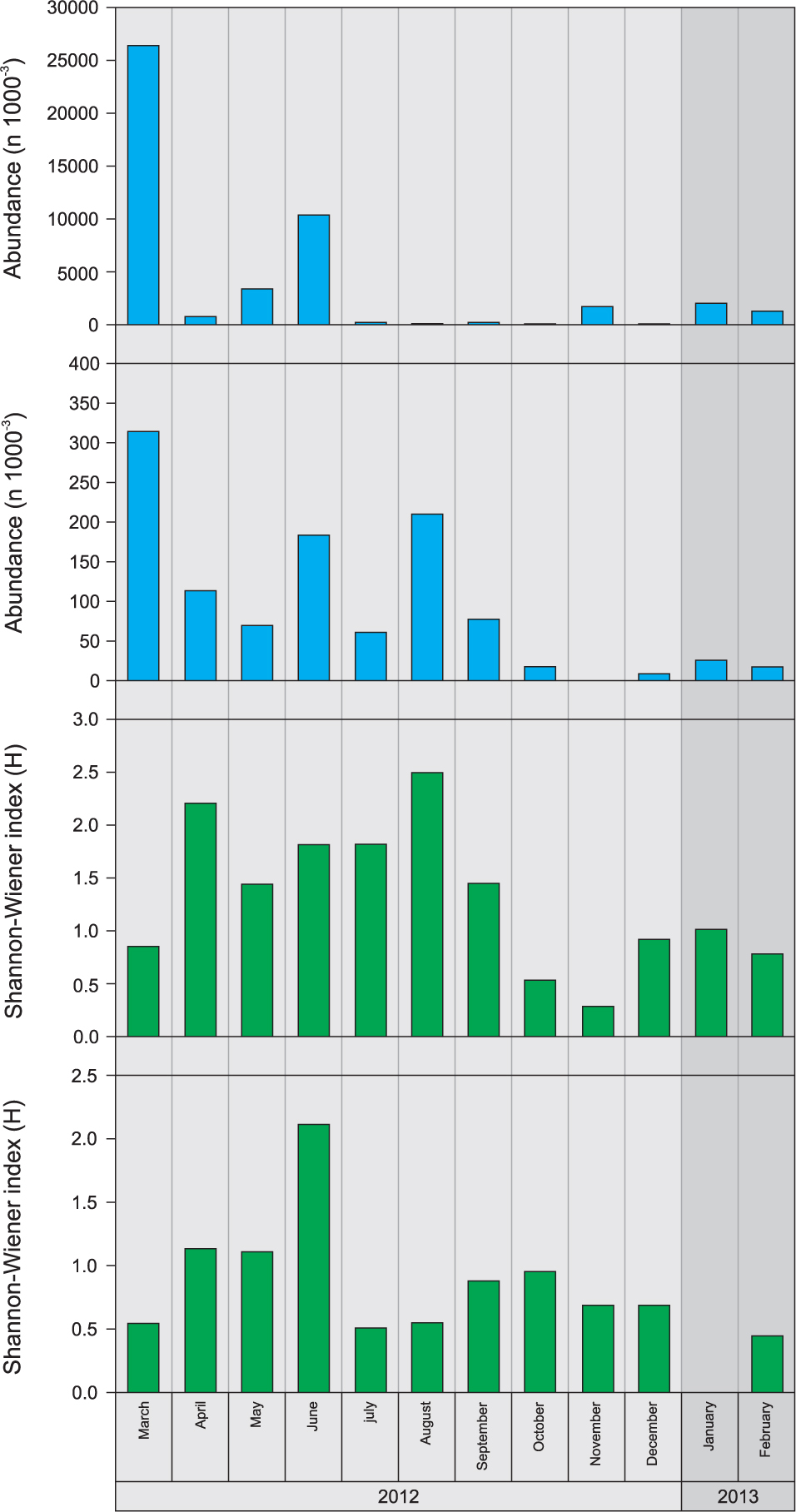
Figure 2
(A) fish egg density, (B) larval fish density, (C) Shannon-Wiener Index H for fish eggs, (D) Shannon-Wiener Index H for larval fish assemblages between March 2012 and February 2013. Egg and larval fish abundance are standardized by volume of water filtered (number of eggs or larvae per 1000 m3).
Biodiversity of fish eggs and larvae
Biodiversity and seasonal variation in species richness was examined. Biodiversity was relatively high in spring and summer for fish eggs. The maximum species richness was observed in June with the eggs of 23 fish species (Table 2). Eggs of 16 species were found in April and August. The minimum species richness was determined in September with the eggs of 3 species. Pielou’s evenness component (J’) values were similar to the values of the Shannon-Wiener Index H (Table 2). The maximum value of the Shannon-Wiener Index H was determined in August – 2.498 and the minimum value in November – 0.290 (Figure 2C). The dominance increased and species richness further decreased in the fall. Although the Shannon-Wiener Index H was higher in spring and summer, the dominance index increased and the Shannon-Wiener and Margalef indices decreased in May. This was due to the high abundance of M. barbatus barbatus and D. annularis eggs in May.
Table 2
Temporal variation in the abundance, species richness and values of some biodiversity indices for fish eggs and larvae
| Numeric data | Stage | March | April | May | June | July | April | September | October | November | December | January 13 | February 13 |
|---|---|---|---|---|---|---|---|---|---|---|---|---|---|
| Individuals | Egg | 4234 | 97 | 1108 | 1912 | 60 | 47 | 39 | 13 | 284 | 35 | 368 | 233 |
| Larvae | 57 | 19 | 17 | 44 | 14 | 69 | 27 | 5 | 2 | 2 | 9 | 6 | |
| Species richness | Egg | 13 | 16 | 15 | 23 | 10 | 16 | 8 | 3 | 4 | 5 | 7 | 9 |
| Larvae | 4 | 5 | 4 | 11 | 3 | 7 | 6 | 3 | 2 | 2 | 1 | 2 | |
| Abundance (ind. 1000 m−3) | Egg | 26420 | 740 | 3440 | 10380 | 250 | 160 | 220 | 70 | 1700 | 200 | 2100 | 1290 |
| Larvae | 360 | 130 | 80 | 210 | 70 | 240 | 90 | 20 | 0 | 10 | 30 | 20 | |
| Dominance (D) | Egg | 0.6526 | 0.1553 | 0.3718 | 0.2222 | 0.2294 | 0.1019 | 0.3149 | 0.7278 | 0.8736 | 0.569 | 0.4672 | 0.6483 |
| Larvae | 0.7248 | 0.4404 | 0.3841 | 0.1477 | 0.7449 | 0.7845 | 0.6159 | 0.44 | 0.5 | 0.5 | 1 | 0.7222 | |
| Shannon-Wiener Index (H) | Egg | 0.8537 | 2.198 | 1.439 | 1.81 | 1.816 | 2.498 | 1.453 | 0.536 | 0.2897 | 0.9221 | 1.01 | 0.7782 |
| Larvae | 0.5441 | 1.129 | 1.115 | 2.107 | 0.5091 | 0.5521 | 0.8765 | 0.9503 | 0.6931 | 0.6931 | 0 | 0.4506 | |
| Pielou’s evenness component (J’) | Egg | 0.3328 | 0.7926 | 0.5314 | 0.5772 | 0.7885 | 0.9011 | 0.6989 | 0.4879 | 0.209 | 0.5729 | 0.5189 | 0.3542 |
| Larvae | 0.3925 | 0.7012 | 0.8044 | 0.8787 | 0.4634 | 0.2837 | 0.4892 | 0.865 | 1 | 1 | 0 | 0.65 |
The highest biodiversity of fish larvae was observed in spring (Figure 2D). The maximum species richness occurred in June with the larvae of 11 fish species and the maximum Shannon-Wiener Index H also in June, with the value of 2.107 (Table 2). The minimum biodiversity and species richness were observed in autumn and winter for fish larvae. Only S. sprattus larvae were sampled in January and the minimum larval biodiversity was observed in January and February, with the Shannon-Wiener Index H values of 0 and 0.450, respectively. Another important finding was that the larval biodiversity index in April was greater than in July, August, and September. Although species richness was higher in August and September, the dominance of E. encrasicolus generated lower biodiversity in July, August and September. Unexpectedly, we observed low species richness in July with the larvae of 3 species.
Discussion
The abundance of fish eggs and larvae in the survey area seems to be related to the increasing sea surface temperature. In the Mediterranean, early summer spawning species start to spawn in late spring and early summer, i.e. in the transitional period. Fish eggs and larvae reach the maximum abundance value and the maximum species richness in this period (Sabates 1990). These findings coincide with our study, where highest spawning occurred in May and June. In contrast, the maximum egg density was observed in March due to high spawning of the winter spawning species S. sprattus. In the Adriatic Sea, this species generally spawns between November and December. The spawning peaks at water temperatures between 9°C and 14°C (Dulcic 1998). Satilmiş et al. (2014) reported that S. sprattus was the dominant species in the winter period at water temperatures between 7°C and 12°C around the coast at Sinop, the Black Sea. Peck et al. (2012) observed that the highest egg survival and the first feeding rate of this species occurred between 8°C and 10°C. These results were similar to our findings where S. sprattus spawned between January and April and peaked in March when the mean sea surface temperature was 8.8°C. In March, 86% of the total eggs sampled were represented by S. sprattus. This observation suggests that the abundance of ichthyoplankton in a given area is directly associated with the optimum physicochemical requirements of existing species.
In general, the biodiversity and species diversity had higher values in spring and summer and lower values in autumn and winter. These results coincide with the general temperate water hypothesis. The observed increase in the larval biodiversity could be attributed to the summer spawners triggered off by a rapid increase in sea surface temperatures. Some very small fluctuations in the biodiversity in the same season were observed in our study. The relatively low biodiversity values in May for fish eggs, and in August and September for fish larvae may result from the extreme dominance of several species. Normally, the larval biodiversity index may be higher in the summer months compared to April in temperate waters. In contrast, the larval biodiversity index was higher in April than July, August and September. This situation resulted from the high larval density of E. encrasicolus. This finding is consistent with Mavruk’s (2009) findings, who observed a higher biodiversity index in the fall compared to the spring due to high spawning of Salaria pavo. Unexpectedly, we observed low abundance, low species richness and biodiversity values in July. The reason for this is not clear, but it may be due to the large amount of suspended material on the sea surface resulting from heavy rain and southwesterly winds. Another possible explanation may be the increased vertical mixing from the bottom to the surface layers in July (Türkoğlu 2010).
Considering the abundance and biodiversity from a spatial perspective, different results were observed compared to previous studies from the nearby areas. Although the current study is based on a small sampling area, the findings suggest that high species richness was observed. A total of 40 species of fish eggs and 24 species of larvae were sampled in the study area. Alimoglu (2002) found 27 species of fish eggs and larvae in the northeastern Marmara Sea. Yüksek et al. (2006) reported that 16 species of fish eggs and larvae were sampled in the Golden Horn, Istanbul in 1999, and the number increased to 27 species in 2002 after the water quality improved. Demirel (2004) reported 21 species of ichthyoplankton for the whole Marmara Sea in the summer periods between 1994 and 2000. In terms of abundance values, the maximum egg abundance was observed for E. encrasicolus, M. barbatus barbatus and D. annularis (Arim 1957; Demirel 2004; Ak 2000; Coker 2003) in the Marmara and Aegean Seas. Demirel et al. (2007) indicated that the western and southwestern parts of the Marmara Sea, especially Erdek Bay, were characterized by the highest abundance and species richness throughout the Marmara Sea. They also indicated that E. encrasicolus had the highest fish egg abundance. In this study, we observed a relatively large number of E. encrasicolus eggs. Almost all E. encrasicolus eggs sampled in our study were in the tailed embryo phase. The relatively lower abundance of earlier egg phases might indicate that E. encrasicolus does not spawn in the Dardanelles Strait and as the spawned eggs develop they drift from the spawning grounds in the Marmara Sea to the sampling area. It is possible that E. encrasicolus spawns around Erdek Bay and the developing eggs and larvae drift to the Aegean Sea via the Dardanelles.
Since different current regimes exist at different depths, additional work needs to be conducted to determine the ichthyoplankton biodiversity and density in terms of vertical stratification in the Dardanelles Strait. Moreover, further investigations should be conducted on larger spatial and temporal scales. Future research should therefore focus on the interactions between ichthyoplankton and sea currents.
Acknowledgement
this study is part of the MSc Thesis of Ismail Burak DABAN. We are grateful to Dr. Alkan Öztekin, Umut Tuncer and Osman Odabaşi who helped with the field sampling.