
Introduction
The oilfish, Ruvettus pretiosus Cocco, 1833, is a member of the family Gempylidae (snake mackerels), which are common in tropical, subtropical and warm temperate waters all over the world and are represented by 23 species belonging to 16 genera (Parin 1986). Only one gempylid species, R. pretiosus, exists in the Mediterranean Sea. R. pretiosus is an oceanic, benthopelagic species found worldwide in tropical and warm temperate seas, generally living at depths ranging from 100 to 700 m in the open ocean, mostly solitary or in pairs near the bottom (Nakamura & Parin 1993). R. pretiosus is usually found in Atlantic, Pacific, Indian oceans as well as in the Mediterranean Sea (Froese & Pauly 2012).
The first report from the Mediterranean comes from 1887 by Kolombatović (Bettoso & Dulčić 1999). Rarely found on the Mediterranean coast of Turkey, R. pretiosus was first recorded in 1999 from Antalya Bay (Kaya & Bilecenoğlu 1999) and then in 2013 from Iskenderun Bay (Gürlek et al. 2013). The species has not been previously recorded from the Sea of Marmara (Torcu et al. 2012; Bilecenoglu et al. 2014), hence this is the first record for this basin and the third reported occurrence in Turkish waters.
Materials and methods
The Sea of Marmara is an inland sea, located entirely within the borders of Turkey that connects the Black Sea with the Aegean Sea: the Bosphorus Strait connects it with the Black Sea and the Dardanelles (Çanakkale) Strait with the Aegean Sea. The latter is 62 km long but only 1.3 to 7 km wide, on average 55 m deep, with a maximum depth of 103 m. Water flows in both directions along the strait, from the Sea of Marmara to the Aegean Sea via a surface current and in the opposite direction via an undercurrent (Beşiktepe 2003). The Dardanelles strait waters are economically very important to Turkey, because the region supports the main commercial surroundings and purse seine fisheries.
One specimen of R. pretiosus was found on the shore at sunrise by a commercial fisherman on the Güzelyalı coast of the Dardanelles strait (40°02’N; 026°20’E), on the 25th of November 2012 (Fig. 1). The specimen was identified according to Nakamura & Parin (1993) and immediately measured and photographed. It was preserved in 4% formalin and then deposited in the Admiral Piri Reis Marine Museum, the Faculty of Marine Sciences and Technology, (PRM-PIS 2012-0069) Çanakkale Onsekiz Mart University, Turkey.
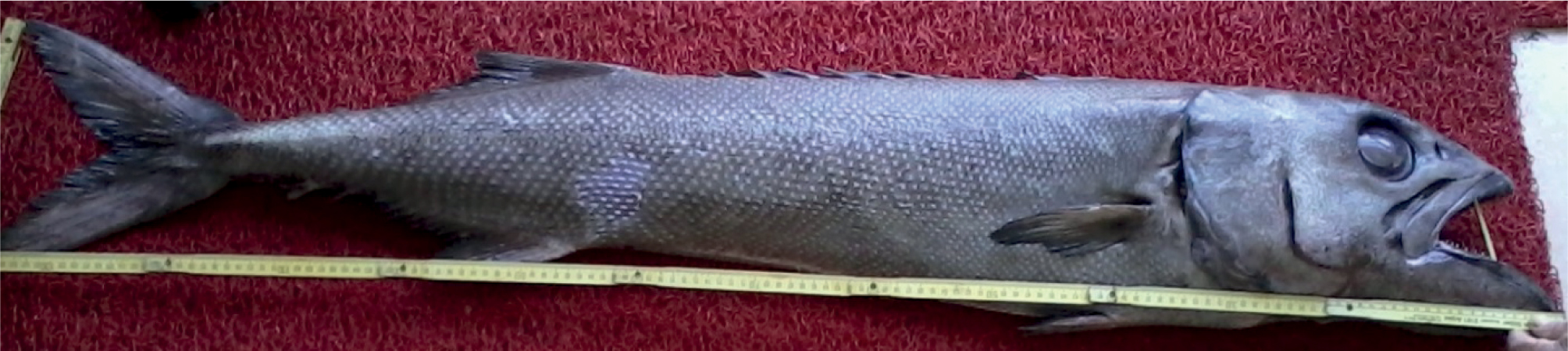
Figure 1
Ruvettus pretiosus, 139 cm TL, from the Dardanelles strait, the Marmara Sea, Turkey
Results and Discussion
Morphometric measurements and meristic counts are presented in Table 1. Oilfish was 139 cm long (TL) and weighed 12.4 kg. Body elongated, semi-fusiform, laterally compressed. The mouth large, the lower jaw extends slightly anteriorly to the upper jaw. Strong vomer teeth present in both jaws, fang-like in the anterior part of the upper jaw. The maxilla exceeds the vertical level from the posterior border of the eyes. Two detached dorsal and anal finlets. The anal fin similar to the second dorsal fin in shape and size. Body covered with small cycloid scales interspersed with rows of rough spiny tubercles and dark-brown (Kaya & Bilecenoğlu 1999).
Table 1
Morphological and meristic data for the specimen of Ruvettus pretiosus in the Dardanelles straits
| Morphometric data | Value (cm) |
|---|---|
| Total length | 139 |
| Fork length | 127.5 |
| Standard length | 120 |
| Anal length | 80 |
| Predorsal length | 35 |
| Head length | 23 |
| Maxillary length | 14.5 |
| Snout length | 10 |
| Eye diameter | 6 |
| Preorbital space | 12.5 |
| Dorsal fin base length | 72 |
| Anal fin base length | 25 |
| Pelvic fin length | 11 |
| Caudal fin length | 12.5 |
| Anal height | 17 |
| Body height | 23 |
| Meristic data | Counts |
| Dorsal fin rays | XIII + 16 |
| Pelvic fin rays | I + 5 |
| Pectoral fin rays | 15 |
| Anal fin rays | 17 |
| Total weight (g) | 12 400 |
R. pretiosus is generally captured by a bottom trawl in northern Japan (Yamamura 1997), a handline hook in the Indian Ocean (Stobbs & Bruton 1991), a long line in the eastern Mediterranean Sea (Damalas & Megalofonou 2010; Gabr & El-Haweet 2012), the North Aegean Sea (Kampouris et al. 2013), Mexico and in the north-western Atlantic Ocean (Keller & Kerstetter 2014), at night at a depth of approximately 400 m. However, we found a dead specimen on the shore. Although members of the family Gempylidae are common in tropical and temperate seas all over the world (Table 2), the specimen of R. pretiosus was found in relatively cold water of the Dardanelles straits (7-26°C). R. pretiosus usually lives in deep waters but at night it travels to the surface waters to feed on fish, squids and crustaceans (Nakamura & Parin 1993). We obtained the oilfish in shallow waters, which they usually do not habitat, so it is likely that the specimen came to the shore for feeding. Because, prey groups mentioned above were also reported in the studies conducted in the same region where our study was carried out (Özen et al. 2009; Ateş et al. 2011). The temperature in the Dardanelles strait is abruptly changing from the surface to the bottom due to opposite currents. Therefore, we hypothesize that the specimen might have been affected by these changes and also died for this reason.
Table 2
Catch depth and fishing gears of Ruvettus pretiosus by region
| Fishing Gear | Depth (m) | Region | References |
|---|---|---|---|
| Tuna longline | 200-400 | In the south-central Pacific | Nakamura & Parin (1993) |
| Longline | - | Mediterranean, Strait of Gibraltar | Buencuerpo et al. (1998) |
| Shoreline | - | Northern Adriatic Sea | Bettoso & Dulčić (1999) |
| Longline | 180 | Mediterranean, Antalya Bay | Kaya & Bilecenoglu (1999) |
| Commercial bottom trawl | 65 | Southern Mediterranean | Elbaraasi et al. (2007) |
| Tuna longline handline | 50-250 | Brazilian coast | Viana et al. (2012) |
| Gillnet | 100-150 | South-eastern coast of India | Sureshkumar et al. (2013) |
| Bottom trawl | 160 | Mediterranean, Iskenderun Bay | Gurlek et al. (2013) |
| Longline | 2 | North Aegean Sea | Kampouris et al. (2013) |
| By hand | Shore | Marmara Sea | This study |
In the last two decades, the advance of thermophilic species has been the first and most cited evidence for the linkage between climate change and distribution patterns of the biodiversity in the Mediterranean Sea. More than 30 Mediterranean warm-water indigenous fish species have now been recorded north of their original geographical distribution. In poikilothermic organisms such as fishes, the temperature may determine the population and community structure through its direct influence on the survival, reproduction and resource-use patterns of single individuals. Climate warming is driving species ranges toward the poles and this ‘harbinger’ is now perceptible in the Mediterranean realm where a variety of thermophilic organisms, belonging to macroalgae, plankton, invertebrates and, as we expect, fishes, extend their distribution toward northern areas (CIESM, 2008). The northward advance of thermophilic fishes is one of the first, and maybe most detectable biotic response to climatic changes (Azzurro 2008).