
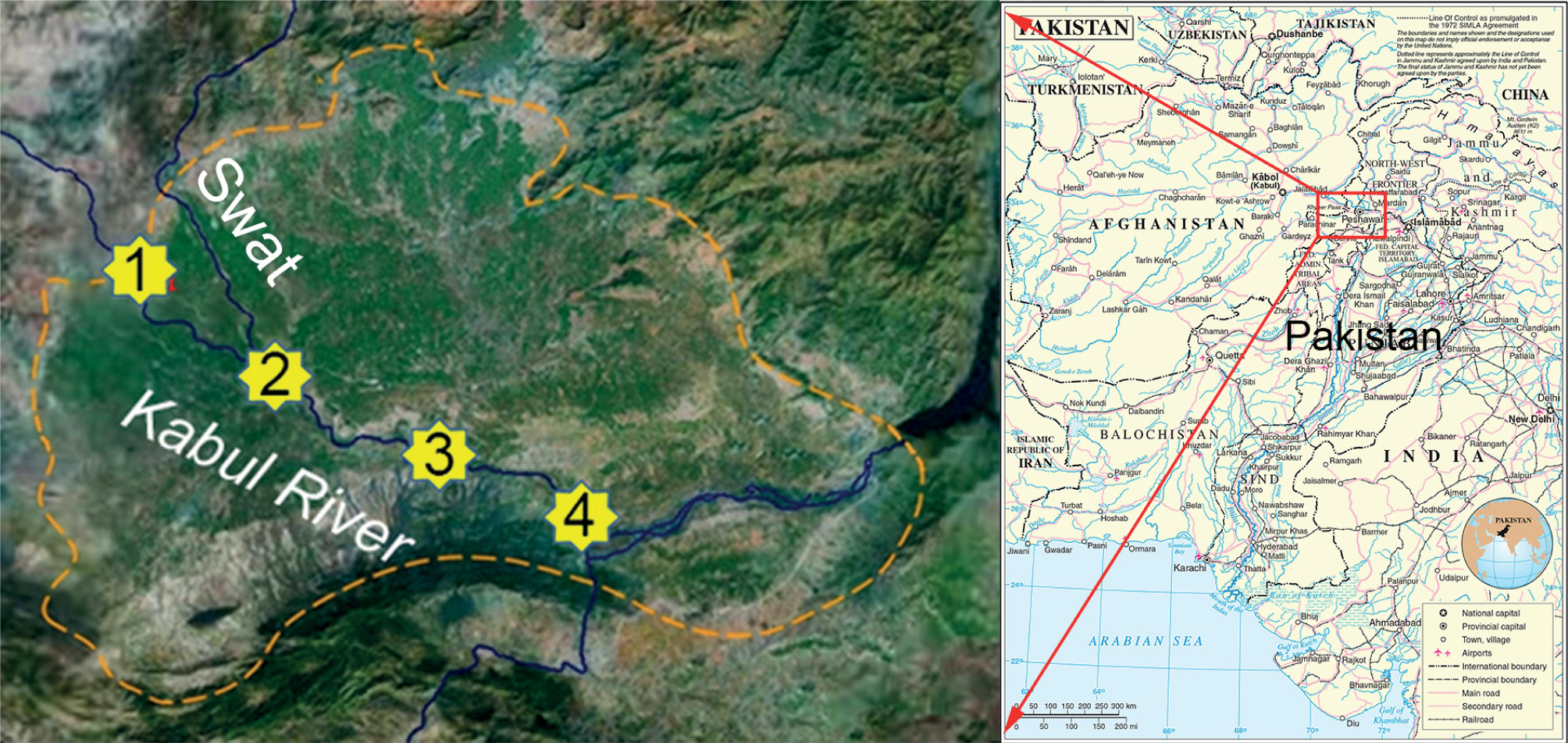
Figure 1
Peshawar Valley with the Kabul River sampling sites on the map of Pakistan (http://www.un.org/Depts/Cartographic/map/profile/pakistan.pdf)
Table 1
The 100-point index ranges according to Mitchell and Stapp (1992)
| Class | Range | Quality |
|---|---|---|
| 1 | 90-100 | Excellent |
| 2 | 70-90 | Good |
| 3 | 50-70 | Medium |
| 4 | 25-50 | Bad |
| 5 | 0-25 | Very Bad |
Table 2
Water variables over the study sites in the Kabul River
| Parameter | Unit | Warsak | Sardaryab | Nowshera | Khairabad | RPI |
|---|---|---|---|---|---|---|
| Temperature | °C | 18 | 19.6 | 20.8 | 22 | 20.2 |
| pH | 7.4 | 7.9 | 7.3 | 7.8 | 7.6 | |
| Conductivity | mSm cm-1 | 263 | 268 | 377 | 471 | 340.6 |
| Turbidity | NTU | 3 | 4 | 9 | 7 | 6.1 |
| T.D.S. | mg l-1 | 110 | 135 | 212 | 190 | 168.1 |
| T.S.S. | 220 | 230 | 280 | 264 | 252.1 | |
| Salinity | 0.2 | 0.6 | 1.3 | 2.0 | 1.0 | |
| Alkalinity | mg Eq l-1 | 75 | 101 | 157 | 166 | 128.2 |
| Hardness | 167 | 144 | 155 | 180 | 157.4 | |
| D.O. | mg l-1 | 6.5 | 5.59 | 6.78 | 6.5 | 6.3 |
| B.O.D. | mg O2 l-1 | 0.8 | 1.4 | 5.4 | 6 | 3.5 |
| NO2- | mg l-1 | 0.00 | 0.03 | 0.03 | 0.38 | 0.1 |
| NO3- | 2.81 | 6.48 | 1.64 | 4.87 | 4.0 | |
| NH3-N | 0.00 | 0.13 | 0.54 | 1.92 | 0.6 | |
| S2- | 0.16 | 0.33 | 0.36 | 0.80 | 0.4 | |
| SO42- | 26 | 23.25 | 25.6 | 59.5 | 30.6 | |
| PO43- | 0.14 | 0.26 | 0.15 | 1.14 | 0.4 | |
| Cl- | 7 | 8 | 12 | 18 | 11.0 | |
| Saprobity Index S | 1.55 | 1.55 | 1.59 | 1.59 | 1.571 | |
| WESI Index | 0.50 | 0.44 | 0.67 | 0.44 | 0.532 | |
| WQI Index | 54.67 | 50.16 | 39.39 | 46.36 | 46.33 |
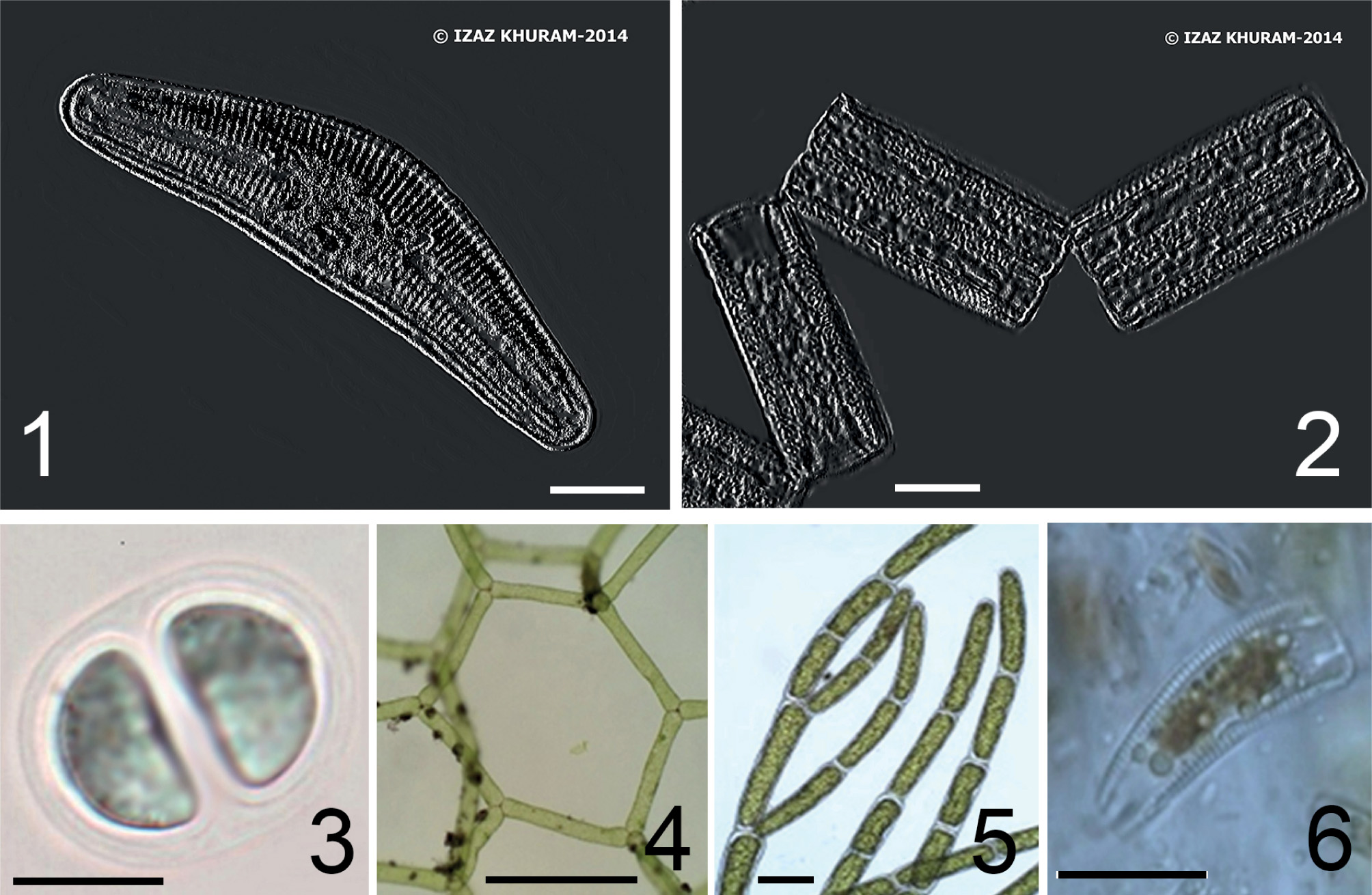
Figure 2
The most distributed algal species-indicators in the Kabul River communities with their ecological preferences: Cymbella affinis Kützing (benthic, temperature-temperate, low-streaming waters, pH-indifferent, saproxene, oligosaprobe, oligotraphentic, autotrophic) (1); Diatoma vulgaris Bory (planktonic-benthic, low-streaming waters, chloride-indifferent, saproxene, beta-mesosaprobic, meso-eutraphentic, autotrophic) (2); Chroococcus turgidus (Kützing) Nägeli (planktonic-benthic, aerophile, halophile, xeno-beta-mesosaprobic) (3); Hydrodictyon reticulatum (Linnaeus) Bory (planktonic-benthic, standing water, oligo-alpha-mesosaprobic) (4); Cladophora glomerata (Linnaeus) Kützing (planktonic-benthic, low-streaming waters, chloride-indifferent, oligo-alpha-mesosaprobic) (5); Rhoicosphenia abbreviata (C.Agardh) Lange-Bertalot (benthic, low-streaming waters, chloride-indifferent, eurysaprobe, oligo-alpha-mesosaprobic, meso-eutraphentic, autotroph) (6). Scale bar: fig. 2(1-4): 6-10 μm; fig. 2(5): 50 μm
Table 3
Ecological preferences of the most distributed algal species-indicators in the Kabul River
| Taxa | Hab | T | Oxy | Sal | Wat | Sap | Index S | Tro | Nutr |
|---|---|---|---|---|---|---|---|---|---|
| Cyanobacteria | |||||||||
| Chroococcus turgidus (Kützing) Nägeli | P-B, S | - | aer | hl | - | x-b | 0.8 | - | - |
| Bacillariophyta | |||||||||
| Cymbella affinis Kützing | B | temp | st-str | i | sx | o | 1.1 | ot | ats |
| Diatoma vulgaris Bory | P-B | - | st-str | i | sx | b | 2.2 | me | ate |
| Rhoicosphenia abbreviata (C. Agardh) Lange-Bertalot | B | - | st-str | i | es | o-a | 1.9 | me | ate |
| Chlorophyta | |||||||||
| Cladophora glomerata (Linnaeus) Kützing var. glomerata | P-B | - | st-str | i | - | o-a | 1.9 | - | - |
| Hydrodictyon reticulatum (Linnaeus) Bory | P-B | - | st | - | - | o-a | 1.8 | - | - |
Table legend: Substrate preferences (Hab): P-B – planktonic-benthic, B – benthic, S – soil. Temperature preferences (T): temp – temperate. Oxygenation and streaming (Oxy): st – standing water, st-str – low streaming water, aer – aerophiles. Halobity degree (Sal): i – oligohalobes-indifferent, hl – halophiles. Saprobity groups according to Watanabe (Wat): es – eurysaprobes, sx – saproxenes. Species-specific Index of Saprobity (S). Self-purification zone preferences (Sap): x-b – xeno-beta-mesosaprobes; o – oligosaprobes; o-a – oligo-alpha-mesosaprobes. Trophic status (Tro): ot – oligotraphentic; me – meso-eutraphentic. Nitrogen uptake metabolism (Nutr): ats – nitrogen-autotrophic taxa, tolerating very small concentrations of organically bound nitrogen; ate – nitrogen-autotrophic taxa, tolerating elevated concentrations of organically bound nitrogen
Table 4
Biodiversity data over the study sites in the Kabul River
| Division | Warsak | Sardaryab | Nowshera | Khairabad |
| Abundance, total scores | ||||
| Cyanobacteria | 65 | 80 | 79 | 91 |
| Bacillariophyta | 46 | 58 | 64 | 63 |
| Xanthophyta | 25 | 25 | 35 | 35 |
| Euglenophyta | 4 | 7 | 5 | 5 |
| Chlorophyta | 92 | 135 | 142 | 149 |
| Charophyta | 203 | 236 | 231 | 248 |
| Sum of Scores | 435 | 541 | 556 | 591 |
| Number of Species | ||||
| Cyanobacteria | 22 | 28 | 29 | 32 |
| Bacillariophyta | 26 | 34 | 36 | 36 |
| Xanthophyta | 5 | 5 | 7 | 7 |
| Euglenophyta | 3 | 6 | 5 | 5 |
| Chlorophyta | 24 | 36 | 37 | 39 |
| Charophyta | 47 | 58 | 56 | 60 |
| No of Species | 127 | 167 | 170 | 179 |
Table 5
Stepwise regression analysis results for the Kabul River sampling sites
| Dependent variables | Step 1 | Step 2 | Step 3 |
|---|---|---|---|
| Number of Species | T 0.85* | T, Cond 0.99** | T, Cond, Hard 0.99*** |
| Cyanobacteria | T 0.94* | T, DO 0.99* | T, Sal, DO 0.99 |
| Chlorophyta | T 0.80* | T, Cond 0.99* | T, Cond, Hard 0.99 |
| Xanthophyta | T 0.89* | T, SO4 0.88** | T, SO4, NH4 0.99 |
| Euglenophyta | pH 0.39* | pH, Turb 0.71* | pH, DO, Turb 0.99 |
Negatively correlated variables are marked in bold. Statistical significance, p-value:
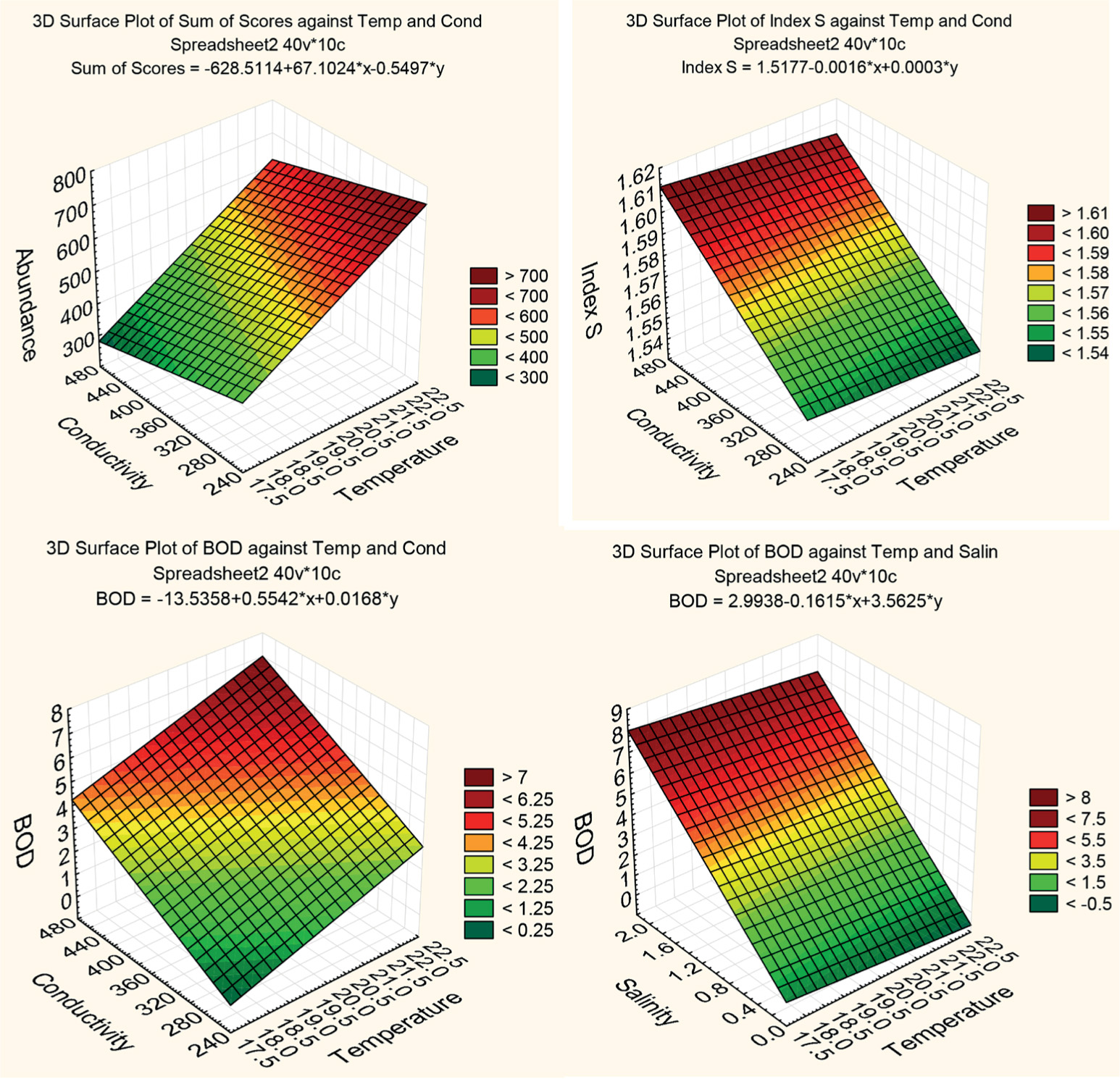
Figure 3
Surface plots of relationships between biological and chemical variables at the Kabul River sites
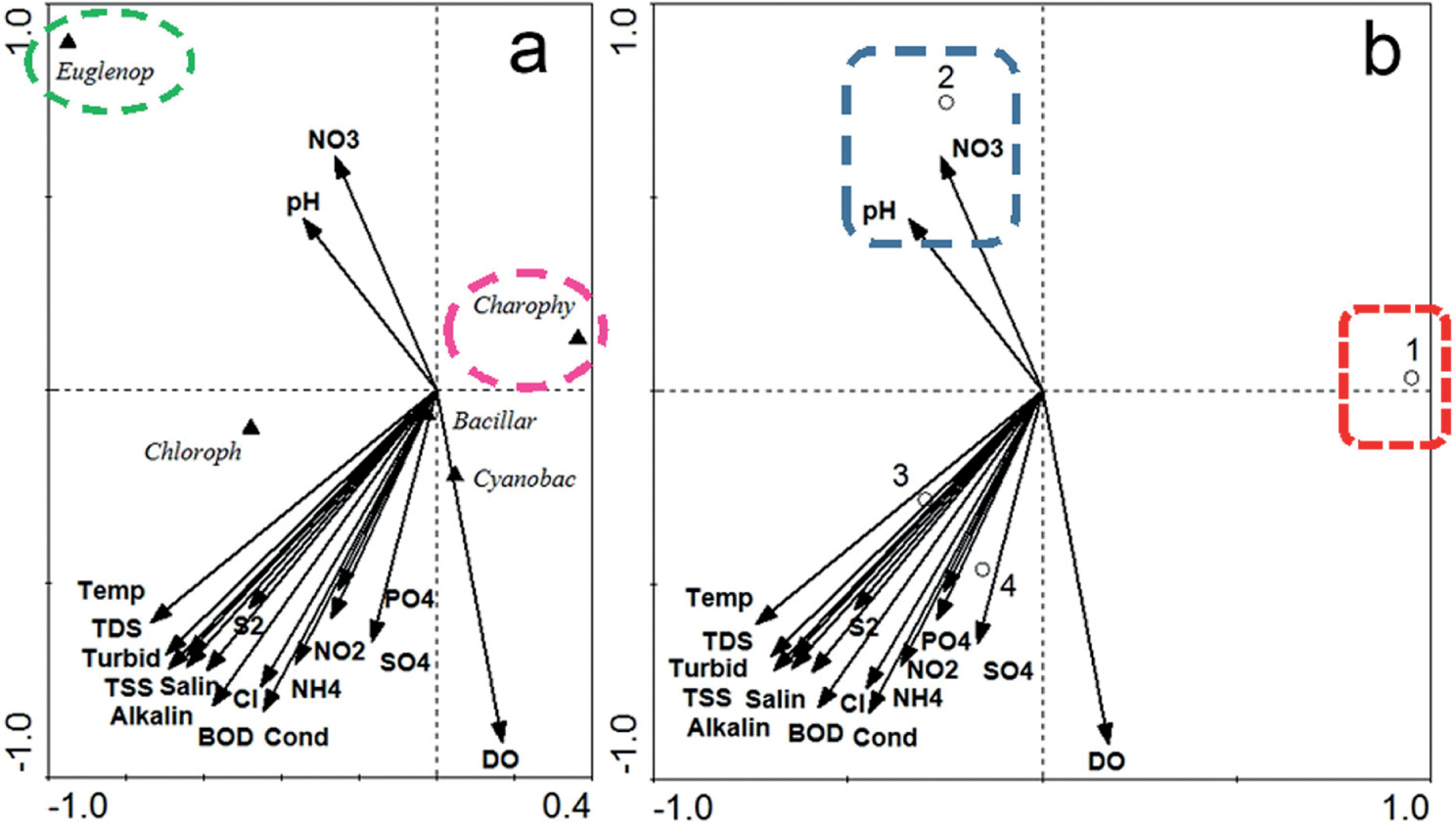
Figure 4
CCA Biplot of relationships between divisional diversity and environmental variables in the Kabul River (a); CCA Triplot of relationships between the sites and environmental variables in the Kabul River (b)
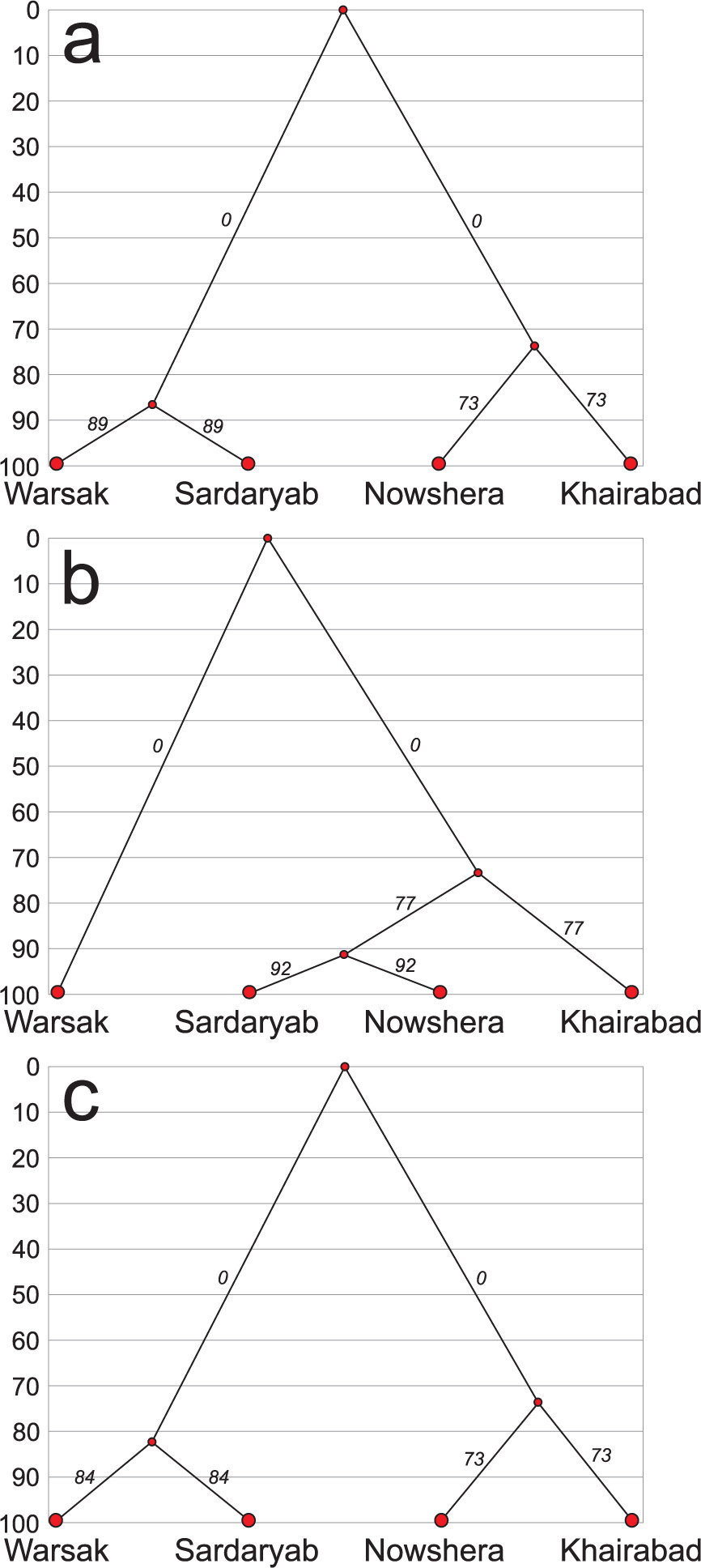
Figure 5
Dendrogram of all chemical variables at the Kabul River study sites (a); Dendrogram of all biological variables at the Kabul River study sites (b); Dendrogram of all variables at the Kabul River study sites (c)
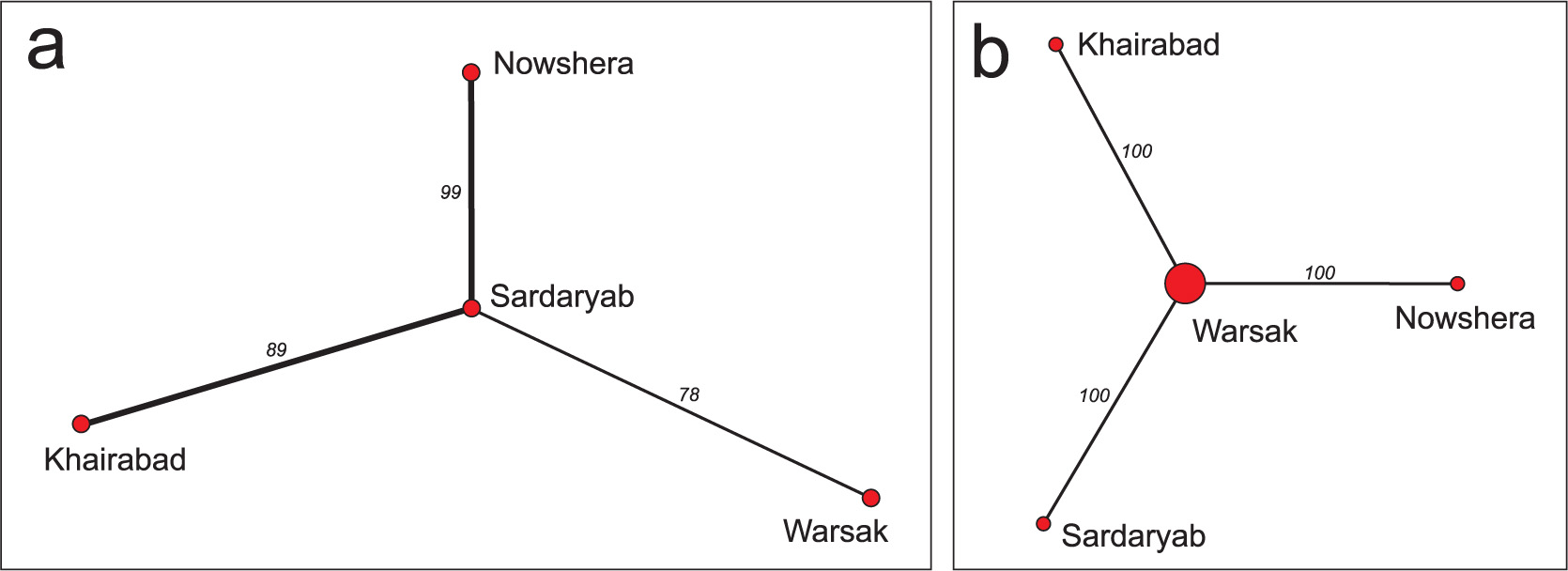
Figure 6
Dendrite of algal divisions’ similarity at the Kabul River study sites (a); Dendrite of algal communities’ similarity at the Kabul River study sites (b)