
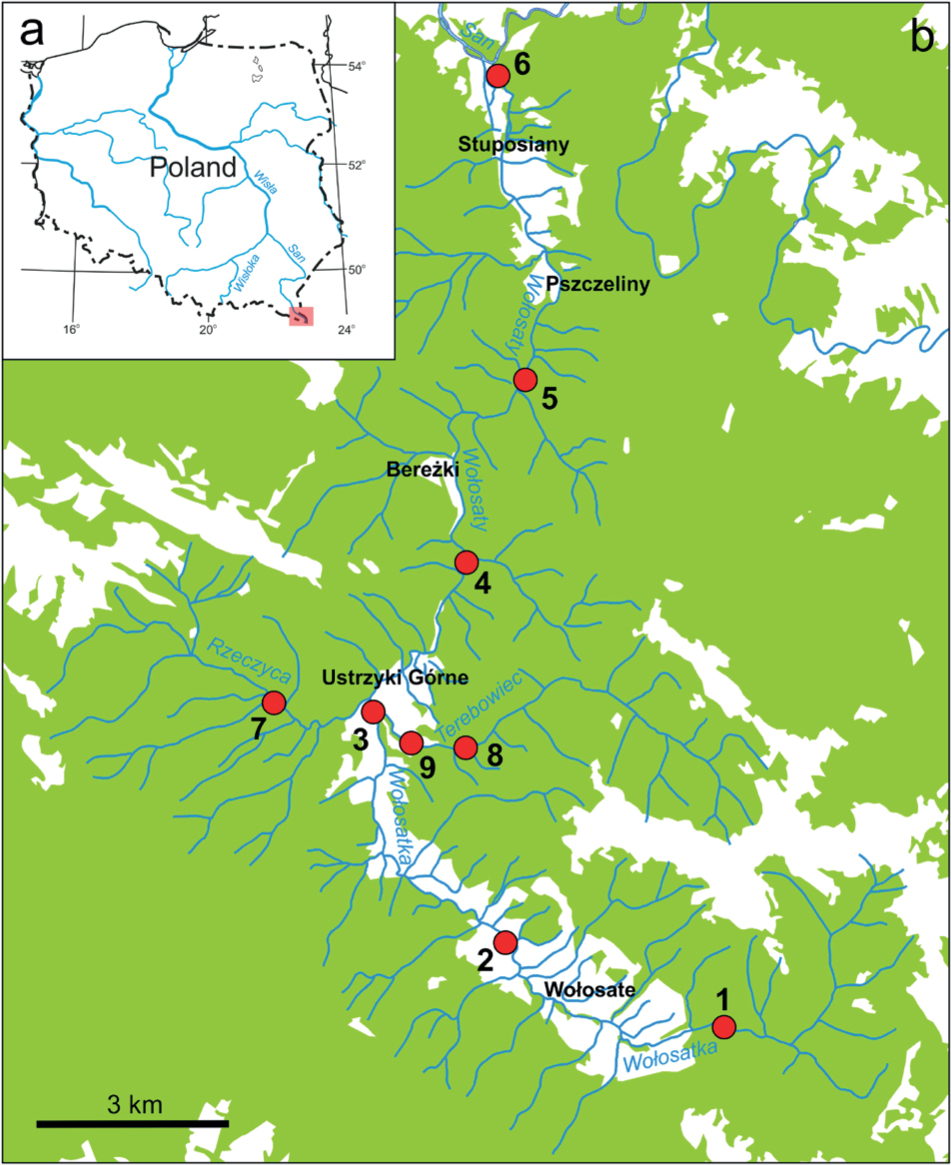
Figure 1
Location of the study area (a) and sampling sites (1-9) distribution at Wołosaty stream and tributaries (b)
Table 1
Values of water physicochemical parameters in the Wołosaty stream and tributaries in 2013-2015, and description of sampling sites together with the most frequent accompanying diatom taxa (* below the limit of detection)
| Streams | Wołosatka | Wołosaty | Rzeczyca | Terebowiec | |
|---|---|---|---|---|---|
| Total number of sampling sites | 2 | 4 | 1 | 2 | |
| Width | m | 3-6 | 4-20 | 1.5-3 | 5-7 |
| Depth | 0.1-0.3 | 0.2-0.4 | 0.1-0.3 | 0.2-0.4 | |
| Type of the bottom | stones, at the first site stones covered with mosses in 30-40% | stones, at sites 5-6 stones covered with mosses and other algae from the genus Chlorophyta in 20-30% | stones | stones, at site 8, larger stones covered with mosses | |
| Insolation | site 1 – low site 2 – high | high at all sites | low | site 8 – low site 9 – average | |
| physicochemical parameters | |||||
| Temperature | °C | 8.0-12.2 | 5.6-10.8 | 7.4-10.0 | 6.1-9.3 |
| pH | 6.4-8.8 | 6.5-8.6 | 6.4-8.4 | 6.4-8.4 | |
| Conductivity | µS cm-1 | 78-254 | 146-278 | 97-246 | 86-284 |
| O2 | mg l-1 | 10.16-10.67 | 10.65-11.44 | 10.6-10.24 | 10.67-11.06 |
| Cl- | 0.43-5.33 | 0.65-5.35 | 0.60-5.31 | 0.41-5.59 | |
| 11.05-20.69 | 12.79-26.77 | 16.31-33.34 | 12.53-27.19 | ||
| 1.67-2.46 | 1.94-3.15 | 1.78-3.20 | 2.01-2.86 | ||
| * | *-0.64 | * | * | ||
| 0.06-0.71 | 0.14-0.88 | 0.04-0.06 | 0.06-0.13 | ||
| Mg2+ | 5.00-7.82 | 5.26-10.12 | 5.33-9.32 | 5.62-10.10 | |
| Ca2+ | 30.31-34.25 | 33.72-41.55 | 38.75-39.72 | 32.42-35.31 | |
| The most frequent taxa | Achnanthidium pyrenaicum, Cocconeis placentula var. lineata, C. placentula var. euglypta, Diatoma ehrenbergii | Achnanthidium pyrenaicum, A. minutissimum var. minutissimum, Cymbella parva, Diatoma ehrenbergii | Achnanthidium pyrenaicum, A. minutissimum var. minutissimum, A. thienemannii, Cymbella parva | Achnanthidium pyrenaicum, Diatoma ehrenbergii | |
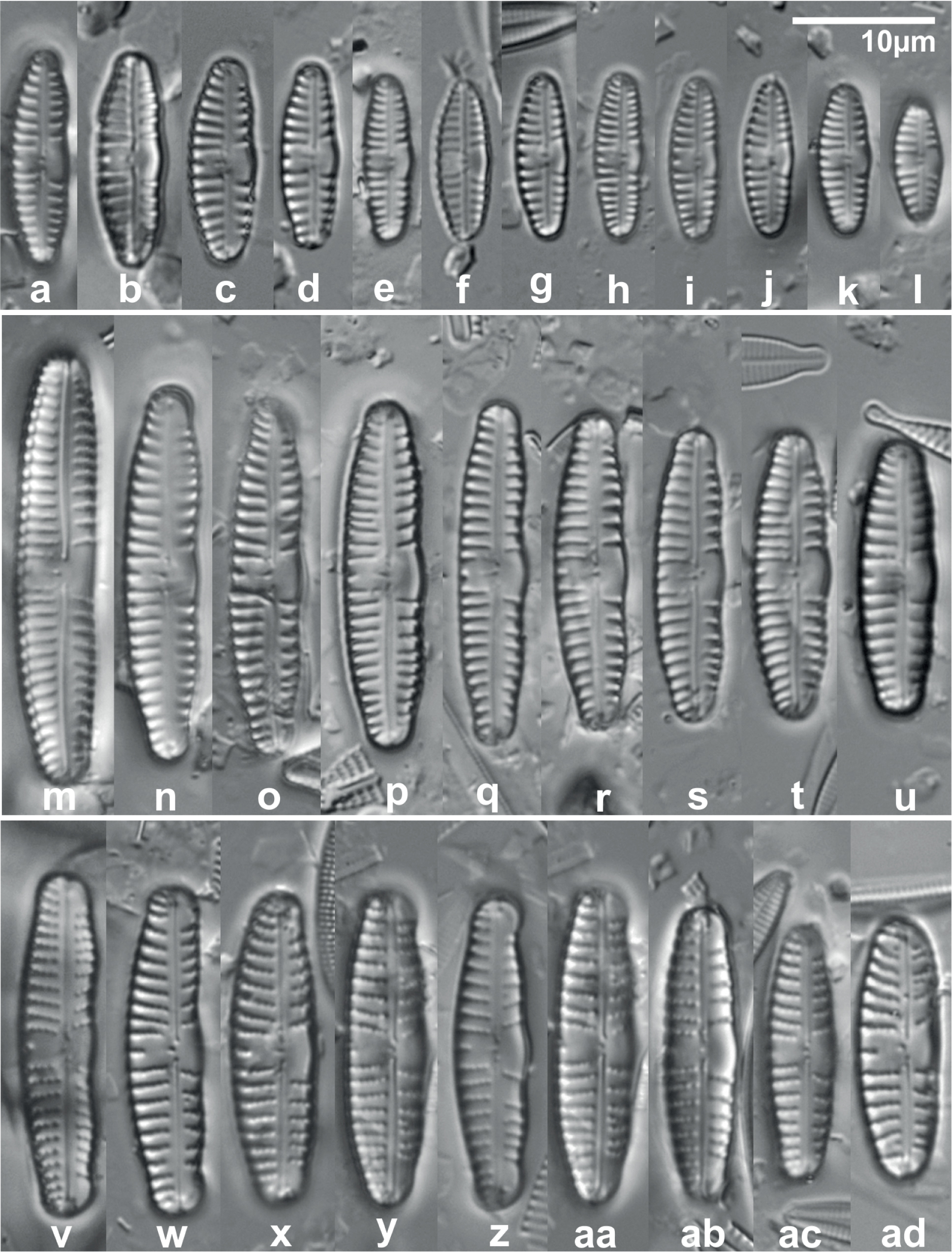
Figure 2
Light microscope (LM) images of Reimeria sinuata (a-l), Reimeria ovata (m-u) and Reimeria uniseriata (v-ad)
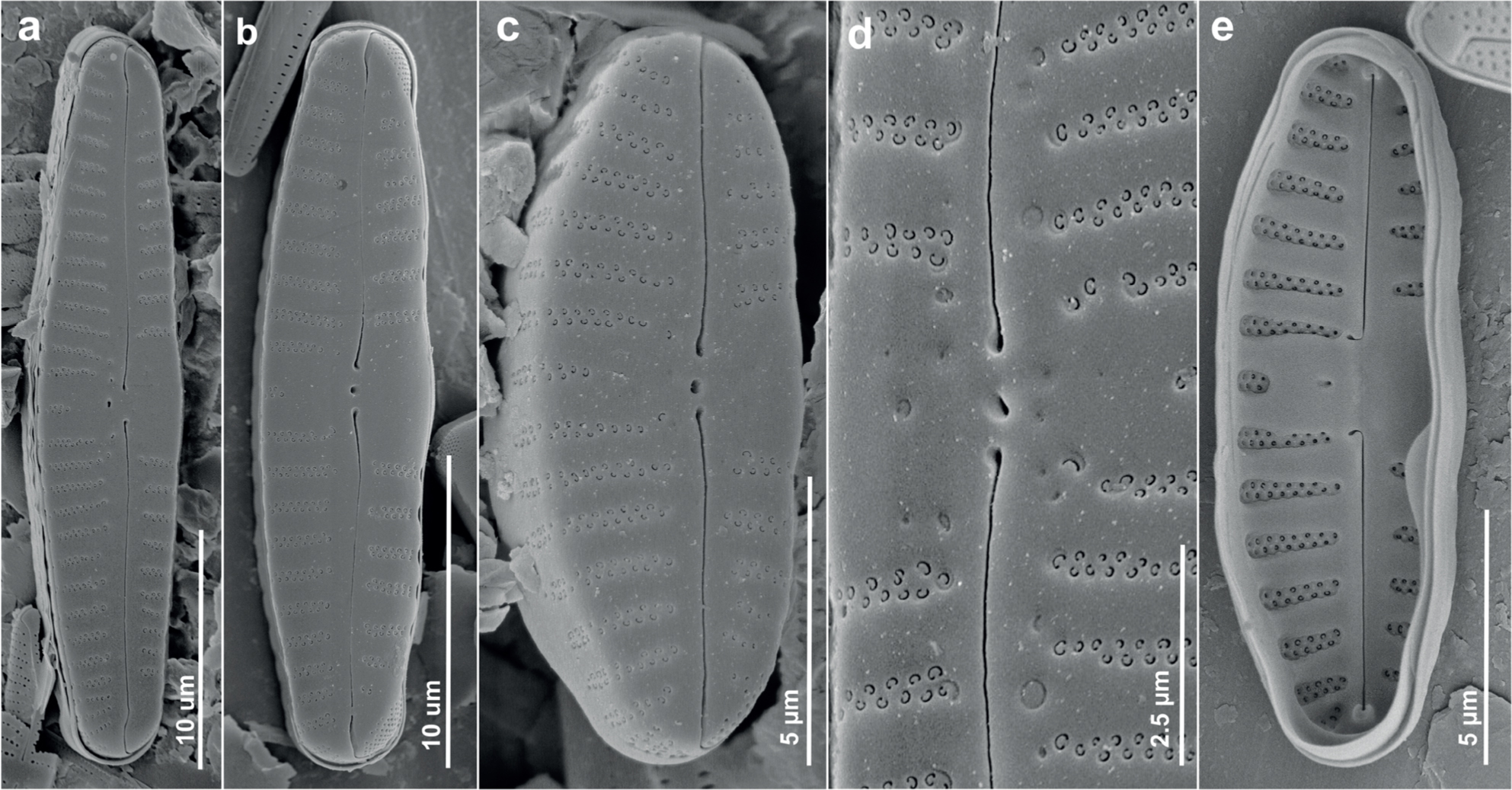
Figure 3
Scanning electron microscope (SEM) images of Reimeria ovata. External view of the entire valve (a-c), external detail of the central area of the valve (s) and internal view of the valve (e)
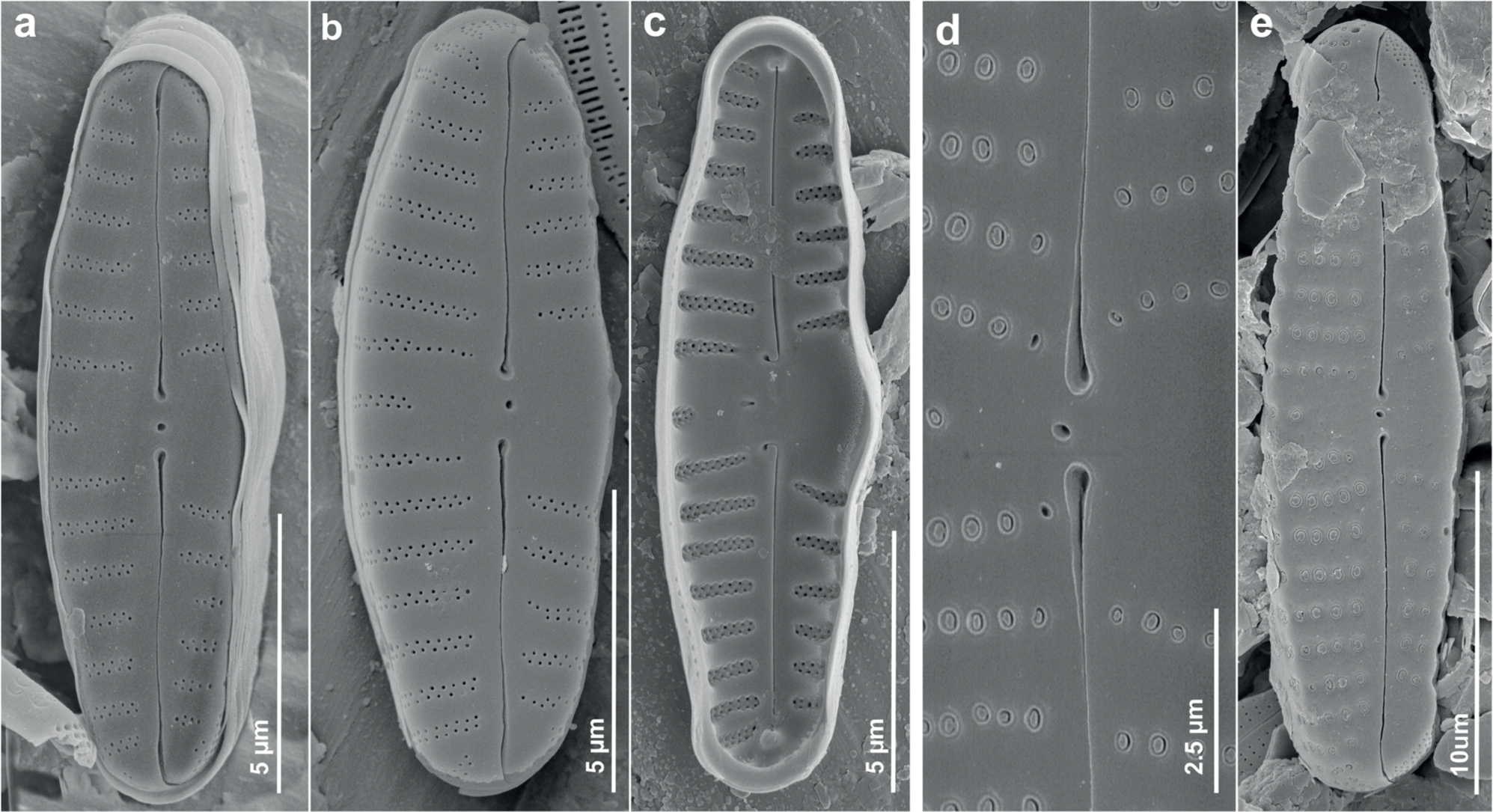
Figure 4
Scanning electron microscope (SEM) images; Reimeria sinuata: external view of the entire valve of (a-b), internal view of the valve (c). Reimeria uniseriata: external detail of the central area of the valve (d), external view of the entire valve (e)
Table 2
Comparison of the valve morphology and occurrence of Reimeria sinuata with the other taxa from the genus Reimeria, recorded in the Wołosaty stream and tributaries
| Taxa | Reimeria ovata (n=30) | Reimeria sinuata (n=30) | Reimeria uniseriata (n=10) |
|---|---|---|---|
| Length (µm) | 12.4-31.0 | 8.9-14.2 | 16.5-26.5 |
| Width (µm) | 4.6-6.3 | 3.8-4.3 | 4.2-6.4 |
| Number of striae in 10 µm | 9-13 most commonly 10-11 | 12-15 | 7-9 |
| Occurrence | Always as single cells, found on stones and most frequent on mosses. | Very rare, found on stones and mosses. | Very rare, found mostly on stones. The rarest of the three taxa found in the analyzed samples. |