
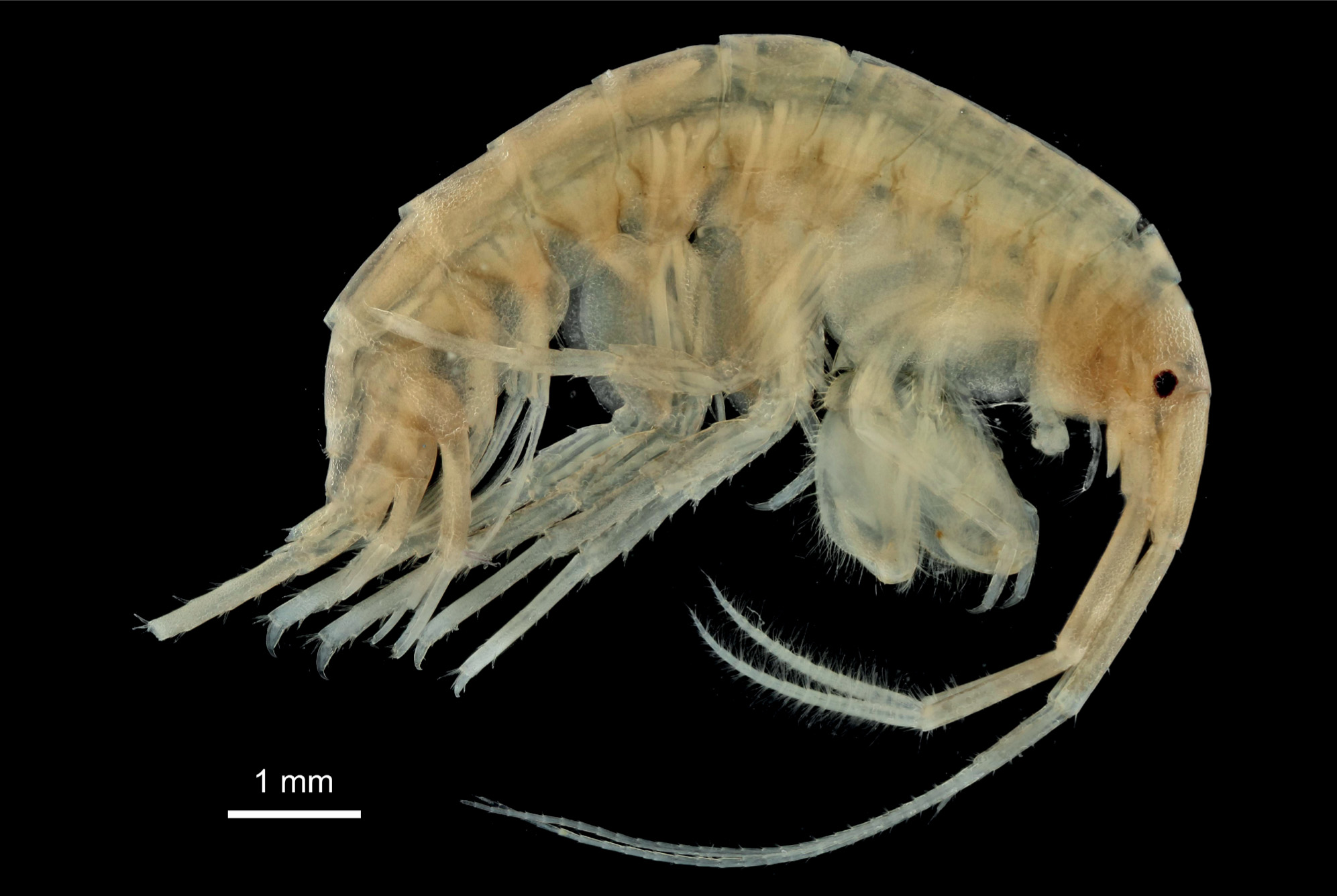
Figure 1
Adult male specimen of M. nitida Smith, 1873 collected from the Gulf of Gdańsk in 2014 (Photograph: C. d’Udekem d’Acoz and F. Kerckhof, RBINS)
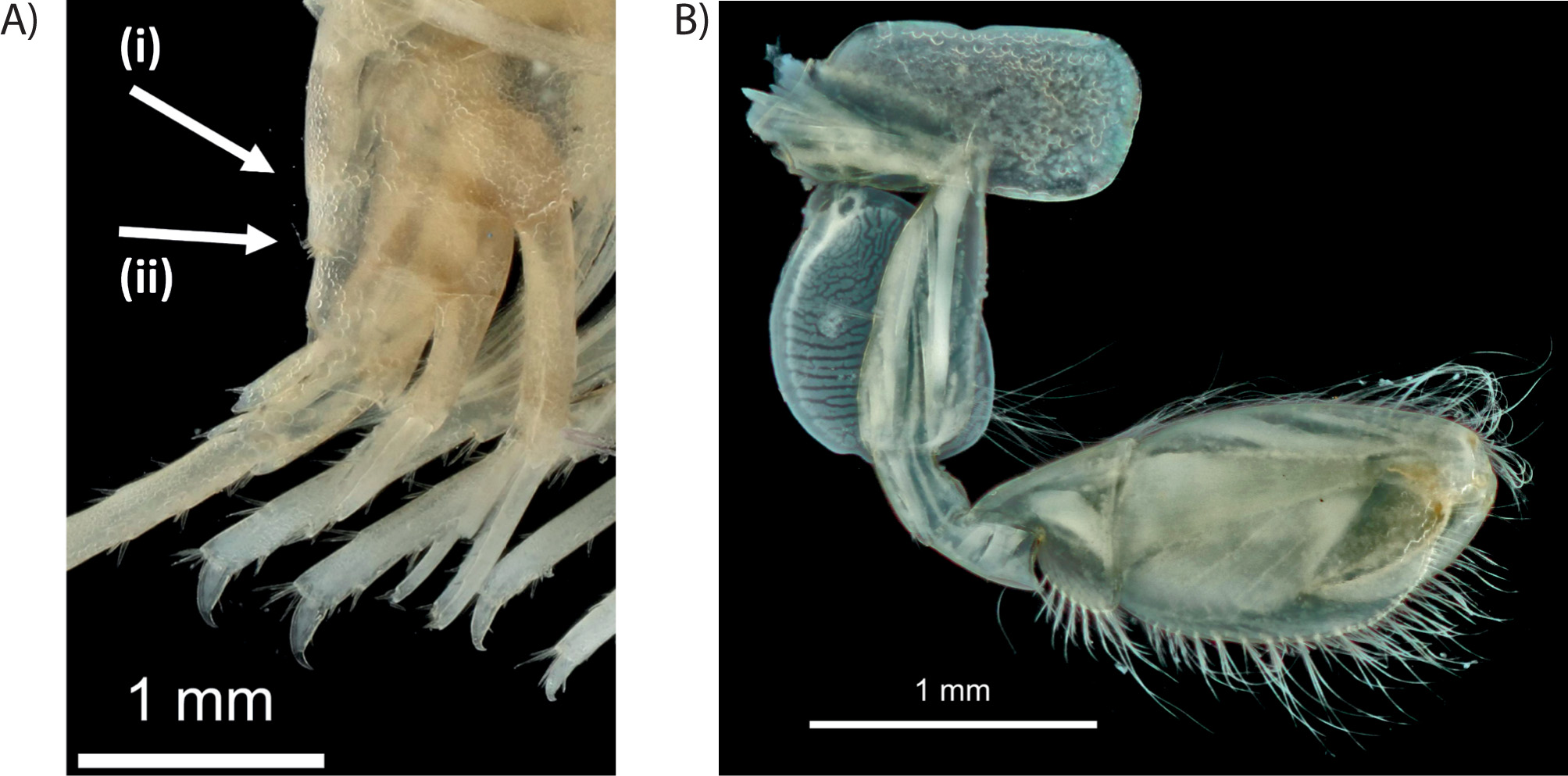
Figure 2
Taxonomic features used for identification of M. nitida: (A) the first urosome segment (i) and dorsolateral spines on the second urosome segment (ii), (B) second male gnathopod (Photograph: C. d’Udekem d’Acoz and f. Kerckhof, rbins)
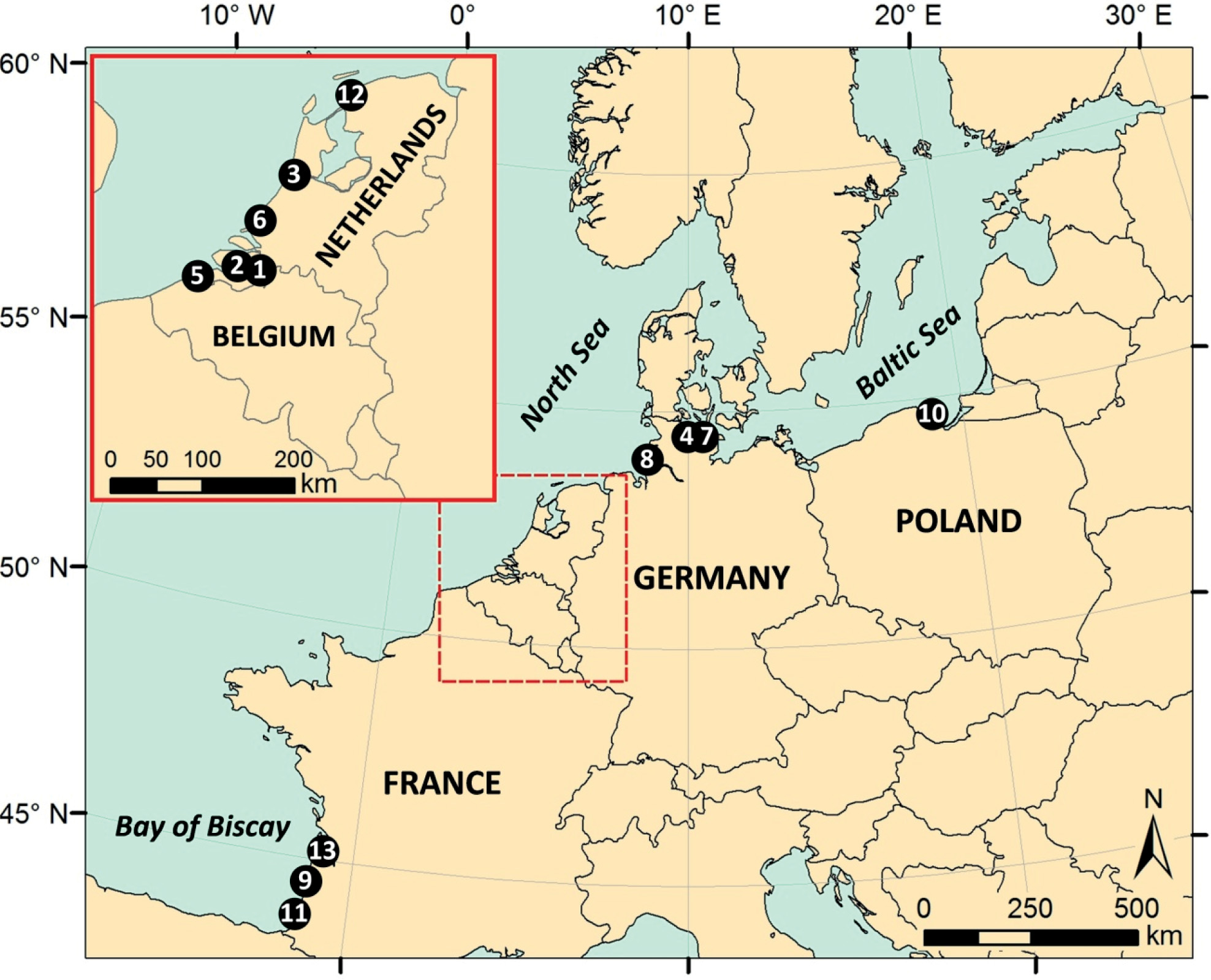
Figure 3
Summary records of M. nitida in European coastal waters (chronologically, according to literature and this study; report from Mecklenburg Bay is not included due to lack of detailed data (Lackschewitz et al. 2014)):
1 – 1996, Belgium, Western Scheldt (Ysebaert et al. 2000 – as M. palmata), 2 – 1998 and 1999, the Netherlands, Western Scheldt (van Moorsel & Waardenburg 1999 – as Melita sp. (Faasse & Moorsel 2003), 3 – 2001 the Netherlands, North Sea Canal, connecting Amsterdam with the North Sea (Munts 2002), 4 – 2008, Germany, Kiel Canal (BioConsult 2009 – as Melita pellucida), 5 – 2009, Belgium, harbour of Zeebrugge (Boets et al. 2011), 6 – 2010, the Netherlands, New Waterway, the artificial mouth of the Rhine River connecting Rotterdam with the North Sea (Reichert & Beermann, 2011), 7 – 2010, Germany, Kiel Canal (Reichert & Beermann, 2011), 8 – 2012, Germany, Cuxhaven (Lackschewitz et al. 2014), 9 – 2013, France, Arcachon Bay (Gouillieux et al. 2016), 10 – 2014, Poland, the Gulf of Gdansk, present study, 11 – 2014, France, Hossegor Lake (Gouillieux et al. 2016), 12 – 2014, the Netherlands, Wadden Sea (Gittenberger et al. 2015), 13 – 2016, France, Gironde Estuary (Gouillieux et al. 2016) (Geographic data source: ESRI)
Table 1
Taxonomic characters to distinguish M. nitida from M. palmata (Bousfield 1973; Chapman 1988; Jarrett & Bousfield 1996)
| Taxonomic character | M. nitida Smith, 1873 | M. palmata Montagu, 1804 |
|---|---|---|
| antenna 1 | accessory flagellum with 2-3 segments | accessory flagellum with 2-4 segments |
| dorsal teeth on pleon and uro-some segments | absent; a group of dorsolateral spines on either side of urosome 2 | single tooth on urosome segment 1, two smaller dorsolateral teeth on urosome segment 2 |
| male gnathopod 2 | propodus very broad across the distal margin (almost triangular) |
Table 2
Basic ecological characteristic of M. nitida Smith, 1873
| Factor/Biological process | Species characteristic |
|---|---|
| Temperature | - distribution shows tolerance of low and high temperatures; individuals found in water up to 32°C (Faasse & van Moorsel 2003) |
| Salinity | - mesohaline regions of estuaries, in salinities 3-20 PSU, occasionally to 30 PSU (Bousfield 1973) |
| Substrate | - muddy bottom areas, the species can burrow into soft sediment (Bousfield 1973; Borowsky et al. 1997); - at the base of clumps of hydroids and ectoprocts (Bousfield 1973); - in crevices created by oyster reefs (Watling & Maurer1972; Faasse & van Moorsel 2003; Heiman et al. 2008); - in pen shells Atrina rigida (Munguia et al. 2007); - on hard substrates, both natural and artificial, like boulders, rock fills, asphalt fragments in loose gravel (Chapman 1988; Faasse & van Moorsel 2003; Reichert & Beermann 2011) |
| Nutrition | - consumes epiphytes, seagrass debris and detritus; macrophagy and microphagy were both observed, with the latter occurring most often (Zimmerman et al. 1979); - consumes soft sediment (Borowsky et al. 1997) |
| Reproduction | - annual life cycle with several broods, ovigerous females occur in May-September, their size is 5.00-8.71 mm, the number of juveniles per female is 5-51 (Bousfield 1973; Borowsky 1980) |