
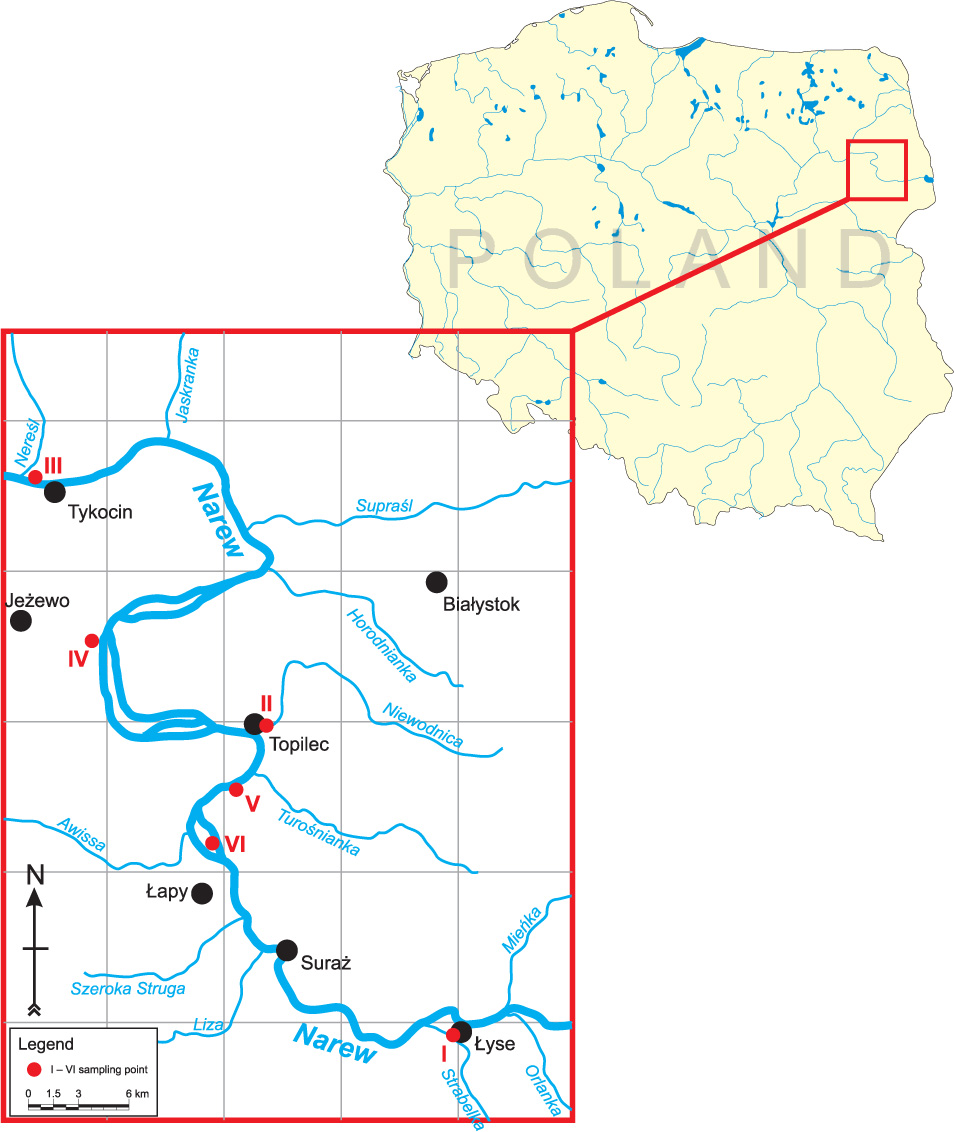
Figure 1
The study area and sampling sites at the lotic oxbow lakes and tributaries of the Narew River
Table 1
Physicochemical composition of water samples collected from the tributaries of the Narew River (I, II, III) and from the lotic oxbow lakes of the Narew River (IV, V, VI) in spring (n=3)
| Specification | Unit | I | II | III | IV | V | VI |
|---|---|---|---|---|---|---|---|
| Temperature | °C | 6 | 5 | 6 | 7 | 8 | 8 |
| pH | 7.60 | 7.74 | 7.64 | 7.10 | 7.21 | 7.13 | |
| O2 | mg dm3 | 15.69 | 15.45 | 15.68 | 12.58 | 12.59 | 13.59 |
| BOD5 | 8.23 | 7.22 | 7.22 | 7.81 | 7.22 | 9.23 | |
| COD | 9.05 | 14.64 | 14.64 | 9.02 | 7.00 | 9.05 | |
| CO2 | 13.0 | 12.0 | 12.0 | 11.0 | 11.3 | 11.0 | |
| Alkalinity in CaCO3 | mval | 4.5 | 4.3 | 4.2 | 4.4 | 4.1 | 4.5 |
| N-NH3 | mg dm3 | 0.770 | 1.071 | 0.970 | 0.770 | 0.720 | 0.760 |
| N-NO2 | 0.0236 | 0.0262 | 0.0236 | 0.0236 | 0.0236 | 0.0320 | |
| N-NO3 | 0.360 | 0.460 | 0.460 | 0.220 | 0.460 | 0.230 | |
| P-PO4 | 0.520 | 0.760 | 0.560 | 0.560 | 0.400 | 0.430 | |
| Sulfates | 19.15 | 18.26 | 18.26 | 26.32 | 19.33 | 20.15 | |
| Chlorides | 54 | 53 | 53 | 65 | 58 | 54 | |
| Total hardness | mg Ca dm3 | 101.40 | 109.6 | 108.8 | 69.84 | 109.6 | 108.6 |
| Total hardness | mg Mg dm3 | 10.32 | 10.74 | 10.74 | 3.44 | 9.03 | 8.32 |
| Fe | mg | 0.90 | 1.40 | 1.40 | 0.90 | 0..40 | 0.95 |
| Dry residue | mg dm3 | 272 | 295 | 295 | 294 | 256 | 256 |
| Dissolved solids | 256 | 283 | 283 | 281 | 247 | 240 | |
| Suspended solids | 16 | 12 | 12 | 13 | 9 | 16 |
Table 2
Physicochemical composition of water samples collected from the tributaries of the Narew River (I, II, III) and from the lotic oxbow lakes of the Narew River (IV, V, VI) in autumn (n=3)
| Specification | Unit | I | II | III | IV | V | VI |
|---|---|---|---|---|---|---|---|
| Temperature | °C | 12 | 14 | 12 | 18 | 16 | 19 |
| pH | 7.60 | 7.75 | 7.65 | 7.10 | 7.22 | 7.15 | |
| O2 | mg dm3 | 15.68 | 15.66 | 15.67 | 14.66 | 14.67 | 14.68 |
| BOD5 | 7.81 | 7.21 | 9.22 | 8.22 | 8.22 | 8.22 | |
| COD | 9.02 | 7.00 | 9.05 | 9.06 | 14.63 | 14.64 | |
| CO2 | 13.0 | 12.2 | 10.0 | 12.0 | 12.0 | 12.0 | |
| Alkalinity in CaCO | mval | 4.4 | 4.0 | 4.5 | 4.5 | 4.3 | 4.2 |
| N-NH3 | mg dm3 | 1.470 | 1.220 | 1.340 | 0.790 | 0.270 | 0.970 |
| N-NO2 | 0.0336 | 0.0330 | 0.0320 | 0.0236 | 0.0272 | 0.0336 | |
| N-NO3 | 0.650 | 0.580 | 0.660 | 0.220 | 0.460 | 0.230 | |
| P-PO4 | 0.620 | 0.760 | 0.760 | 0.560 | 0.500 | 0.673 | |
| Sulfates | 20.15 | 38.26 | 38.26 | 26.32 | 19.33 | 20.15 | |
| Chlorides | 65 | 58 | 54 | 54 | 53 | 53 | |
| Total hardness | mg Ca dm3 | 72.00 | 72.00 | 69.84 | 100.30 | 107.50 | 104.70 |
| Total hardness | mg Mg dm3 | 3.44 | 9.03 | 8.32 | 10.25 | 10.16 | 10.22 |
| Fe | mg dm3 | 0.90 | 0..40 | 0.95 | 1.80 | 2.30 | 2.20 |
| Dry residue | 292 | 266 | 258 | 278 | 298 | 299 | |
| Dissolved solids | 279 | 247 | 240 | 266 | 286 | 286 | |
| Suspended solids | 13 | 19 | 18 | 12 | 12 | 13 |
Table 3
Fungi and straminipilous organisms found in water collected from the tributaries and from the lotic oxbow lakes of the Narew River in spring and autumn (a – autumn, s – spring)
| Kingdom, class, order and species | Water sites | |||||
|---|---|---|---|---|---|---|
| Narew-tributaries (Nt) | Narew-oxbow lakes (No) | |||||
| I | II | III | IV | V | VI | |
| Fungi | ||||||
| Ascomycota | ||||||
| Pleosporales | ||||||
| 1. Alternaria alternata (Fr.) Keissl. | s | |||||
| Eurotiales | ||||||
| 2. Aspergillus fumigatus Fresen. | a | s | s | |||
| Saccharomycetales | ||||||
| 3. Geotrichum candidum Link | s | s | s | |||
| Blastocladiomycota | ||||||
| Blastocladiales | ||||||
| 4. Allomyces moniliformis Coker & Braxton | s | |||||
| 5. Blastocladiopsis parva (Whiffen) Sparrow | a | a | s, a | a | a, s | s, a |
| 6. Catenaria anguillulae Sorokin | a | a | a | |||
| 7. C. verrucosa Karling | s | s | ||||
| 8. Catenophlyctis variabilis (Karling) Karling | s | s | s | |||
| Chytridiomycota | ||||||
| Chytridiales | ||||||
| 9. Chytridium xylophilum Cornu | s | |||||
| 10. Chytridium schenkii (P.A. Dang.) Scherff | ||||||
| Spizellomycetales | ||||||
| 11. Rhizophlyctis rosea (de Bary et Woronin) A. Fisch | s | |||||
| Cladochytriales | ||||||
| 12. Nowakowskiella elegans (Nowakowski) Schröter | s, a | a | a | a | ||
| 13. Polyphagus euglenae Nowakowski | a | s | s, a | |||
| 14. Rhizophydium globosum (Braun) Rabenhorst | s | s | s | s | ||
| Zygomycota | ||||||
| Zoopagales | ||||||
| 15. Zoophagus insidians Sammerst. | a | s, a | s | s | ||
| Stramenopila | ||||||
| Oomycota | ||||||
| Monoblepharidiales | ||||||
| 16. Monoblepharis brachyandra Lagerheim | s, a | s, a | s, a | s, a | ||
| 17. Monoblepharis macrandra (Lagerheim) Woronin | s, a | s, a | s, a | s, a | ||
| Leptomitales | ||||||
| 18. Leptomitus lacteus C. Agardh | s | s | ||||
| Pythiales | ||||||
| 19. Pythium acanthicum Drechsler | s, a | a | ||||
| 20. P. afertile Kanouse et Humphrey | a | s | s | a | ||
| 21. Globisporangium debaryanum (R. Hesse) Uzuhashi, Tojo & Kakish. | a | a | a | |||
| 22. P. myriotylum Drechsler | s, a | s, a | ||||
| Rhipidiales | ||||||
| 23. Rhipidium parhtenosporum Kanouse | a | a | a | |||
| Saprolegniales | ||||||
| 24. Achlya americana Humphrey | s | a, s | s | |||
| 25. A. ambisexualis Raper | a | s | a | s | ||
| 26. A. debaryana Humphrey | a | s, a | a | |||
| 27. A. colorata Pringsheim | s | s, a | s | s | ||
| 28. A. flagellata Coker | s, a | |||||
| 29. A. radiosa Maurizio | s | s | s | |||
| 30. Aphanomyces irregularis Scott | s, a | s, a | s, a | a | a | a |
| 31. Newbya oligocantha Spencer, Vick & Dick | s | s | ||||
| 32. Saprolegnia diclina Coker | s | |||||
| 33. S. ferax (Gruith.) Thur. | s, a | s, a | s, a | s, a | s, a | s, a |
| 34. S. glomerata (Tiessnh.) A. Lund | a | s, a | a | a | ||
| 35. S. mixta de Bary | s | s | s, a | a | ||
| 36. Scoliolegnia asterophora (de Bary) M.W. Dick | s | s | s | |||
| Total number | 14s/13a | 15s/13a | 9s/9a | 8s/9a | 11s/7a | 13s/10a |
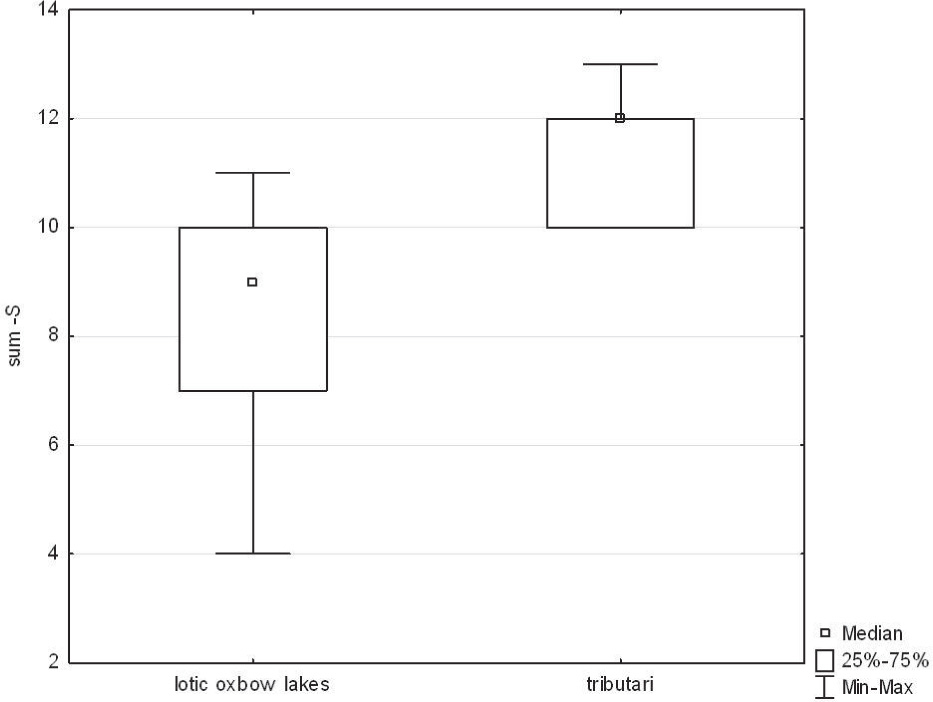
Figure 2
Significant statistical differences between the number of fungi and fungus-like organisms identified in the oxbow lakes and tributaries of the Narew in spring
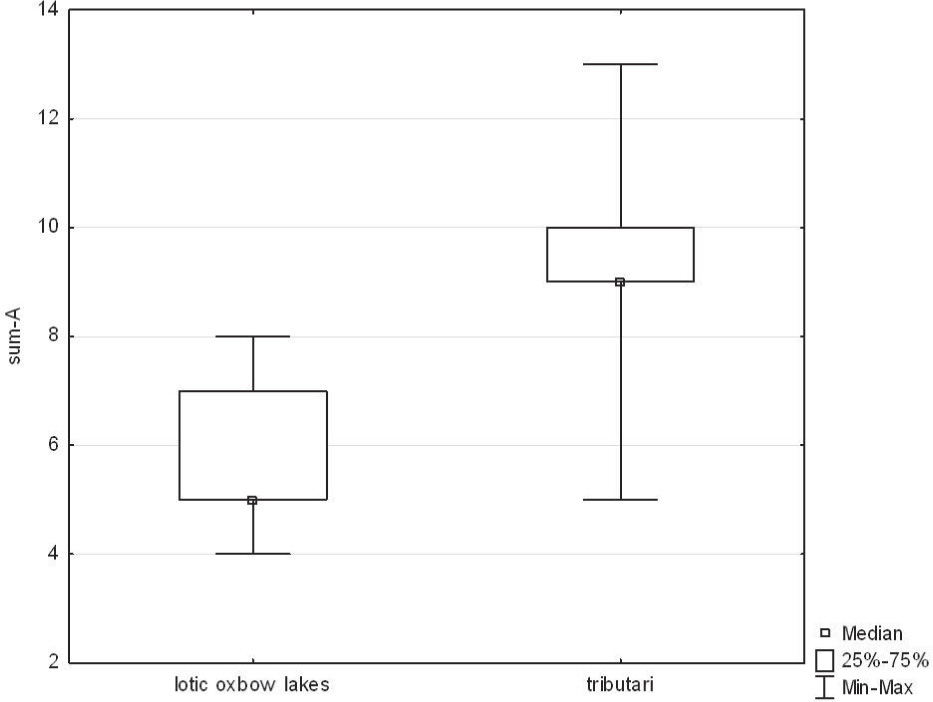
Figure 3
Significant statistical differences between the number of fungi and fungus-like organisms identified in the oxbow lakes and tributaries of the Narew in autumn
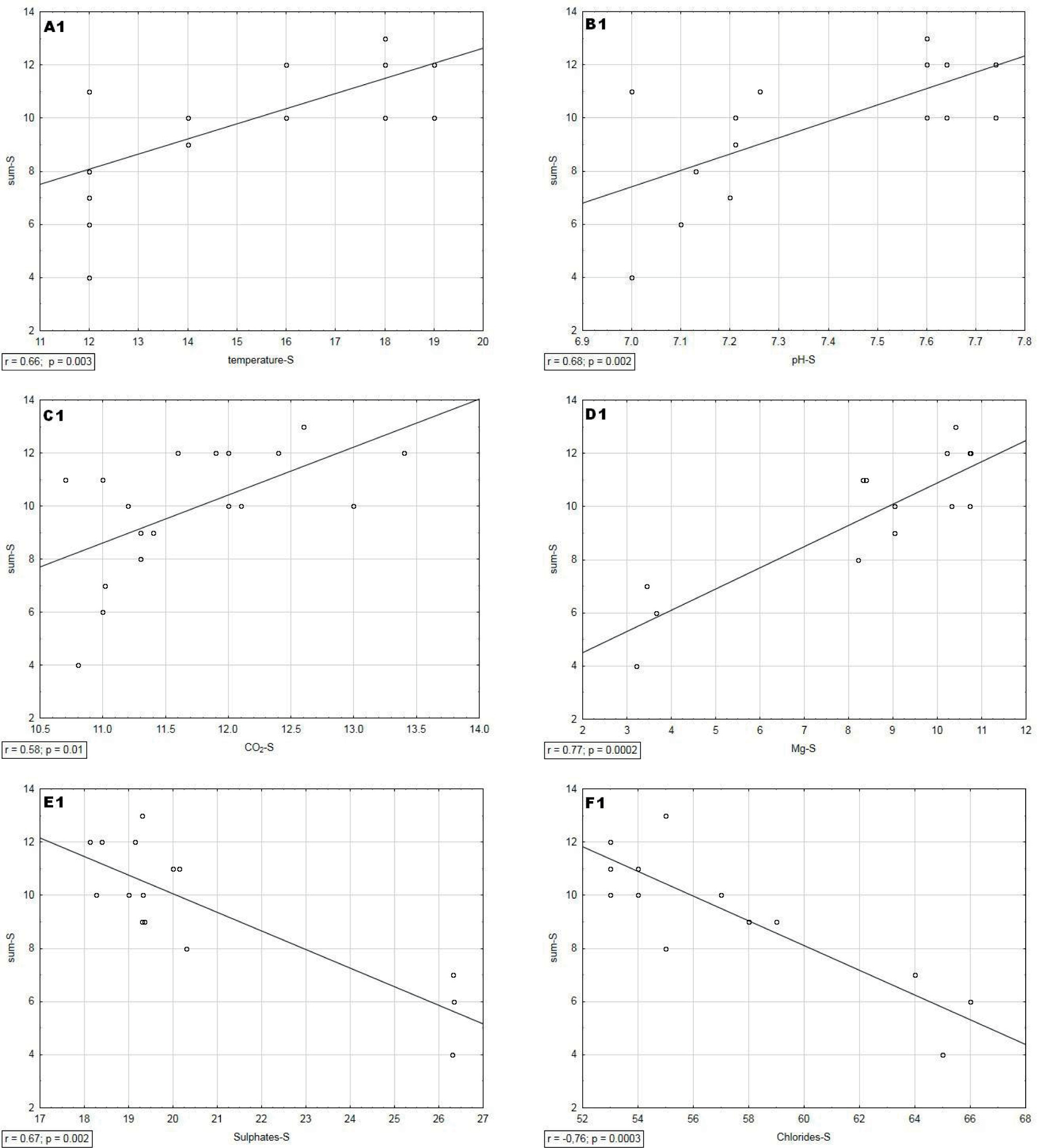
Figure 4
Statistically significant correlations between the number of fungi and fungus-like organisms identified in spring in the studied waters and the values of hydrochemical parameters: A1 – temperature, B1 – pH, C1 – carbon dioxide, D1 – magnesium, E1 – sulphates, F1 – chlorides
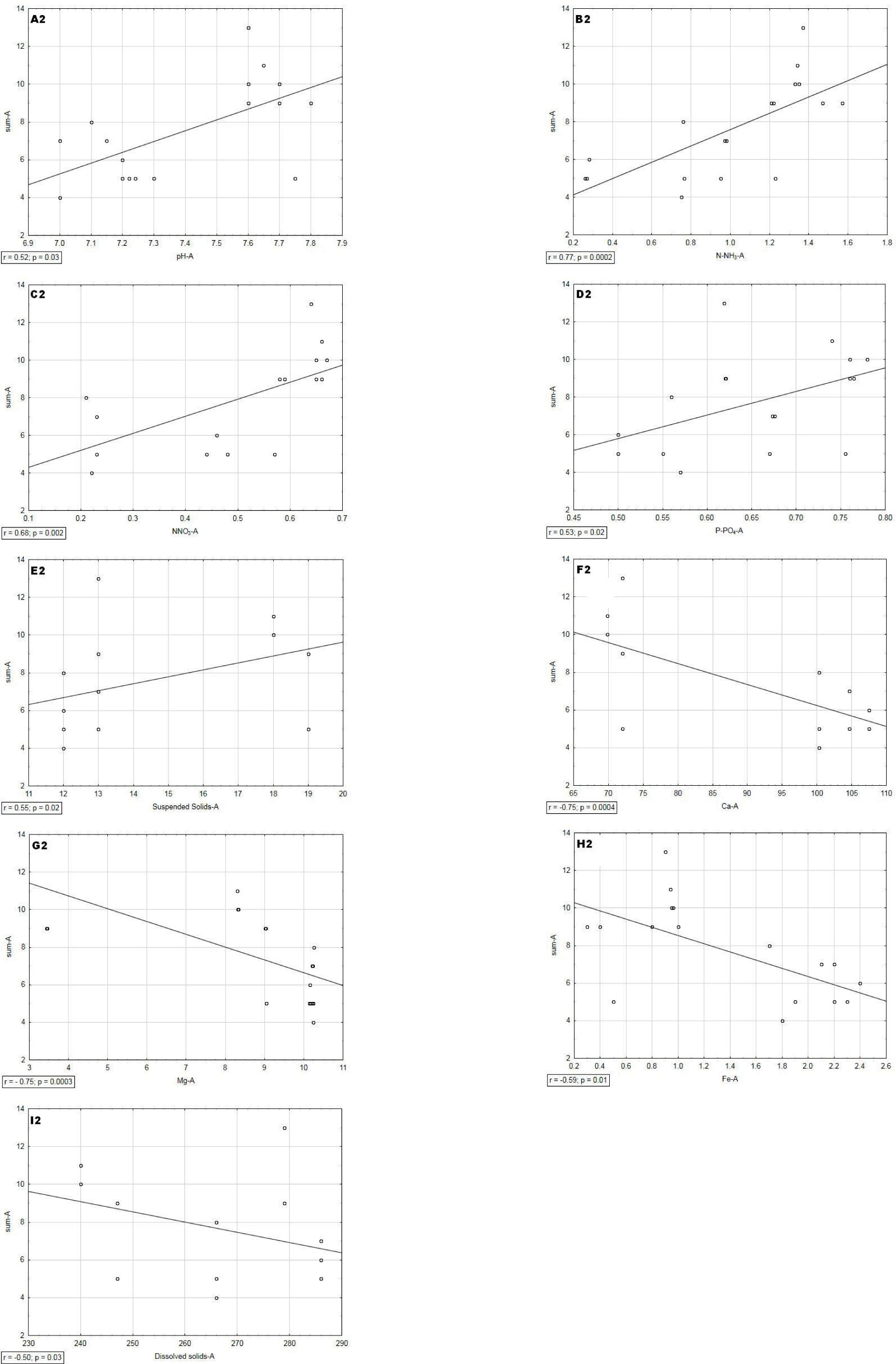
Figure 5
Statistically significant correlations between the number of fungi and fungus-like organisms identified in autumn in the studied waters and the values of hydrochemical parameters: A2 – pH, B2 – ammoniacal nitrogen, C2 – nitrate nitrogen, D2 – phosphates, E2 -suspended solids, F2 – calcium ions, G2 – magnesium, H2 – iron, I2 – dissolved solids