
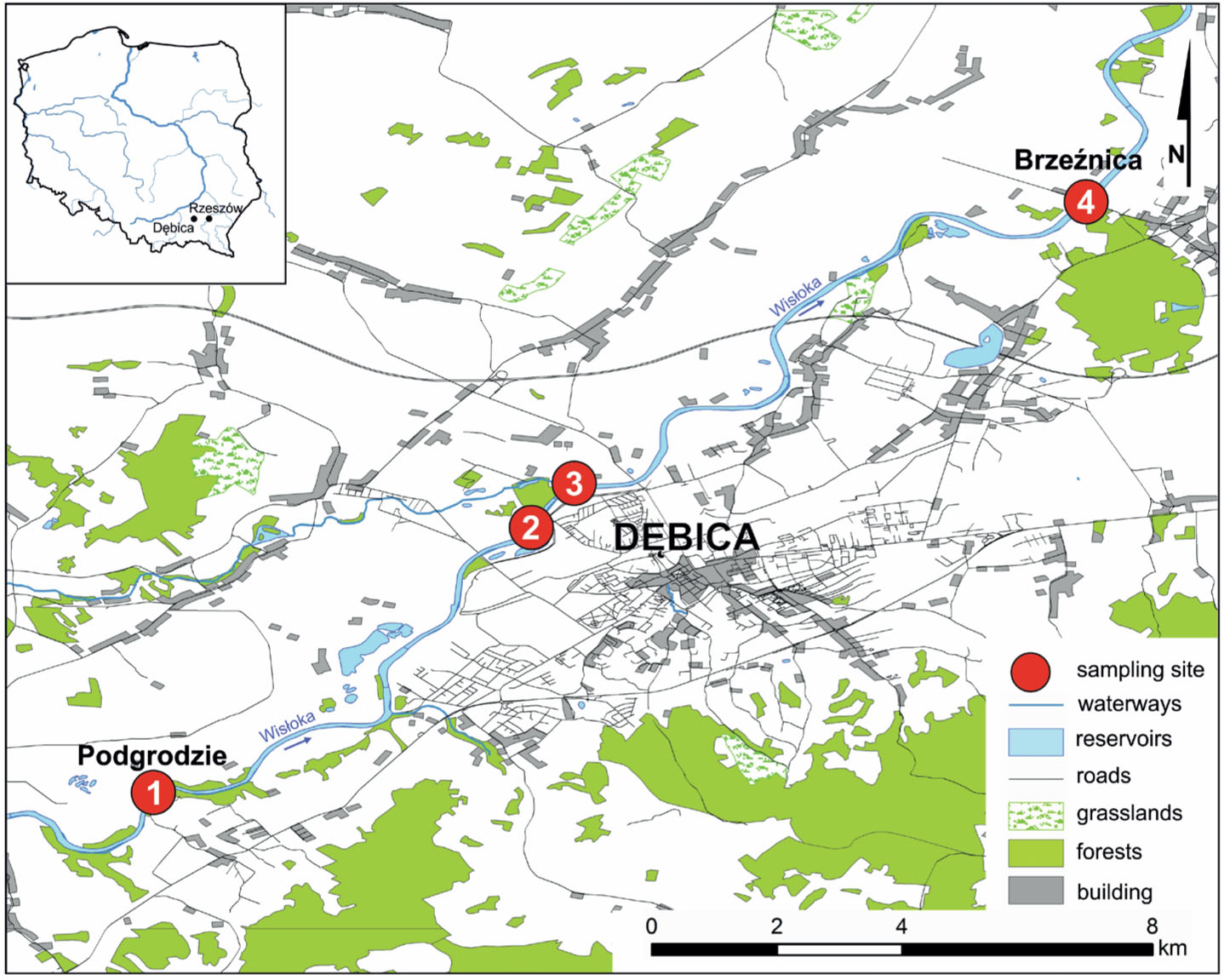
Figure 1
The location of sampling sites: 1 – site no. 1 in Podgrodzie village, 2-3 – sites in the Dębica town, 4 – site no. 4 in the Brzeznica village (own study based on data from the Geodetic and Cartographic Documentation Centre in Rzeszów)
Table 1
The range of indices values and corresponding ecological status according to Dumnicka et al. (2006)
| Water Quality Class* | Ecological status | SPI | GDI | TDI | Trophic state |
|---|---|---|---|---|---|
| I | high | > 17 | > 17 | <35 | oligotrophic |
| II | good | 15-17 | 14-17 | 35-50 | oligo/mesotrophic |
| III | moderate | 12-15 | 11-14 | 50-60 | mesotrophic |
| IV | poor | 8-12 | 8-11 | 60-75 | eutrophic |
| V | bad | <8 | <8 | >75 | hypertrophic |
Table 2
Values of physicochemical water parameters with description of sampling sites (1-4) in the Wisłoka River
| Parameter | Unit | Site | |||
|---|---|---|---|---|---|
| 1 50° 0’56.8” N 21° 19’ 59.6” E | 2 50° 3’ 27.8” N 21° 23’ 25.2” E | 3 50° 3’ 50.3” N 21° 24’ 13.2” E | 4 50° 6’ 14.9” N 21° 28’ 8.6” E | ||
| Insolation | high | high | high | high | |
| Bottom | stony | stony | stones and silt | stones and silt | |
| Width | m | ca 35 | ca 60 | ca 50 | ca 35 |
| Temperature | °C | 2-20 | 3-21 | 2-21 | 2-22 |
| pH | 6.5-7.7 | 6.7-7.6 | 6.6-7.5 | 6.6-7.5 | |
| Conductivity | µS cm-1 | 364-463 | 404-451 | 372-450 | 423-480 |
| Cl- | mg l-1 | 9.43-9.54 | 5.70-10.31 | 6.78-10.29 | 7.80-11.45 |
| NO2,-N | 0.18-0.22 | 0.12-0.25 | 0.11-0.19 | <0.15 | |
| NO3-N | 1.41-3.83 | 1.61-2.20 | 1.65-2.69 | 1.51-2.82 | |
| SO,42- | 33.54-33.90 | 21.85-35.96 | 25.35-35.81 | 27.51-38.31 | |
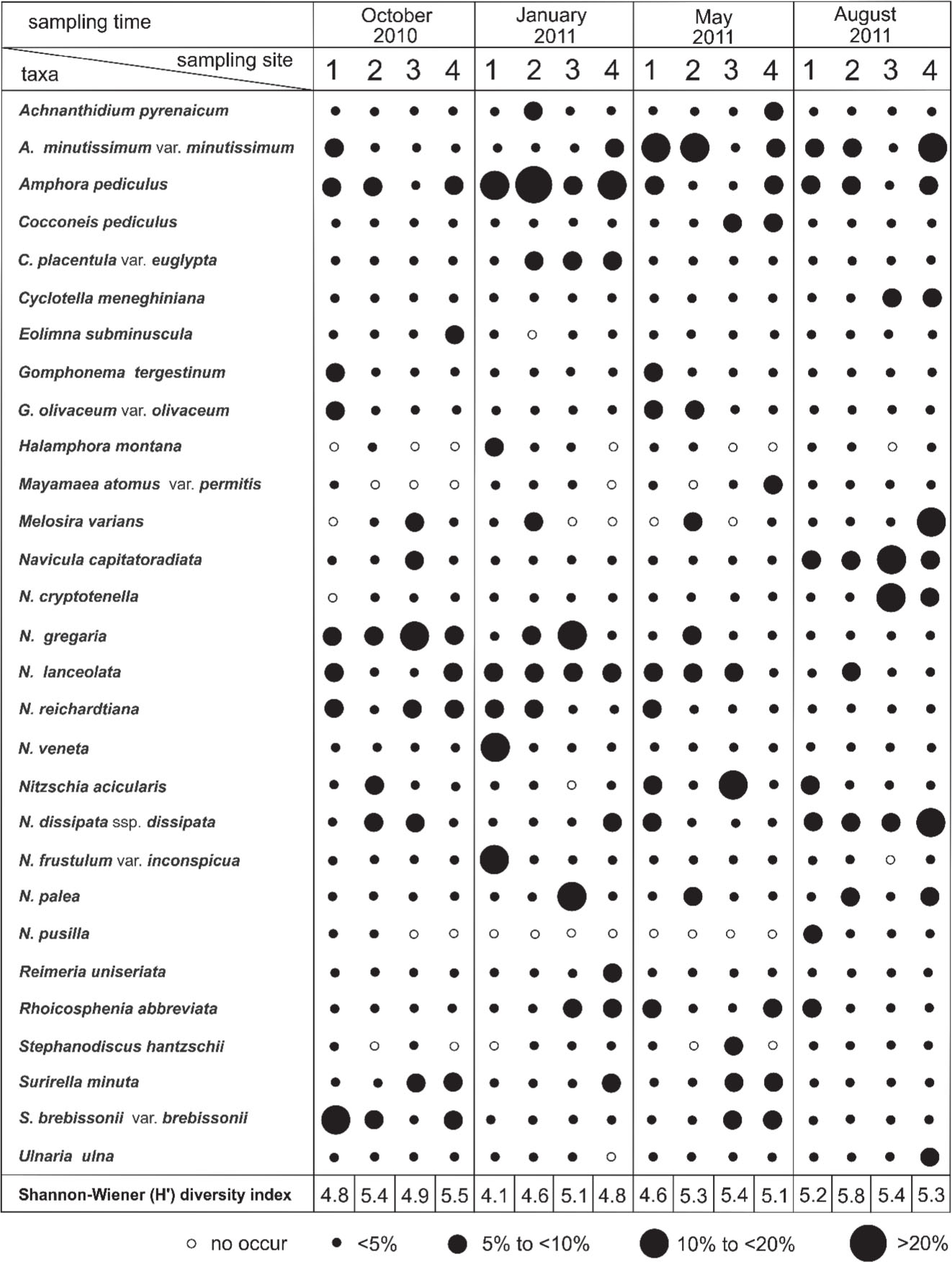
Figure 2
Dominance structure (%) in diatom assemblages and Shannon-Wiener (H’) diversity index values at the sampling sites in the Wisłoka River
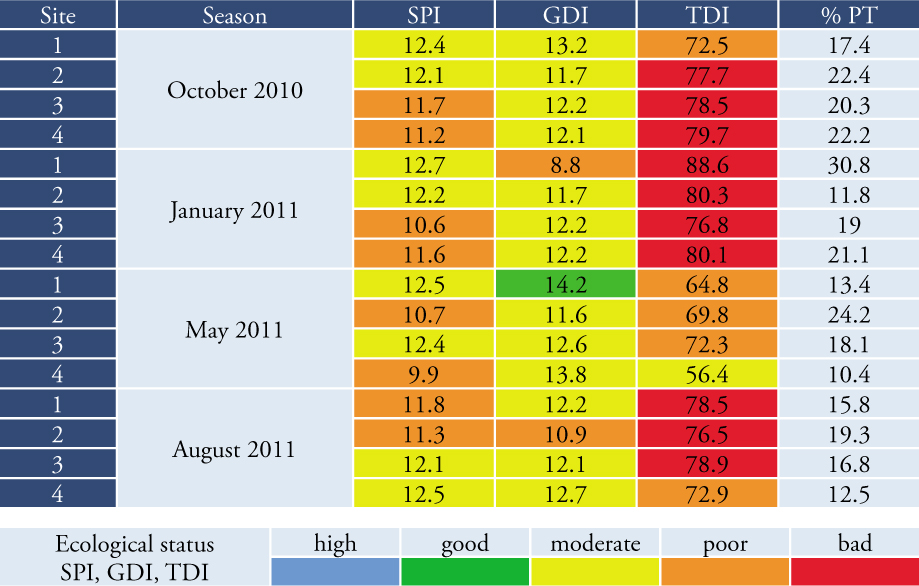
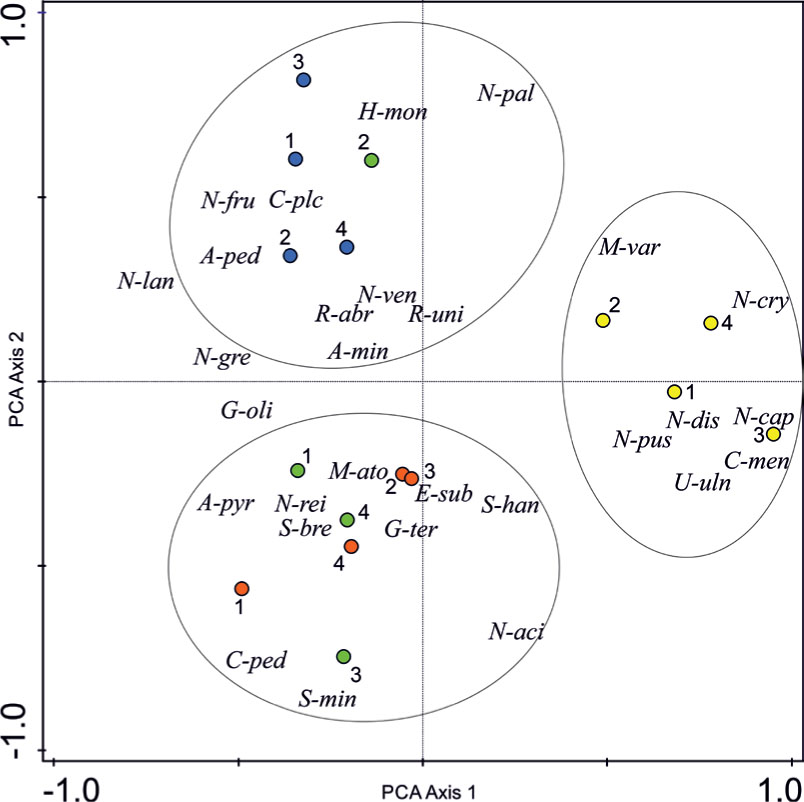
Figure 3
PCA ordination of sampling sites determined by relative community composition. Circled clusters represent sites of similarity based on the sampling season. Three distinct zones were identified (green points – spring season, yellow points – summer season, orange points – autumn season, blue points – winter season). The main species codes are as follows: A-pyr – Achnanthidium pyrenaicum, A-min – Achnanthidium minutissimum var. minutissimum, A-ped – Amphora pediculus, C-ped – Cocconeis pediculus, C-plc – Cocconeis placentula var. euglypta, C-men – Cyclotella meneghiniana, E-sub – Eolimna subminuscula, U-uln – Ulnaria ulna, G-ter – Gomphonema tergestinum, G-oli – Gomphonema olivaceum var. olivaceum, H-mon – Halamphora montana, M-ato – Mayamaea atomus var. atomus, M-var – Melosira varians, N-cap – Navicula capitatoradiata, N-cry – Navicula cryptotenella, N-gre – Navicula gregaria, N-lan – Navicula lanceolata, N-rei – Navicula reichardtiana, N-ven – Navicula veneta, N-aci – Nitzschia acicularis, N-dis – Nitzschia dissipata ssp. dissipata, N-fru – Nitzschia frustulum var. inconspicua, N-pal – Nitzschia palea, N-pus – Nitzschia pusilla, R-uni – Reimeria uniseriata, R-abr – Rhoicosphenia abbreviata, S-han – Stephanodiscus hantzschi, S-min – Surirella minuta, S-bre – Surirella brebissonii var. brebissonii
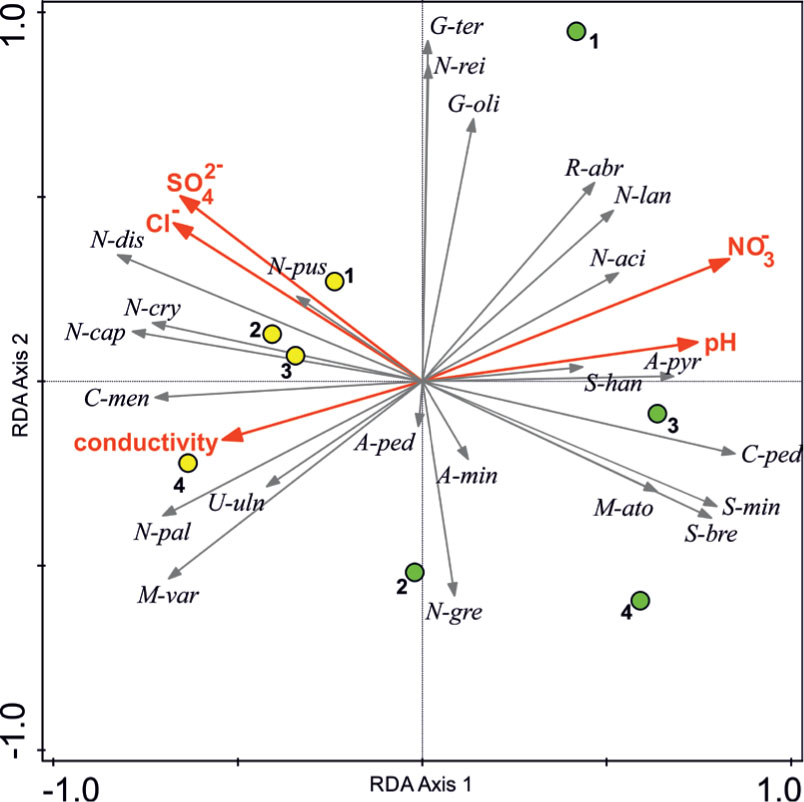
Figure 4
Diagram of the redundancy analysis (RDA) presenting the relationships between the analyzed diatom assemblages and water chemical parameters (green points – spring season, yellow points – summer season). Taxa abbreviations – see the Fig. 3.