
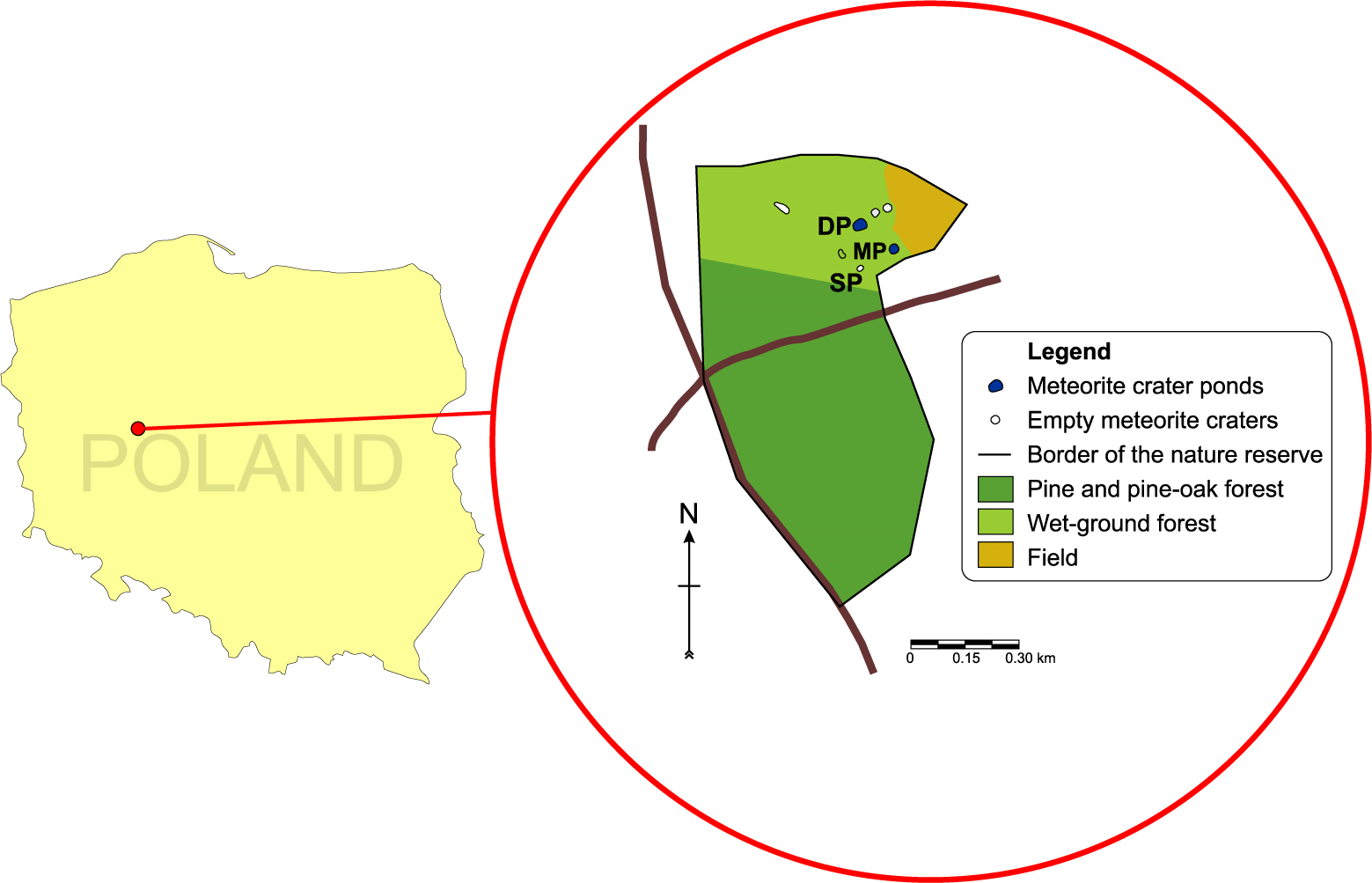
Figure 1
Location of the nature reserve “Meteorite Morasko” in Poland and location of the surveyed craters in the reserve (DP, MP and SP)
Table 1
Mean values of physico-chemical parameters, abundance of competitors and predators, and morphometric parameters with the standard error and Kruskal-Wallis test (KW-H) in the studied meteorite crater ponds (DP – deep, MP – medium and SP – small) in different moths (A – April, M – May, J – June) (Temp – water temperature, O2 – oxygen concentration, pH – pH value, Cond – electric conductivity, Chl a – chlorphyll a concentration, NO3 – nitrate content, PO4 – phosphorus content, A.com – Aedes communis, Ostrac – Ostracoda, Chaob – Chaoborus crystallinus, Comp Tot – the total number of competitors, Carn Cope – carnivorous copepods’ abundance, Pred Tot – the total number of predators
| DP | MP | SP | |||||||||||
|---|---|---|---|---|---|---|---|---|---|---|---|---|---|
| A | M | J | KW-H | A | M | J | KW-H | A | M | J | KW-H | ||
| Abiotic parameters | |||||||||||||
| Temp | ±C | 9±3.0 | 13±1 | 14±4 | 10.6** | 11±3 | 14±3 | 14±5 | 5.0 | 10±3 | 11±2 | 15±3 | 11.7** |
| O2 | mg l−1 | 7.0±5.1 | 2.2±1.2 | 3.7±2.3 | 2.7 | 6.1±1.9 | 5.9±1.1 | 5.8±1.1 | 0.4 | 2.8±1.0 | 4.2±1.7 | 3.0±0.6 | 6.0* |
| pH | - | 7.9±0.6 | 7.6±0.4 | 7.3±0.2 | 12.6** | 7.6±0.1 | 7.4±0.3 | 7.4±0.7 | 0.1 | 6.4±0.3 | 6.9±0.4 | 7.0±0.0 | 17.3** |
| Cond | μS cm-3 | 144±20 | 158±38 | 201±128 | 2.4 | 541±53 | 516±89 | 334±88 | 24.3** | 362±240 | 695±221 | 429±12 | 19.0** |
| Chl a | μg l-1 | 84±51 | 14±11 | 5±5 | 19.5** | 24±13 | 10±9 | 6±5 | 15.1** | 24±17 | 25±16 | 7±4 | 14.8** |
| NO3 | mg l-1 | 0.21±0.01 | 0.17±0.1 | 0.00±0.00 | 21.5** | 0.19±0.02 | 0.18±0.11 | 0.00±0.00 | 20.5** | 0.73±0.51 | 0.34±0.21 | 0.00±0.00 | 20.6** |
| PO4 | 2.27±0.25 | 3.21±0.31 | 2.03±0.63 | 24.3** | 0.2±0.08 | 0.24±0.15 | 0.53±0.62 | 1.3 | 3.05±0.86 | 2.91±0.62 | 1.36±1.42 | 16.5** | |
| Biotic parameters | |||||||||||||
| A.com | ind. l-1 | 1±2 | 2±2 | 7±8 | 4.9 | 2±2 | 2±3 | 2±3 | 1.4 | 83.±130 | 4±3 | 4±4 | 7.4* |
| Ostrac | 662±1014 | 1703±1631 | 27±64 | 21.7** | 18±50 | 354±537 | 3±8 | 24.0** | 6±9 | 22±23 | 0.1±0.3 | 19.0** | |
| Chaob | 3±4 | 3±8 | 9±9 | 5.6 | 1±1 | 0.2±0.4 | 1±1 | 3.4 | 0.1±0.3 | 0±0 | 1±1 | 6.1* | |
| Comp Tot | 663±1014 | 1705±1630 | 34±62 | 19.2** | 20±50 | 357±536 | 5±7 | 22.5** | 90±132 | 26±24 | 4±4 | 14.8** | |
| Carn Cope | 3±4 | 0.1±0.3 | 0±0 | 13.9** | 5±6 | 0±0 | 0.1±0.3 | 18.5** | 1±1 | 1±3 | 0±0 | 8.9* | |
| Pred Tot | 8±7 | 8±16 | 18±17 | 5.2 | 7±8 | 0.3±1 | 2±3 | 12.7** | 1±2 | 1±2 | 1±1 | 3.1 | |
| Morphometric parameters | |||||||||||||
| Maximum crater diameter | m | 40 | 27 | 16 | |||||||||
| Maximum pond diameter | 35 | 25 | 20 | ||||||||||
| Maximum pond depth | 1.5 | 1 | 0.5 | ||||||||||
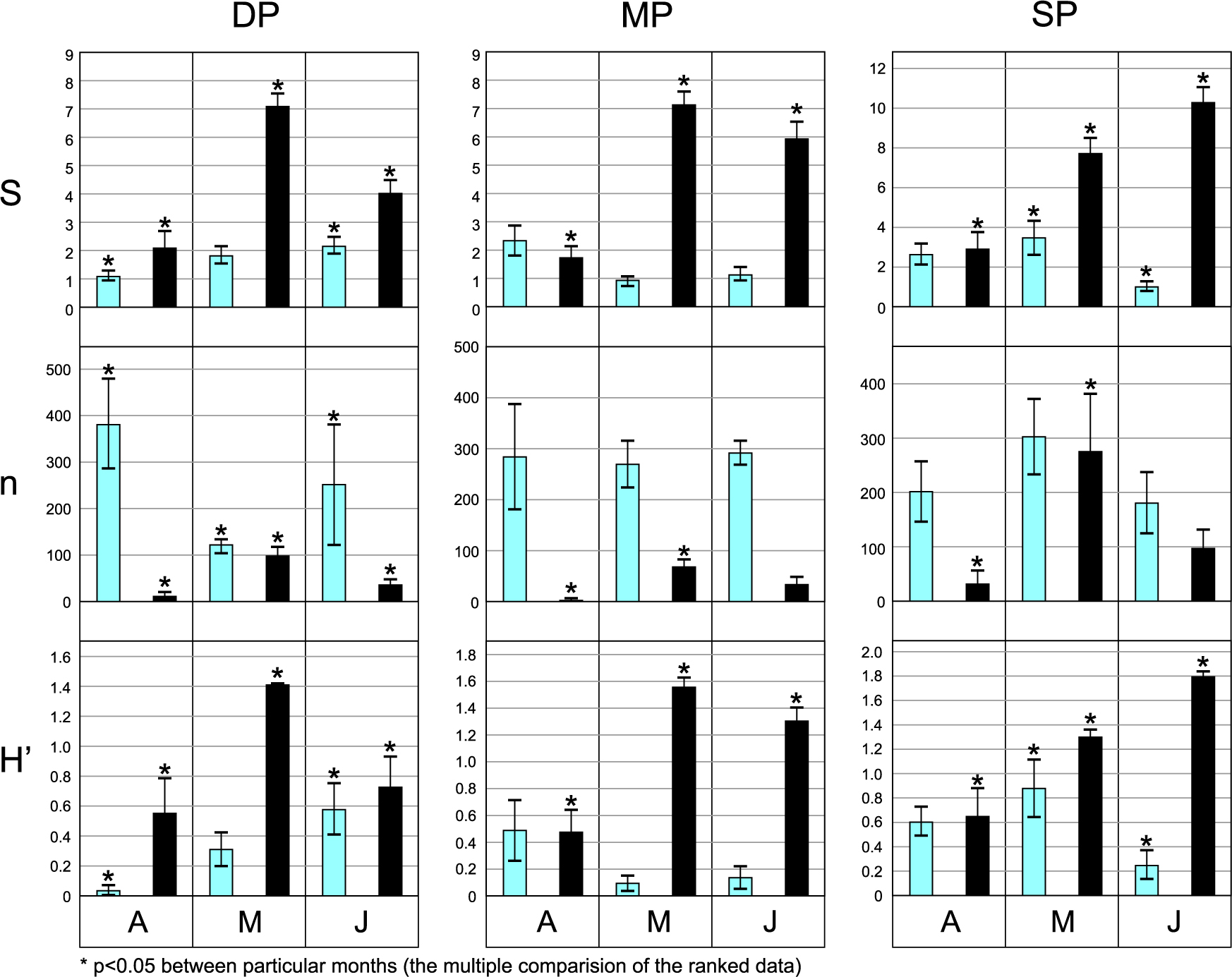
Figure 2
Mean values of copepod (blue bars) cladoceran (black bars) and species number (S), abundance (n; ind. l-1) and Shannon diversity index (H’) in meteorite crater ponds (DP – deep, MP – medium, SP – shallow) in different moths (A – April, M – May, J – June) with the standard error
Table 2
Mean values of cladoceran and copepod abundance with the list of dominant species in meteorite crater ponds (DP – deep, MP – medium, SP – shallow) in different months (A – April, M – May, J – June) with the standard error and Kruskal-Wallis test (KW-H) (Large Clad – large cladocerans, Small Clad – small cladocerans, Clad ♂ – cladoceran males, Cope Larvae – copepod larvae, Cope Adult – adult forms of copepods)
| Unit | DP | MP | SP | ||||||||||
|---|---|---|---|---|---|---|---|---|---|---|---|---|---|
| A | M | J | KW-H | A | M | J | KW-H | A | M | J | KW-H | ||
| Large Clad | ind. l-1 | 10±18 | 56±43 | 29±23 | 15.6** | 3±4 | 33±26 | 7±5 | 19.3** | 21±41 | 139±123 | 49.±58 | 14.2** |
| Small Clad | 0.2±0.5 | 2±2 | 9±13 | 12.0** | 1±2 | 25±17 | 22±19 | 17.9** | 1±2 | 3±2 | 12±9 | 23.4** | |
| Clad | 0.3±1 | 8±10 | 0±0 | 11.6** | 1±1 | 4±5 | 1±1 | 17.2** | 8±17 | 85±90 | 3±3 | 21.5** | |
| Cope Larvae | 361±240 | 97±40 | 241±258 | 4.7 | 200±147 | 264±106 | 286±90 | 4.1 | 134±101 | 307±324 | 180±120 | 2.9 | |
| Cope Adult | 12±18 | 19±16 | 10±9 | 3.4 | 10±11 | 5±5 | 5±4 | 0.8 | 5±4 | 11±10 | 1±1 | 14.8** | |
| Alonella excisa | + | + | + | ||||||||||
| Bosmina longirostris | + | ||||||||||||
| Chydorus sphaericus | + | ||||||||||||
| Daphnia pulex | + | + | + | + | + | + | + | ||||||
| Scapholeberis mucronata | + | ||||||||||||
| Simocephalus exspinosus | + | + | + | ||||||||||
| Cyclops vicinus | + | + | |||||||||||
| Megacyclops viridis | + | + | + | + | + | ||||||||
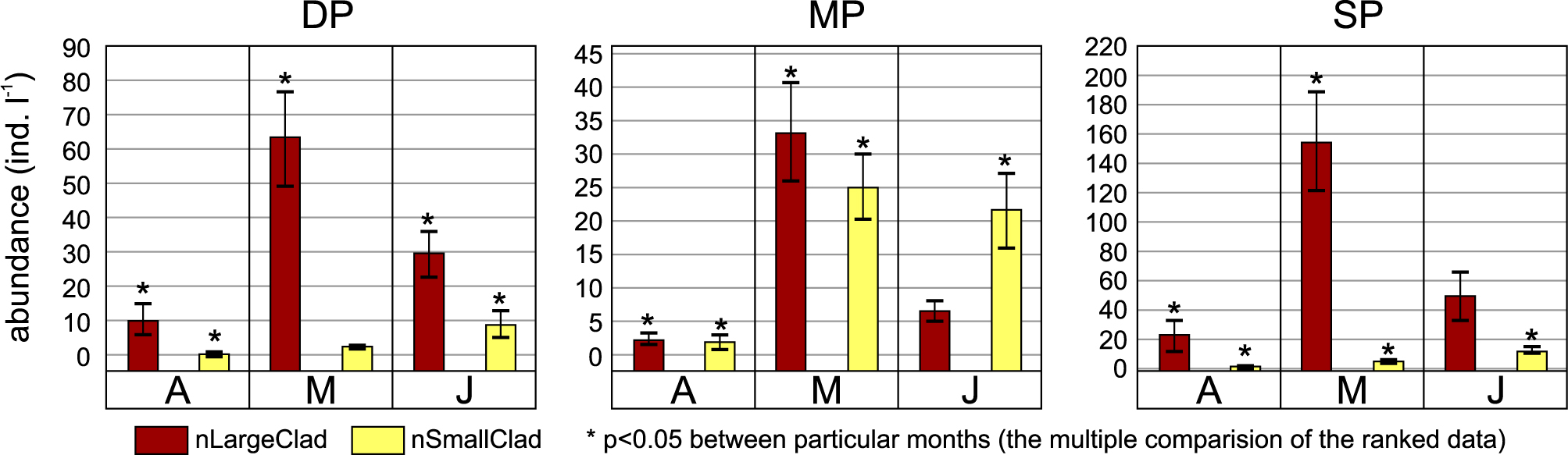
Figure 3
Mean number of large (nLargeClad) and small species (nSmallClad) of Cladocera (ind. l-1) in the studied months (A – April, M – May, J – June) in meteorite crater ponds (DP – deep, MP – medium, SP – shallow) in different moths (A – April, M – May, J – June) with the standard error
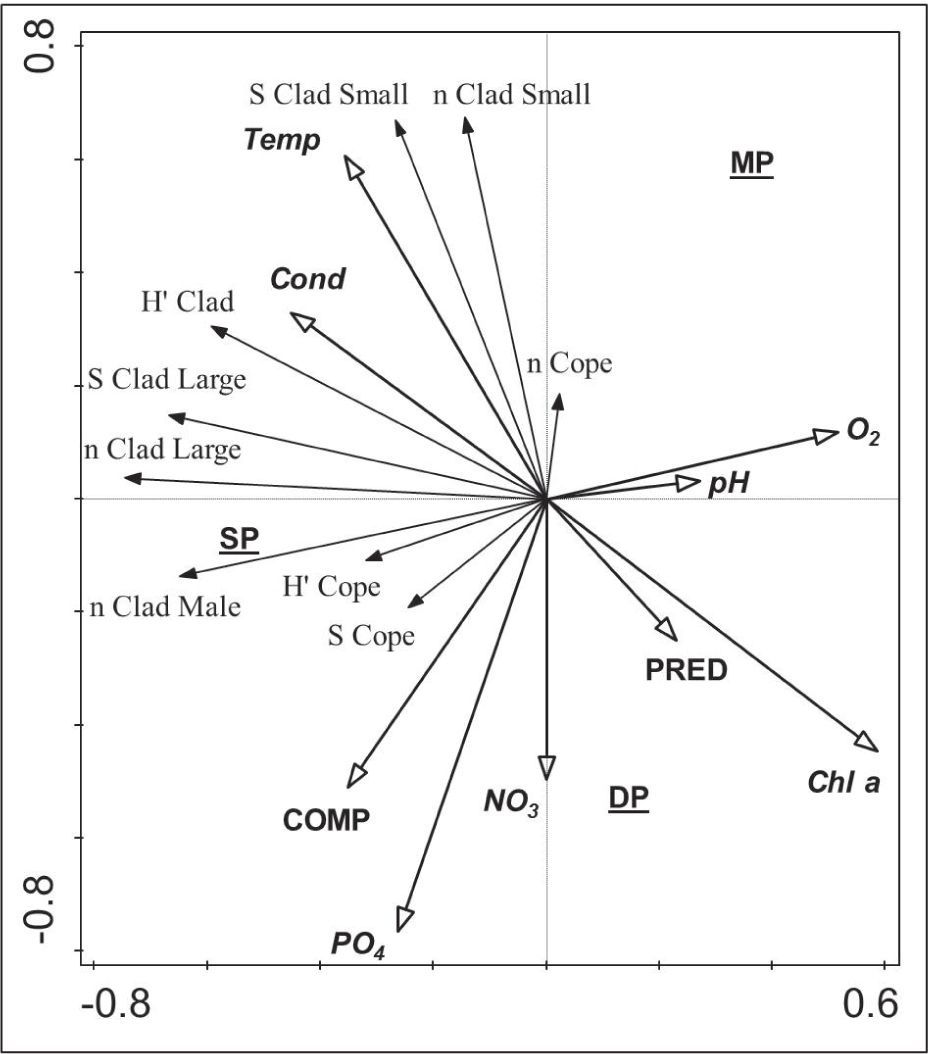
Figure 4
The redundancy analysis diagram showing the relationships between species richness (S), Shannon diversity index (H’), abundance (n)