1. Private Equity Funds and Tax law
The private equity model has spread across the world since the model gained momentum in the United States in the 1960s, and over time, this investment form has drawn a lot of attention to itself. On the positive side, private equity funds have been acknowledged to play an important role in bridging global finance and businesses’ capital needs. However, on the negative side, public concern has often been displayed regarding the consequences of the private equity funds’ activities, for example, with respect to labor retrenchment in the target companies, unsustainable debt levels, compensation levels of fund managers, and, last but not least, tax issues. 1
A wide range of tax-related questions may come up with respect to the activities of private equity funds. 2A non-exhaustive list could include issues such as taxation of capital gains, taxation of carried interest, deductibility of interest expenses and management fees, withholding taxes on interest and dividends, and the applicability of anti-avoidance rules. Moreover, an import issue concerns the question of whether the investment in a private equity fund may create a permanent establishment (PE) for foreign investors. 3
The last question has been chosen as the research topic for this article, as the answer to the question may be of outmost importance when investors are considering whether or not to invest in a foreign private equity fund. 4 Furthermore, it is not a simple question to answer, as the answer is highly dependent on the facts and circumstances of the specific private equity fund in question and because these structures are often quite sophisticated. 5 Accordingly, it was not particularly surprising that Working Party 1 on Tax Conventions and Related Questions, when dealing with this particular question in 2012, concluded that more specific guidance could not be provided for the private equity industry on this matter. 6
In addition, the chosen topic is both timely and of practical relevance, as courts and administrative bodies in cases from around the world have been faced with the question on whether a private equity fund may create a PE for foreign investors. 7 In this regard, it should also be noted that the amendments to the PE definition prescribed in the OECD/G20 BEPS report on Action 7, and incorporated into the 2017 version of the OECD Model Tax Convention on Income and Capital (21 November 2017) with commentaries, may have pushed this question further up the agenda. 8 Accordingly, the aim of this article is to analyze if—and if yes, under which circumstances—investments in a private equity fund may give rise to a PE for the foreign investors.
The article starts out by briefly describing the functioning and organizational setup of private equity funds, as knowledge hereof constitutes a necessary foundation for the subsequent discussions. After this, a traditional legal dogmatic method is used to analyze the research question. The dogmatic analysis is divided in two main parts, as the question of creating a PE for the foreign investors will be considered in relation to both the main PE rule and the agency PE rule. The discussions will, among other things, draw on Danish experiences, as the question concerning PE for private equity investors has been dealt with in a number of recent decisions from the National Tax Board, as well as in the Danish literature, and very recently by the Danish legislator. However, relevant experiences and case law from other jurisdictions will also be included.
As mentioned, the above analyses will be based on doctrinal legal studies because the primary aim of the article is to deduce valid law by gathering, systemizing, and analyzing legal sources of relevance for the topic (i.e., considerations de lege lata). 9 In this context, attention will be devoted to analyzing the PE concept defined in Article 5 of the OECD Model with Commentary as many PE provisions in bilateral tax treaties as well as in domestic law rely on the OECD definition. 10 Thus, although the OECD Model is not a binding treaty, it has often proved to be of great importance for the interpretation and application of tax treaty provisions.11Moreover, even though uncertainty remains concerning the exact legal status of the Commentary to the OECD Model, the Commentary is widely accepted as a guide to the interpretation and application of tax treaties based on the OECD Model.12
As also mentioned, case law available from around the world will be included in the analyses. Accordingly, even though case law of one jurisdiction is not binding for courts and authorities in other jurisdictions, the widespread use of the OECD PE concept has entailed that court decisions from other jurisdictions may be an important source of guidance when national courts consider cases regarding the PE concept.13In other words, interpretive solutions or principles may circulate through judicial transplants activated by domestic courts.14
Finally, on the basis of the findings of the dogmatic analysis, some tax policy options are briefly discussed. The aim is to shed light on some of the jurisdictions where the legislator has already responded to the legal challenges unveiled in the previous sections of the article. Thus, by discussing the pros and cons of these domestic legislative solutions, the aim is to provide fruitful insights that could be of assistance when considering if or how to react to these challenges in other jurisdictions as well as in international fora (i.e., considerations de lege ferenda).
2. The Functioning, Organization, and Regulation of Private Equity Funds
Private equity funds may be broadly defined as businesses that draw on capital and debt in the international financial system to acquire stakes in companies that are intended to be sold for profit after a number of years.15 Typically, the portfolios of private equity funds contain only a few positions (target companies) in which the fund has acquired control. Accordingly, private equity investments are normally illiquid, as the investors (limited partners) commit their capital for a longer period of time.16 In other words, most private equity funds are the so-called closed-end funds, which mean that investors cannot withdraw their investment until the fund is terminated. The injected capital is normally invested for a 4- to 5-year period, and subsequently, there is a period of typically 5–8 years during which the fund will exit its investments and return capital and profits to the partners.17
The investors in private equity funds often consist of professional investors such as pension funds, insurance companies, high-net-worth individuals, family offices, endowments, foundations, funds of funds, and sovereign wealth funds. The capital provided by these investors is used by the private equity funds to acquire large—often entire or at least controlling—shareholdings in a number of target companies.18 Thus, when the target companies have been acquired, the private equity funds tend to alter the structure of the target companies in various ways, for example, by disposing assets that are not deployed efficiently, replacing management, and changing business plans.19
Private equity firms play a number of roles in the market, and the funds’ investments can take different forms. The most well-known investment type is probably the leveraged buyout (LBO), in which the private equity fund acquires a majority stake in a target company, using equity from a relatively small group of investors in combination with a significant amount of debt. The targets of such acquisitions are often mature larger companies. On the opposite, another important subgroup of private equity investments, known as venture capital, focuses on investing in younger often very innovative companies that may have difficulties in finding alternative sources of financing. Accordingly, such investments are often praised for their important role in nurturing new industries.20
Even though the structure of different private equity funds varies, a basic version of a typical fund structure can be outlined. Often, a private equity firm is legally structured as a limited partnership owned jointly by a general partner and a number of limited partners (the investors). Often, the general partner is an entity owned by the fund managers. The fund managers or entities owned by the fund managers receive annual management fees, typically amounting to 1–3% of the fund’s assets, for this work (sometimes also one or several advisory companies are part of the overall structure and they also have to be remunerated). Moreover, they also receive carried interest, which is a portion of the profits generated by the fund. The carried interest typically amounts to about 20%of the profits generated by the fund exceeding the so-called hurdle rate (e.g., 7% or 8% p.a.). Thus, there should be a strong incentive for the fund managers to maximize the value for the fund.
In practice, a new corporation (NewCo) is typically set up by the private equity fund. NewCo receives equity investments from the private equity fund and sometimes also from the management of the target company, as well as debt financing from lenders. NewCo then uses this funding to acquire the target company for cash. Subsequently, the cash flows from NewCo, and the target company is used to service the debt payments.21
Historically, private equity funds and their fund managers have not been subject to detailed regulation. However, the financial crisis that started in 2008 led to increased calls for the regulation of the industry. In the United States, for example, registration requirements were generally not imposed on fund managers because most managers of private equity funds would manage 14 or fewer funds and, therefore, were qualified for exemption from registration under the Investment Advisors Act of 1940. Among other things, the so-called Dodd-Frank Act from 2010 changed that. Accordingly, fund managers are now required to register with the US Securities and Exchange Commission (SEC) and to disclose information on a wide range of behavior.22
Also, in Europe, tighter regulation of the private equity industry has been adopted in the aftermath of the financial crisis. Thus, in 2010, the so-called Alternative Investment Fund Managers Directive (AIFMD) was agreed upon.23The directive applies to entities established in a member state that manage one or more alternative investment funds. Furthermore, the directive also applies to managers who reside outside the European Union if they manage alternative investment funds within the European Union or market such funds to investors domiciled in the European Union. Typically, the general partner of a private equity fund should be considered a manager covered by the directive which, as a consequence, means that a number of requirements have to be fulfilled. These requirements concern authorization, size of capital, appointment of a depository, procedures for valuation of assets, remuneration policies, implementation of risk management systems, limitations on leverage, transparency, and disclosure.24
3. The Private Equity Fund as a PE—Overall Concerns
The organization of the private equity fund as a limited partnership normally entails that the fund itself should be considered transparent for tax purposes.25 Accordingly, no economic double taxation of the income generated by the private equity fund should occur, provided that both the source state and the state of residence of the investors acknowledge that the fund is transparent for tax purposes.26 However, juridical double taxation may occur if both the source state and the residence state consider themselves entitled to tax the income of the investors in the private equity fund.27 This could, for example, be the case if the source state is of the opinion that the investors of the private equity fund should be considered to have a PE in the source state, whereas the residence state of the investors does not agree that the criteria for creating a PE in the source state are fulfilled.28 Nevertheless, double non-taxation could also occur if no taxation takes place in the source state—for example, because no PE is considered to be created there—and the investor is tax exempt in the residence state or is resident in a tax haven.29
Keeping this in mind, it is understandable that investors, as well as private equity firms and tax authorities (states), have a strong interest in determining up-front whether an investment in a private equity fund will create a PE for foreign investors.30 In this regard, it seems expedient to analyze the PE definition, as set out in Article 5 of the OECD Model, more precisely the main PE rule and in particular the agency PE rule.
However, before initiating the analysis, it should be noted that a number of changes were made to Article 5 of the OECD Model with commentaries in late 2017. Some of the changes to the commentaries were intended to clarify the interpretation of Article 5 and should, therefore, according to the OECD, be taken into account even for the purposes of interpretation and application of tax treaties concluded before the adoption of the 2017 version of the OECD Model.31This, for example, applies to the changes made to the Commentary to the main PE rule in Article 5(1). However, a number of the other changes made to the Commentary to Article 5 are prospective only and do not affect the interpretation of the former provisions of the OECD Model and of tax treaties in which these provisions are included. Among other things, this applies to the new commentaries to the agency PE rule in Article 5(5-6 and 8) of the OECD Model (2017) that relate to the modification of the wording of the agency PE rule itself (which was based on the adoption of the OECD/G20 BEPS report on Action 7).32This development will be taken duly into account when analyzing the question on whether an investment in a private equity fund will create a PE for foreign investors pursuant to the agency PE rule.33
4. Creating a PE for Investors in Private Equity Funds After the Main PE Rule
Even though investors, private equity firms, and expert groups have mainly been occupied with the question on whether an investment in a private equity fund will create a PE for foreign investors after the agency PE rule,34 it is also necessary to consider the possibility of creating a PE after the main PE rule, as the facts and circumstances concerning the setup of different private equity funds may vary.35 Furthermore, it should be kept in mind that the agency PE rule only provides an alternative test of whether an enterprise has a PE.36
Pursuant to the main PE rule in Article 5(1) of the OECD Model (2017), the term PE means a fixed place of business through which the business of an enterprise is wholly or partly carried on. Accordingly, the existence of a PE requires that the following three conditions all are fulfilled (and that the overall activity of the fixed place of business is not of a preparatory or auxiliary character, cf. Article 5(4)):
1 ) the existence of a “place of business,” that is, a facility such as premises or, in certain instances, machinery or equipment;
2) this place of business must be “fixed,” that is, it must be established at a distinct place with a certain degree of permanence,37
3) the carrying on of the business of the enterprise through this fixed place of business.38 This usually means that persons who, in one way or another, are dependent on the enterprise (personnel) conduct the business of the enterprise in the state in which the fixed place is situated.39
4.1. Does the Private Equity Fund Have a Fixed Place of Business (Conditions 1 and 2)?
Typically, a private equity fund vehicle (the partnership) will not have any premises of its own. Therefore, it seems relatively straightforward to arrive at the conclusion that no PE should be considered created pursuant to the main PE rule. Moreover, in order to safely avoid creating a PE in the jurisdictions of the portfolio companies, the assistance needed locally is often obtained from an advisory company, and private equity funds are typically very careful not to use the facilities of the advisory company in any way. In addition, in order to make it clear that the activities of, for example, the personnel of the advisory company cannot be considered a place of management for the private equity fund, as exemplified in Article 5(2)(a) of the OECD Model, it is common to ensure that no overlap exists with respect to the positions (corporate offices) held by the personnel of the advisory company and the individuals directly involved in the private equity fund (e.g., individuals participating in the investment committee of the fund).40
However, before arriving at the conclusion that no PE issues are triggered, it must be thoroughly assessed whether, in the concrete situation at hand, the private equity fund vehicle should actually be seen as having the premises of some of the parties involved in the structure at its disposal (e.g., the premises of the management company or an advisory company). If this is in fact the case, it should, in addition, be analyzed whether the investors in the private equity fund could be considered to carry on business through that fixed place of business.
A case decided by the Danish National Tax Board in 2013 dealt with these particular questions, and even though the decision concerned the PE issue in a Danish context, it may be of general interest to other jurisdictions and the interpretation of their tax treaties.41Moreover, it seems fruitful to discuss the issue based on actual cases, as this may provide a clearer picture of the peculiarities of the private equity structures.
Thus, in the Danish case from 2013, the National Tax Board actually found that the investors in a Danish private equity fund should be considered to have the premises of the management company at their disposal.42Hence, the investors were considered to have a fixed place of business at the offices of the management company. As the National Tax Board also found that the investors carried on business through this fixed place of business, the National Tax Board concluded that the foreign investors should be considered to have a PE in Denmark according to the main PE rule.43
In order to understand and discuss this decision by the Danish National Tax Board, the particular facts and circumstances of the setup are briefly described in the following paragraphs. Moreover, a simplified structure is depicted in Figure 1.
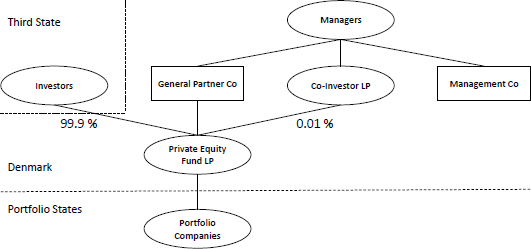
Figure 1
Briefly explained, the private equity fund vehicle (Private Equity Fund LP) was set up as a Danish limited partnership, the so-called “kommanditselskab.” The fund vehicle did not have any employees and had no offices or other premises at its disposal. Its only governing body was the general meeting. The general partner was a Danish limited company (General Partner Co), which was governed by a board of directors, consisting of members of the management team (managers). The general partner was responsible for the overall approval and execution of the investments, whereas a management company (Management Co) was responsible for all other operations, for which it received a management fee.44 Also General Partner Co did not have any premises at its disposal. Thus, the board meetings of General Partner Co, as well as the general meeting of Private Equity Fund LP, were meant to take place at Management Co’s offices in Denmark. More than 99% of the funds injected in the private equity fund vehicle came from institutional investors (investors) and <1% came from the managers who had made their investment through another Danish limited partnership (Co-Investor LP), which was entitled to receive carried interest. Considering the foreign investors, the National Tax Board was asked to assume that the investors were resident in a state having a tax treaty with Denmark containing a PE provision similar to the one found in Article 5 of the OECD Model (2010).45
On the basis of these facts, the National Tax Board first stated that the private equity fund vehicle should be considered to constitute an enterprise, according to Article 5(1) of the OECD Model, and that the determination of whether a PE existed or not, therefore, should be made with respect to the fund vehicle itself and not the individual investors.46
Thereafter, the National Tax Board considered whether a fixed place of business existed (Conditions 1 and 2 of the main PE rule). With regard to this question, the National Tax Board concluded that the fact—that the fund vehicle’s general meetings were to take place at the management company’s offices—in itself entailed that the fund vehicle should be considered to have a fixed place of business through these offices. Moreover, even if the general meetings were not permanently held at the management company’s offices, the National Tax Board found that the investors should be considered to have a fixed place of business at their disposal through the management company’s offices. In reaching this conclusion, the National Tax Board seems to put emphasis on the fact that the whole investment project, in the National Tax Board’s view, was widely controlled by the members of the management team, who had dual roles and co-invested.
This part of the National Tax Board’s decision has rightly been criticized in the Danish literature.47 Accordingly, even if the fund vehicle’s general meetings actually were to take place at the management company’s offices, it does not necessarily mean that the fund vehicle should be considered to have a fixed place of business through these offices, as the meetings would be of a purely temporary nature.48 In addition, and more generally, it could be argued that the actual activities of the general partner, the management company, and the management team could not entail that the fund vehicle should be considered to have the offices of the management company at its disposal. The argument could be supported by the fact that the general partner and the management company were separate legal entities carrying on their own activities and that the managers carried on their management activities independently within the boundaries of these separate entities.
Finally, the National Tax Board found that the investment activities of the LP was qualified as business activities under the PE definition, as the aim of the fund vehicle was to undertake, manage, and transfer investments for the purpose of obtaining economic benefits.49 Thus, in conclusion, the tax board stated that the foreign investors should be considered to carry on business in Denmark through a PE existed in Denmark, as a fixed place of business, through which the business of an enterprise was carried on.
The decision was received with some surprise, because it appears to deviate from previous Danish cases decided by the National Tax Board.50 In addition, the decision created uncertainty, regarding what should be considered valid law, when assessing whether foreign investors carry on business in Denmark through a PE. As a result, a number of additional requests for binding rulings, concerning this matter, have subsequently been submitted to the National Tax Board.
It is relevant to take a look at these subsequent decisions, as they provide more guidance on which factors the National Tax Board considers decisive when making the assessment of the private equity setup.51In particular, it seems worth highlighting a decision from 2014, as it was the first of a couple of decisions, in which the National Tax Board, in contrast to the 2013 decision, found that no PE was created for the foreign investors in the private equity fund.52
The facts of the 2014 decision were in many ways similar to the facts in the 2013 decision. However, some differences occurred. In particular, it is worth noting that the general partner was organized as a commercial foundation and that no members of the management team and none of the investors were among the board members in the commercial foundation. The board of the commercial foundation held its meetings at different locations, and the commercial foundation only had a c/o address at a law firm’s office. The general meetings of the fund vehicle (a limited partnership) should also be held at different locations. Finally, opposite to the setup in the 2013 decision, the management team did not make any co-investment in the private equity fund itself. Instead, the managers made minority investments in the target companies through an intermediary holding company. A simplified structure is depicted in Figure 2.
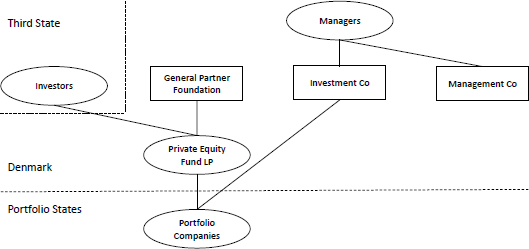
Figure 2
In reaching the conclusion that no PE was created, the National Tax Board attached great importance to the fact that the management and steering of the commercial foundation were separated from the management team and the management company. In other words, emphasis was put on the fact that the board members in the commercial foundation who had the decision-making power consisted of independent, professional individuals. Accordingly, in contrast to the 2013 decision, the National Tax Board concluded that the fund vehicle should not be considered to have disposal over the premises of the management company through the board members of the general partner (i.e., the members of the board in the commercial foundation), as the board members had no affiliation with the management company or its owners. Thus, the fund vehicle should not be considered to have a fixed place of business.
The conclusion reached by the National Tax Board appears to be correct, as it is indeed hard to see how the fund vehicle should be able to dispose over the premises of the management company in a structure where complete separation existed between the board members of the general partner and the management company and its owners. Hence, the requirement that the premises, facilities, or installations should be owned, rented, or otherwise at the disposal of the enterprise, cannot be considered fulfilled in such a situation.53
If the 2014 decision reduced the Danish private equity industry’s concerns, regarding the risk of creating PE in Denmark for foreign investors, the debate flared up once again following a decision from the National Tax Board published in 2015.54 Just like the private equity setups discussed in the 2013 and 2014 decisions, the fund vehicle (a Danish limited partnership) as well as the general partner did not have any premises of their own. The general partner was organized as a corporation that was led by a board of directors and the directors were not affiliated with the Danish management company or its owners (the management company acted as investment advisor to the general partner’s board of directors).
However, in contrast to the 2014 decision, the general partner (a Danish corporation) was fully owned by the owners of the Danish management company. This apparently caused the National Tax Board to conclude that a PE was created in Denmark despite the fact that the general partner was led by independent, professional individuals who were not affiliated with the Danish management company or its owners. Thus, on the basis of the fact that the general partner was fully owned by the owners of the management company, the National Tax Board found that the entire setup in effect was prepared, administered, and controlled by the owners of the management company. Against this background, the National Tax Board concluded that the fund vehicle had disposal over the premises of the Danish management company because of the coinciding ownership. Accordingly, the fund vehicle was found to have a fixed place of business at the premises of the Danish management company through which it carried out its business. In other words, the setup created a PE in Denmark for the foreign investors.
The National Tax Board’s reasoning in the 2015 decision is not particularly convincing.55 It appears far-fetched to conclude that coinciding ownership, that is, the fact that the general partner in the fund vehicle was fully owned by the owners of the management company should entail that the fund vehicle had disposal over the premises of the management company. Accordingly, such a conclusion seems to rely on the assumption that the owners of the general partner, and not the general partner’s board of directors, managed the general partner. Even though the owners of the general partner obviously had certain rights, for example, access to exercise their rights as shareholders at the general meeting, it is worth noting that even 100% ownership does not in itself entail that the shareholders of a company should be considered to manage the company they own.56
In addition, it does not seem correct to assume that the owners of the general partner had access to a fixed place of business in Denmark, just because the owners also owned a Danish management company. At least, such an assumption does not appear in line with the underlying rationale of Article 5(7) of the OECD Model,which states that the fact that a parent company controls a foreign subsidiary does not of itself entail that the subsidiary should be considered a PE of the parent company.57
4.2. Does the Enterprise Carry on Business Through the Fixed Place (Condition 3)?
As stated above, the third condition of the main PE rule stipulates that the business of the enterprise should be carried on through the fixed place. In order to assess whether this is the case, first, it has to be determined what the term enterprise refers to. Second, it has to be considered whether any business is actually carried out by the enterprise through the fixed place.58
With respect to the 2013 decision, dealt with in Section 4.1, the Danish National Tax Board stated that the private equity fund vehicle should be considered to constitute an enterprise, according to Article 5(1) of the OECD Model, and that the determination of whether a PE existed or not, therefore, should be made with respect to the fund vehicle itself and not the individual investors. This conclusion appears to be correct.59 Accordingly, in Article 3(1)(c) of the OECD Model, it is stated that the term "enterprise" applies to the carrying on of any business. In this regard, the OECD Committee of fiscal affairs has rightly expressed the view that the term seems to correspond to a business organization and that a fiscally transparent entity, such as a partnership, should, therefore, be viewed as a distinct enterprise within the meaning of Article 5(1). This distinct enterprise, being carried on by each partner, thus constitutes an enterprise of each state where a partner is resident as regards the profit share of that particular partner.60
Even though it appears correct to see the private equity fund vehicle as the relevant enterprise, it must also be considered whether any business is in fact carried out through this enterprise and whether this business actually is the business of the enterprise or alternatively of someone else.61
In the Danish 2013 decision, the National Tax Board found that the investment activities of the private equity fund vehicle qualified as business activities under the PE definition, as the aim of the fund vehicle was to undertake, manage, and transfer investments for the purpose of obtaining economic benefits.62This statement may, however, be challenged.63
The OECD Model does not contain an exhaustive definition of the terms "business" and "business profits," and the commentary suggests interpreting these terms in the light of the domestic law of the state that applies the convention.64 Moreover, at least in light of previous Danish administrative case law, as well as the practice traditionally followed by the tax authorities, it may be argued that the investment activities of a private equity fund vehicle should not qualify as business activities under the PE definition if the activities consist of passive investment in longer-term shareholdings.65
Anyway, if it is assumed that the investment activities of the private equity fund vehicle do constitute a business activity, it then becomes decisive to determine whether it is in fact the business of the private equity fund vehicle that is carried out through the fixed place of business or, instead, the business of someone else, for example, the management company.
A ruling from the Swedish Council for Advance Tax Rulings may provide some insight regarding this issue.66
The ruling concerned a company domiciled in Guernsey (Foreign Investor) that contemplated to invest in a Swedish limited partnership, the so-called kommanditbolag (Private Equity Fund KB). Foreign company should act as a limited partner, whereas another Swedish or foreign company should act as general partner (GP Co.) The plan was that Private Equity Fund KB should generate income from investments in inter alia Swedish companies (Target Companies). KB should not have any employees. Instead, an external Swedish company (Management Co.) would be engaged to administer Private Equity Fund KB’s investment activities. When registering Private Equity Fund KB with the Swedish commercial register, the address of Management Co. was used. A simplified structure is depicted in Figure 3.
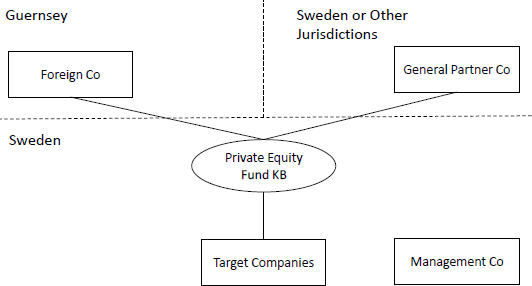
Figure 3
Even though the issue concerned the domestic Swedish PE definition, the Council made several references to the OECD Model with commentaries.67 Against this background, the Council initially concluded that a head office registered with Management Co. would meet the so-called place of business requirement. Moreover, the Council found the place of business to be fixed. Subsequently, the Council addressed the abovementioned question on whether it was in fact the business of the private equity fund that was carried out through the fixed place of business. In this regard, the Council placed emphasis on the fact that Management Co. was responsible for providing investment proposals to the fund’s investment committee, for administering the remuneration to the members of the committee, and for managing the bookkeeping of Private Equity Fund KB. On the basis of these findings, the Council concluded that Private Equity Fund KB’s business should be considered carried out through the fixed place of business. Accordingly, the activities were considered to create a PE for foreign investor at the premises of Management Co.
The ruling has received criticism in the literature.68 Thus, it has been argued that the ruling was based on a too formalistic approach, for example, with respect to the conclusion that Private Equity Fund KB should be considered to have access to a fixed place of business at the premises of Management Co., just because Private Equity Fund KB would formally be registered as having its head office there. Furthermore, it has been pointed out that it seems more convincing to conclude that it was the business of Management Co. that would be carried out through the fixed place of business and not the business of Private Equity Fund KB.69
This criticism appears to be in line with the views that later has been expressed by the Expert Group on Removing Tax Obstacles to Cross-border Venture Capital Investments. Thus, the Group has argued that the role and the business of a fund manager are different to the roles and the business of the fund and its investors. Accordingly, in the view of the Expert Group, the fund manager cannot be regarded as creating a permanent establishment according to the main PE rule. In other words, the fund manager is carrying out its own independent business of providing services to the fund or to the investors, rather than being a place of management, a branch, or other fixed place of business of the fund or its investors.70
In the Commentary to Article 5(1) of the OECD Model, it is stated that there are different ways in which an enterprise may carry on its business. In most cases, the business of an enterprise is carried on by the entrepreneur or persons who are in a paid–employment relationship with the enterprise (personnel). This personnel includes employees and other persons receiving instructions from the enterprise (e.g., dependent agents). The powers of such personnel in its relationship with third parties are irrelevant. Moreover, it makes no difference whether or not the dependent agent is authorized to conclude contracts if he or she works at the fixed place of business of the enterprise.71
Accordingly, these statements in the Commentary seem to support the position of the Expert Group described above. However, it should be acknowledged that the Commentary also mention that persons other than employees who are receiving instructions from the enterprise may be considered to carry out the business of the enterprise. Accordingly, based on these statements in the Commentary, it may not be completely excluded that, for example, the employees of a management company in certain situations could be considered to carry out the business of the private equity fund vehicle.72However, all in all, it seems most convincing to conclude—like the Expert Group did—that fund managers typically must be considered to carry out their own independent business of providing services to the fund or to the investors and that the fund managers, therefore, cannot be considered to carry out the activities of the private equity fund vehicle.73This particularly appears to be true when the fund managers provide its services to several different private equity funds
4.3. Conclusions Concerning the Main PE Rule
On the basis of the abovementioned decisions from the Danish National Tax Board, it can be seen that a private equity setup, at least according to Danish administrative case law, may create a PE for foreign investors in certain situations, even after the main PE rule in Article 5(1-2) of the OECD Model, if the facilities of, for example, the management company could be considered otherwise at the disposal of the fund vehicle. In particular, this may be the case if members of the management team have dual roles, that is, are also part of the management in the general partner, and if the management team co-invests in the private equity fund.74However, the correctness of this view may be challenged when the general partner and the management company are separate legal entities carrying on their own activities and the managers carry on their management activities independently within the boundaries of these separate entities.
Pursuant to the administrative case law of the Danish National Tax Board coinciding ownership—that is, the fact that the general partner in the fund vehicle is fully owned by the owners of the management company—may entail that the fund vehicle has disposal over any premises of the management company. However, this line of thinking seems questionable, as it appears to rely on the flawed assumption that the owners of the general partner, and not the general partner’s board of directors, manage the general partner.
The decisions from the Danish National Tax Board have created uncertainty. However, from a taxpayer’s perspective, it seems possible to steer clear of creating a PE after the main rule, in particular if it is secured that the members of the management team do not have dual roles and that no coinciding ownership is in place. In other words, and to sum up, the investors should not be particularly exposed to the risk of creating a PE abroad, after the main rule, if the following apply to the private equity fund structure:
The private equity fund (the limited partnership)
– Does not have its own premises but only a c/o address at a law firm
– Does not have personnel
– Does not have a decision-making body that meets regularly at a fixed place
– Does not have power to direct how the management company’s activities should be performed but only maps out how the overall investment policy should be
The general partner
– Does not have its own premises but only a c/o address at a law firm
– Does not have personnel
– Does have an independent board (i.e., independent of the management company and the management team) that secures that the general partner takes due care of its economic and administrative obligations and that holds meetings at different addresses
– Does not have to follow detailed instructions from the management company or the partnership
The management company (or advisory company)
– Does not have decision-making authority with respect to the acquisition and disposal of investments
– Does not have to follow detailed instructions from the partnership or the investors
On the basis of the abovementioned considerations, it may, therefore, be concluded that the typical investment in a private equity fund should normally not create a PE for foreign investors after the main PE rule in Article 5(1) of the OECD Model, as the fund typically will not have disposal over a fixed place of business. However, in certain situations, it may be argued that the private equity fund has disposal over the premises of, for example, a management company, if there is no clear separation between the management of the private equity fund and that of the management company. In order for this to constitute a PE, it is also a condition that the business of the enterprise (i.e., the business of the private equity fund) is actually carried on through the fixed place (i.e., through the premises of a management or advisory company), which should normally not be considered the case.
5. Creating a PE for Investors in Private Equity Funds After the Agency PE Rule
As mentioned earlier, a main tax concern of investors, private equity firms, and expert groups have been whether an investment in a private equity fund would create a PE for foreign investors after the agency PE rule.75 This rule is based on the generally accepted principle that an enterprise should be treated as having a PE in a state if there is, under certain conditions, a person acting for it even though the enterprise may not have a fixed place of business in that state after the main PE rule. Accordingly, Article 5(5) of the OECD Model stipulates the conditions under which an enterprise is deemed to have a permanent establishment in respect of any activity of a person acting for it. In other words, Article 5(5) simply provides an alternative test of whether an enterprise has a PE.76
The agency PE concept is limited to persons who, in view of the nature of their activity, involve the enterprise to a particular extent in business activities in the state concerned. The rule thus reflects the underlying principle that the presence, which an enterprise maintains in a contracting state, should be more than merely transitory if the enterprise is to be regarded as maintaining a PE and, hence, a taxable presence in that state.77
Moreover, where an enterprise of a contracting state carries on business dealings through an independent agent carrying on business as such, it cannot be taxed in the other contracting state in respect of those dealings if the agent is acting in the ordinary course of that business, cf. Article 5(6) of the OECD Model. As a result, the activities of such an agent who represents a separate and independent enterprise should not result in the finding of a PE of the foreign enterprise.78
When analyzing whether an investment in a private equity fund may create a PE for foreign investors after the agency PE rule, it should be taken into consideration that a number of changes were made to Article 5(5-6) of the OECD Model and the relevant Commentary in late 2017. The changes to the agency PE rule with Commentary—that were made as a result of the adoption of the OECD/G20 BEPS report on Action 7—do not affect the interpretation of the former provisions of the OECD Model Tax Convention and of tax treaties in which these provisions are included. 79 Accordingly, these changes will only affect the interpretation of new bilateral tax treaties based on the amended agency PE rule with commentaries or tax treaties amended through the multilateral instrument.80
Thus, as both the new and the old version of the agency PE rule with commentaries may be of relevance, depending on the situation in question and the jurisdictions involved, this article will analyze the old as well as the new versions. In other words, first, it will be analyzed whether an investment in a private equity fund may create a PE for foreign investors after the old agency PE rule with commentaries, and second, the same question will be discussed with respect to the new version.81
5.1. The Agency PE Rule Before the 2017 Update
In general, Article 5(5) of the OECD Model deems an enterprise to have an agency PE in a state where a person acting on behalf of the enterprise has the authority to conclude contracts in the name of the enterprise, habitually exercises such authority in the state, is not an agent of independent status acting in the ordinary course of its business and is not engaged exclusively in preparatory or auxiliary activities.82
With respect to private equity structures, it must be determined whether the activities of, for example, the advisory company, the management company, or perhaps the general partner, may create a PE for the private equity fund (and thereby the investors), because at least one of these entities could be regarded as a dependent agent acting on behalf of the private equity fund. In this regard, it is paramount to take a closer look at the activities of these entities as well as their legal rights and obligations, in order to assess whether the entity in question should be considered a dependent agent or an independent agent.
5.1.1. Agency-PE through a Local Advisory Company?
When the management team initiates a new fund structure, tax considerations are obviously taken into account. Accordingly, a typical private equity fund structure is setup in way that should, among other things, minimize the risk of creating a PE in the jurisdiction of the portfolio companies. This aim could be reached by limiting the amount and extent of activities taking place in the jurisdiction of the portfolio company. However, successful selection, evaluation, and supervision of investments in foreign portfolio companies normally will require local knowledge. Thus, an advisory company in the jurisdiction of the portfolio company is often used to assist in these matters. A common private equity fund setup may, therefore, be depicted as shown in Figure 4:
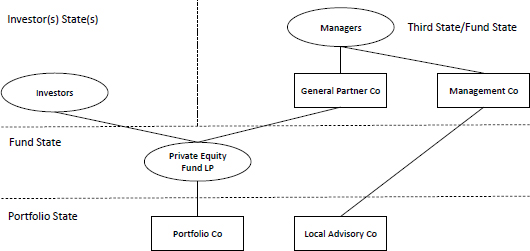
Figure 4
In order to avoid creating a PE in the Portfolio State for the investors in Private Equity Fund LP, the activities of Local Advisory Co, at local level, will be limited to a merely advisory role. Accordingly, Local Advisory Co will not be granted authority to make decisions that binds Private Equity Fund LP. Instead, Local Advisory Co will restrict its activities to pure advice, collation of information, identifying target companies, proposing investment terms, and so on.83Accordingly, in such a situation, Local Advisory Co usually should not be considered to constitute an agency PE in the Portfolio State for the investors, cf. Article 5(5) of the OECD Model,84 already because Local Advisory Co does not have the authority to conclude contracts that are binding for Private Equity Fund LP and, therefore, does not habitually exercise such an authority.85
Moreover, it could be argued that the activities of Local Advisory Co resemble the activities of a broker. A broker merely brings parties together, in casu Private Equity Fund LP and the sellers or buyers of the shareholdings in the Portfolio Companies, and a broker is directly mentioned in Article 5(6) of the OECD Model as an example of an “agent” of independent status.86 In practice, it would be easier to demonstrate the necessary independence of Local Advisory Co if the advisory agreement does not include an exclusivity clause and if Local Advisory Co has diversified the source of its revenue by providing services to other clients.87
A recent judgment from the Korean Supreme Court illustrates a situation in which the activities of local advisory companies were not considered to constitute an agency PE.88 Roughly described, the case concerned private equity investments in Korean companies (target companies) made through a Belgian special purpose vehicle, the so-called société en commandite par actions (SCA), with a Bermudan limited partnership acting as general partner (GP). Investment supporting activities in Korea were provided by two subsidiaries (advisory companies) domiciled in Korea and owned by the GP.
Initially, the Korean tax authorities had argued that a fixed place PE was established in Korea, as the directors of the Korean advisory companies performed important and essential activities of the fund. In addition, if no fixed place PE should be seen to exist, the tax authorities was of the opinion that the activities of the directors constituted an agency PE, as the directors in the eyes of the tax authorities continuously and repeatedly exercised authority to conclude contracts on behalf of the fund.
The Supreme Court overturned the tax authorities’ decision. First, the Court stated that no fixed place PE in Korea should be considered to exist, primarily because important investment decisions were made by the GP outside Korea and because the local activities of the directors were performed in their capacities as executives in the Korean advisory companies, both of which were corporations legally separate from the GP, which received a fee from the GP in return for their services. Second, the Supreme Court decided that no agency PE should be considered to exist even though the Korean advisory companies were controlled by the GP and despite the fact that the directors performed certain activities related to the negotiation of contracts concerning the acquisition of Korean target companies. Hence, the Supreme Court found that there was not sufficient evidence to substantiate that the directors had the authority to conclude contracts on behalf of the fund in Korea as agents and that they exercised such authority repeatedly. Instead, the Supreme Court found the activities of the Korean advisory companies to be of a preparatory and auxiliary nature.89
The judgment from the Korean Supreme Court shows that it may be possible to avoid creating a PE in the portfolio state for the investors in a private equity fund if the activities of a local advisory company are restricted to a merely advisory role. However, based on the judgment, it does not seem possible to pinpoint exactly when the services of a local advisory company crosses the line and creates an agency PE, as the judgment in part seems to be based on the fact that sufficient evidence on contract concluding authority could not be found.
5.1.2. Agency PE Through a Management Company or a General Partner?
It also has to be considered whether the management company in the fund structure could create an agency PE for the investors in the private equity fund in the jurisdiction of the portfolio company and/or in the jurisdiction where the management company is established. It is often argued that this should not be the case, as the management company should be considered an independent agent with respect to the private equity fund.90 Accordingly, rather than being subject to detailed instructions from the fund, the management company conduct its activities under a general freedom to act. Moreover, the personnel of the management company (the managers) apply their special skills and knowledge to gather relevant information and make investment proposals for the fund to finally decide on. Thus, it could be argued that the management company is independent of the fund and the investors, both legally and economically and that the management company acts in the ordinary course of its business. Accordingly, no agency PE should exist.91
This issue has also been dealt with in Danish administrative case law. In short, the conclusion in the cases decided by the National Tax Board traditionally has been that the management companies and other involved parties/persons should be considered independent agents with respect to the private equity funds (limited partnerships) in question. In these cases, the National Tax Board mainly placed emphasis on the fact that the relevant entities and fund managers were not subject to detailed instruction or control, they had other sources of income, they could incur ordinary professional liability, they held similar positions in other contexts, they had other clients, and they bore the operational risk for the activities performed. Thus, as the management/advisory companies were considered to be independent agents, they did not constitute a PE pursuant to the agency PE rule.92
However, in a case from 2016, the Danish tax authorities, in contrast to previous administrative case law, suddenly argued that the investors in a Danish private equity fund should be considered to have a PE, as the general partner (and not the management company) constituted a dependent agent with respect to the private equity fund. Even though the National Tax Board, at the end, did not follow the recommendation from the tax authorities, it is valuable to take a closer look at the arguments put forward by the tax authorities.93
Briefly explained, the private equity fund vehicle (Private Equity Fund LP) in question was set up as a Danish limited partnership. The fund vehicle did not have any employees and had no offices or other premises at its disposal. Its only governing body was the general meeting, which would be held at different locations but never at the premises of the management company (Management Co).
The general partner was organized as a commercial foundation (General Partner Foundation) and had no employees. It was led by a board, and no members of the management team (Managers) and none of the investors were among the board members. The board of General Partner Foundation held its meetings at different locations, and the foundation only had a c/o address at a law firm’s office.
General Partner Foundation was responsible for the overall approval and execution of the investments, whereas Management Co was responsible for all other operations, for which it received a management fee. Management Co made investment recommendations to the board of General Partner Foundation, and based on these recommendations, the board would make the final investment decisions. Accordingly, Management Co could not make binding investment decisions on behalf of Private Equity Fund LP. Management Co was also the administrator of the other private equity funds.
The management team did not make any co-investment in the private equity fund itself. Instead, the management team made minority investments in the portfolio companies (Investments) through intermediary limited partnerships (Co-investor LP), and they were entitled to receive carried interest. A simplified structure is depicted in Figure 5.
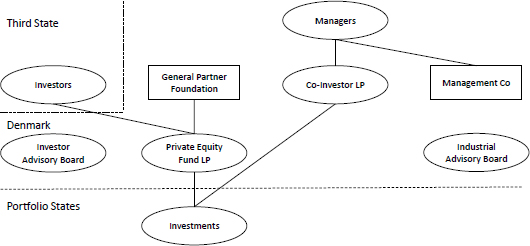
Figure 5
According to the recommendation from the Danish tax authorities, no PE should be considered to exist pursuant to the main PE rule, as Private Equity Fund LP, in the view of the tax authorities, did not have a fixed place of business at its disposal. However, pursuant to Article 5(5) of the OECD Model, the tax authorities argued that General Partner Foundation should be considered a dependent agent and that an agency PE, therefore, would exist.
The tax authorities started out by arguing that General Partner Foundation should be considered a “person” carrying out activities for Private Equity Fund LP.94 Then, the tax authorities highlighted that General Partner Foundation would possess all the powers related to the operations of Private Equity Fund LP, including the economic and administrative powers. Thus, as General Partner Foundation had the authority to make legally binding decisions on behalf of Private Equity Fund LP, General Partner Foundation was considered to constitute an agent.
The tax authorities then continued by considering whether General Partner Foundation should be considered an independent agent, pursuant to Article 5(6) of the OECD Model. In this regard, the tax authorities argued that because General Partner Foundation was a participant in Private Equity Fund LP, it could by definition not be considered independent (legally or economically). Moreover, the tax authorities highlighted that General Partner Foundation essentially only carried out activities for one enterprise, that is, Private Equity Fund LP and that the entrepreneurial risk, concerning the private equity investment activities, was not borne by General Partner Foundation, as General Partner Foundation received a fixed fee for its services. Hence, in the eyes of the tax authorities, General Partner Foundation could not be considered to act in the ordinary course of its business and could not be considered independent with respect to Private Equity Fund LP. Accordingly, the investors in Private Equity Fund LP should be considered to have a PE in Denmark, pursuant to the agency PE rule, as General Partner Foundation was seen as constituting a dependent agent of Private Equity Fund LP.95
As mentioned above, the National Tax Board did not follow the recommendation of the tax authorities. In an ultra-short statement, the National Tax Board just stated that it did not concur with the recommendation and that no PE should be considered to exist. References were made to previous administrative decisions from the National Tax Board, where no PE was found to exist in similar structures but no further explanation was given.
The recommendation from the tax authorities was received with some surprise, as it was not anticipated that the tax authorities would suddenly try to turn previous administrative case law upside-down. Accordingly, despite the fact that the National Tax Board, at the end, did not follow the recommendation, the decision caused some debate.96
It is not possible to deduce from the decision what precisely caused the National Tax Board to dismiss the tax authorities’ recommendation (besides the alleged similarities with the facts in previous administrative decisions). However, based on the premises and the outcome of previous decisions, as well as the Commentary to Article 5(5-6) of the OECD Model, it seems possible to challenge the validity of the tax authorities’ line of argumentation.
It is worth recalling that under the agency PE rule, the enterprise is deemed to have a PE in respect of any activities which that person undertakes for the enterprise. Moreover, it should be recalled that the main condition for the existence of an agency PE is that a person has, and regularly exercises, an authority to conclude contracts in the name of a foreign enterprise, cf. Article 5(5) of the OECD Model. As General Partner Foundation actually was carrying out an activity of Private Equity Fund LP, namely, conducting the overall approval and execution of Private Equity Fund LP’s investments (i.e., decisions on acquisition and disposal of the shareholding in the target companies on a current basis),97 it seems appropriate at least to consider whether General Partner Foundation could actually be considered an agent (dependent or independent).98 In this regard, however, it should be noted that if a partnership is treated as transparent for the purposes of an applicable tax treaty, the general partner itself is the taxpayer (or at least one of the taxpayers, provided that the general partner actually owns a share of the capital). Consequently, it could be argued that the general partner’s contract-concluding activities in the source state do not in themselves constitute a PE there, as Article 5(5) of the OECD Model becomes inapplicable with respect to the general partner (because the general partner is the entrepreneur himself or herself).99 However, this allegedly should not exclude that the general partner’s activities could constitute an agency PE for the other partners (the investors) in the partnership.100
As the tax authorities’ actually did consider General Partner Foundation to be an agent, it makes sense to try assessing whether General Partner Foundation is to be considered a dependent or an independent agent. When distinguishing between these two types of agents, it should be recalled that an agent will only be considered independent, pursuant to Article 5(6) of the OECD Model (2014), if the agent is independent of the enterprise both legally and economically and the agent acts in the ordinary course of his business when acting on behalf of the enterprise.
In this context, it seems questionable to conclude, as the tax authorities did, that the general partner in a partnership per se should be considered dependent, just because the general partner is a participant.101Thus, in the Commentary to Article 5(6), it is explained that a person cannot be regarded as independent if the person is subject to detailed instructions or comprehensive control.102In other words, this means that if a person is not subject to detailed instructions, it is an indication of independence. In this regard, it is worth noticing that the board of General Partner Foundation did not appear to be subject to detailed instructions from Private Equity Fund LP. Instead, the board had to make the investment decisions for Private Equity Fund LP based on an initially adopted and more general investment strategy. Accordingly, this fact, combined with the abovementioned statement in the Commentary, points in the direction of independence.103
In further support of this conclusion, it could also be argued that the principal, that is, Private Equity Fund LP, therefore, was relying on the skill and knowledge of the board members in General Partner Foundation. Such reliance on the special skills and knowledge of the agent may also be seen as an indication of independence.104
Furthermore, with respect to the test of legal independence, the Commentary states that it should be noted that the control that a parent company exercises over its subsidiary in its capacity as shareholder is not relevant when considering the dependence of the subsidiary in its capacity as an agent for the parent company. This statement is consistent with the rule in Article 5(7) of the OECD Model (2014).105 Even though the private equity setup does not mirror the relationship between a parent and a subsidiary, it could be argued that the underlying rationale should also apply in a private equity fund setting. Accordingly, a general partner should not per se be considered a dependent agent of a partnership, as this has to be decided according to the same tests that apply to unrelated companies.
With respect to the test of economic independence, the Commentary place emphasis on the number of principals represented by the agent, as independent status is less likely if the activities of the agent are performed wholly or almost wholly on behalf of only one enterprise over the lifetime of a business or a long period of time.106 On the one hand, it must be admitted that General Partner Foundation initially would only act as general partner with respect to one private equity fund, which can be seen as a sign of dependence.107 On the other hand, however, it also seems relevant to place emphasis on the fact that General Partner Foundation over time was supposed to act as general partner with respect to other private equity funds as well. Moreover, it could be argued that it would be appropriate to look at the individual members of the board in General Partner Foundation, instead of (only) on the whole board as such. As all the individual board members held additional positions in other boards and organizations, it thus indicates some degree of independence.
Finally, when considering whether an agent acts in the ordinary course of his business, it is important to assess to what degree the agent bears entrepreneurial risk, as entrepreneurial risk is an indication of independence.108 In this regard, the tax authorities noted that Private Equity Fund LP would administer investments for around DKK 4– 6 billion and that the size of the remuneration of General Partner Foundation ought to reflect the monetary risk associated with these huge investments. As General Partner Foundation was only entitled to a modest annual remuneration equal to the salary cost of the board members plus 10%, and a return on its equity amounting to EURIBOR 12 months plus 15%, the tax authorities argued that the entrepreneurial risk did not fall on General Partner Foundation.
Against this, the taxpayer argued that the remuneration should be evaluated up against General Partner Foundation’s actual monetary risk associated with its liability. According to the taxpayer, this liability could not exceed DKK 300,000, that is, the size of General Partner Foundation’s equity. Thus, the modest remuneration should not be considered disproportionate.
Concerning the entrepreneurial risk, the tax authorities’ argument is not without merit, as an agent’s fixed or performance-based remuneration may indicate a lack of independence. However, it should be taken into account that this fact is not determinative. Moreover, if the agent is exposed to other kinds of risks, the agent may be considered to be independent.109 Accordingly, it seems appropriate to argue that the ordinary managerial risk, as well as the potential risk of facing claims for damages concerning negligent actions, should be included in the assessment.
On the basis of an overall assessment of the different arguments discussed above, it appears that the National Tax Board did right when deciding not to follow the recommendation from the tax authorities.110 Thus, it seems correct to conclude that General Partner Foundation could not be considered a dependent agent, particularly because the board of General Partner Foundation did not appear to be subject to detailed instructions from Private Equity Fund LP, which is a strong indication of independence. However, it must be admitted that uncertainty remains.111
5.2. The Agency PE-rule following the 2017-update
As previously mentioned, a number of changes were made to Article 5 of the OECD Model Tax Convention with commentaries in late 2017. Some of the changes to the commentary were intended to be mere clarifications and have, to some extent, been dealt with above when analyzing the main PE rule. However, other amendments are prospective only and do not affect the interpretation of the former provisions of the OECD Model Tax Convention and of tax treaties in which these provisions are included. Among other things, this applies to the new commentaries to the agency PE rule, based on the OECD/G20 BEPS report on Action 7, as these changes relate to the modification of the wording of the agency PE rule itself. Accordingly, these changes will only affect the interpretation of new bilateral tax treaties based on the amended agency PE rule with commentaries or tax treaties amended through the multilateral instrument.112
The amendments to the agency PE rule were originally prescribed in the OECD/G20 BEPS report on Action 7,113and the reason for wishing to amend the PE definition mainly derived from the fact that some multinational enterprises had managed to artificially avoid creating a PE, for example, by using various commissionaire arrangements.114 Such arrangements have created significant controversy in recent years and have resulted in a number of highly debated court cases in different jurisdictions.115 Accordingly, in order to tackle PE avoidance strategies by lowering the PE thresholds, the following amendments have been made to Article 5 of the OECD Model Tax Convention: (1) the dependent agent test has been expanded, (2) the independent agent criteria have been tightened, and (3) the PE exemptions for preparatory and auxiliary activities have been narrowed.116
Even though the target of these amendments is multinational enterprises and not private equity fund structures, the changes might have repercussions for the evaluation of private equity fund structures as well. Therefore, the possible effect of these changes for investors in private equity funds is further analyzed.117
Pursuant to the revised Article 5(5) of the OECD Model (2017), an agency PE exists where a person is acting in a contracting state on behalf of an enterprise and, in doing so, habitually concludes contracts, or habitually plays the principal role leading to the conclusion of contracts that are routinely concluded without material modification by the enterprise, and these contracts are (a) in the name of the enterprise, (b) for the transfer of the ownership of, or for the granting of the right to use, property owned by that enterprise or that the enterprise has the right to use; or (c) for the provision of services by that enterprise. As is evident, contracts are still the key reference point for local activity, but in the revised version, the focus is on the substance of the contracting. In other words, the actual conclusion of contracts locally is not necessarily needed to create a PE. Moreover, even though the revised language targets standardized contracts, it also seems to cover non-standardized, negotiated contracts if these are routinely concluded and not materially modified.118 Accordingly, with respect to private equity fund structures, it cannot be excluded that the activities of, for example, an advisory company, a management company, or a general partner could constitute an agency PE for the investors, just because these persons abstain from actually concluding contracts in the name of the private equity fund.
Pursuant to the commentaries to the revised agency rule, a person is acting in a contracting state “on behalf of” an enterprise when that person involves the enterprise to a particular extent in business activities in the state concerned, for example, where an agent acts for a principal, where a partner acts for a partnership, where a director acts for a company, or where an employee acts for an employer. In addition, it is stated that the person acting on behalf of an enterprise can be a company and that the actions of the employees and directors of such a company should be considered together for the purpose of determining whether and to what extent that company acts on behalf of the enterprise.119 These examples in the commentaries suggest that the threshold for when a person is considered to act “on behalf of” an enterprise is low.120 Moreover, depending on the actual circumstances, these commentaries seem to entail that an advisory company, a management company, or a general partner could be considered to act on behalf of the private equity fund if such a person, for example, plays a decisive role in connection to the fund’s acquisition or disposal of portfolio companies.
In this regard, it seems useful to take a closer look at the phrase “habitually plays the principal role leading to the conclusion of contracts that are routinely concluded without material modification by the enterprise.” According to the commentaries, this phrase is aimed at situations in which the conclusion of a contract directly results from the actions that the person performs in a contracting state on behalf of the enterprise, even though, under the relevant law, the contract is not concluded by that person in that state. In addition, it is stated that the principal role leading to the conclusion of a contract will typically be associated with the actions of the person who convinced the third party to enter into a contract with the enterprise.121 Also, these statements in the commentaries seem to suggest that the activities of an advisory company, a management company, or a general partner, depending on the actual circumstances, may be covered by the revised agency PE rule.122
However, before reaching this conclusion, it has to be considered whether these persons fulfill the criteria for being independent agents, cf. Article 5(6) of the OECD Model (2017), as this would entail that no agency PE should be considered to exist. In the revised wording, the words “broker” and “general commission agent” are deleted. However, this does not seem to entail any material change.123More important is the new phrase stating that “where, however, a person acts exclusively or almost exclusively on behalf of one or more enterprises to which it is closely related, that person shall not be considered to be an independent agent within the meaning of this paragraph with respect to any such enterprise.”
The term “almost exclusively” does not appear to be particularly clear. However, in the revised commentaries, it is stated that this means that where the person’s activities, on behalf of enterprises to which it is not closely related, do not represent a significant part of that person’s business that person will not qualify as an independent agent. Where, for example, the sales that an agent concludes for enterprises to which it is not closely related represent <10% of all the sales that it concludes as an agent acting for other enterprises that agent should be viewed as acting “exclusively or almost exclusively” on behalf of closely related enterprises.124
With respect to the term “closely related,” the new Article 5(8) of the OECD Model (2017) states that a person or an enterprise is closely related to an enterprise if, based on all the relevant facts and circumstances, one has control of the other or both are under the control of the same persons or enterprises. In any case, a person or an enterprise shall be considered to be closely related to an enterprise if one possesses directly or indirectly >50% of the beneficial interest in the other (or, in the case of a company, >50% of the aggregate vote and value of the company’s shares or of the beneficial equity interest in the company) or if another person or enterprise possesses directly or indirectly >50% of the beneficial interest (or, in the case of a company, >50% of the aggregate vote and value of the company’s shares or of the beneficial equity interest in the company) in the person and the enterprise or in the two enterprises.125
In short, the “closely related standard” can be said to include both a “>50% beneficial interest measure” and an “open-ended factual test based on the concept of control.”126 In particular, the latter part of the “closely related standard” does not seem particularly clear, and it has rightly been argued that the word “control” may very well encompass the participation in the management of a company, because the participation of one company in the management of another company could result in some form of control.127
In the literature, it has been argued that these revisions to the “independent agent concept” generally leave fund managers acting for several controlled funds unaffected, subject to how control of voting power is dealt with.128 In other words, the opinion seems to be that no agency PE should exist if the fund managers (i.e., the personnel of an advisory company or a management company) act for several different funds, as the fund managers in such cases cannot be seen as acting exclusively or almost exclusively on behalf of one or more enterprises to which it is closely related.
This conclusion may be correct as long as the fund managers do render services to several different funds and as long as the fund managers cannot be considered to control the fund (or vice versa). However, as mentioned above, the “closely related standard” contains not only a “>50% beneficial interest measure” but also an “open-ended factual test based on the concept of control.”129 Given this wide and quite vague definition, and depending on the actual fund structure, uncertainty may remain as to whether the fund managers (the advisory company or management company) are actually closely related to the fund(s) or not. Moreover, even if the activities of the advisory and management companies are not considered to constitute an agency PE for the investors in the private equity fund, it still also has to be considered whether the activities of the general partner could constitute an agency PE.130
In conclusion, it, therefore, appears that the revised agency PE rule, ceteris paribus, may have increased the likelihood of creating a PE in the jurisdictions of advisory companies, management companies, and/or general partners for the foreign investors in a private equity fund.131
5.3. Conclusions Concerning the Agency PE Rule
With respect to private equity structures, it must be determined whether the activities of, for example, the advisory company, the management company, and/or the general partner may create an agency PE for the private equity fund (and thereby the investors), because at least one of these entities could be regarded as a dependent agent acting on behalf of the private equity fund.
In order to avoid creating a PE in the jurisdictions of the portfolio companies, the activities of local advisory companies will often be limited to a merely advisory role. Accordingly, the local advisory company will not be granted authority to make binding decisions on behalf of the private equity fund. In such a situation, the local advisory company should hitherto not be considered to constitute an agency PE in the jurisdiction of the portfolio company, pursuant to the 2014 version of Article 5(5) in the OECD Model.
With respect to the management company, it seems appropriate to argue that the management company will fulfill the requirements for being considered an independent agent, cf. the 2014 version of Article 5(6) in the OECD Model, if the management company conducts its activities under a general freedom to act, the personnel of the management company apply their special skills and knowledge to gather relevant information and make investment proposals for the fund to finally decide on. Accordingly, under such circumstances the management company should be considered independent of the fund and the investors both legally and economically, and therefore, no agency PE should exist. The same should hold true for the general partner (no matter whether the management company performs the role as general partner or another entity does so). However, it must be admitted that the final conclusion will be highly dependent on the facts and circumstances of the specific private equity fund in question and that legal uncertainty may remain.
The revised agency PE rule contained in the 2017 version of the OECD Model with Commentary seems to have exacerbated this uncertainty, as it is now explicitly stated that the actual conclusion of contracts locally is not necessarily needed to create a PE, and because the revised agency PE rule appears to have increased uncertainty as to whether advisory companies, management companies, and in particular general partners could be considered independent of the fund.
6. Tax Policy Considerations
Whether an increased likelihood of creating an agency PE for foreign investors in private equity funds should be welcomed or not depends, among other things, on the different jurisdictions’ tax policy goals. However, it seems worth noting that such a development does not fit well with the 2010 recommendations from the European Commission Expert Group. When dealing with venture capital funds and taxation, the Expert Group advocated for a solution where the foreign investors in a private equity fund preferably should not be considered to have an agency PE that could create an additional layer of taxation for the investors.132
One of the reasons leading to this conclusion was the fact that the uncertainty about the PE issue caused fund managers to limit their activities and set up complicated structures, including separate advisory companies. In the eyes of the Expert Group, this situation was highly inefficient, costly, and complex, and it could potentially deter investments.133
The risk of deterring investments made through private equity funds has also been a concern of legislators. As an example, it could be mentioned that Finland in 2005 introduced new legislation aiming at making investment in Finnish private equity funds more attractive.134 Previously, domestic Finnish legislation had been interpreted so that investments made through a Finnish limited partnership created a PE for the foreign investors.
The leading case was a judgment from the Finnish Supreme Administrative Court from 2002, in which the Court found that a non-resident partner in a Finnish partnership was deemed to have a PE in Finland.135 The case involved a Swedish limited liability company that was a silent partner in a Finnish venture capital limited partnership, the so-called kommandiittiyhtiö (Ky). The main purpose of the Ky was to make investments in Finnish target companies. The general partner (GP), a Finnish limited liability company, was responsible for operating and managing the fund activities, and the Swedish partner’s role was confined to passive investment or to act as member of the fund’s investment board.
The reasoning of the Finnish Supreme Administrative Court was somewhat peculiar and has been subject to criticism in the literature.136 Thus, the Court avoided ruling straightforwardly that the Swedish partner’s participation as such constituted a PE in Finland. Instead, the Court ruled that the income should be taxable in Finland, already because of the fact that the Ky was domiciled in Finland and the Ky had its own assets separate from the assets of the partners, who owned a fraction of the partnership (not the individual assets). Against this background, the Court merely concluded that the applicable tax treaty should not be interpreted as if Finland had agreed to waive its right to tax such income generated in Finnish partnerships.
The Finnish legislator found this case law to be harmful in respect of choosing Finnish limited partnerships as vehicles for private equity investments, and the legislator, therefore, decided to amend the legislation. The amended legislation entailed that limited partners in a Finnish limited partnership engaged in venture capital business should be taxable in Finland only on the part of the income that would have been taxable in Finland had the partner received it directly. Subsequently, Finnish case law has confirmed that investments in funds other than venture funds also can be covered by the new rules.137
As argued above, the revised agency PE rule in the 2017 version of the OECD Model seems to have increased the likelihood of creating an agency PE for foreign investors in private equity funds. Against this background, it is not unlikely that other jurisdictions may (re-) consider their domestic legislation, in order to secure that the jurisdiction may (still) be able to attract private equity investments. As an example, a recently adopted Danish bill addresses the PE issue for foreign investors in private equity funds.138
The Danish legislator is of the opinion that foreign investors in Danish private equity funds, going forward, more often may be perceived to have an agency PE in Denmark, if the amended PE definition in the 2017 version of the OECD Model is implemented in Danish tax law.139 Despite the fact that such implementation has not (yet) taken place, the Danish legislator wish to secure that Denmark continues to be an attractive jurisdiction to invest in for foreign investors, and the Danish legislator has, therefore, adopted a new provision that aims at excluding foreign private equity fund investors from being considered to have a PE in Denmark.140 In short, the new provision entails that the foreign investors should not be considered to carry out business in Denmark as long as the investments constitute passive investments in shares, claims, debt, and financial contracts (i.e., not an actual trading activity). As the foreign investors, in such situations, should no longer be considered to carry out business in Denmark, the investments should not create a PE in Denmark for the foreign investors, neither pursuant to the main PE rule nor the agency PE rule as formulated in domestic Danish law.141
On the one hand, and from a purely Danish perspective, the adoption of the new provision appears understandable and expedient. Accordingly, it does seem likely that the provision may enhance Denmark’s possibilities for attracting foreign investment. Moreover, the provision may eliminate or reduce the private equity funds’ need for setting up complicated and inefficient investment structures, only in order to mitigate the risk of creating a PE for the foreign investors. On the other hand, and from a wider/global perspective, such a development may be less desirable if it is correct that a significant part of the profits received by the investors in private equity funds are never taxed anywhere.142Therefore, before too many jurisdictions take action in domestic legislation, it might be beneficial if tax policy makers at a global level took a closer look at the tax issues related to private equity fund investments, in order to ensure that the investors are neither subject to double taxation nor double non-taxation. Such a discussion should ideally be based on a thorough study of how investors in cross-border private equity fund structures are actually taxed. Moreover, if new and specific tax provisions for private equity funds are introduced, the design of such rules should preferably take into account the increased regulatory requirements that many jurisdictions have imposed on private equity funds in the aftermath of the financial crisis as discussed in Section 2.
7. Conclusions
A wide range of tax-related questions may come up with respect to the activities of private equity funds. One important issue concerns the question of whether the investment in a private equity fund may create a PE for foreign investors, as the answer to this question may be of outmost importancewhen investors are considering whether or not to invest in a foreign private equity fund.
On the basis of a legal dogmatic analysis, it appears appropriate to conclude that the investments made in a typical private equity fund setup should normally not be considered to create a PE for the investors in the fund, neither pursuant to the main rule, cf. Article 5(1) of the OECD Model (2014 and 2017), nor the agency PE-rule, cf. Article 5(5-6) of the OECD Model (2014). However, the final outcome will depend on the specific setup of the private equity fund at hand, and some degree of legal uncertainty may often remain.
Moreover, the recent amendments to the agency PE rule—prescribed in the OECD/G20 BEPS Report on Action 7 and incorporated into the 2017 version of the OECD Model Tax Convention with Commentaries—appear to have increased the likelihood of creating a PE for foreign investors in private equity funds and to have exacerbated the legal uncertainty. This development may deter investments, and it, therefore, seems likely that some jurisdictions will take unilateral action, in order to remain attractive for private equity fund investments.
Such unilateral initiatives may be both understandable and expedient when considered from a purely domestic perspective. However, from a wider/global perspective, such a development may be less desirable. Accordingly, it might be beneficial if tax policy makers at a global level took a closer look at the tax issues related to private equity fund investments, in order to ensure that the investors are neither subject to double taxation nor double non-taxation. Such a discussion should ideally be based on a thorough study of how investors in cross-border private equity fund structures are actually taxed.