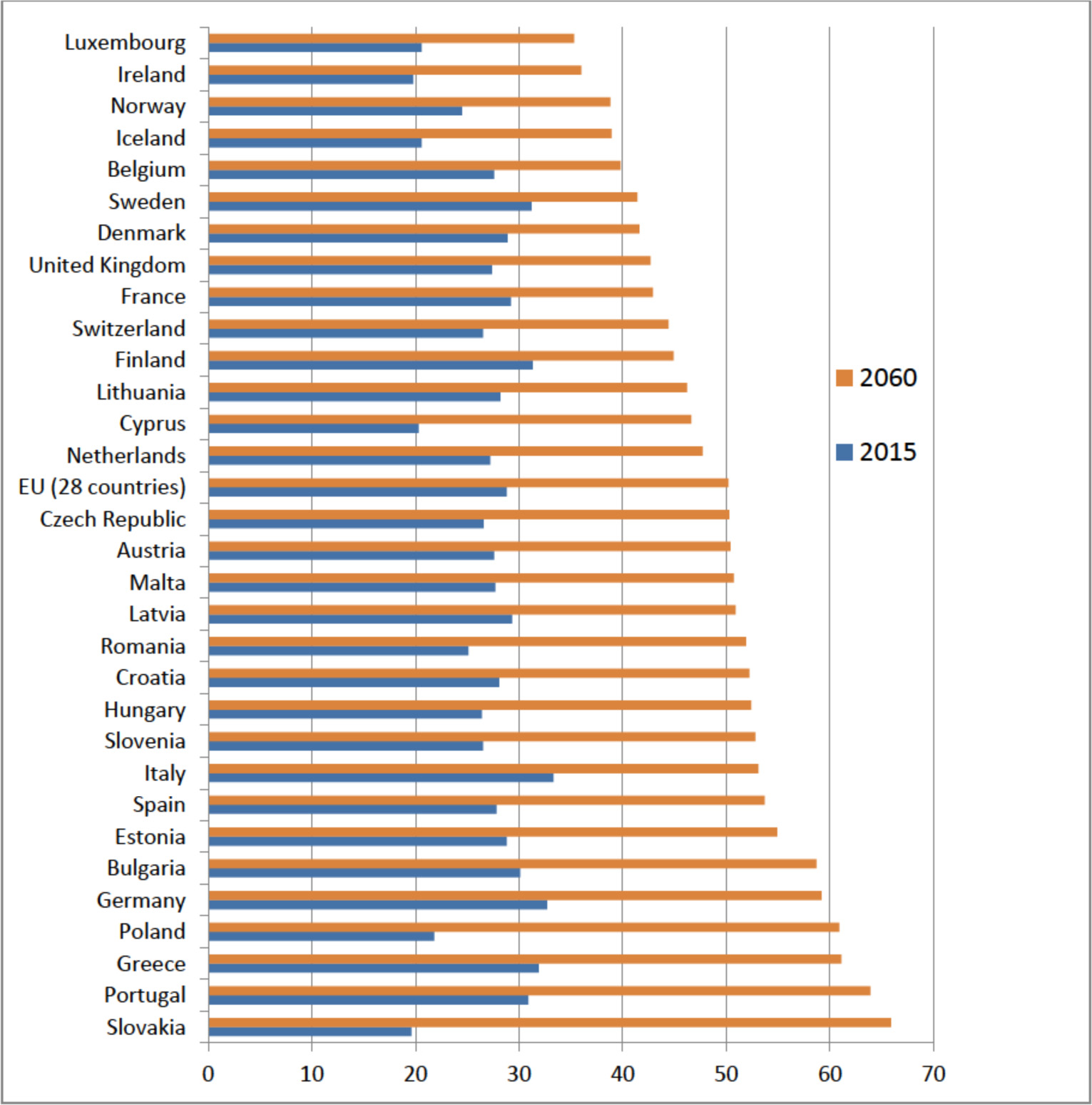
Figure 1
Old-age dependency ratio expressed as a percentage (number of individuals age 65 or older relative to number of individuals of working age), 2015 and 2060. Sorted according to the ratio in 2060.
Source: Eurostat - Population Projections EUROPOP2013.
http://ec.europa.eu/eurostat/tgm/table.do?tab=table&init=1&plugin=1&language=en&pcode=tsdde511
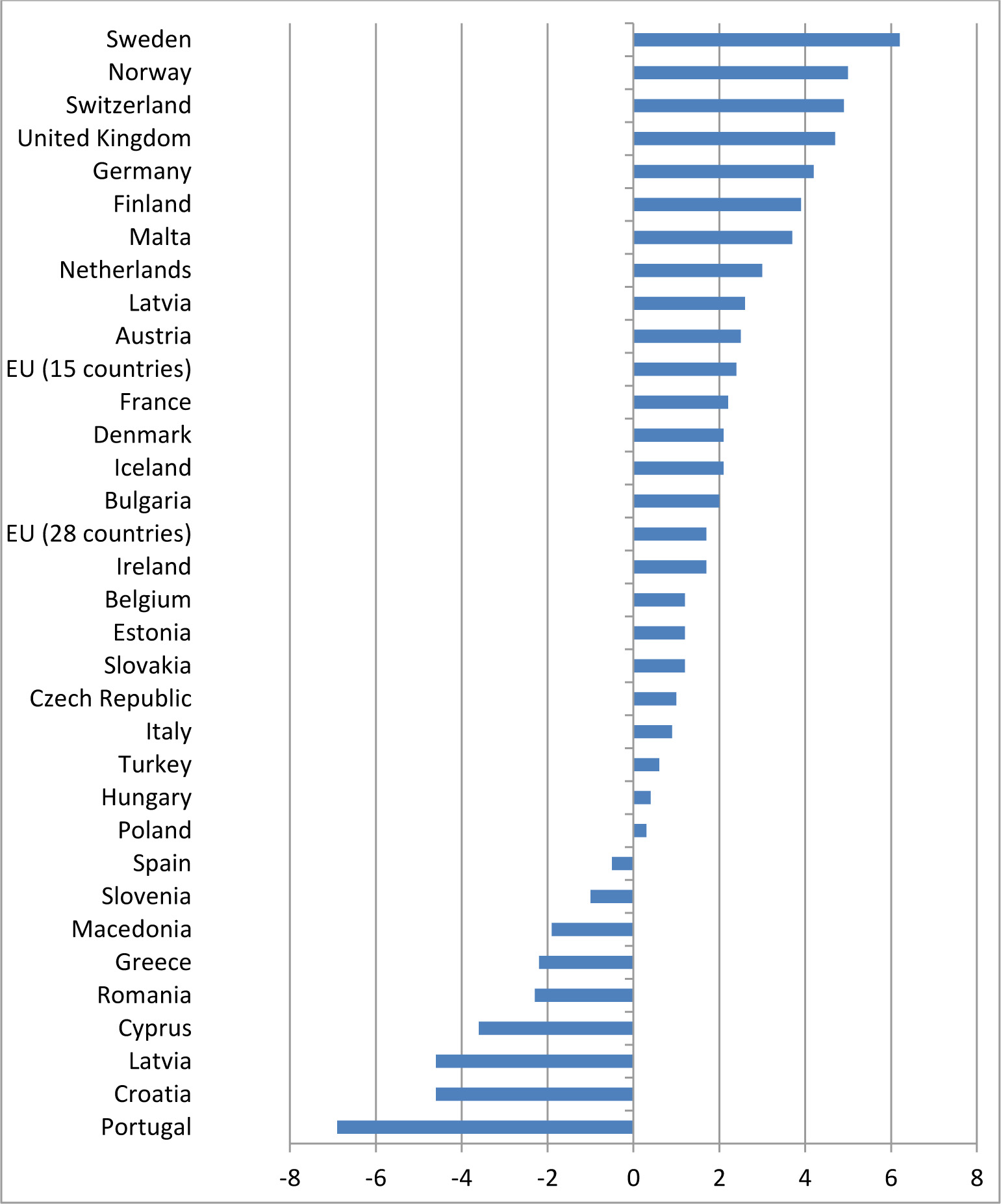
Figure 2
Change in employment rates for people age 65–74, 2006–2014, percent.
Sources: Skattebetalarna (Swedish Taxpayers Association (2015)) and Eurostat
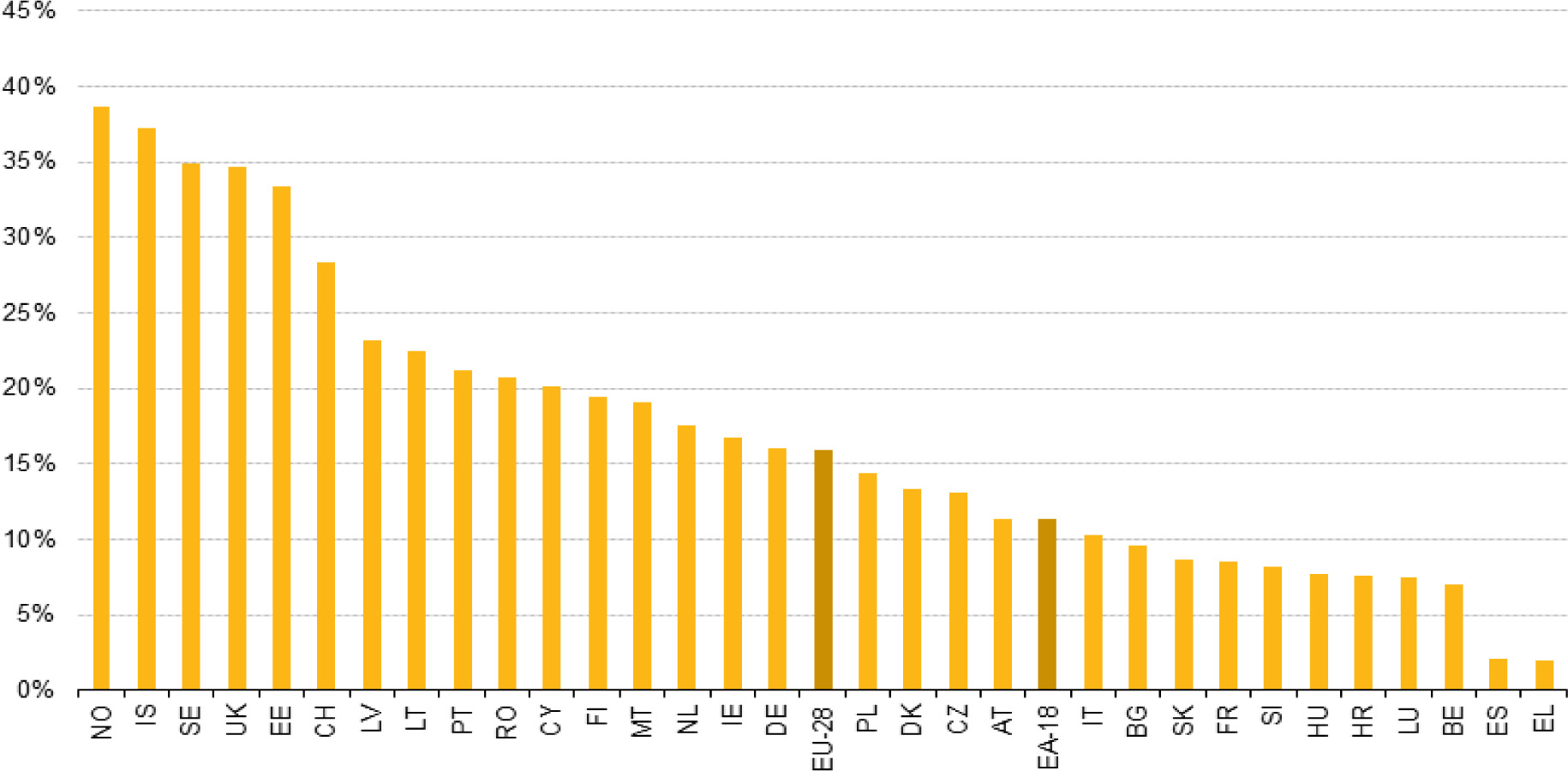
Figure 3
Percentage of working pension beneficiaries age 50–69 in 2012.
Source: Eurostat, LFS AHM 2012.
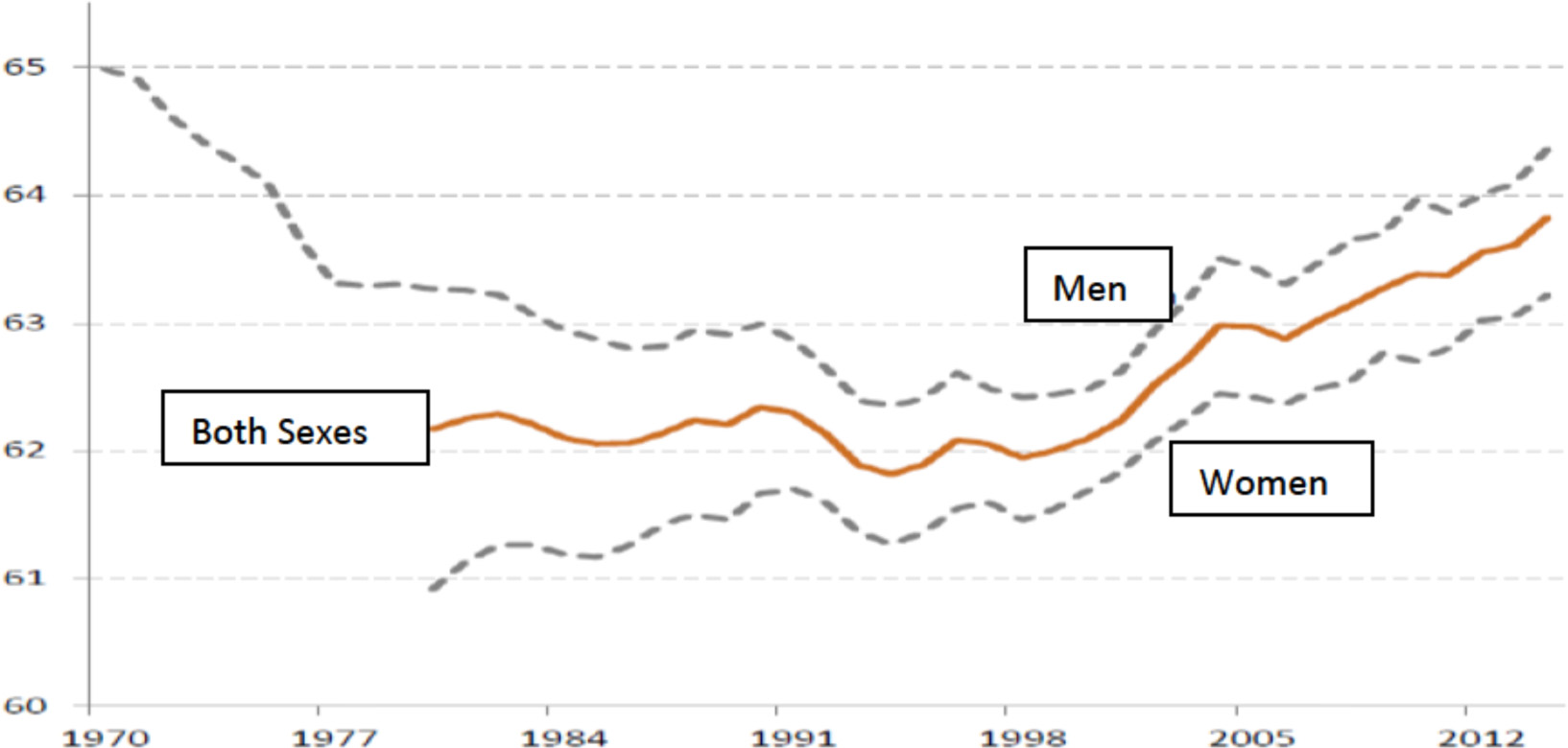
Figure 4
Changes in exit age over time. Source: Swedish Pensions Agency (2015)
Source: Swedish Pensions Agency (2015)
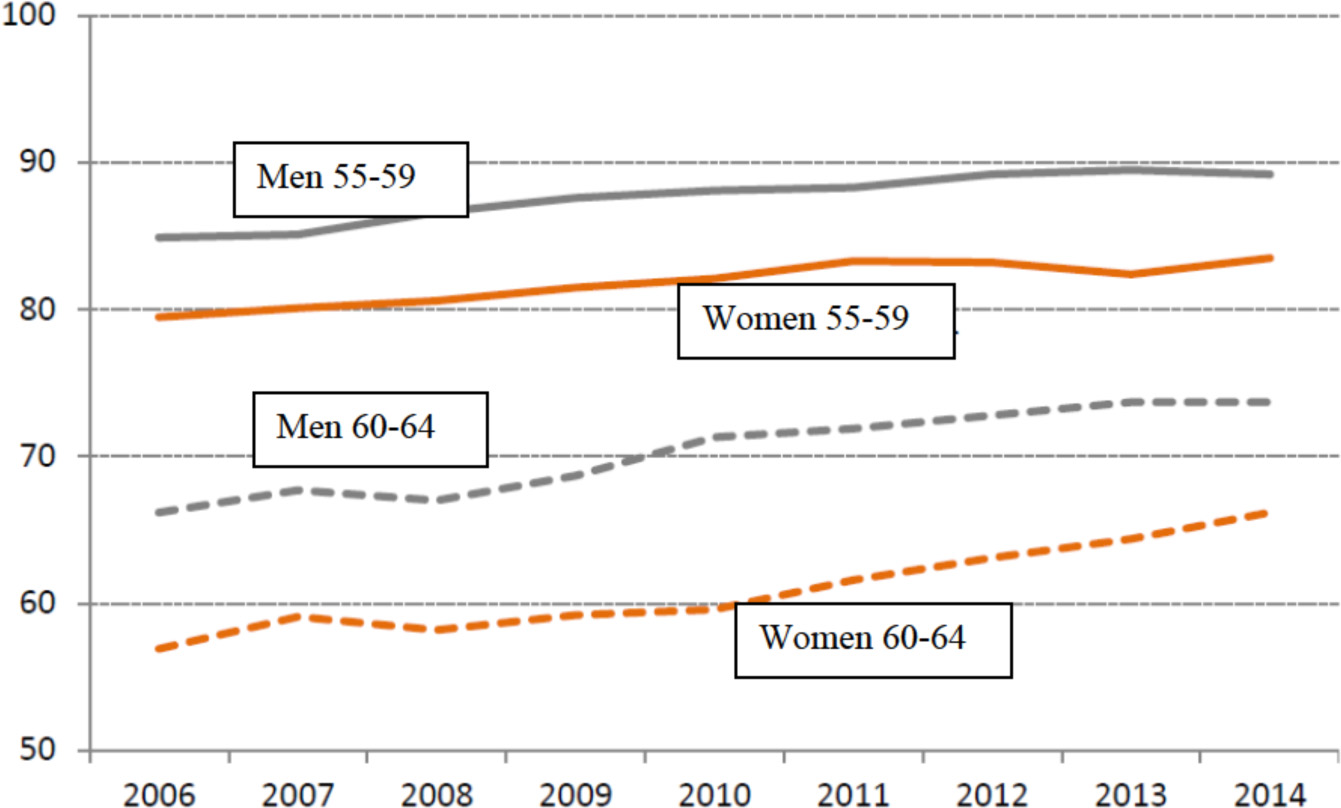
Figure 5
Labor force participation as a percentage of the population, age 55–64.
Source: Swedish Pensions Agency (2015)
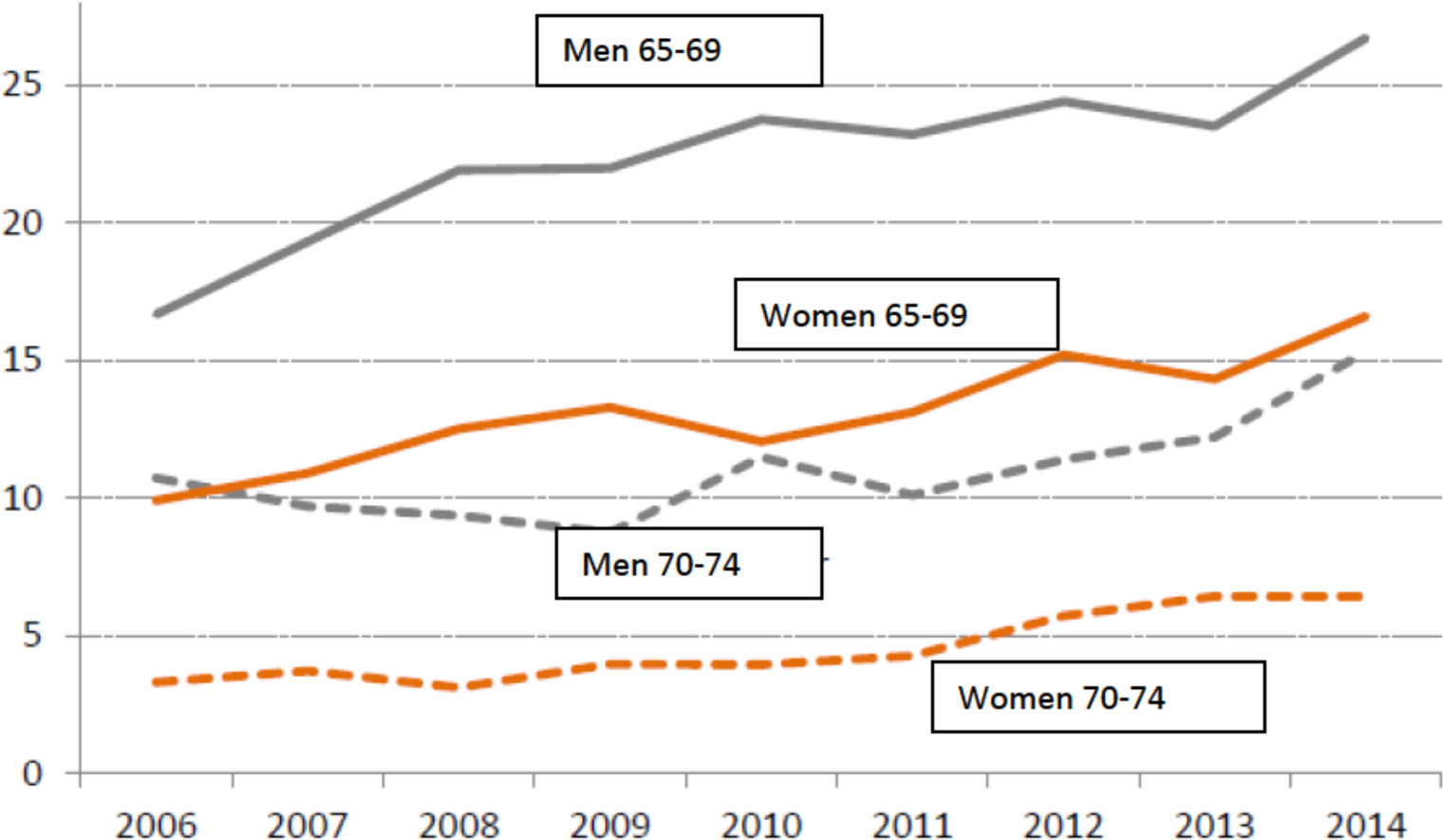
Figure 6
Labor force participation as a percentage of the population, age 65–74.
Source: Swedish Pensions Agency (2015)
Table 1
Working hours/week, 2014.
| Women | Men | |
|---|---|---|
| 55–64 | 36.1 | 40.0 |
| 65–69 | 24.3 | 28.1 |
| 70–74 | 13.8 | 21.3 |
Source: Swedish Pensions Agency (2015)
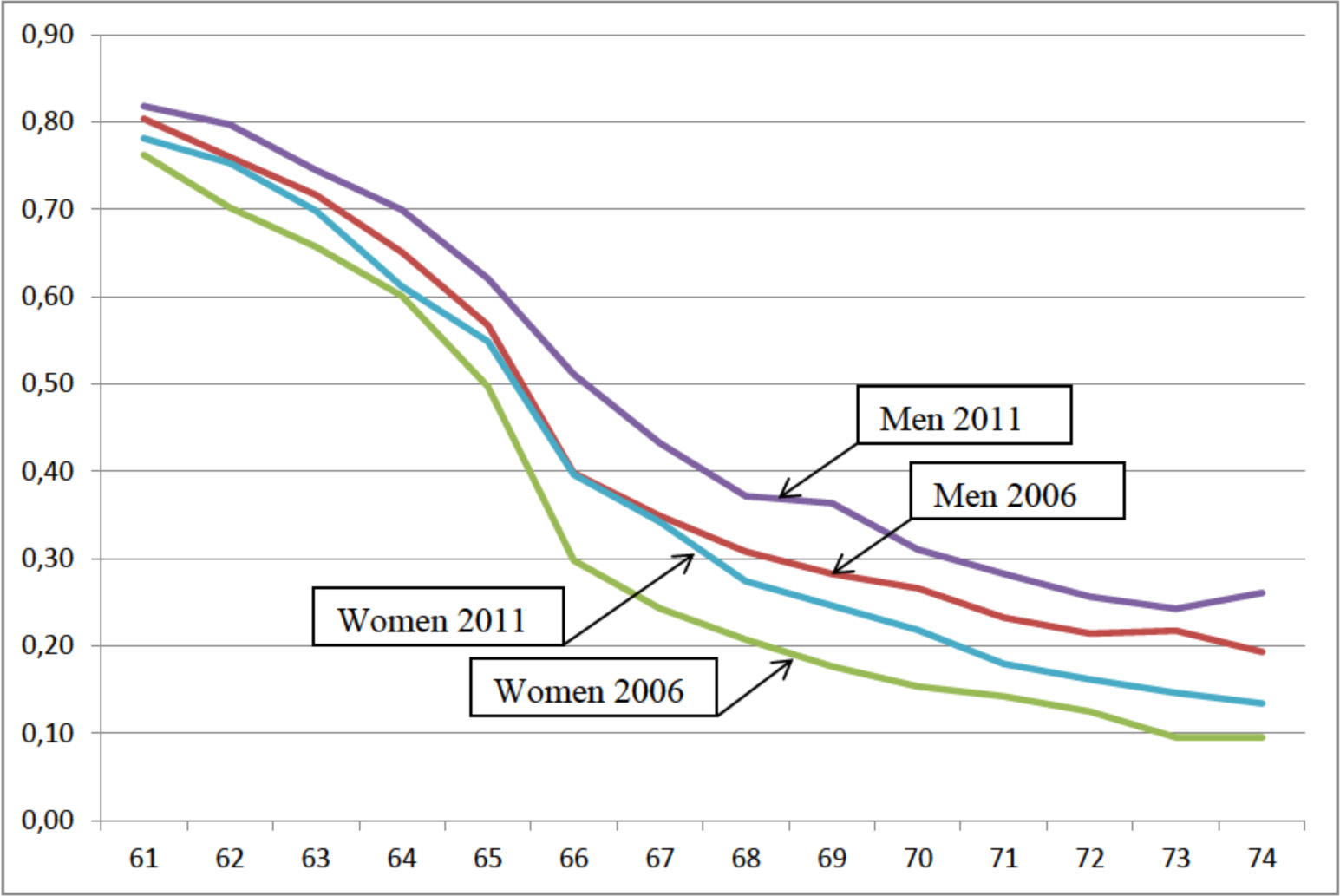
Figure 7
Percentage with labor income, age 61–74, 2006 and 2011. Source: Own calculations, LINDA data 2006 and 2011
Source: Own calculations, LINDA data 2006 and 2011
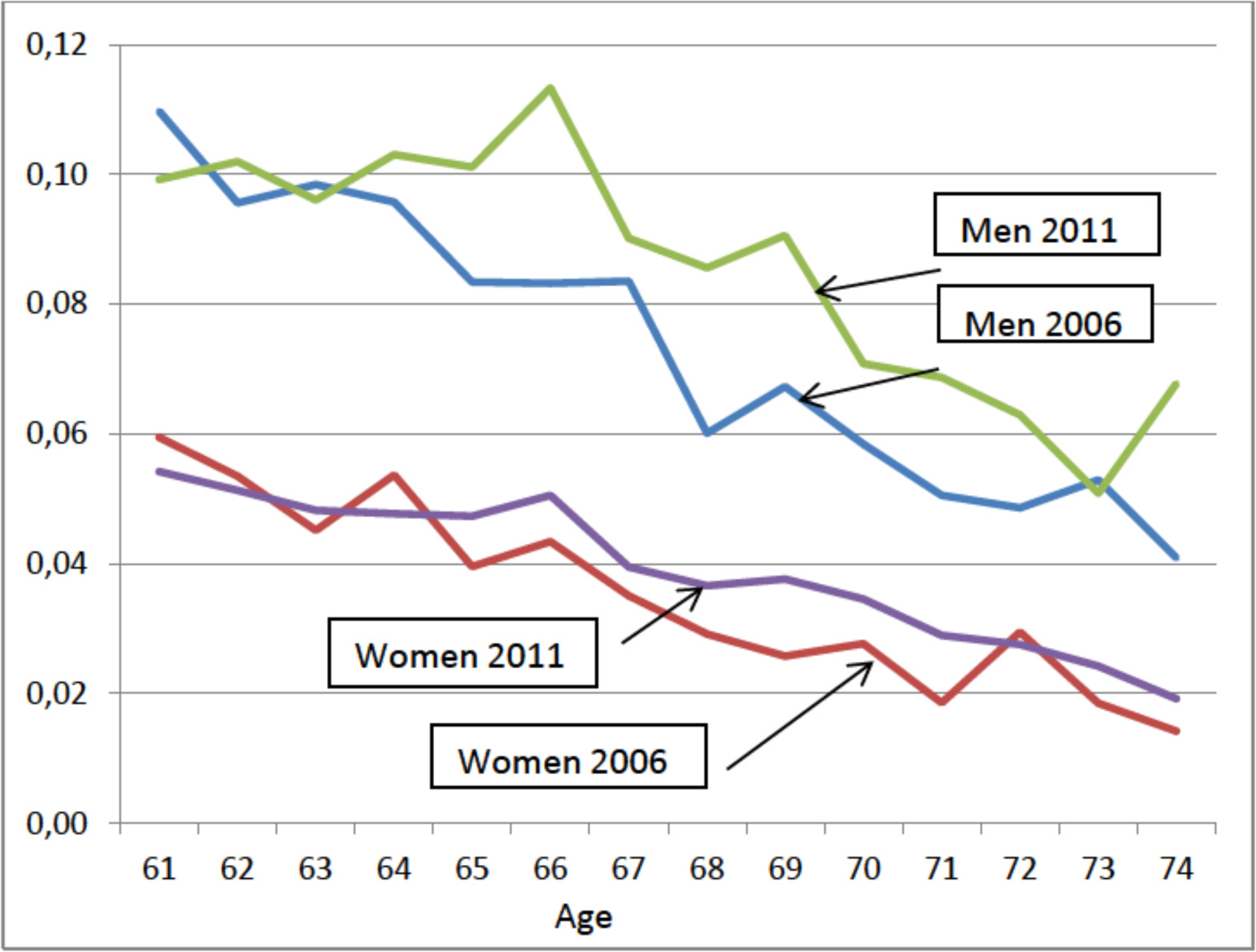
Figure 8
Percentage with business income, individuals age 61–74 in 2006 and 2011.
Source: Own calculations, LINDA data 2006 and 2011
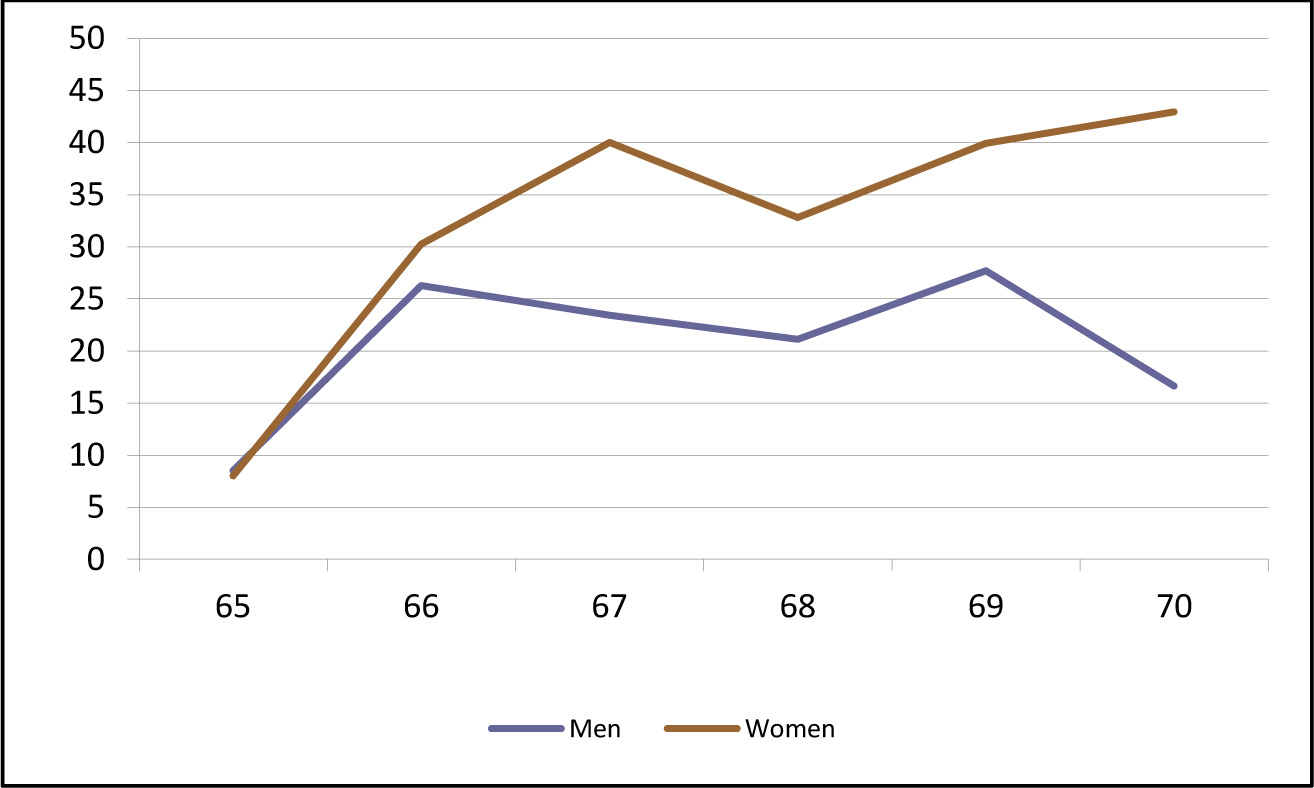
Figure 9
Percentage increase from 2006 to 2011 of individuals with both pension and labor income, distributed by age and sex.
Source: Own calculations, LINDA data 2006 and 2011
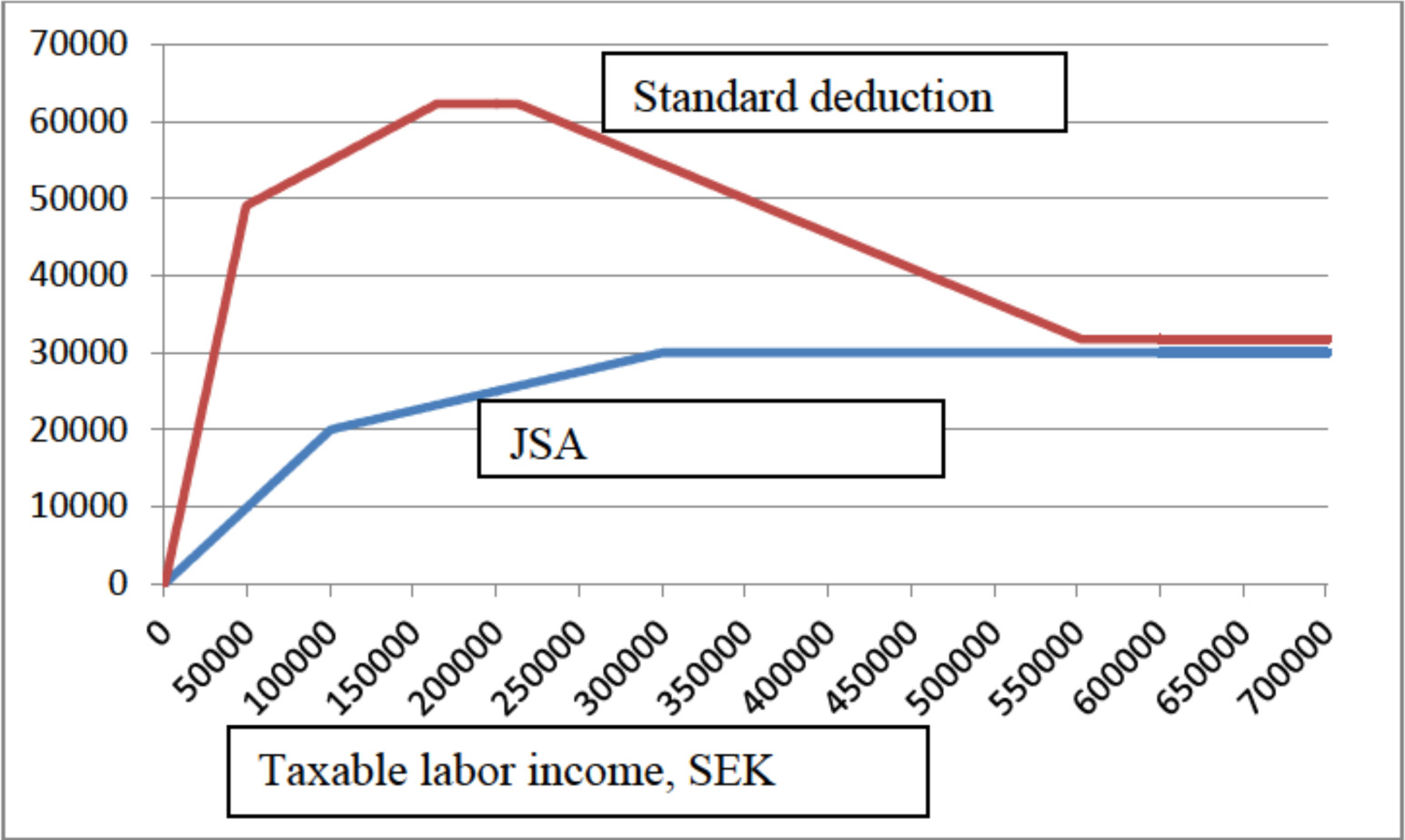
Figure 10
Standard deduction and JSA for individuals older than 65 in 2014.
Source: Own calculations
Note: The calculations are based on an average municipal tax of 31.86%
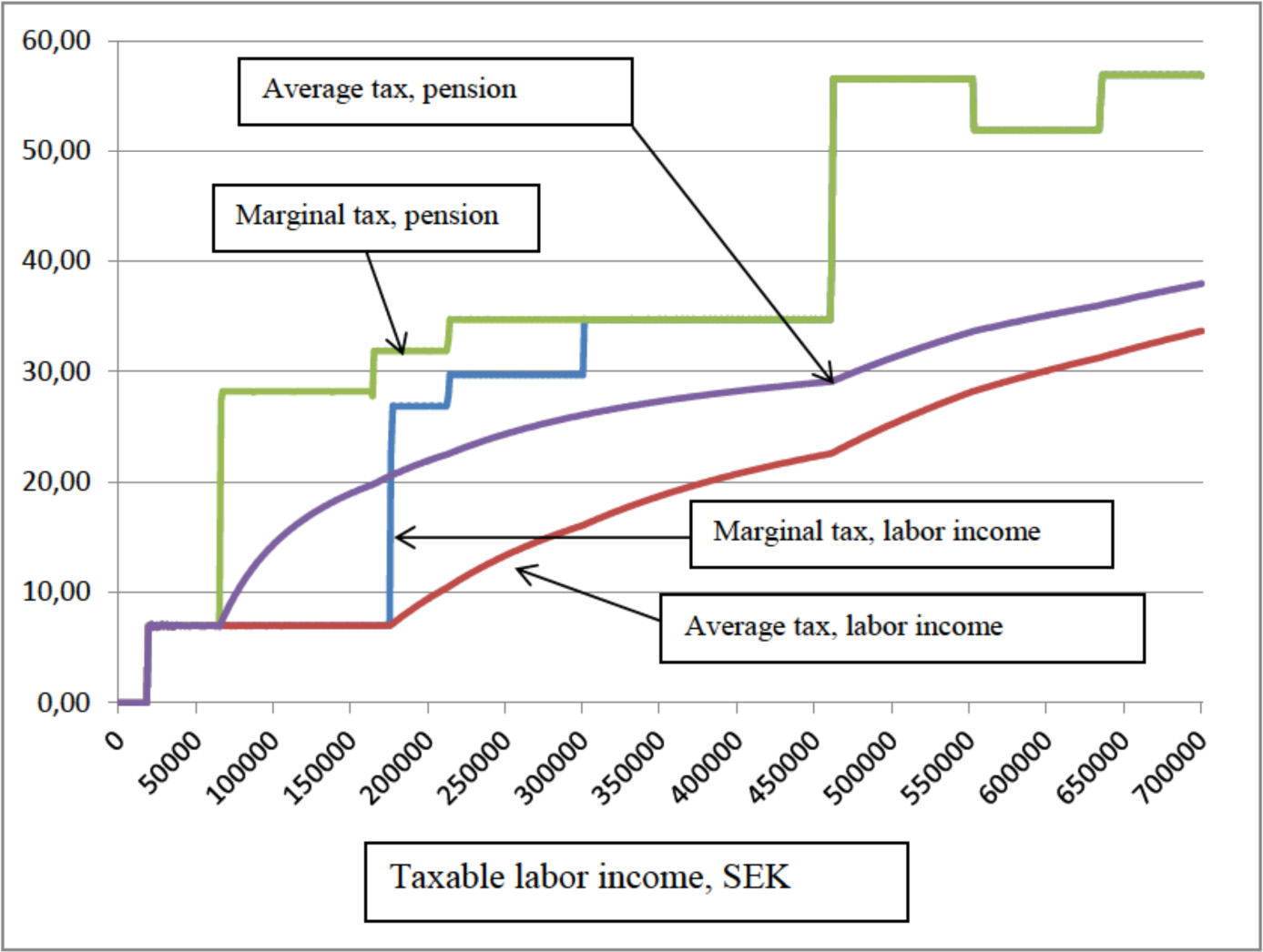
Figure 11
Average and marginal tax in 2014, expressed in percent, for people older than 65 with and without the JSA.
Source: Own calculations
Note: The calculations are based on an average municipal tax of 31.86%
Table 2
Statistics for individuals aged 64 and 66 (2004–2011).
| 64 | 66 | |
|---|---|---|
| Percentage with annual income above one income base amount | 0.53 | 0.22 |
| Percentage with business income above 25% of one income base amount | 0.06 | 0.05 |
| Percentage highest education compulsory school | 0.31 | 0.34 |
| Percentage highest education secondary school | 0.52 | 0.51 |
| Percentage highest education university | 0.16 | 0.15 |
| Percentage married | 0.76 | 0.75 |
| Percentage male | 0.53 | 0.55 |
| Percentage foreign-born | 0.12 | 0.12 |
| Percentage self-employed | 0.08 | 0.08 |
| Percentage residing in a large city | 0.31 | 0.31 |
| Percentage residing in a medium- sized city | 0.40 | 0.40 |
| Percentage residing in rural area | 0.29 | 0.30 |
| Number of individuals in the sample | 47,342 | 41,381 |
Table 3
Estimated parameters.
| Annual income above one income base amount | Business income above 0.25* of one income base amount | |
|---|---|---|
| Constant | 0.4371*** | 0.0301*** |
| p (before reform = 0, otherwise 1) | 0.0765*** | 0.0122*** |
| t (Age 66 = 1, otherwise 0) | -0.3283*** | -0.0143*** |
| Reform (p × t) | 0.0313*** | 0.0106*** |
| Highest education secondary school | 0.0412*** | -0.0034 |
| Highest education university | 0.1615*** | 0.0098*** |
| Married | -0.0316*** | 0.0067*** |
| Male | -0.0140* | 0.0301*** |
| Married and male | 0.1103*** | 0.0175*** |
| Foreign-born | -0.1168*** | -0.0249*** |
| Self-employed | 0.2883*** | —— |
| Self-employed and foreign-born | 0.0874*** | —— |
| Medium-sized city | -0.320*** | -0.0048** |
| Rural | -0.0364*** | 0.0049* |
| Mean for percentage with income in the entire sample | 0.387 | 0.057 |
| Mean for percentage with income in the treatment group before the reform | 0.166 | 0.044 |
| The estimated reform efect without control variables | 0.0382*** | 0.0117*** |
The standard errors are robust to heteroscedasticity.
In addition to the variables shown here, the calendar year, from 2005–2010, is included in the model.
Table 4
Summary of evaluations of effects on the employment rate of targeted tax reductions for older workers.
| Reform effect Estimated parameter | Percentage effect in relation to mean, entire sample | Percentage effect in relation to mean, treatment group before the reform | |
|---|---|---|---|
| Pirttilä and Selin (2011) | 0.020 | 3 | 19 |
| Data: LFS, 2001–2010 | |||
| Control: 55–64, Treatment: 65–74 | |||
| Mean | |||
| Entire sample, 60%* | |||
| Treatment group before reform, 10.3% | |||
| Ministry of Finance (2012) | 0.07 | 18 | 47 |
| Data: HF, 2004–2009 | |||
| Control: 64, Treatment: 66 | |||
| Probit model | |||
| Mean | |||
| Entire sample, 38.8%** | |||
| Treatment group before reform 15%*** | |||
| Laun (2012) | 0.015 | 5 | 8 |
| Data: Total population, 2001–2009 | |||
| Control: Aged 65 Jan–Feb | |||
| Treatment: Aged 65 Nov–Dec | |||
| Only individuals with income 1996–2000 | |||
| Mean | |||
| Entire sample 30.6% | |||
| Treatment group before reform 19,3%**** | |||
| Flood (2016) | 0.031 | 8 | 19 |
| Data: LINDA, 2004–2011 | |||
| Control: 64, Treatment: 66 | |||
| Mean | |||
| Entire sample 38.7% | |||
| Treatment group before reform 16.6% | |||
| Flood (2016) | 0.022 | 7 | 13 |
| Data: LINDA, 2004–2011 | (Signifcant at 10%) | ||
| Control: Aged 65, Jan–Mar | |||
| Treatment: Aged 65, Oct–Dec | |||
| Mean | |||
| Entire sample 31.4% | |||
| Treatment group before reform 16.2% | |||
| Flood (2016) | 0.011 | 19 | 24 |
| Data: LINDA 2004–2011 | |||
| Self-employed | |||
| Control: 64, Treatment: 66 | |||
| Mean | |||
| Entire sample 5.7% | |||
| Treatment group before reform 4.4% |
Note: HF (Household Finances) is a sample survey at the individual level that consists of both register-based and interview-based data. The sample size is about 40,000 (about 20,000 households)
Table 5
Attempt to replicate some results for evaluations of the effects on the employment rate of the targeted tax reductions for older workers.
| Reform effect Estimated parameter | Percentage effect in relation to mean, entire sample | Percentage effect in relation to mean, treatment group before the reform | |
|---|---|---|---|
| Comparison, Ministry of Finance | 0,06 | 16 | 36 |
| Data: LINDA, 2004–2009 | 0,05 | 13 | 30 |
| Control: 64, Treatment: 66 | 0,026 | 7 | 16 |
| Probit model evaluated at mean | |||
| Probit model, mean of individual values | |||
| OLS | |||
| Mean: | |||
| Entire sample 37.6%** | |||
| Treatment group before reform 16.6%*** | |||
| Comparison 1, Laun | 0,021 | 5 | 11 |
| Data: LINDA, 2001–2009 | |||
| Control: 64, Treatment: 66 | |||
| Only individuals with income 1996–2000 | |||
| Mean: | |||
| Entire sample 39.9% | |||
| Treatment group before reform 18,0% | |||
| Comparison 2, Laun | 0,024 | 8 | 12 |
| Data: LINDA, 2001–2009 | (Significant at 10%) | ||
| Control: age 65 Jan–Mar | |||
| Treatment: age 65 Oct–Dec | |||
| Only individuals with income 1996–2000 | |||
| Mean: | |||
| Entire sample 28.6% | |||
| Treatment group before reform 19,3% |
Table 6
Probability of collecting old-age pension.
| Variables | Men | Women |
|---|---|---|
| Intercept | 771.6555*** | 1244.0820*** |
| Initial value | 12.5024*** | 10.4820*** |
| 2010 | 3.2093*** | 2.4360*** |
| 2011 | 4.0886*** | 3.3542*** |
| Age | -25.9246*** | -40.5899*** |
| Age2/100 | 21.4813*** | 32.9001*** |
| Compulsory school | 1.0436*** | 0.7356*** |
| Secondary school | 0.9632*** | 0.5444*** |
| Large city | -0.3362*** | -0.3831*** |
| Native-born | 0.8478*** | 0.7693*** |
| Replacement rate | 1.4188*** | 1.4211*** |
| Income above cap | 0.4773*** | 0.1591 |
Table 7
Size of old-age pension assuming collection.
| Variables | Men | Women |
|---|---|---|
| Constant | 11.560*** | 11.198*** |
| 61 | -1.028*** | -1.146*** |
| 62 | -0.731*** | -0.829*** |
| 63 | -0.605*** | -0.720*** |
| 64 | -0.519*** | -0.568*** |
| 65 | -0.383*** | -0.354*** |
| Compulsory school | -0.534*** | -0.339*** |
| Secondary school | -0.344*** | -0.212*** |
| Large city | 0.103*** | 0.109*** |
| Native-born | 0.385*** | 0.250*** |
| Replacement rate | 1.010*** | 1.292*** |
| Replacement rate2 | -0.173*** | -0.246*** |
Table 8
Evaluation of the increased JSA based on the 2014 rule system.
| Increased JSA for people age 66 and older | Increased JSA for people age 61 and older | |||
|---|---|---|---|---|
| Without behavioral modification, percent (1) | With behavioral modification, percent (2) | Without behavioral modification, percent (3) | With behavioral modification, percent (4) | |
| Employment rate | 0 | 13.3 | 0 | 3.8 |
| Working hours | 0 | 9.0 | 0 | 5.9 |
| Pension income | 0 | -0.2 | 0 | -0.3 |
| Labor income | 0 | 6.9 | 0 | 2.9 |
| Income tax | -1.0 | -0.3 | -1.8 | -1.3 |
| Transfers | 00 | 0 | -0.4 | |
| Disposable income | 0.4 | 1.1 | 0.7 | 1.3 |
| VAT | 0.4 | 1.1 | 0.7 | 1.3 |
| Payroll taxes | 0 | 3.7 | 0 | 2.0 |
| Total budget efect, SEK millions | -432 | 275 | -1,514 | -66 |
Note: The effects are calculated as a percentage change for those who are age 66–70 and age 61–70 in relation to the corresponding amount in a tax system that does not include the increased JSA
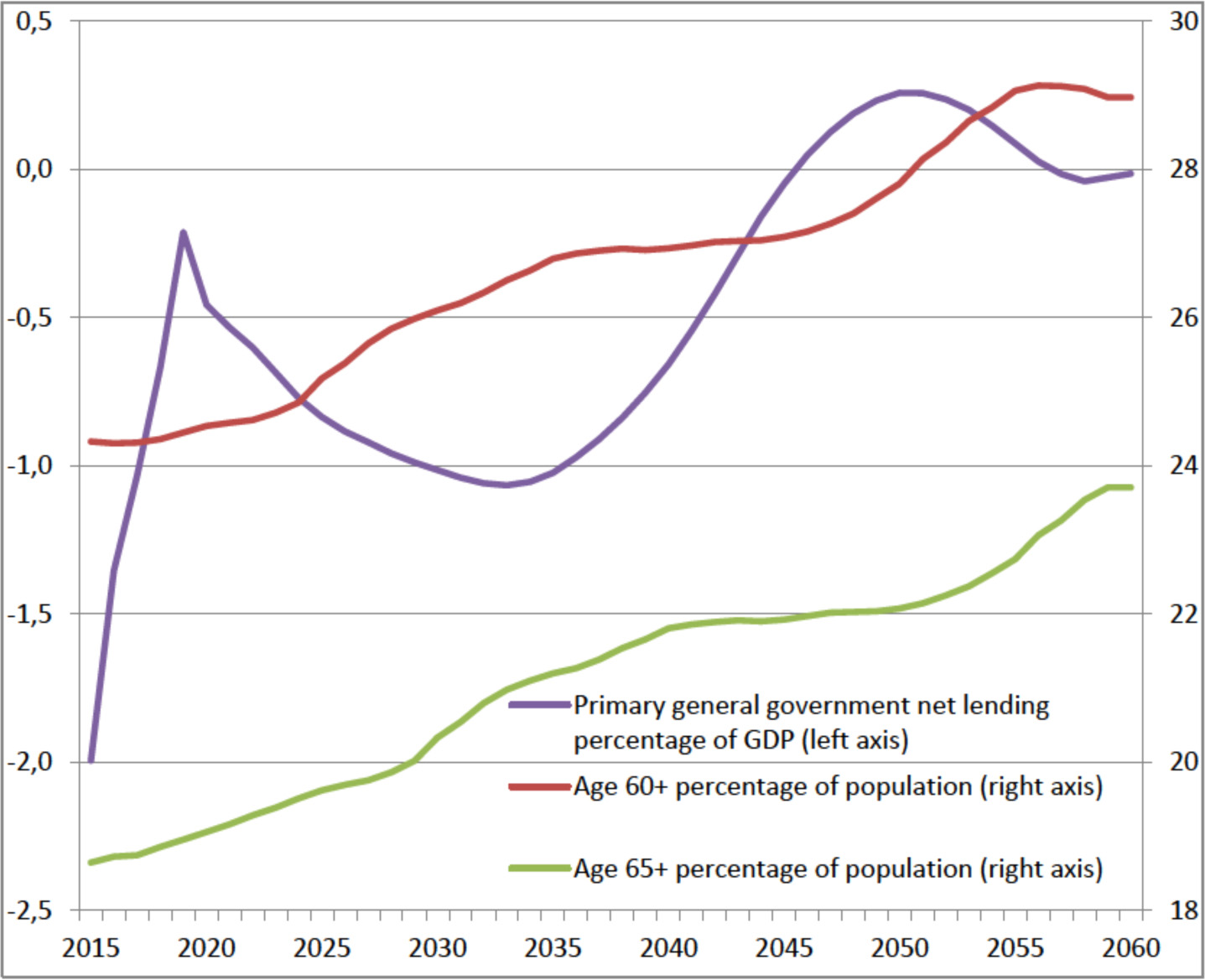
Figure 12
Primary general government net lending as a percentage of GDP and the percentage of older people in the population.
Source: Flood and Ruist (2015)
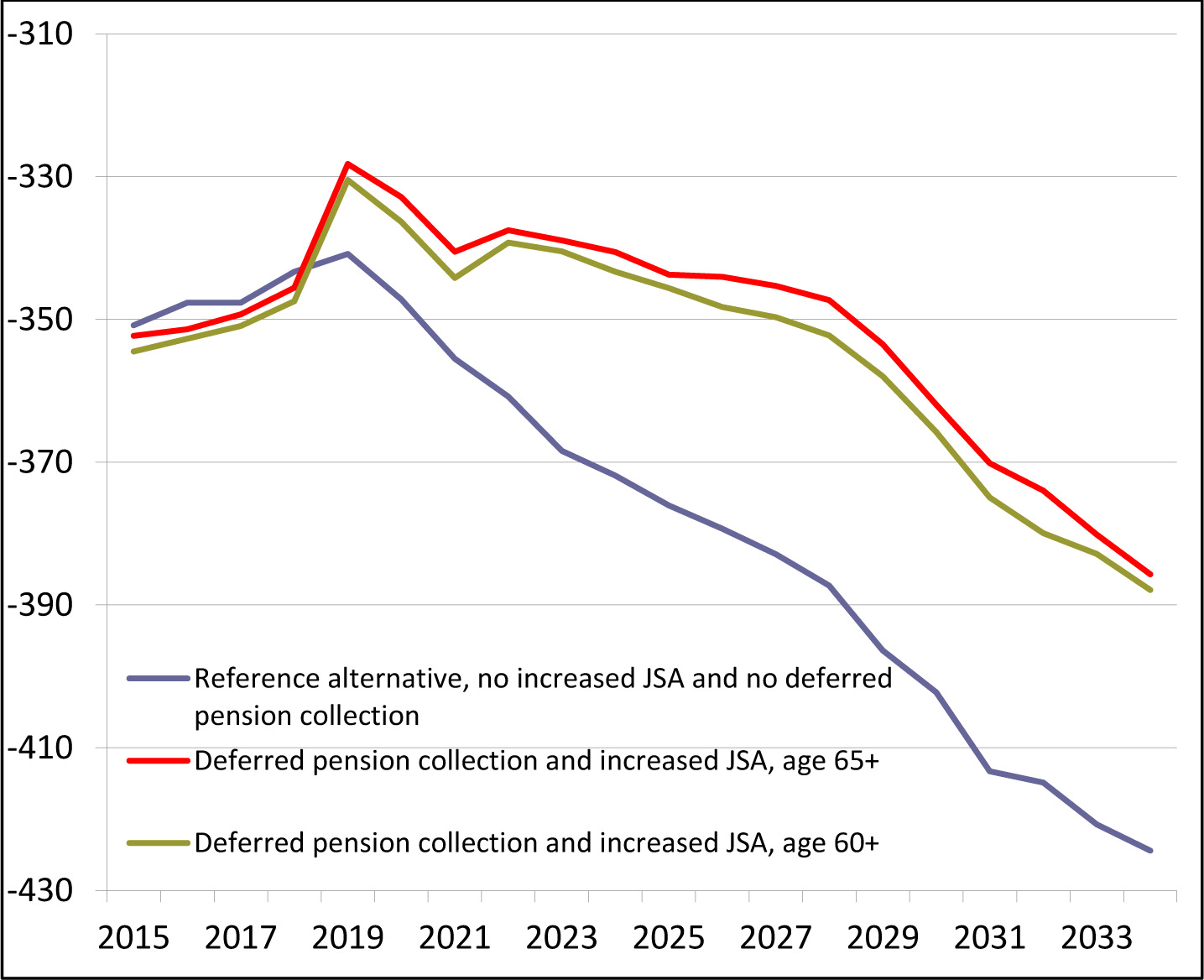
Figure 13
Primary general government net lending in SEK billions for those older than 60 and the period of 2015–2034.
Table 9
Net present value of general government net lending in SEK billions and percentage change compared with the reference alternative. The calculations refer to the period of 2015–2035 and individuals older than 60.
| SEK billions | Percentage change compared with reference alternative | |||
|---|---|---|---|---|
| No discount | Discount rate 3% | No discount | Discount rate 3% | |
| Reference alternative | –7,532 | –5,537 | ||
| Increased JSA at 66 | –7,023 | –5,199 | –6.7 | –6.1 |
| Increased JSA at 61 | –7,085 | –5,243 | –5.9 | –5.3 |