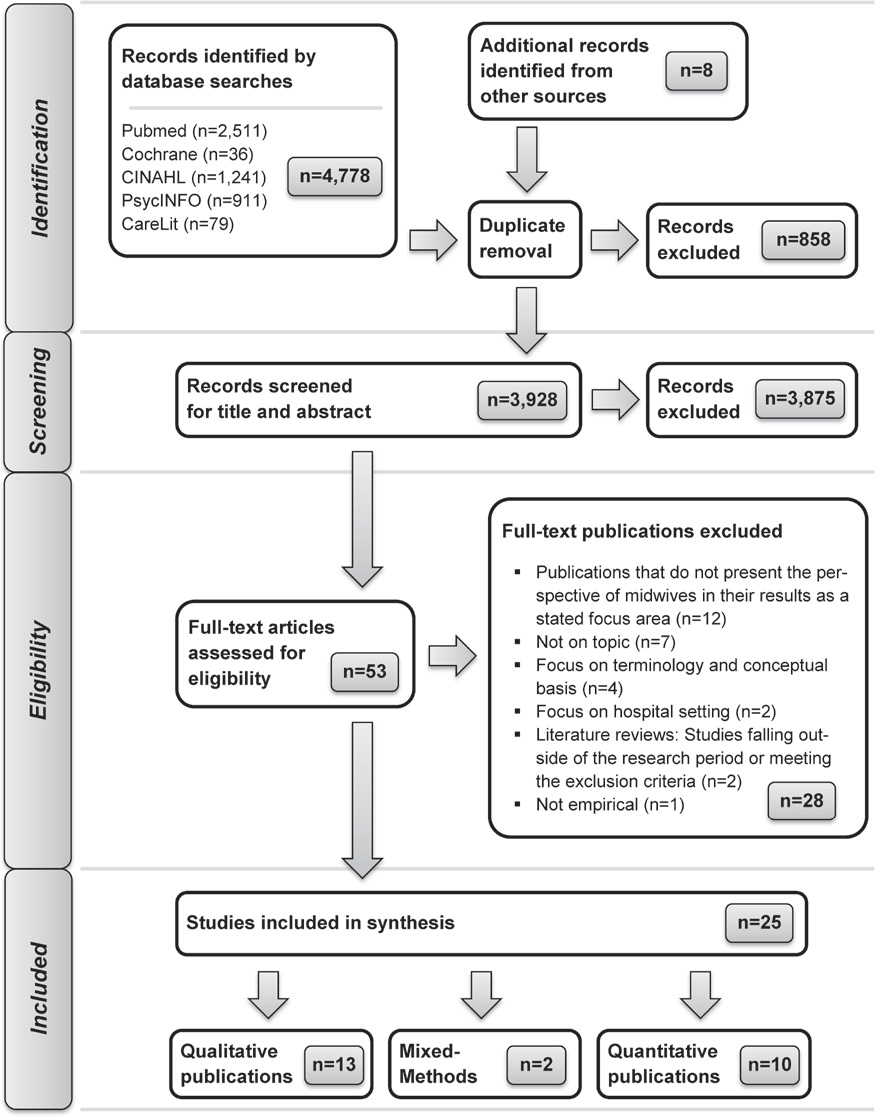
Figure 1
PRISMA flow chart illustrating the exclusion process
Table 1
Overview of studies excluded from analysis
| First author and year11 | Title | Reason for exclusion |
|---|---|---|
| Beldon (2005) | Health promotion in pregnancy: The role of the midwife | Not on topic |
| Borrow (2011) | Community-based child health nurses: An exploration of current practice | Publication that does not present the perspective of midwives in its results as a stated focus area |
| Caldwell (2006) | Preparing for practice: How well are practitioners prepared for teamwork | Publication that does not present the perspective of midwives in its results as a stated focus area |
| Colvin (2013) | A systematic review of qualitative evidence on barriers and facilitators to the implementation of task-shifting in midwifery services | Not on topic |
| Crotty (2012) | Helping and hindering: Perceptions of enablers and barriers to collaboration within a rural South Australian mental health network | Publication that does not present the perspective of midwives in its results as a stated focus area |
| D’Amour (2005) | The conceptual basis for interprofessional collaboration: Core concepts and theoretical frameworks | Focus on terminology and conceptual basis |
| Downe (2010) | Creating a collaborative culture in maternity care | Focus on terminology and conceptual basis |
| Harris (2012) | Effect of a collaborative interdisciplinary maternity care program on perinatal outcomes | Publication that does not present the perspective of midwives in its results as a stated focus area |
| Heatley (2011) | Defining collaboration in Australian maternity care | Focus on terminology and conceptual basis |
| Lane (2006) | The plasticity of professional boundaries: A case study of collaborative care in maternity services | Focus on hospital setting |
| Larsson (2009) | Professional role and identity in a changing society: Three paradoxes in Swedish midwives’ experiences | Focus on hospital setting |
| Lavender (2004) | An exploration of midwives’ views of the current system of maternity care in England | Not on topic |
| Lipp (2008) | A woman centred service in termination of pregnancy: A grounded theory study | Not on topic |
| Manniën (2012) | Evaluation of primary care midwifery in the Netherlands: Design and rationale of a dynamic cohort study (DELIVER) | Publication that does not present the perspective of midwives in its results as a stated focus area |
| Mclntyre (2012) | The struggle for contested boundaries in the move to collaborative care teams in Australian maternity care | Not empirical |
| McKenna (2009) | Health care managers’ perspectives on new nursing and midwifery roles: Perceived impact on patient care and cost effectiveness | Not on topic |
| Martin (2010) | Developing interdisciplinary maternity services policy in Canada. Evaluation of a consensus workshop | Publication that does not present the perspective of midwives in its results as a stated focus area |
| Peterson (2013) | Most family physicians work routinely with nurse practitioners, physician assistants, or certified nurse midwives | Publication that does not present the perspective of midwives in its results as a stated focus area |
| Psaila, Schmied (2014) | Discontinuities between maternity and child and family health services: Health professional’s perceptions | Not on topic |
| Schmied (2010) | The nature and impact of collaboration and integrated service delivery for pregnant women, children and families | Discursive paper that does not present the perspective of midwives in its results as a stated focus area, one study already included (Homer et al., 2009) |
| Sheehan (2007) | Comparison of language used and patterns of communication in interprofessional and multidisciplinary teams | Focus on terminology and conceptual basis |
| Smith (2015) | Midwife-physician collaboration: A conceptual framework for interprofessional collaborative practice | Publication that does not present the perspective of midwives in its results as a stated focus area |
| Stamp (2008) | Aboriginal maternal and infant care workers: Partners in caring for Aboriginal mothers and babies | Not on topic |
| Stevens (2012) | Description of a successful collaborative birth center practice among midwives and an obstetrician | Publication that does not present the perspective of midwives in its results as a stated focus area |
| Supper (2015) | Interprofessional collaboration in primary health care: A review of facilitators and barriers perceived by involved actors | Literature review including 44 articles: three studies focus on midwifery: one is out of research period, two met the exclusion criteria |
| Vedam (2014) | Transfer from planned home birth to hospital: Improving interprofessional collaboration | Publication that does not present the perspective of midwives in its results as a stated focus area |
| Zwarenstein (2009) | Interprofessional collaboration: Effects of practice-based interventions on professional practice and healthcare outcomes | Publication that does not present the perspective of midwives in its results as a stated focus area |
| Xyrichis (2008) | What fosters or prevents interprofessional teamworking in primary and community care? A literature review | Literature review including 10 articles: four studies focus on midwifery: three are out of research period, one met the exclusion criteria |
Table 2
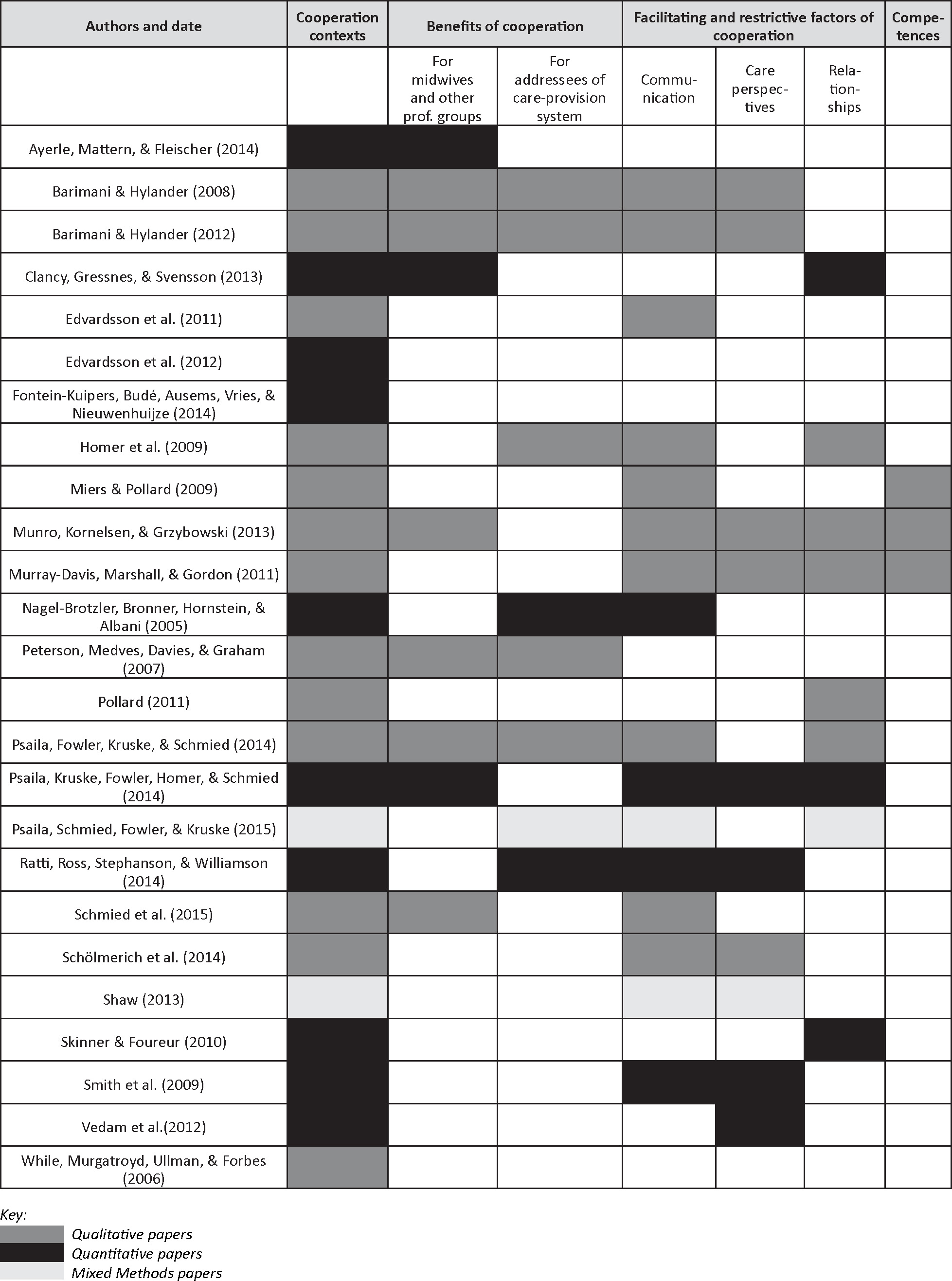
Details and critique of the qualitative papers included in the thematic analysis
| Authors, year, country | Research aim | Sample | Methods | Quality score (CASP, 2013) |
|---|---|---|---|---|
| Barimani & Hylander (2008), Sweden | Exploring health care professionals’ experience of cooperation in the chain of care between antenatal care, postpartum care and child health care | n=32 19 midwives 13 child health care nurses | Focus groups, individual interviews | 9 |
| Barimani & Hylander (2012), Sweden | Investigating strategies for continuity of care for expectant and new mothers | n=41 9 midwives 11 child health care nurses 21 mothers | Interviews, participant observation, document analysis | 9 |
| Edvardsson et al. (2011), Sweden | Exploring facilitators, barriers and requirements for programme sustainability two years after finalizing implementation of a multisectoral child health promotion programme | n=23 5 midwives 7 child health nurses 7 dental nurses 4 pre-school teachers | Face-to-face interviews | 10 |
| Homer et al. (2009), Australia | Describing current approaches to transitions of care from midwives to child and family health nurses; Understanding the barriers and facilitators to effective transition of care | n=67 19 midwifery managers 14 midwifery consultants, community midwives 12 child and family health nurse managers 13 child and family health nurse consultants 4 family coordinators 5 others | Questionnaire with a series of open-end questions | 10 |
| Miers & Pollard (2009), United Kingdom | Exploring non-medical health and social care professionals’ views on the abilities they need to collaborate | n=34 13 nurses 4 midwives 5 physiotherapists 7 social workers 4 occupational therapists | Face-to-face and telephone interviews | 5 |
| Munro, Kornelsen, & Grzybowski (2013), Canada | Exploring barriers to and facilitators of interprofessional models of maternity care between physicians, nurses and midwives in rural British Columbia | n=73 7 midwives 27 physicians 18 nurses 5 community-based providers 5 birthing women 5 administrators 6 decision makers | In depth-interviews, focus group | 10 |
| Murray-Davis, Marshall, & Gordon (2011), United Kingdom | Understanding midwives’ perceptions regarding interprofessional working and learning and its relevance to midwifery care | n=39 11 heads of midwifery 16 midwifery educators 12 newly qualified midwives | Interviews, focus groups | 9 |
| Peterson, Medves, Davies, & Graham (2007), Canada | Describing care providers’ attitudes towards multidisciplinary maternity care and facilitators of and barriers to collaborative maternity care | n=25 participants from national care provider associations: 4 Association of Family Physicians 5 Association of Midwives 3 Nurses Association 4 Society of Obstetricians and Gynaecologists 4 Society of Rural Physicians 5 Association of Women’s Health, Obstetric and Neonatal Nurses | Telephone interviews | 8 |
| Pollard (2011), United Kingdom | Exploring how midwives’ discursive practices relate to the status quo and how they contribute either to maintaining or challenging traditional discourses | n=32 (interviews) 20 midwives 4 obstetricians 8 women n=88 (observation) 32 midwives 4 administrative staff 27 medical staff 5 students 10 auxiliaries 6 other hospital staff 4 women | Interviews, observation | 9 |
| Psaila, Fowler, Kruske,& Schmied (2014), Australia | Describing innovations developed to improve transition of care between maternity and child and family health services at seven sites across four Australian states; Identifying the characteristics common to all innovations | n=33 midwives, managers, child and family health nurses, GP’s, support workers, allied health staff, Aboriginal health workers, community health professionals number of each profession not stated | Face-to-face and telephone interviews, focus groups | 9 |
| Schmied et al., (2015), Australia | Exploring professionals perceptions’ of the challenges and opportunities in implementing a national approach to universal child and family health services across Australia | n=161 60 child and family health nurses 45 midwives 15 GP’s 12 practice nurses 14 allied health professionals 7 childhood specialists 6 staff from non-government organisations 2 government advisors | Focus groups via telephone conference and face-to-face, discussion groups at national conferences, videoconference, teleconference, e-conversation, one-to-one interviews | 10 |
| Schölmerich et al. (2014), Netherlands | Exploring factors that make it challenging to achieve coordination in Dutch midwifery and obstetrics | n=40 13 community midwives 8 hospital-based-midwives 19 obstetricians | Semi-structured interviews, non-participatory observation | 10 |
| While, Murgatroyd, Ullman, & Forbes (2006), United Kingdom | Exploring nurses’, midwives’ and health visitors’ experiences of cross-boundary working | n=113 16 midwives 66 nurses 14 health visitors 3 GP’s 4 social workers 2 Sure Start workers 3 service users 5 others | World café focus group method | 5 |
Table 3
Details and critique of the quantitative papers included in the thematic analysis
| Authors, year, country | Research aim | Sample | Methods | Critique – Framework according to Caldwell, Henshaw, & Taylor (2011) |
|---|---|---|---|---|
| Ayerle, Mattern, & Fleischer (2014), Germany | Collecting data on freelance midwives’ knowledge and attitudes regarding early prevention in Saxony- Anhalt | 42 community midwives | Online survey based on questionnaire | Meets criteria with restrictions
|
| Clancy, Gressnes, & Svensson (2013), Norway | Examining collaboration issues relating to public health nursing in different-sized Norwegian municipalities | n=l,596 849 public health nurses 113 doctors 519 child protection workers 115 midwives | Cross-sectional online survey based on questionnaire | Meets criteria
|
| Edvardsson et al. (2012), Sweden | Examining the outcomes of a child health promotion programme on professionals’ self-reported health promotion practices and to investigate perceived facilitators and barriers for programme implementation | Survey 1: Pre-implementation: n=134 30 midwives 80 nurses 24 pre-school teachers Post-implementation: n=109 22 midwives 67 nurses 20 pre-school teachers Survey 2: Occasion 1: n=142 midwives, nurses, pre-school teachers Occasion 2: n=98 midwives, nurses, pre-school teachers number of each profession not stated in survey 2 | Two surveys based on questionnaire Survey 1: Online survey (before- and after design) Survey 2: Quantitative survey with qualitative elements carried out between seminars | Meets criteria
|
| Fontein-Kuipers, Bude, Ausems, Vries, & Nieuwenhuijze (2014), Netherlands | Exploring the behavioural intentions of antenatal management of maternal distress and examine the factors that influence those intentions | 112 midwives based in the community | Exploratory online survey based on questionnaire | Meets criteria
|
| Nagel-Brotzler, Bronner, Hornstein, & Albani (2005), Germany | Investigating midwives’ experience, knowledge and multiprofessional cooperation in the context of psychic disturbances in early motherhood | 111 midwives | Telephone survey or personal questioning based on a questionnaire or participants completed a questionnaire | Meets criteria with restrictions
|
| Psaila, Kruske, Fowler, Homer, & Schmied (2014), Australia | Exploring the transition of care between maternity services to child and family health services | n=l,753 655 midwives 1098 child and family health nurses | Quantitative online and mail survey with qualitative elements based on questionnaire | Meets criteria
|
| Ratti, Ross, Stephanson, & Williamson (2014), Canada | Identifying barriers and effective working relationship between physicians and midwives, find ways to improve the quality of professional interactions | n=144 25 midwives 73 family physicians 46 obstetricians | Mail survey based on questionnaire | Meets criteria with restrictions
|
| Skinner & Foureur (2010), New Zealand | Describing midwives’ obstetric consultation and referral practices and their perceptions concerning the quality of their professional relationships with obstetricians | 311 midwives | Mail survey based on questionnaire | Meets criteria
|
| Smith et al. (2009), Canada | Eliciting care providers’ opinions regarding seven proposed models of maternity care, barriers to collaborative interprofessional practice and factors that would encourage the practice of intrapartum care | n=l,167 258 midwives 414 obstetricians 495 family physicians own calculations, because in the study response rate is calculated in percent | Mail survey based on questionnaire | Meets criteria with restrictions
|
| Vedam et al. (2012), Canada | Describing educational, practical and personal experiences related to home birth, identify barriers to provision of planned home birth services | n=835 451 midwives 245 obstetricians 139 family physicians | Online survey based on questionnaire | Meets criteria with restrictions
|
Table 4
Details and critique of the mixed-methods papers included in the thematic analysis
| Authors, year, country | Research aim | Sample | Methods | Critique – Strategic questions to trigger critical thinking (Aveyard, Sharp, & Wooliams, 2011) |
|---|---|---|---|---|
| Psaila, Schmied, Fowler, & Kruske (2015), Australia | Examine collaboration in the provision of universal health services for children and families in Australia | Phase 1: n=105 45 midwives 60 child and family health nurses Phase 2: n=l,753 655 midwives 1098 child and family health nurses | Phase 1: Discussion groups, focus groups, teleconferences Phase 2: Online survey | Meets criteria
|
| Shaw (2013), United Kingdom | Exploring midwives’, general practioners’ and maternity services planers’ views of collaborative working in the community | Questionnaire: 10 community midwives, senior partners from 20 GP practices exact number notstatedInterviews (n=5): 6 participants profession notspecifiedProfessional forum: midwives, GP’s, midwifery advisor, representatives from Public Health Agency number of eachprofession notspecified | Questionnaire, semi-structured interviews, professional forum | Meets criteria with restrictions
|