
Table 1
Content of main elements. The detection limit for the (%) concentration is 0.01%. BDL=Below Detection Limits.
| A/A | Sample Codes | Ca content (%) | C content (%) | O2 content (%) | K content (%) | Na content (%) | Fe content (%) | Mg content (%) | Mn content (%) | Si content (%) | Al content (%) | Ti content (%) | Cl content (%) |
|---|---|---|---|---|---|---|---|---|---|---|---|---|---|
| 1 | SB1 | 40.15 | 37.44 | 20.53 | BDL | 0.05 | 0.51 | 0.26 | 0.03 | 0.13 | 0.76 | 0.09 | BDL |
| 2 | SB2 | 37.41 | 38.84 | 21.23 | BDL | 0.07 | 0.41 | 0.18 | BDL | 0.32 | 0.71 | 0.71 | 0.06 |
| 3 | SB3 | 39.05 | 38.15 | 20.28 | BDL | BDL | 0.61 | 0.77 | 0.07 | 0.21 | 0.33 | 0.51 | 0.03 |
| 4 | SB4 | 38.79 | 37.05 | 22.07 | BDL | 0.03 | 0.53 | 0.58 | 0.08 | 0.14 | 0.19 | 0.48 | 0.05 |
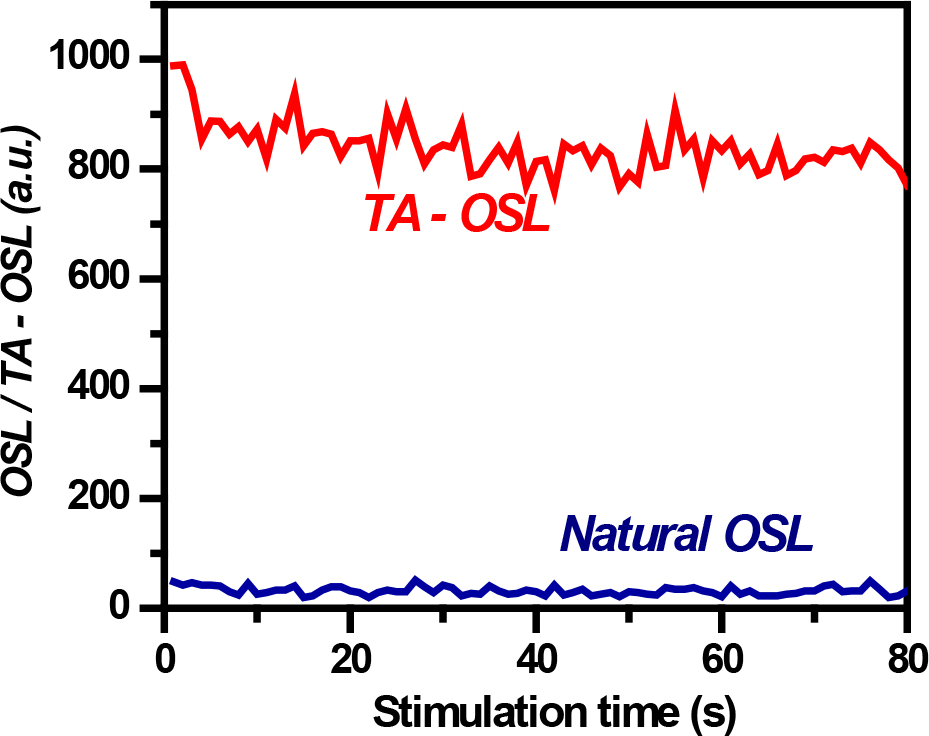
Fig. 1
Representative natural OSL and thermally assisted OSL (TA – OSL) signals corresponding to the CaCO3 sample with code SB3. These signals are not useful for dating applications.
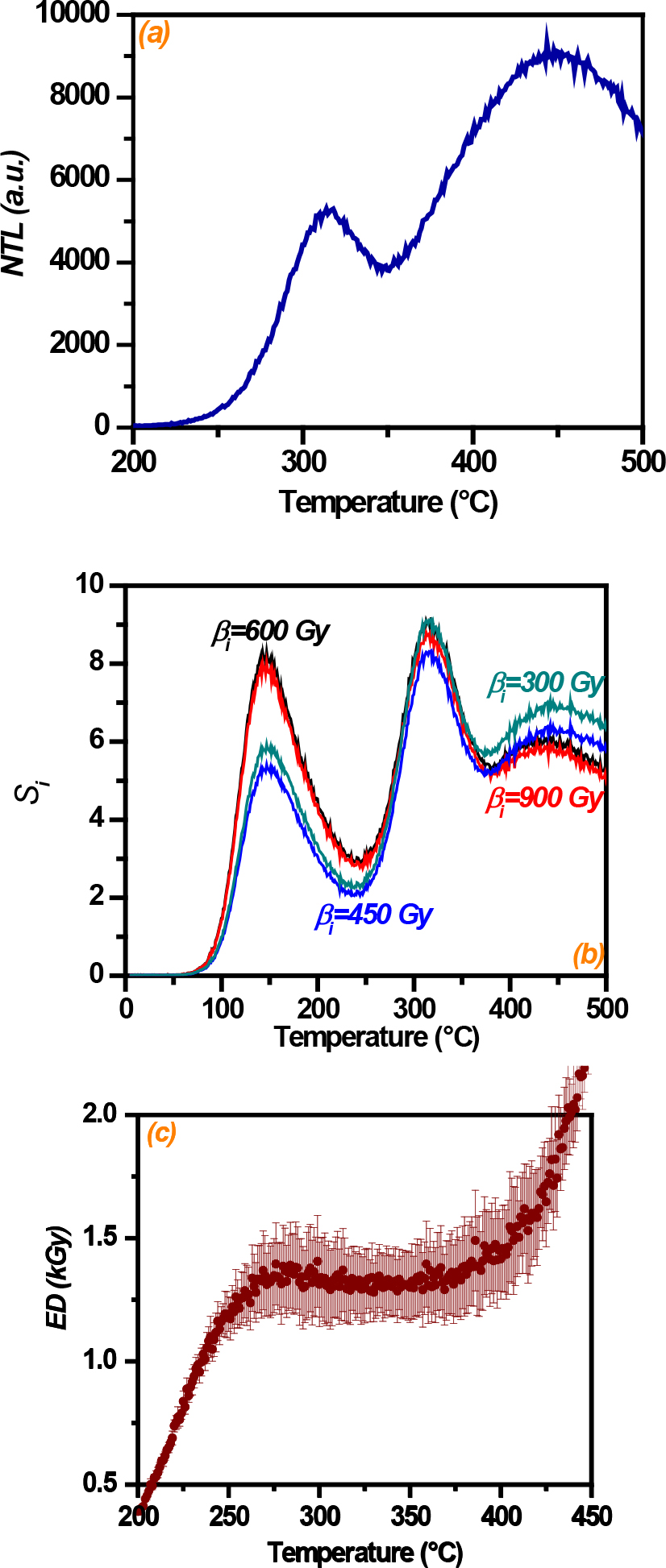
Fig. 2
Typical results of the MAAD plateau method applied for sample SB1. Plot (a) presents a NTL glow curve (as an average of three independently measured glow curves), plot (b) presents the representative Si curves for a selection of additive doses according to equation (2) while plot (c) presents an ED plateau versus glow curve temperature according to equation (1). Error bars correspond to 1σ.
Table 2
Data related to the ED estimation for all four samples.
| A/A | Sample Codes | Plateau ΔT (°C) | Plateau ED (Gy) | P4 ED (Gy) | P5 ED (Gy) | P6 ED (Gy) |
|---|---|---|---|---|---|---|
| 1 | SB1 | 270–370 | 1258 ± 155 | 1578 ± 171 | 1312 ± 137 | 1422 ± 158 |
| 2 | SB2 | 280–385 | 1458 ± 166 | 1682 ± 149 | 1489 ± 155 | 1358 ± 185 |
| 3 | SB3 | 260–380 | 1077 ± 91 | 1236 ± 133 | 1113 ± 107 | 1193 ± 128 |
| 4 | SB4 | 270–380 | 781 ± 70 | 932 ± 98 | 812 ± 86 | 850 ± 88 |
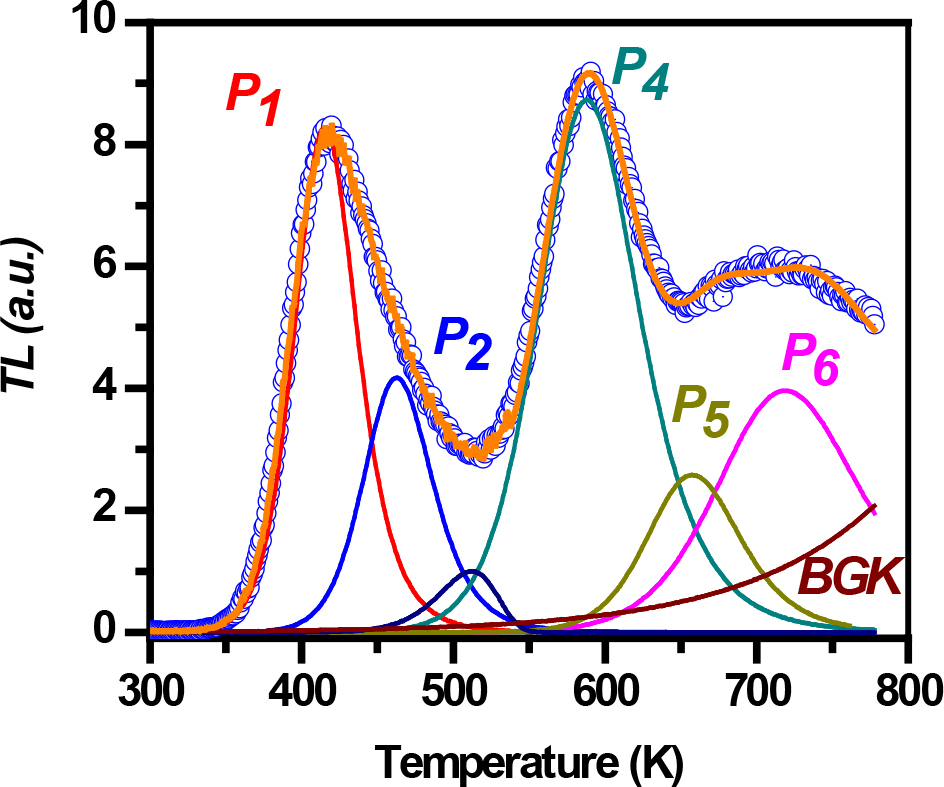
Fig. 3
Representative deconvolution analysis of a TL glow curve corresponding to the sample SB1, after a dose of 450 Gy (open data points). Six different TL glow peaks and a black body radiation curve (BGK) were used in order to fit the experimental glow curve. Each TL glow peak is presented in solid line and is denoted as Pi. Orange solid line indicates the fitting curve. Table 2 indicates the activation energies of the TL peaks.
Table 3
Deconvolution results for fitting parameters of all four samples.
| A/A | Sample Codes | P4 Tmax (°C) | P4 R | P4 E (eV) | P5 Tmax (°C) | P5 R | P5 E (eV) | P6 Tmax (°C) | P6 R | P6 E (eV) |
|---|---|---|---|---|---|---|---|---|---|---|
| 1 | SB1 | 328 ± 4 | 0.06 | 1.34 ± 0.12 | 399 ± 11 | 0.09 | 1.59 ± 0.18 | 453 ± 22 | 0.01 | 1.81 ± 0.21 |
| 2 | SB2 | 326 ± 5 | 0.04 | 1.37 ± 0.11 | 402 ± 10 | 0.05 | 1.63 ± 0.17 | 457 ± 21 | 0.01 | 1.86 ± 0.19 |
| 3 | SB3 | 328 ± 3 | 0.09 | 1.34 ± 0.13 | 404 ± 13 | 0.07 | 1.64 ± 0.16 | 463 ± 22 | 0.02 | 1.88 ± 0.24 |
| 4 | SB4 | 327 ± 5 | 0.05 | 1.41 ± 0.12 | 402 ± 13 | 0.05 | 1.61 ± 0.17 | 459 ± 24 | 0.01 | 1.79 ± 0.20 |
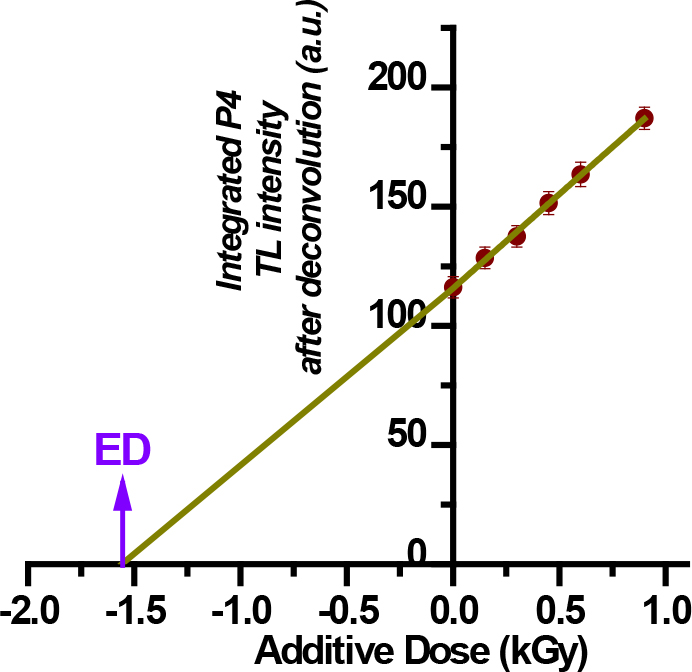
Fig. 4
Representative additive dose growth curve in terms of the integrated intensity of TL glow peak P4 after deconvolution, for the sample with code SB1. The arrow indicates the ED value.