
Table 1
Details of the studied samples.
| Site | Sample code | Dating method | Age (ka) | Expected dose (Gy) |
|---|---|---|---|---|
| Grotte Mandrin, France | X6717 | BSL | 41 ± 3 | 67.3 ± 3.0 |
| Sima de las Palomas, Spain | X6889 | BSL | 102.1 ± 12.0 | 204.5 ± 16.3 |
| Brooksby Quarry, UK | X6444 | geology | >200 | >300 |
| Cueva Negra, Spain | X6888 | palaeomagnetism, biostratigraphy | 780–990 | 600–1190 |
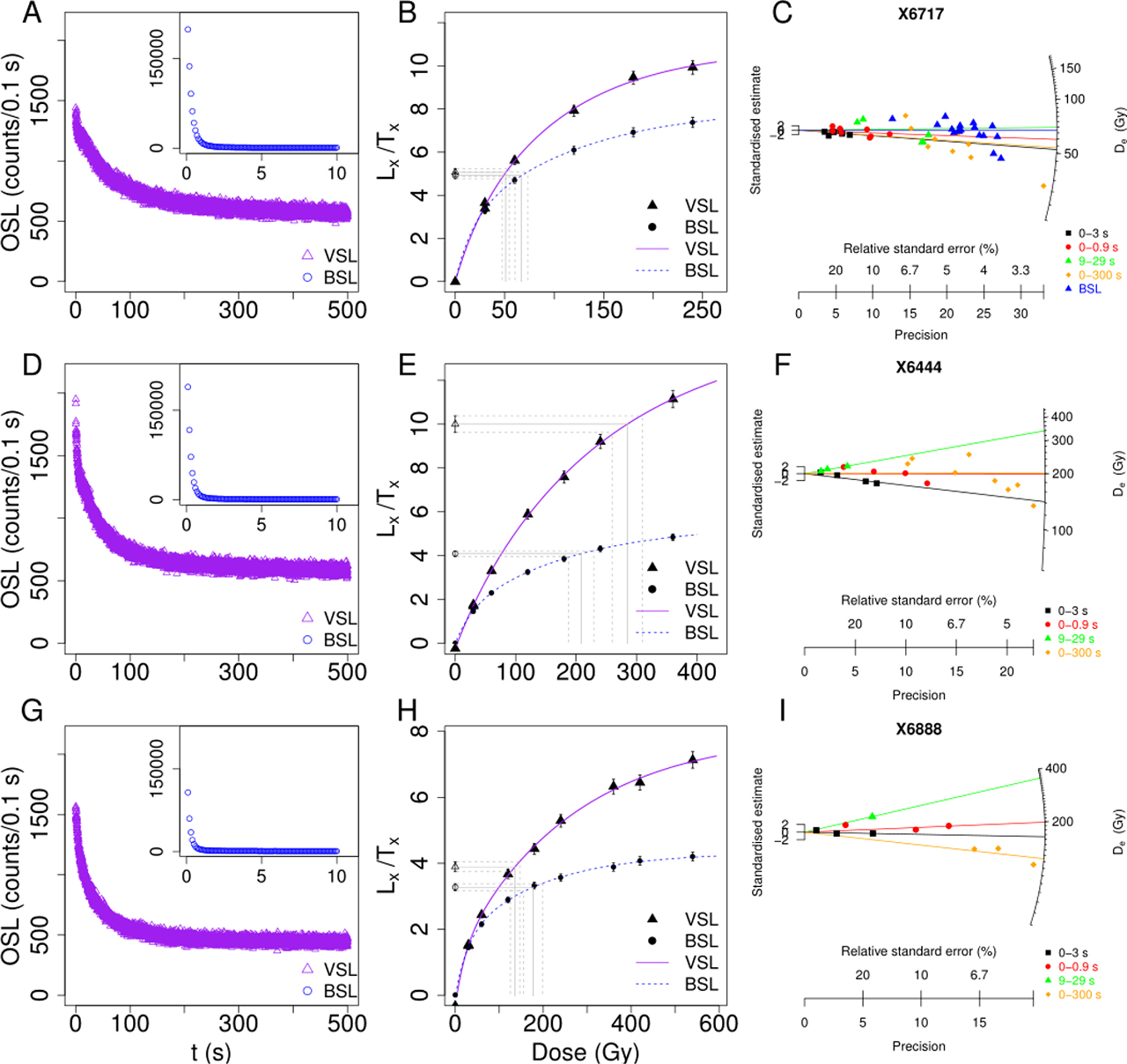
Fig. 1
SAR protocol results for samples X6717 (A,B,C), X6444 (D,E,F) and X6888 (G,H,I). (A,D,G) display the natural signal decay curves, with purple triangles representing the VSL signal and insets showing the preceding BSL (blue circles) for comparison. (B,E,H) show the dose response using the long signal interval (0–300 s; 400–500 s BG) of VSL (triangles) and fast interval (0–0.9 s; 90–100 s BG) of BSL (circles). Error bars show standard errors. (C,F,I) show the De distributions of four VSL signal intervals: 0–3 s (BG: 3–10.5 s) (black squares), 0–0.9 s (BG: 450–500 s) (red circles), 9–29 s (BG: 29–80 s) (green triangles) and 0–300 s (BG: 400–500s) (orange diamonds). The BSL De values of X6717 (blue triangles) are shown for comparison. Lines show the CAM De of each interval. Radial plots modified from Dietze and Kreutzer (2017) (R Core Team, 2016).
Table 2
Protocols used in this study. Alterations are in bold. Note that for the MAAD protocol, only the measurement parameters were based on Ankjærgaard et al. (2016), not the method to estimate the De.
| Step | SAR (adapted from Hernandez and Mercier (2015)) | MAAD (adapted from Ankjærgaard et al. (2016)) | Function |
|---|---|---|---|
| 0 | - | Additive dose | |
| 1 | Preheat (260°C, 10 s) | Preheat (300°C, 100 s or 10 s) | Empty thermally unstable components |
| 2 | Blue bleach (125°C, 40 s) | Blue bleach (125°C, 100 s) | Empty shallow trapped charge |
| 3 | VSL (125°C, 500 s) | VSL (30°C, 500 s) | Measure deep trapped charge (Ln, Lx or La) |
| 4 | Violet bleach (200°C, 500 s) | - | Reduce recuperation |
| 5 | Test dose (18 Gy) | Test dose (50 Gy) | Sensitivity correction |
| 6 | Preheat (260°C, 10 s) | Preheat (300°C, 100 s or 10 s) | Empty thermally unstable components |
| 7 | Blue bleach (125°C, 40 s) | Blue bleach (125°C, 100 s) | Empty shallow trapped charge |
| 8 | VSL (125°C, 500 s) | VSL (30°C, 500 s) | Measure deep trapped charge (Tn, Tx or Ta) |
| 9 | Violet bleach (200°C, 500 s) | - | Reduce recuperation |
| 10 | Regenerative dose | - |
Table 3
VSL De estimates using the SAR protocol. The VSL De values that match the expected dose at 1 sigma are in bold type.
| Sample | Signal (s) | Background (s) | #1 | Overdispersion (%) | De ± se (Gy)2 |
|---|---|---|---|---|---|
| X6717 | 0–0.9 | 450–500 | 8/12 | 13.3 ± 6.5 | 59.7 ± 4.1 |
| 0–300 | 400–500 | 10/12 | 32.1 ± 7.4 | 53.6 ± 5.5 | |
| 0–3 | 3–10.5 | 7/12 | - | 52.4 ± 3.9 | |
| 9–29 | 29–80 | 5/12 | 36.7 ± 12.3 | 69.8 ± 11.8 | |
| X6444 | 0–0.9 | 450–500 | 4/13 | 14.7 ± 8.9 | 199.4 ± 19.8 |
| 0–300 | 400–500 | 8/13 | 27.2 ± 7.2 | 202.2 ± 20.1 | |
| 0–3 | 3–10.5 | 4/13 | - | 141.5 ± 14.1 | |
| 9–29 | 29–80 | 3/13 | - | 339.9 ± 67.4 | |
| X6888 | 0–0.9 | 450–500 | 3/3 | - | 199.0 ± 12.4 |
| 0–300 | 400–500 | 3/3 | 5.5 ± 4.8 | 124.7 ± 5.8 | |
| 0–3 | 3–10.5 | 3/3 | - | 165.2 ± 25.2 | |
| 9–29 | 29–80 | 1/3 | - | 354.5 ± 61.0 |
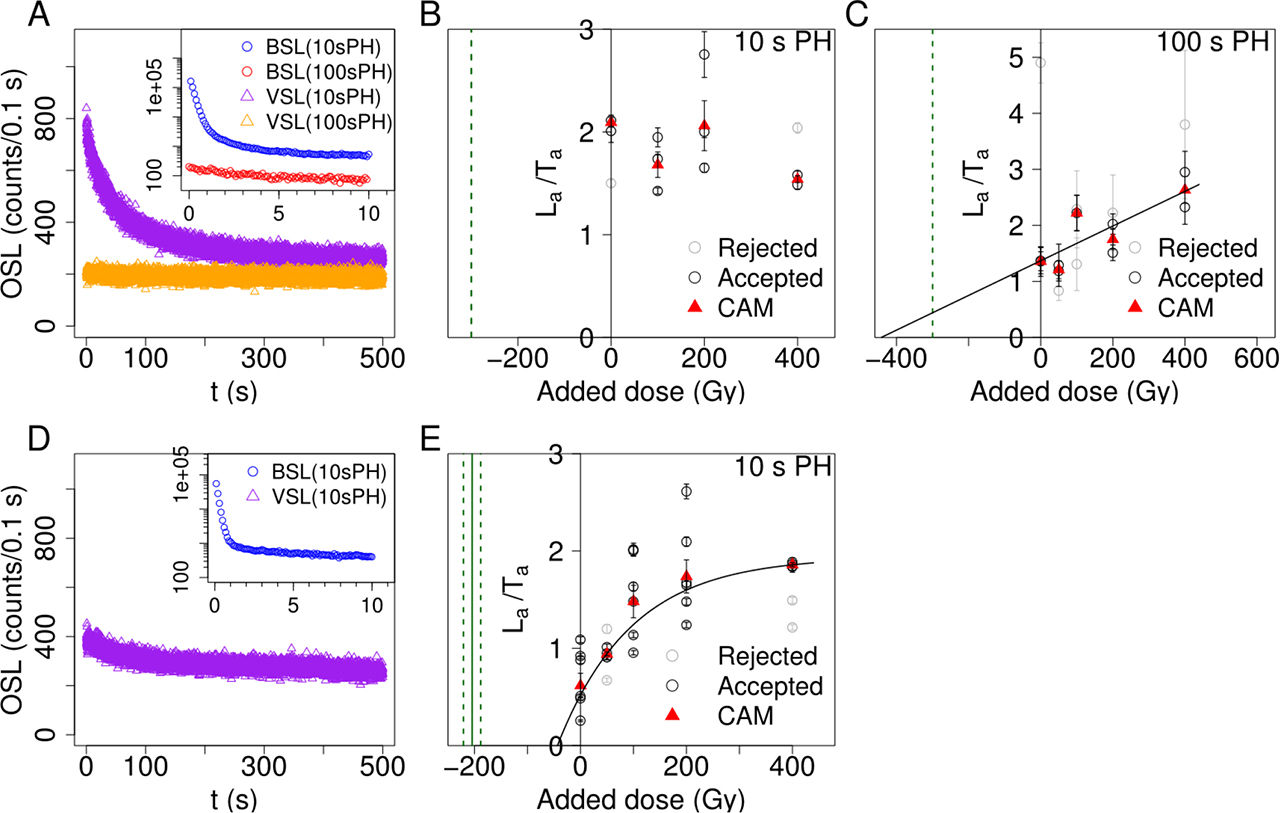
Fig. 2
MAAD protocol results for samples X6444 (A–C) and X6889 (D–E). (A,D) show the natural dose decay curves and (B,C,E) show the dose response using the signal interval 0–300 s (BG: 400–500s). (B,E) resulted from the shortened preheat (10 s) measurement (purple triangles in (A,D)), while (C) resulted from the 100 s preheat measurement (orange triangle in (A)). The CAM of nMAD accepted aliquots were fitted with a linear function in (C) and an exponential function in (E). The green vertical lines correspond to the expected De. Error bars show the standard errors.