
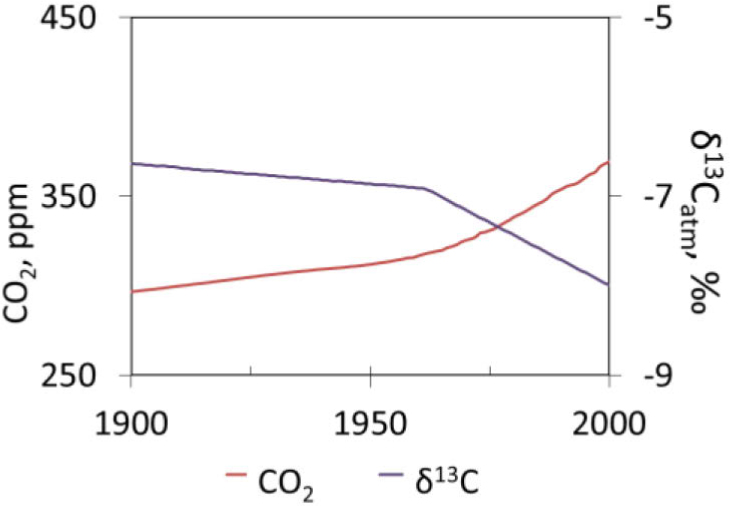
Fig. 1
Decrease of δ13C in the air due to increase of CO2 (according to Boden et al., 2016; McCarroll et al., 2009).
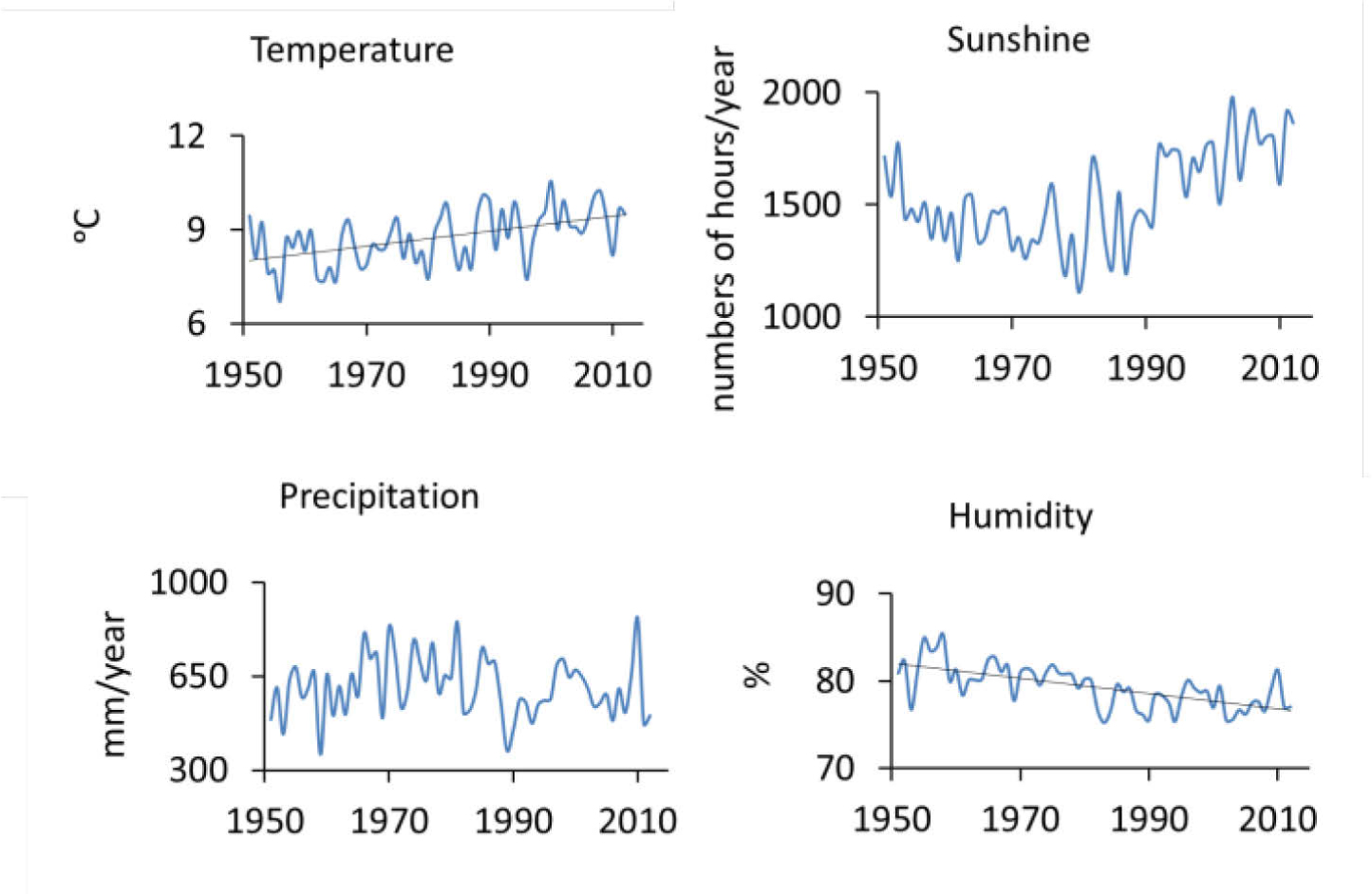
Fig. 2
Climate conditions (mean annual temperature, annual sunshine, annual total rainfall, and air relative humidity) in Opole (1951–2012).
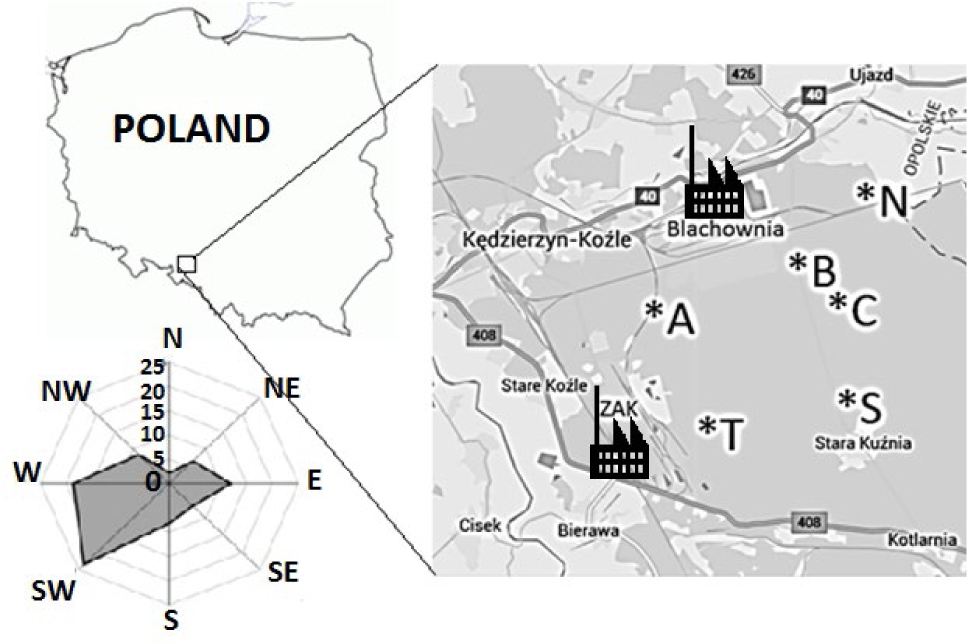
Fig. 3
Sampling sites (A, B, C, N, S, T) in the vicinity of the nitrogen factory: Grupa Azoty ZAK (ZAK) and chemical factory Blachownia Holding S.A. – in the southern part of Poland; and dominant wind direction.
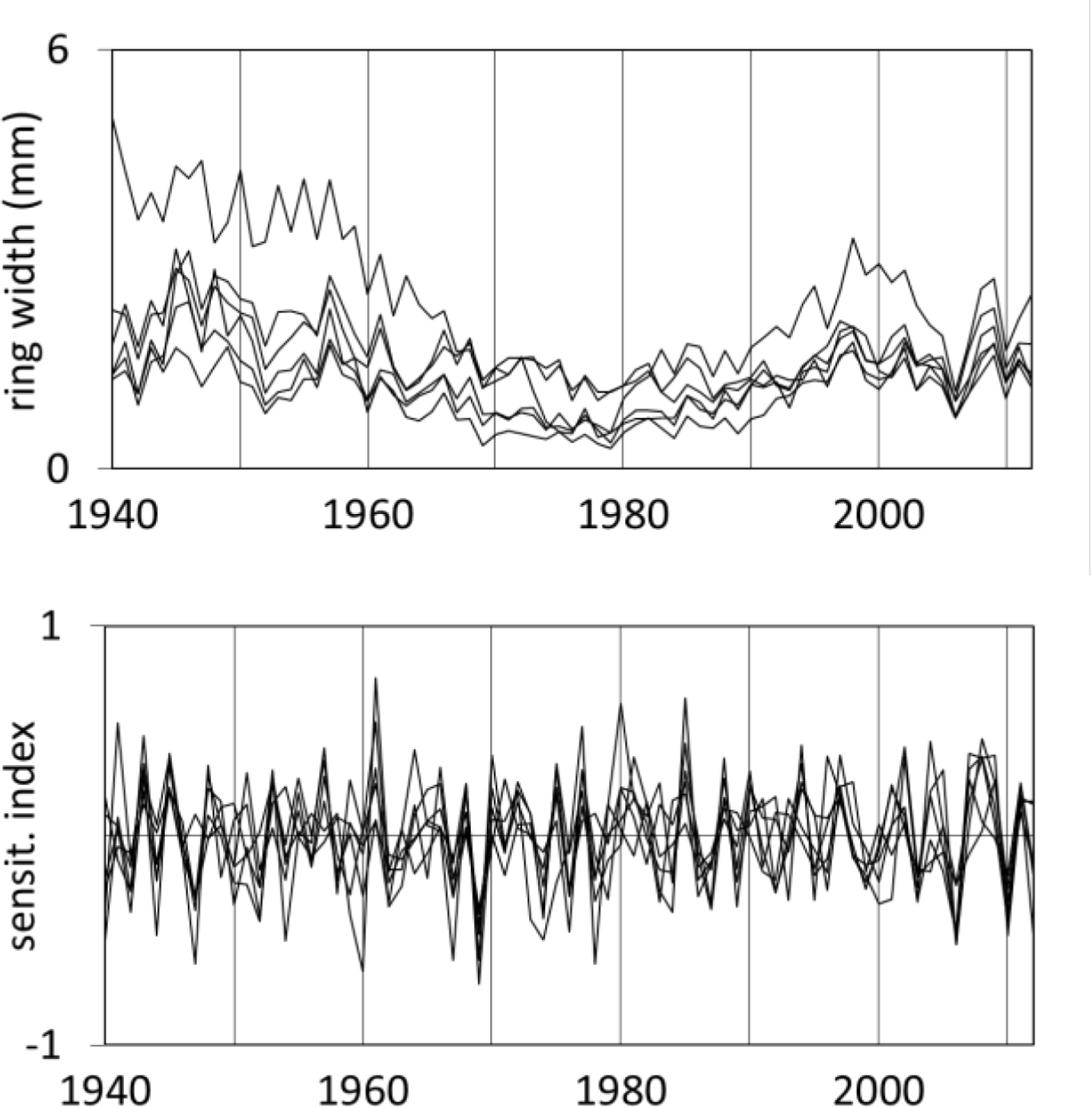
Fig. 4
The course of 6 sites tree-ring width chronologies (top) and sites sensitivity chronologies (bottom).
Table 1
Statistical characteristics of the site chronologies for the 1951–2012 period. TRW – mean tree-ring width; TRI – mean tree-ring index; MS – mean sensitivity; rbt – the mean correlation of standardized series of trees – the signal strength of the chronology, EPS – the expressed population signal is a statistic for examining the common variability in a chronology.
| Site | Lat. N, | Lon. E | Elevation (m) | TRW (cm) | TRI | MS | rbt | EPS |
|---|---|---|---|---|---|---|---|---|
| A | 50°19’ | ,18°15’ | 192 | 2.20 | 1.0 | 0.23 | 0.42 | 0.93 |
| B | 50°20’ | ,18°18’ | 209 | 1.81 | 1.0 | 0.26 | 0.52 | 0.95 |
| C | 50°20’ | ,18°19’ | 218 | 1.31 | 1.0 | 0.28 | 0.49 | 0.95 |
| N | 50°22’ | ,18°23’ | 218 | 1.80 | 1.0 | 0.21 | 0.39 | 0.93 |
| S | 50°18’ | ,18°20’ | 215 | 1.48 | 1.0 | 0.22 | 0.46 | 0.93 |
| T | 50°18’ | ,18°17’ | 207 | 1.77 | 1.0 | 0.26 | 0.49 | 0.95 |
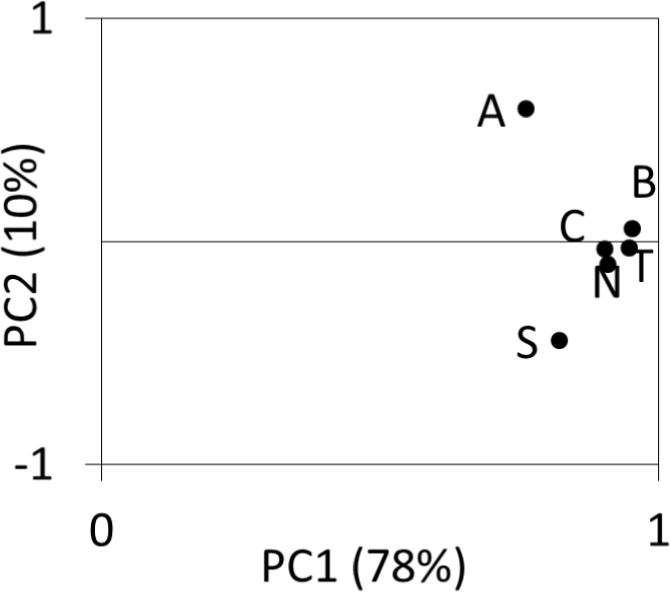
Fig. 5
Comparison of the loadings of the first and second principal components for 6 sites (A, B, C, N, S, T, see Table 1) sensitivity chronologies.
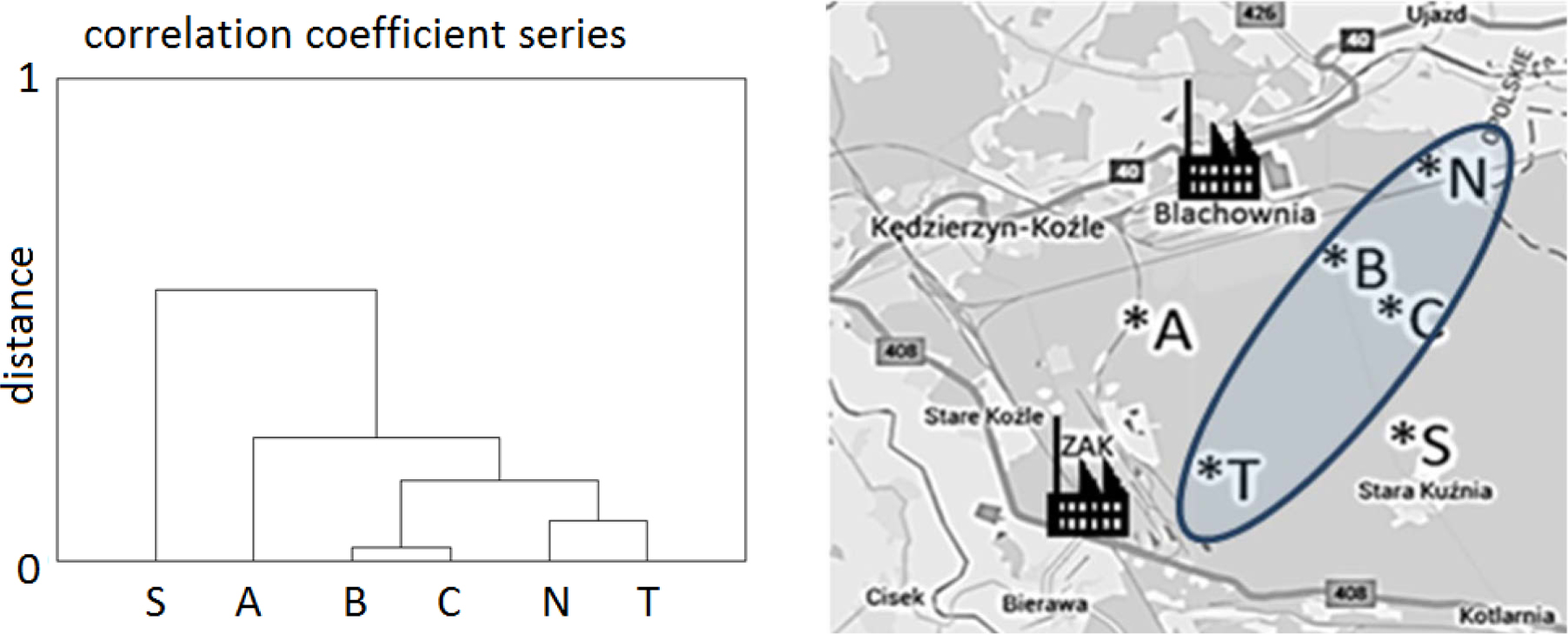
Fig. 6
The dendrogram of clusters of pine population (A, B, C, N, S, T, see Table 1) based on the similarity of their response to climatic conditions. Localization of the pine population with similar response.
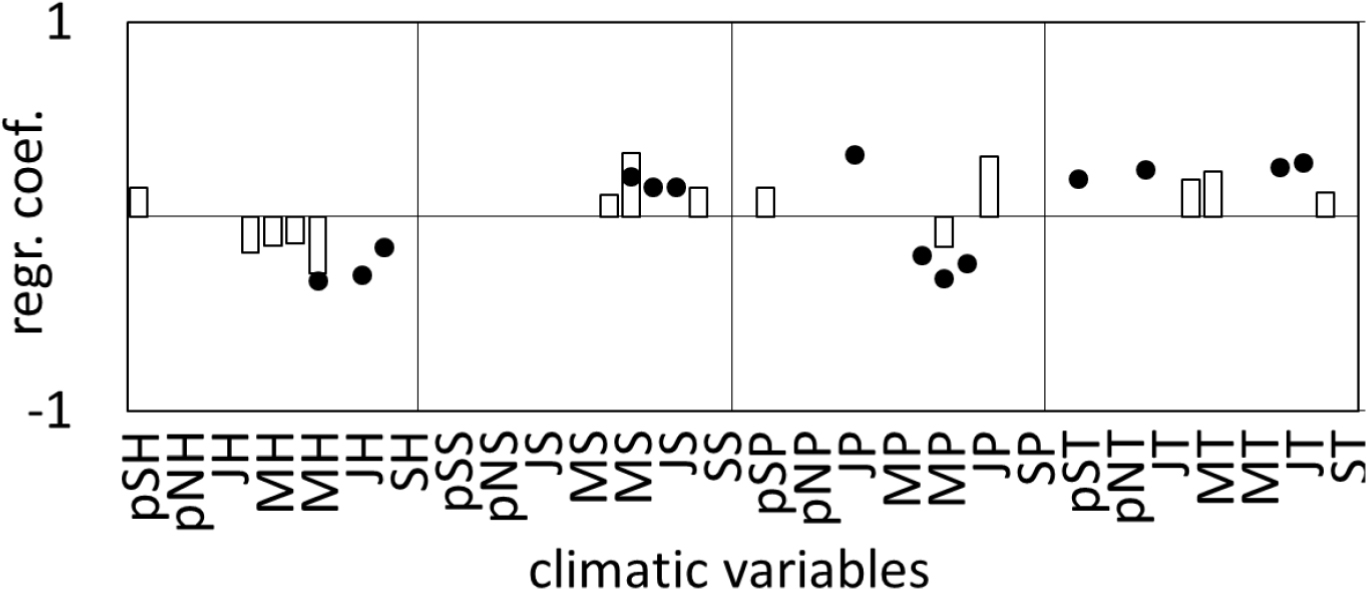
Fig. 7
Significant (at p<0.05) regression (response function) coefficients calculated between PC1 (white bars), and PC2 (black dots) and monthly temperature (T), precipitation (P), sunshine duration (S) and relative humidity (H) from September of the previous year (pS) to September of the given year (S).
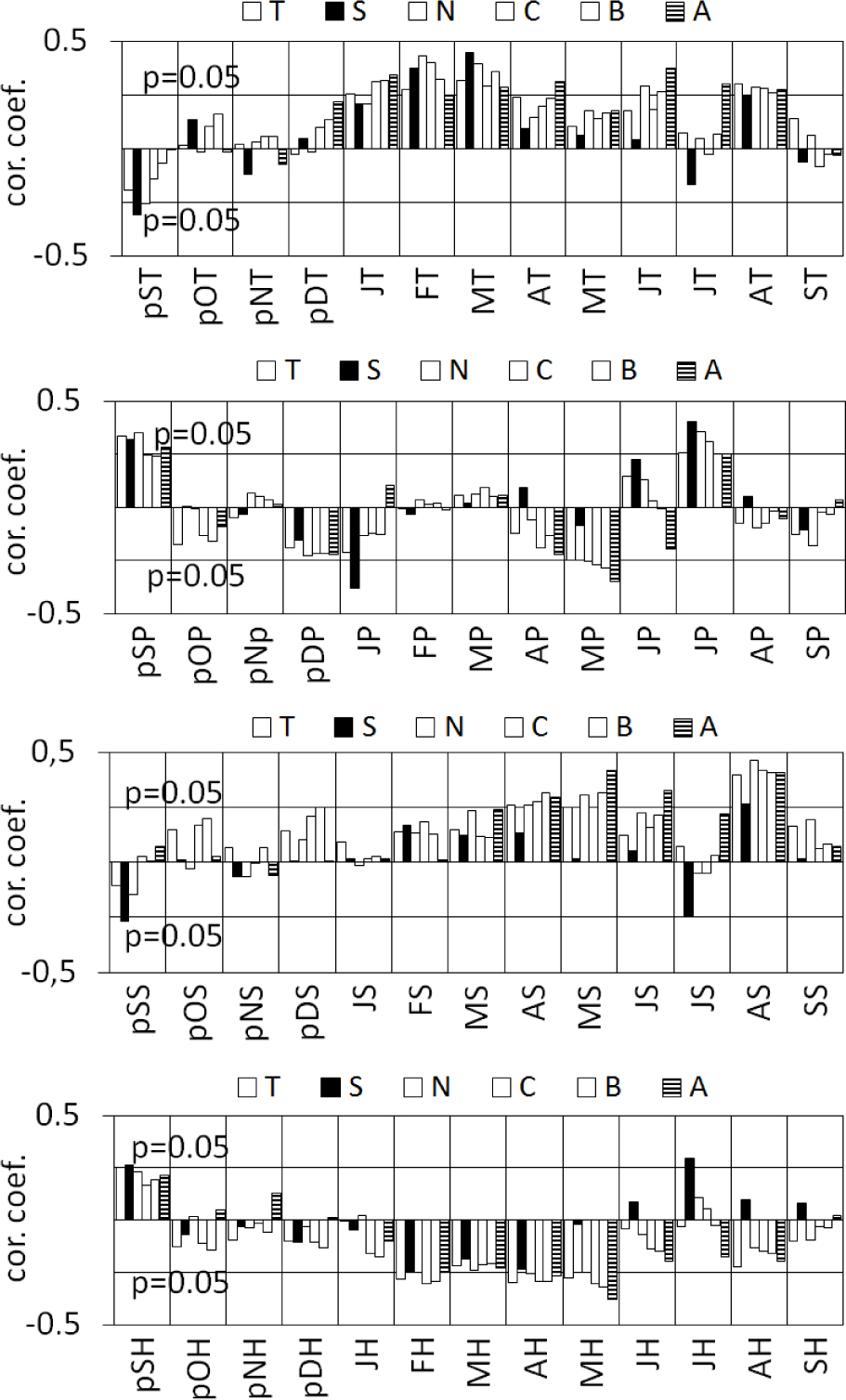
Fig. 8
Correlation coefficients between site (A, B, C, N, S, T, see Table 1) sensitivity chronologies and monthly climatic variables: temperature (T), precipitation (P), sunshine duration (S) and relative humidity (H) from September of the previous year (pS) to September of the given year (S).
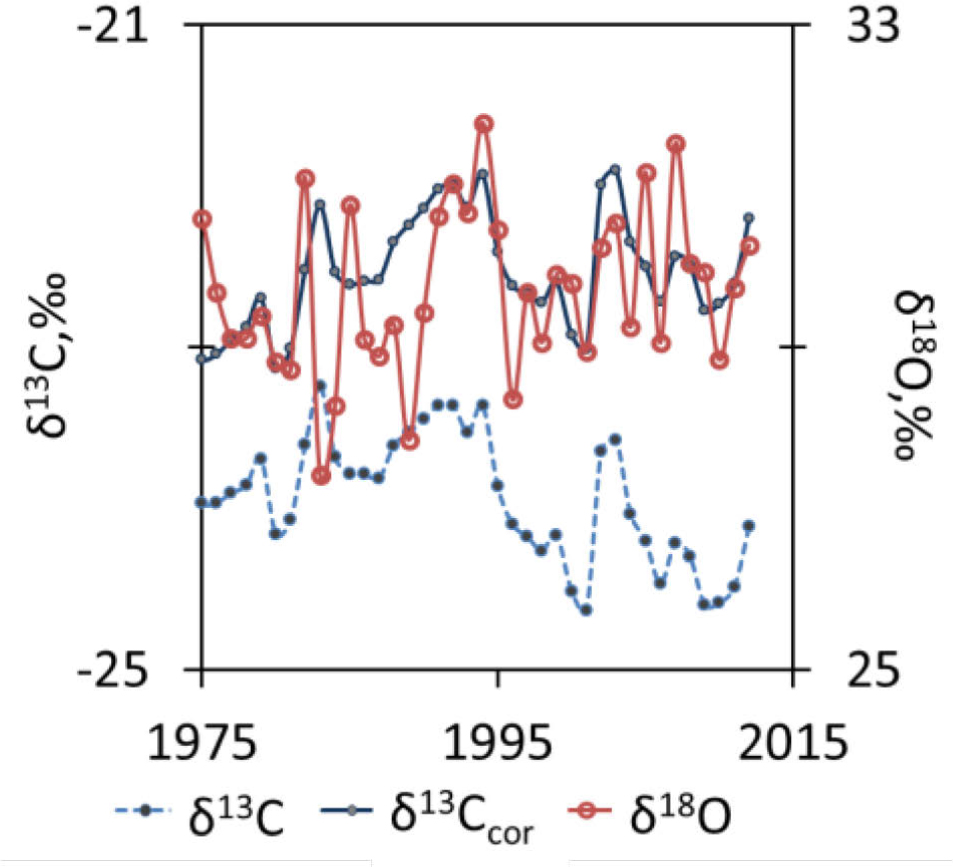
Fig. 9
Stable carbon and oxygen isotopes chronologies. The raw δ13C values (dashed line) have been corrected (δ13Ccor values solid line) for changes in the isotopic ratio of atmospheric CO2.
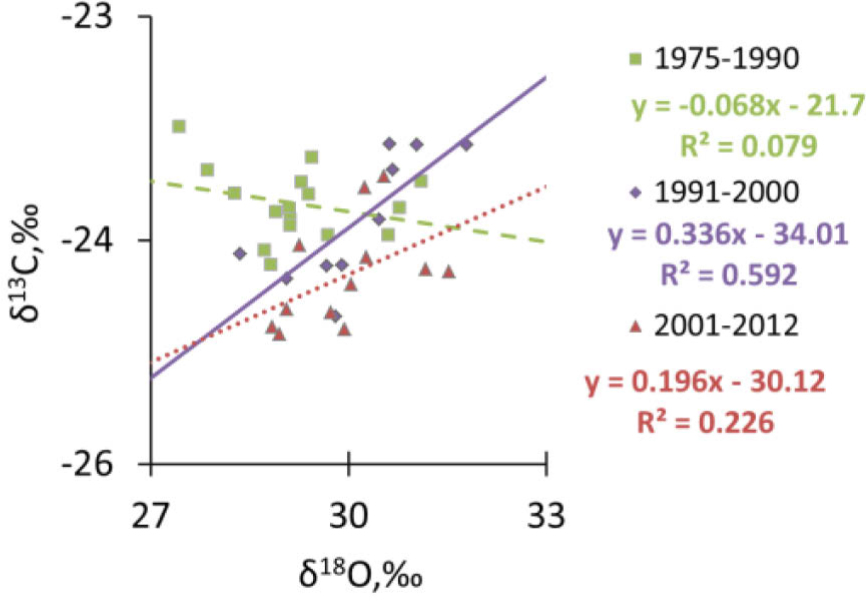
Fig. 10
Correlation between δ13C and δ18O chronologies of Scots pine growing in the industrial area.
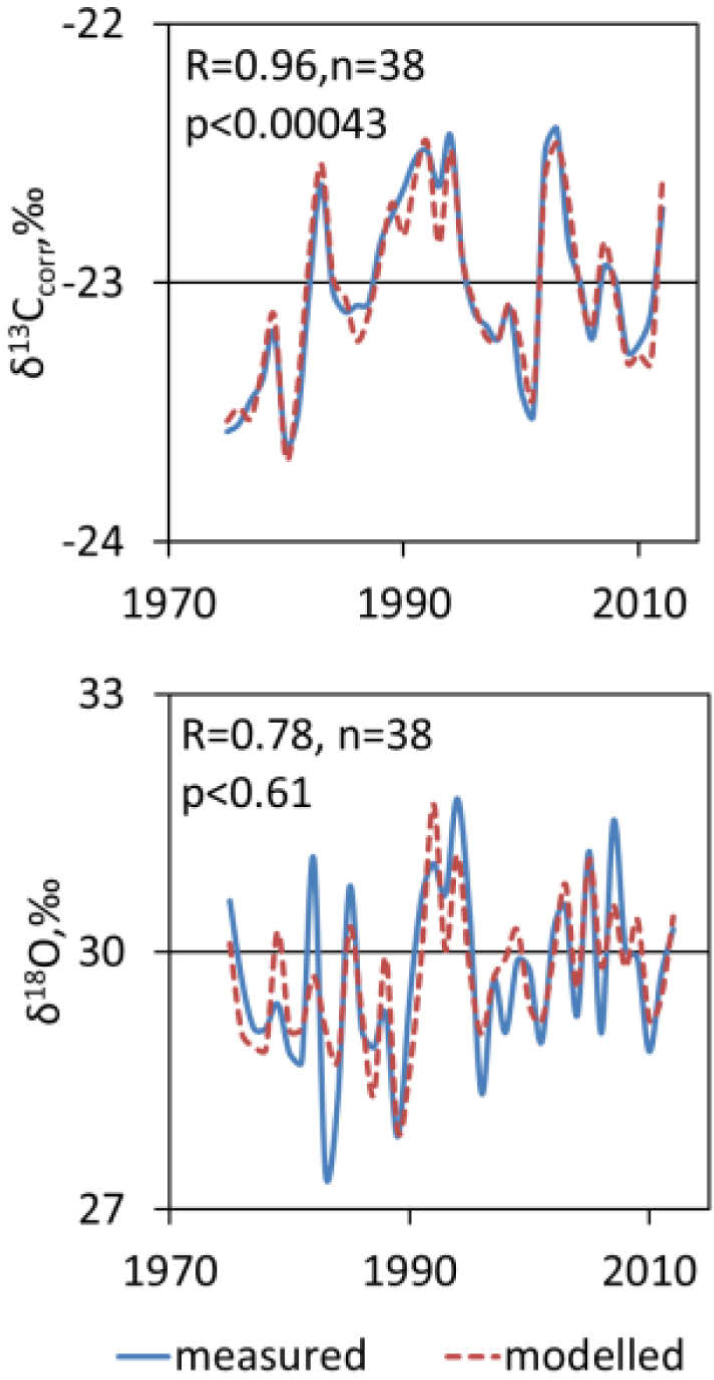
Fig. 11
Measured (solid lines) and modelled (dashed line) values ot carbon and oxygen stable isotopic composition of α-cellulose samples extracted from annual tree rings of pine (1975–2012).
Table 2
The regression coefficient (Eq. 3.1) for the following variables: T (mean of the monthly maximum temperatures), P (monthly total precipitation), S (monthly hours of sunshine duration), H (mean of the monthly relative humidity). bi – multiple regression parameters. The test of significance gives a p-value (n=38).
| Variables | Units | δ13Ccor | δ18O | ||
|---|---|---|---|---|---|
| bi | pi | bi | pi | ||
| ba | ‰ | −15.85 | 0.004 | −34.53 | 0.267 |
| TApr | ‰ / °C | −0.028 | 0.133 | −0.103 | 0.391 |
| TMay | ‰ / °C | −0.043 | 0.156 | 0.421 | 0.043 |
| TJun | ‰ / °C | 0.037 | 0.106 | 0.026 | 0.857 |
| TJul | ‰ / °C | −0.007 | 0.817 | 0.306 | 0.129 |
| TAug | ‰ / °C | 0.047 | 0.110 | 0.219 | 0.247 |
| TSep | ‰ / °C | −0.019 | 0.352 | −0.001 | 0.993 |
| PApr | ‰ / mm | 0.001 | 0.556 | 0.004 | 0.755 |
| PMay | ‰ / mm | −0.003 | 0.079 | 0.004 | 0.693 |
| P Jun | ‰ / mm | −0.001 | 0.596 | −0.007 | 0.588 |
| PJul | ‰ / mm | −0.001 | 0.592 | −0.009 | 0.270 |
| PAug | ‰ / mm | 0.002 | 0.148 | −0.002 | 0.797 |
| PSep | ‰ / mm | −0.001 | 0.652 | 0.002 | 0.872 |
| SApr | ‰ / hours of sunshine | −0.003 | 0.179 | 0.020 | 0.124 |
| SMay | ‰ / hours of sunshine | 0.001 | 0.521 | −0.021 | 0.110 |
| SJun | ‰ / hours of sunshine | 0.007 | 0.003 | −0.008 | 0.541 |
| SJul | ‰ / hours of sunshine | −0.006 | 0.045 | 0.029 | 0.107 |
| SAug | ‰ / hours of sunshine | 0.003 | 0.125 | −0.007 | 0.497 |
| SSep | ‰ / hours of sunshine | −0.006 | 0.013 | 0.019 | 0.205 |
| HApr | ‰ / % | −0.044 | 0.104 | 0.290 | 0.106 |
| HMay | ‰ / % | 0.040 | 0.090 | −0.237 | 0.128 |
| HJun | ‰ / % | 0.088 | 0.009 | −0.150 | 0.446 |
| HJul | ‰ / % | −0.064 | 0.104 | 0.474 | 0.071 |
| HAug | ‰ / % | −0.009 | 0.672 | −0.038 | 0.782 |
| HSep | ‰ / % | −0.090 | 0.001 | 0.120 | 0.374 |
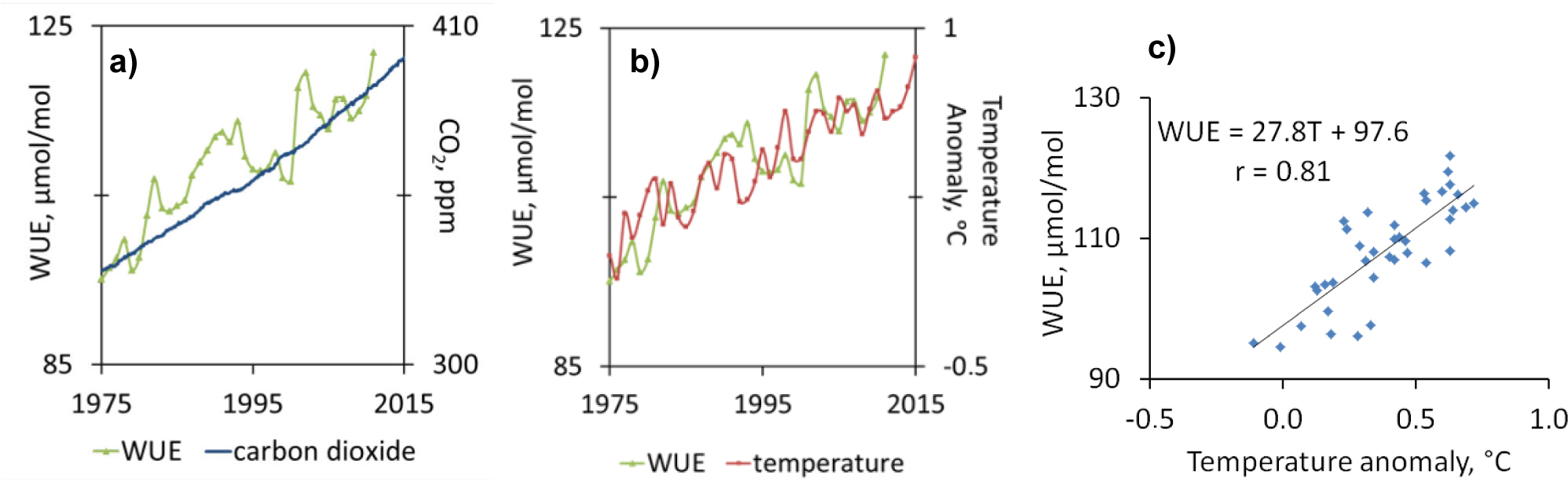
Fig. 12
(a) Changes in water use efficiency (WUE) due to global distribution and variation of the concentration of mid-tropospheric carbon dioxide in parts per million (ppm) and (b) global surface temperature relative to 1951–1980 average temperature (c) correlation between water use efficiency and the variability of the global surface temperature.