
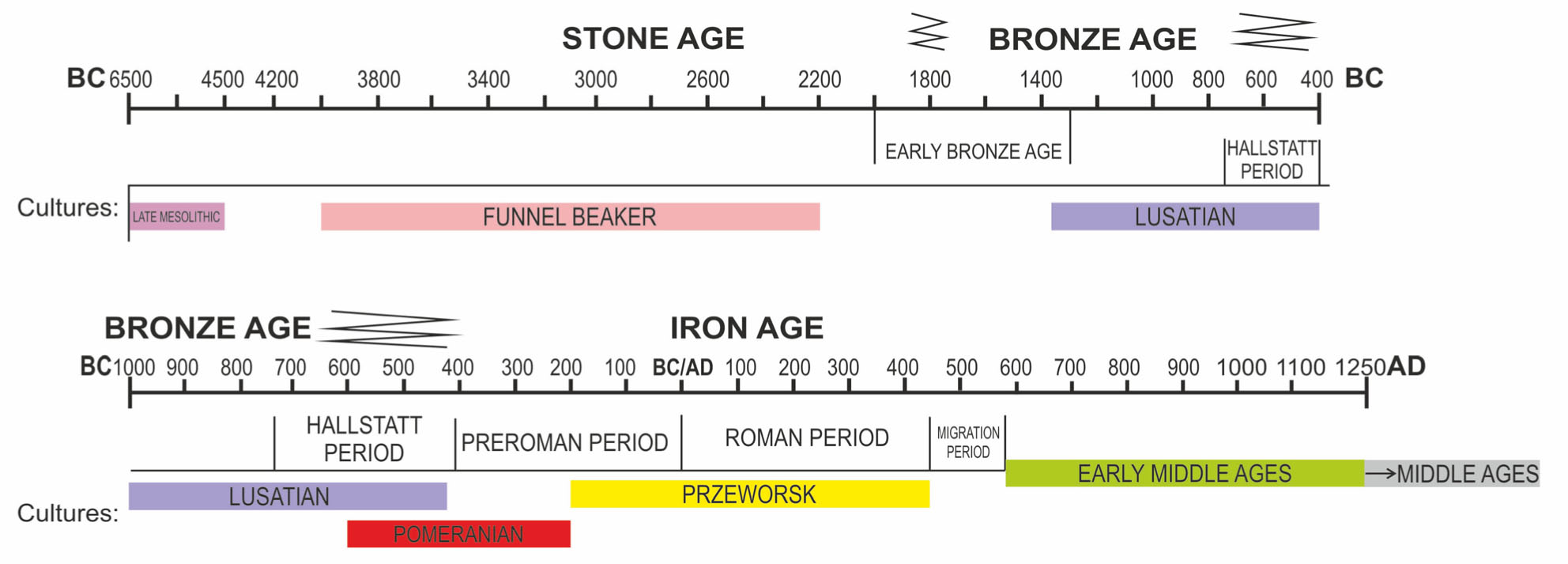
Figure 1
Chart demonstrating the chronological scope of archaeological cultures identified in Sowinki.
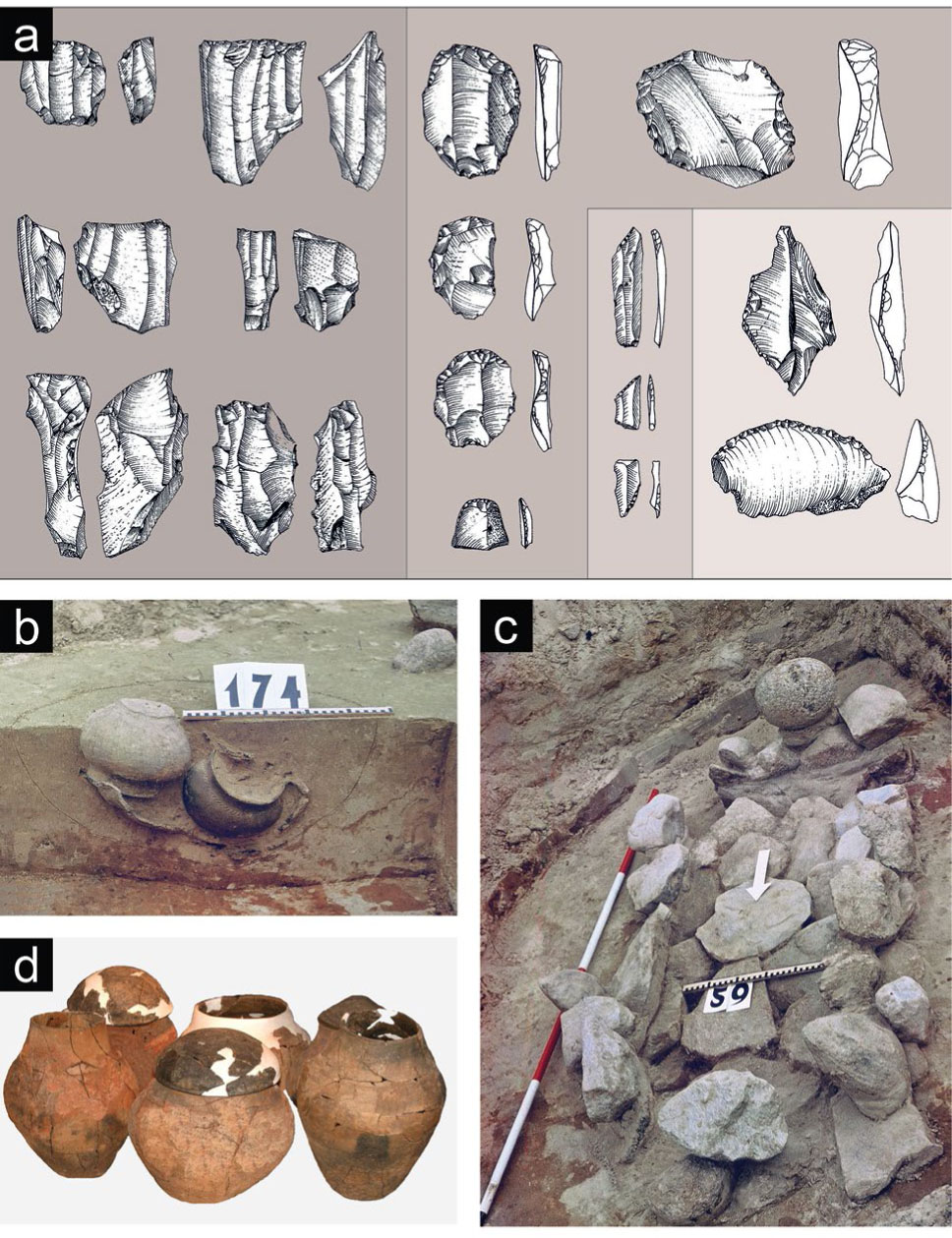
Figure 2
Artefacts from the oldest cultural horizons in Sowinki; a) Mesolithic flint artefacts; from the left: cores, scrapers, truncated blades and retouched flakes (on the right); b) profile of a cloche type cremation grave (no. 174) of the Pomeranian culture; c) grave no. 59 of the Pomeranian culture; d) reconstructed vessels-cinerary urns from a cist grave no. 59.
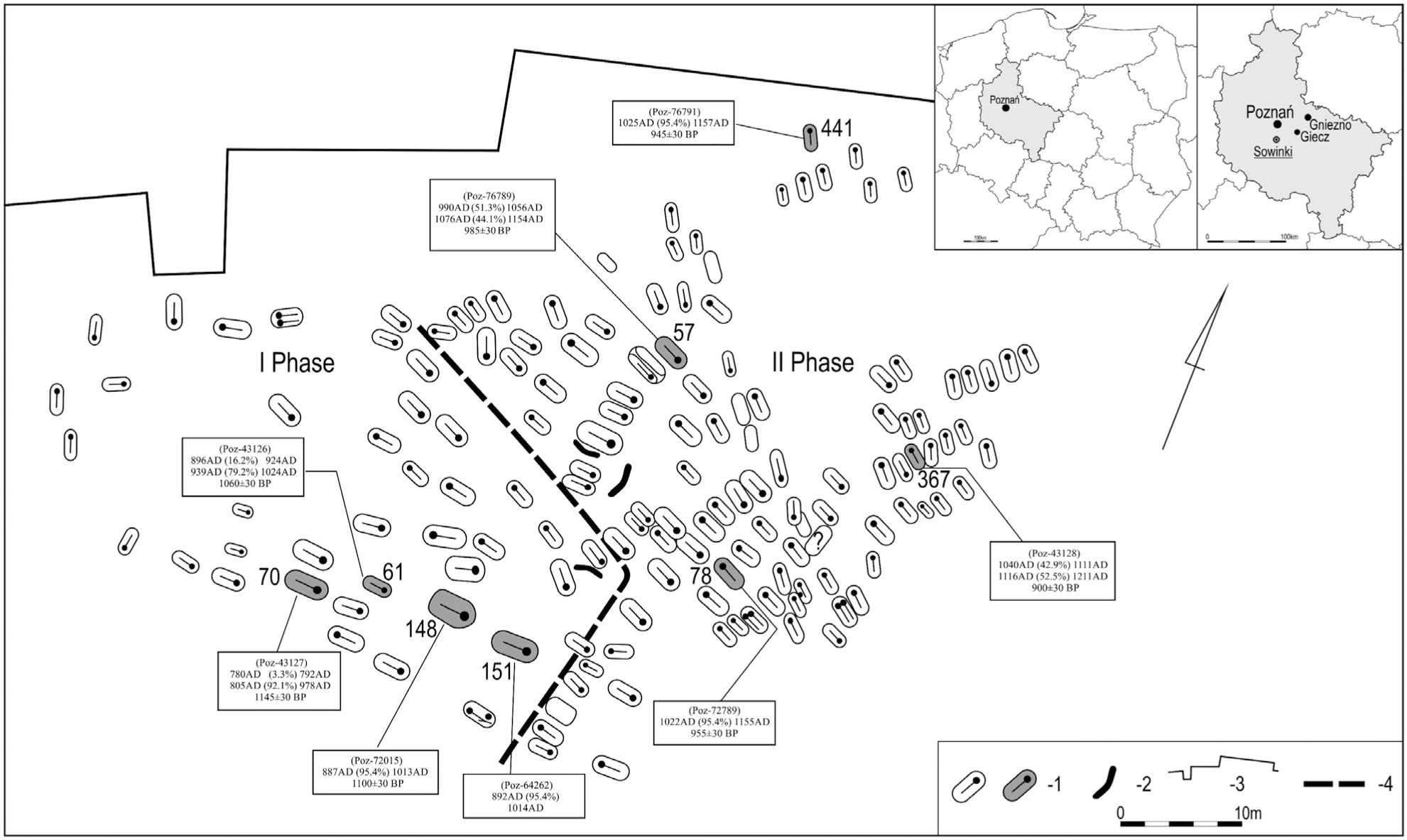
Figure 3
Plan view of skeletal cemetery from the Early Medieval period, with division into phases and radiocarbon dates for 8 burials; 1 — the graves containing radiocarbon dated samples; 2 — ditches surrounding graves; 3 — northern boundary of the excavation; 4 — probable boundary of chronological phases of the cemetery.
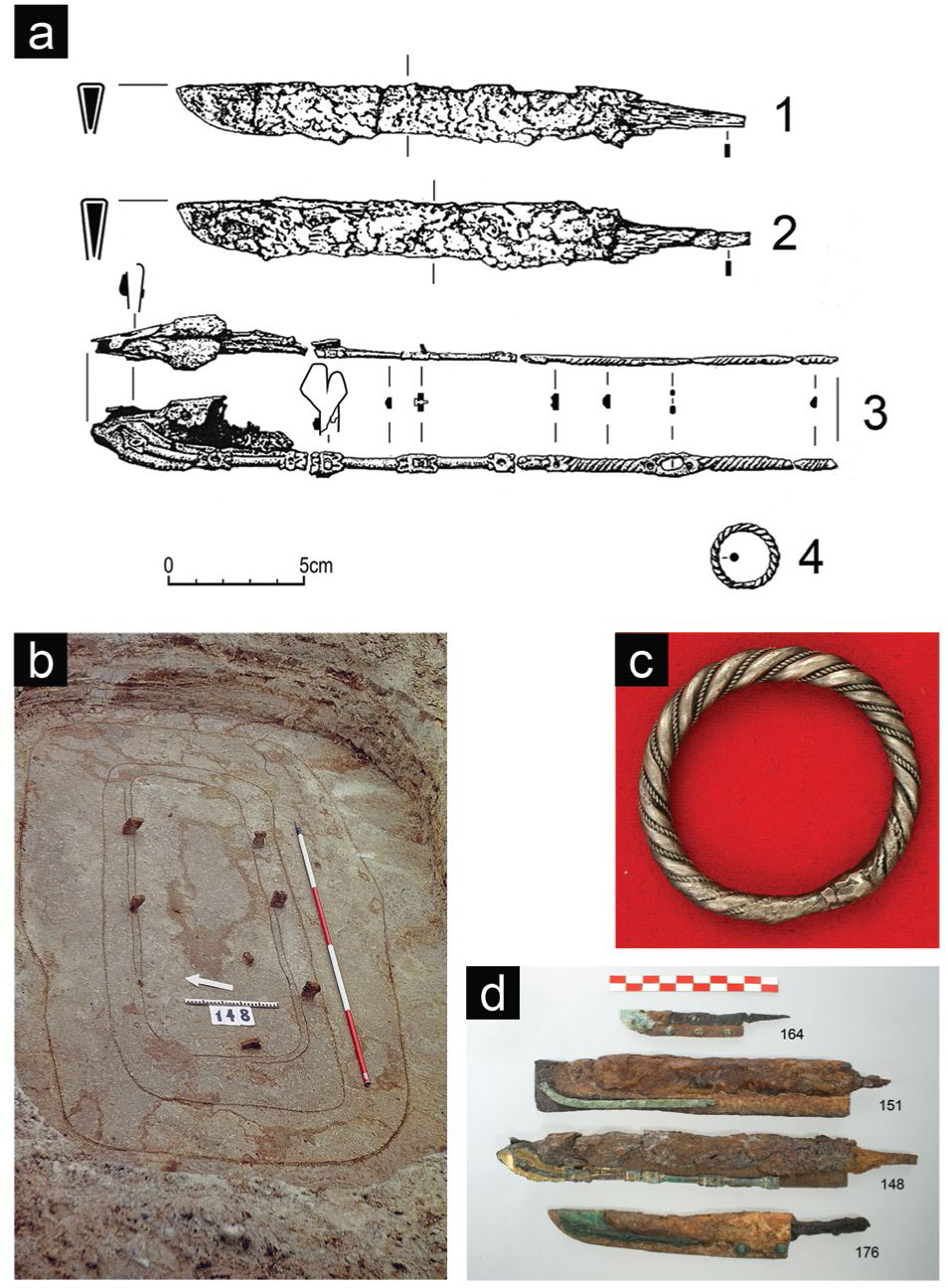
Figure 4
Early Medieval period; a) furnishings of chamber grave no.148: 1–2: knives in lather sheaths; 3: fittings of knives’ sheath; 4: ring; b) plan view of a chamber grave no.148, with the remains of iron; c) silver ring from a chamber grave no.148; d) iron knives in leather sheaths, with bronze decorative fittings from different graves, from the top to the bottom: grave no. 164, grave no. 151, grave no. 148 and grave no. 176.
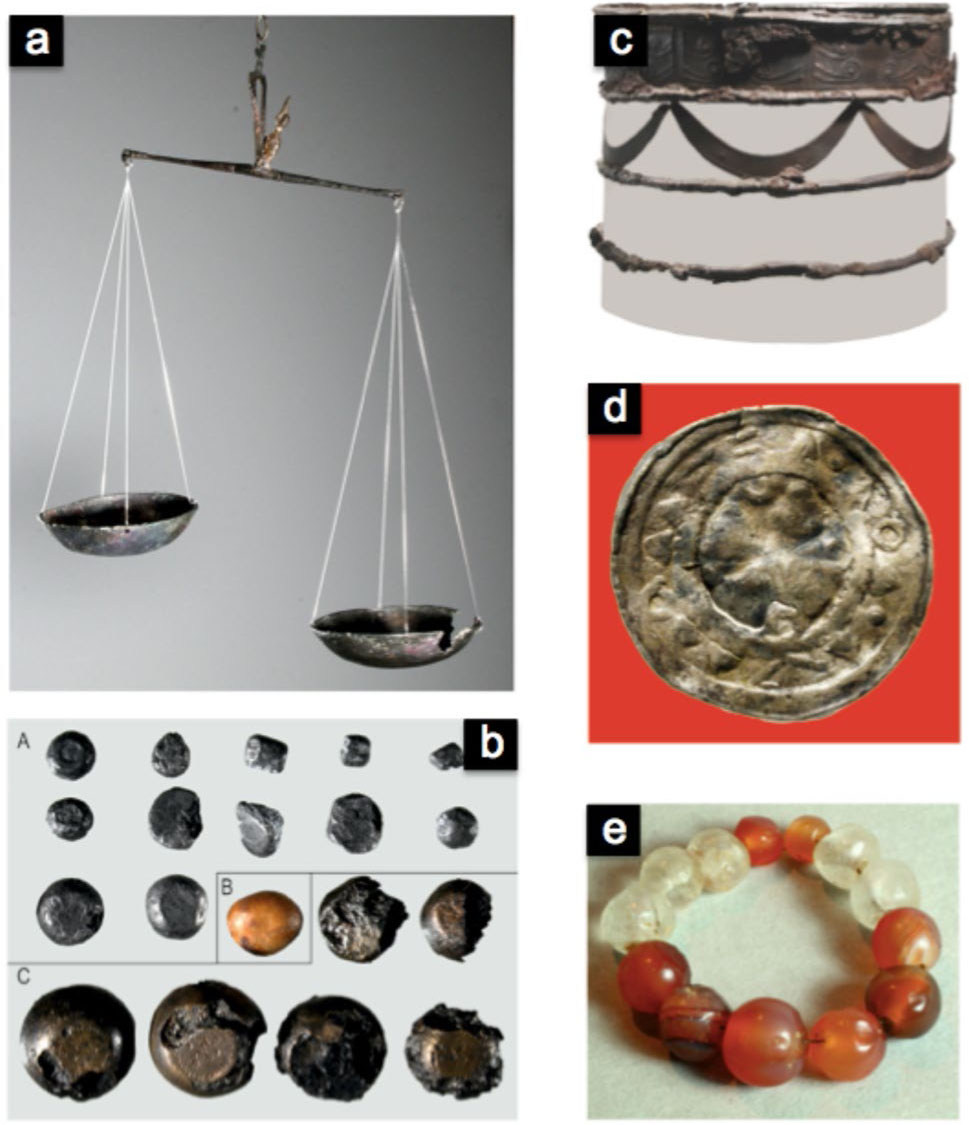
Figure 5
Early Medieval findings in Sowinki; a) bronze balance scales from a merchant’s grave no. 70; b) a set of weights from a merchant’s grave no. 70, A — lead weights, B — probable stone weight uses for tarring, C — iron weights coated with bronze; c) reconstructed stave bucket from a chamber grave no. 151; d) silver coin (minted in Saxony in the years 1020–1040) from grave no. 164; e) beads made of semiprecious Stones (carnelian or rock crystal) from the grave no. 30.
Table 1
Samples from Sowinki, location and features characteristics.
| Sample name | Material | Feature no. | Feature type | Archaeological artefacts from feature |
|---|---|---|---|---|
| SOWI/ob70/1/1989 | Birch (Betula sp.) | 70 | skeletal burial | 38 artefacts: 3 iron knives, wooden bucket, 2 whetstones, belt buckle, iron scissors, folding weighing machine, 18 weights, 6 fishing hooks, 2 awls |
| SOWI/ob61/1/1989 | Human bone (iuvenis)* | 61 | skeletal burial | 1 iron knife, 1 pottery vessel |
| S 23A L4/2014 | Human bone (iuvenis) | 151 | skeletal burial | 8 artefacts: 2 iron knives, ornamented wooden bucket, whetstone, spear head, 2 spurs, spur buckle, awl |
| Sowinki 23A | Human bone (iuvenis) | 148 | skeletal burial | 30 artefacts: 2 iron knives, wooden bucket, whetstone, arabic silver dirham (from the years 950-976), silver ring, coffin fittings |
| Sowinki 23A/78 | Human bone (M-adultus) | 78 | skeletal burial | - |
| Sowinki, 23A gr 57 | Human bone (M?-adultus) | 57 | skeletal burial | 1 iron knife, |
| SOWI/ob367/1/1989 | Human bone (K-adultus) | 367 | skeletal burial | 1 iron knife, 2 temple rings |
| Sowinki, 23A gr 441 | Human bone (M-adultus) | 441 | skeletal burial | - |
Table 2
Results of 14C dating; M — material, W — wood, N, C — nitrogen and carbon percentage, given for bone samples; Lab code: Poz — sample dated with the AMS technique in the Poznan Radiocarbon Laboratory; calibration with OxCal v4.2.4 (Bronk Ramsey et al., 2013) and IntCal13 atmospheric curve (Reimer et al., 2013).
| 14C Age | Cal. Age | Cal. Age | |||
|---|---|---|---|---|---|
| Sample Name | M | Lab. no. | (BP) | (68.2% conf. intervals) | (95.4% conf. intervals) |
| (calAD) | (calAD) | ||||
| SOWI/ob70/1/1989 | W | Poz-43127 | 1145 ± 30 | 775(4.5%)790 | 775(95.4%)975 |
| 870(63.7%)970 | |||||
| SOWI/ob61/1/1989 | 1.9% N | Poz-43126 | 1060 ± 30 | 965(68.2%)1020 | 895(14.4%)925 |
| 6.2% C | 940(81.0%)1025 | ||||
| 1.5% N | 899(24.2%)924 | ||||
| S 23A L4/2014 | 4.9% C | Poz-64262 | 1090 ± 30 | 945(44.0%)990 | 892(95.4%)1014 |
| 8.4% coll | |||||
| 1.4% N | 895(27.8%)925 | ||||
| Sowinki 23A | 4.8% C | Poz-72015 | 1100 ± 30 | 940(40.4%)985 | 885(95.4%)1015 |
| 9.0% coll | |||||
| 1.4% N | 1025(20.5%)1050 | ||||
| Sowinki 23A/78 | 3.8% C | Poz-72789 | 955 ± 30 | 1080(36.0%)1125 | 1020(95.4%)1155 |
| 12% coll | 1135(11.8%)1155 | ||||
| 0.8% N | 1015(39.6%)1050 | 990(51.3%)1060 | |||
| Sowinki. 23A gr 57 | 3.1% C | Poz-76789 | 985 ± 30 | 1090(23.7%)1125 | 1075(44.1 %)1155 |
| 8.7% coll | 1140(5.0%)1150 | ||||
| 2.1% N | 1045(33.0%)1095 | ||||
| SOWI/ob367/1/1989 | 6.5% C | Poz-43128 | 900 ± 30 | 1120(11.8%)1140 | 1035(95.4%)1210 |
| 1145(23.5%)1185 | |||||
| 1.3% N | 1030(15.4%)1055 | ||||
| Sowinki. 23A gr 441 | 3.7% C | Poz-76791 | 945 ± 30 | 1080(52.8%)1155 | 1025(95.4%)1160 |
| 1.8% coll | |||||
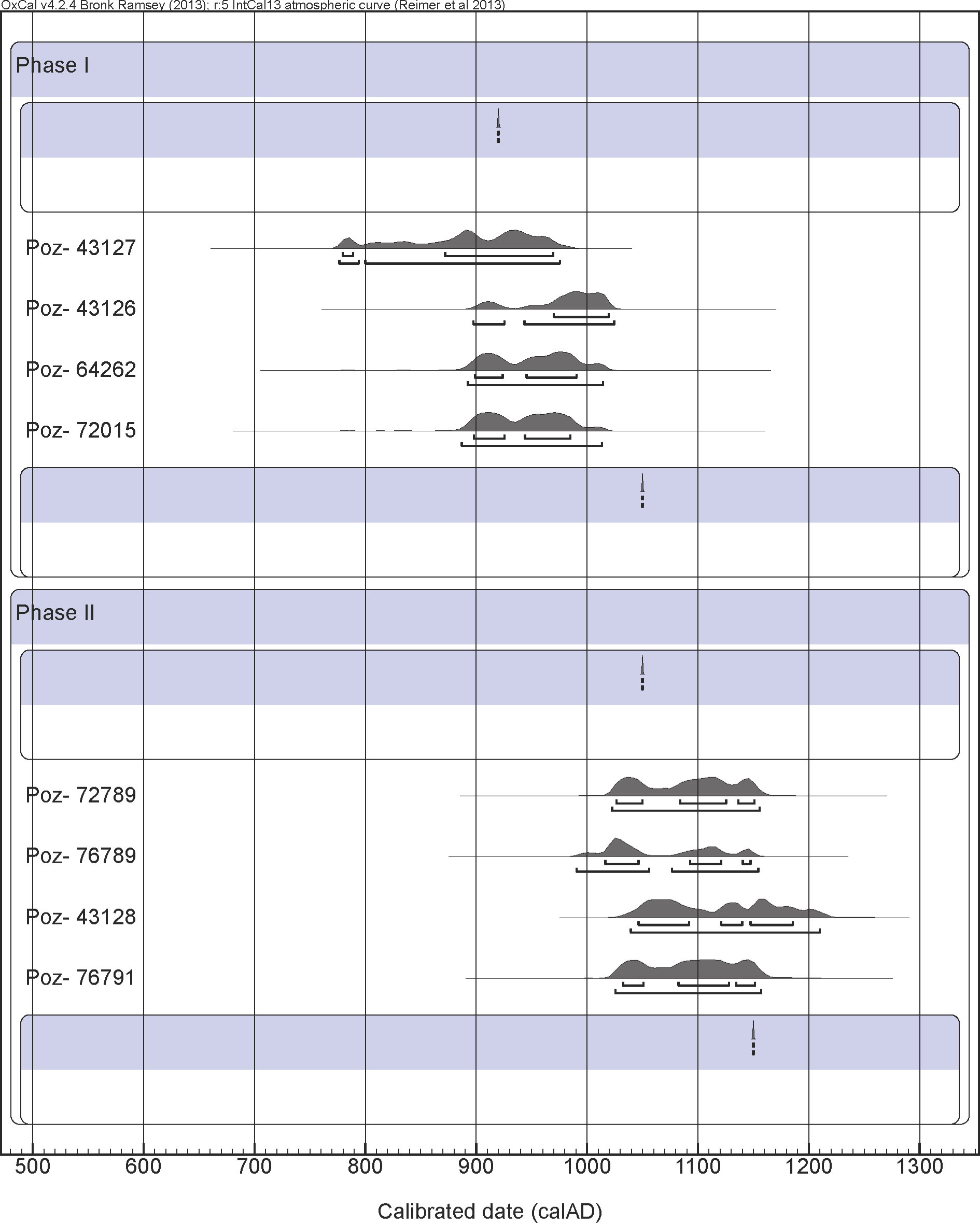
Figure 6
Calibration in graphical form; the boundaries of phases were determined on the basis of relative chronology, radiocarbon measurements and the dating of coins (Krzyszowski, 1995, 1997; Krzyszowski and Suchodolski, in press).
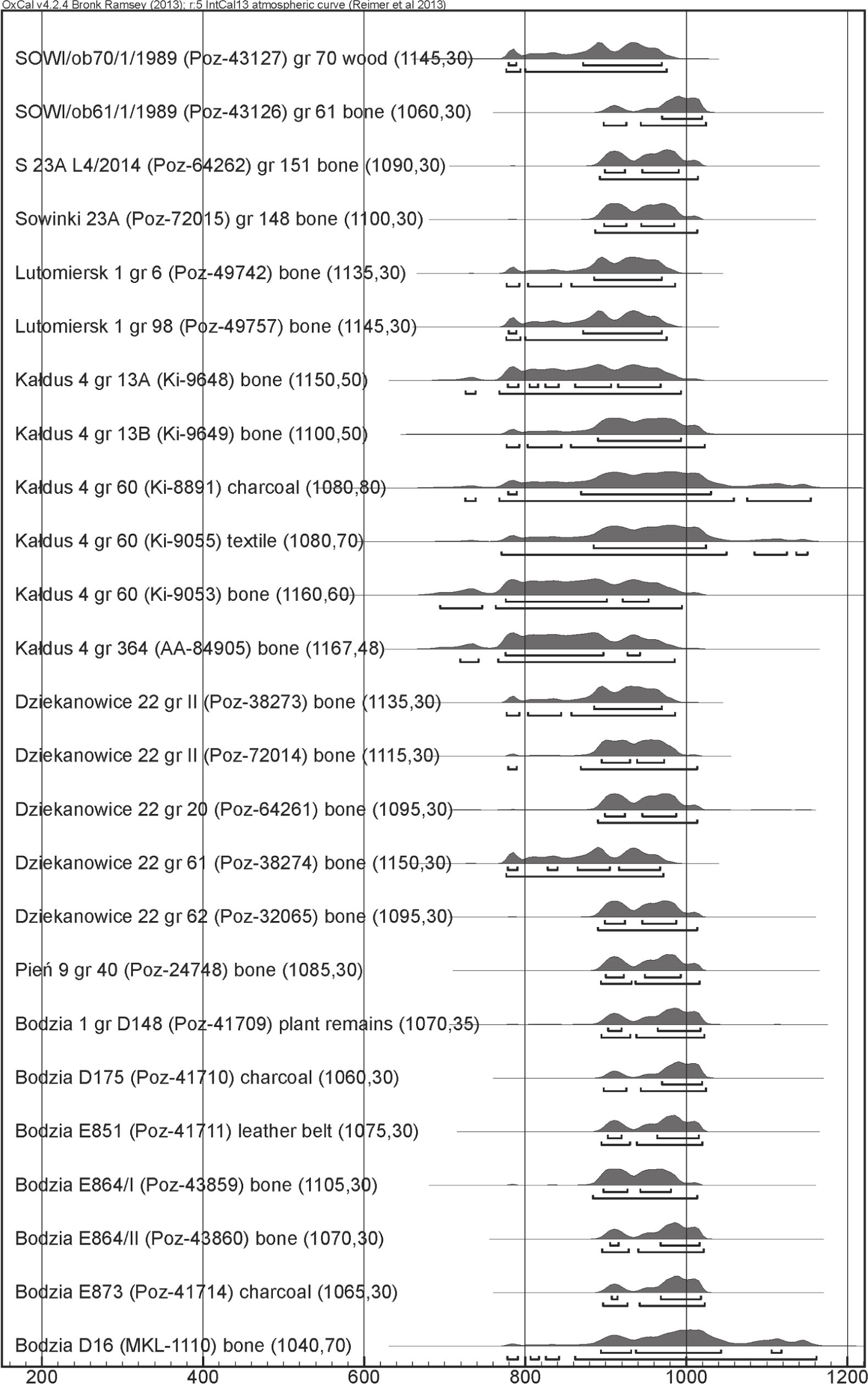
Figure 7
Comparison of radiocarbon dates obtained for selected graves form older phases of early medieval cemeteries in the Polish lands (Sowinki site 23A, Pień site 9, Bodzia site 1, Dziekanowice site 22, Kałdus site 4, Lutomiersk site 1). Poz — laboratory number of samples dated by 14C in Poznań (Poland); Ki — Kiev (Ukraine); AA — Arizona (USA); MKL — Laboratorium Datowań Bezwzględnych at Cianowice near Kraków (Poland); (after references to each archaeological site, cited in the text).