
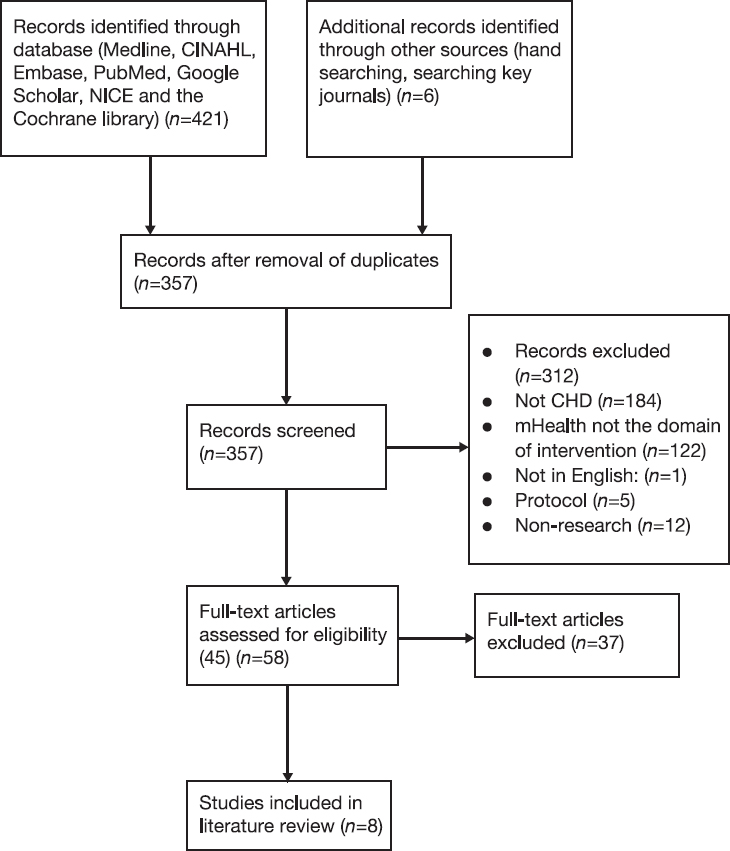
Figure 1
Search findings and process.
Table 1
Characteristics of the included studies.
| Author; country | Study design | Mean age (years) | Gender (male) | Sample size | Duration | IG, CG | Limitation |
|---|---|---|---|---|---|---|---|
| Blasco et al.18; Spain | RCT | 61 | 163 | n = 203 IG = 102 CG = 101 | 12 months | IG: telemedicine + lifestyle counseling + usual care CG: lifestyle counseling + usual care | 1. Patients were not blinded 2. Sample size was relatively small 3. Duration of follow-up was only 1 year |
| Park et al.19; | RCT | 59.2 | 68 | n = 90 | 30 days | IG1 : TM reminders + TM | 1. Sample size was small |
| USA | IG1 = 30 | education | 2. Follow-up period was relatively | ||||
| IG2 = 30 | IG2: TM education | short (30 days) | |||||
| CG = 30 | CG:no TM | 3. Study used self-reported and MEMS data collection, which have inherent limitations | |||||
| Quilici et al.20; | RCT | 64 | 187 | n = 546 | 30 days | IG: SMS + standard care CG: standard care | Self-reported data were used as a measuring method |
| France | |||||||
| Varnfield et al.13; Australia | RCT | 55.5 | 82 | n = 120 | 6 months | IG: baseline to 6 weeks: health and exercise monitoring + delivery of motivational and educational materials via TM; 6 weeks to 6 months: patients were encouraged to maintain lifestyle changes CG: traditional, center-based CR | 1. Sample size was too small 2. A considerable number of patients dropped out 3. Study only focused on patients referred for CR after myocardial infarction and did not address all patients eligible for CR |
| Chow et al.14; Australia | RCT | 58 | 582 | n = 710 | 6 months | IG: four TMs per week for 6 months + usual care CG: usual care | 1. Study was conducted in a single large tertiary referral center hospital, and thus the results may not be generalizable |
| 2. The study delivered the messages in English and excluded non-English-speaking patients | |||||||
| 3. Some outcomes were measured using self-report questionnaire | |||||||
| 4. No cost-effectiveness analysis was carried out | |||||||
| Pfaeffli Dale | RCT | 59.5 | 100 | n = 123 | 6 months | IG: daily SMS TMs + a supporting website + | 1. Outcome assessors were not blinded |
| et al.16; New Zealand | usual care CG: usual care | 2. Primary outcome measure was self-reported, so recall bias is possible | |||||
| 3. Findings may not be transferable to other populations because the sample was predominantly New Zealand European | |||||||
| Martin | RCT; | 58 | 26 | n = 48 | 5 weeks | IG: mHealth intervention | 1. Study had limited size and scope |
| et al.16; | pilot | with tracking and texting | 2. Generalizability remains uncertain | ||||
| USA | trial | components | 3. Study did not use human | ||||
| CG: usual care | coaches as part of the intervention | ||||||
| Frederix et al.17; Belgium | RCT | 61 | 114 | n = 140 | 6 months | IG: telerehabilitation program + conventional, center-based CR CG: conventional, center-based CR | Study had a generalizability problem |
Table 2
Intervention characteristics.
Apps, applications; mHealth, mobile health; TM, text message.
| Study; country | mHealth devices | Informationtransfer | Centralmonitoringcenter | Monitoringintensity | Monitoringpersonnel | Real-timefeedback | Theory-based | Frequency | Patientfeedback |
|---|---|---|---|---|---|---|---|---|---|
| TM Apps Others | |||||||||
| Blascoetal.18; Spain | √ | Automatic | √ | N/A | Cardiologist | N/A | X | N/A | X |
| Park et al.19; USA | √ | Automatic | √ | Daily | Physician | X | 74/30 days | √ | |
| Quilici et al.20; France | √ | Automatic | √ | Daily | N/A | X | X | Daily | √ |
| Varnfield et al.13; Australia | √ √ | Automatic | √ | Daily | Mentors | N/A | √ | N/A | X |
| Chow et al.14; Australia | √ | Automatic | √ | N/A | Clinicians | X | √ | 4 per week | √ |
| Pfaeffli Dale et al.16; NewZealand | Internet | Automatic | N/A | Researchteam | √ | √ | 1 per day | X | |
| Martin et al.16; USA | √ √ | Automatic | √ | N/A | N/A | √ | √ | 3 times/day | √ |
| Frederix et al.17; Belgium | √ Telecoaching | Semiautomatic | √ | N/A | N/A | X | Onceweekly | √ |
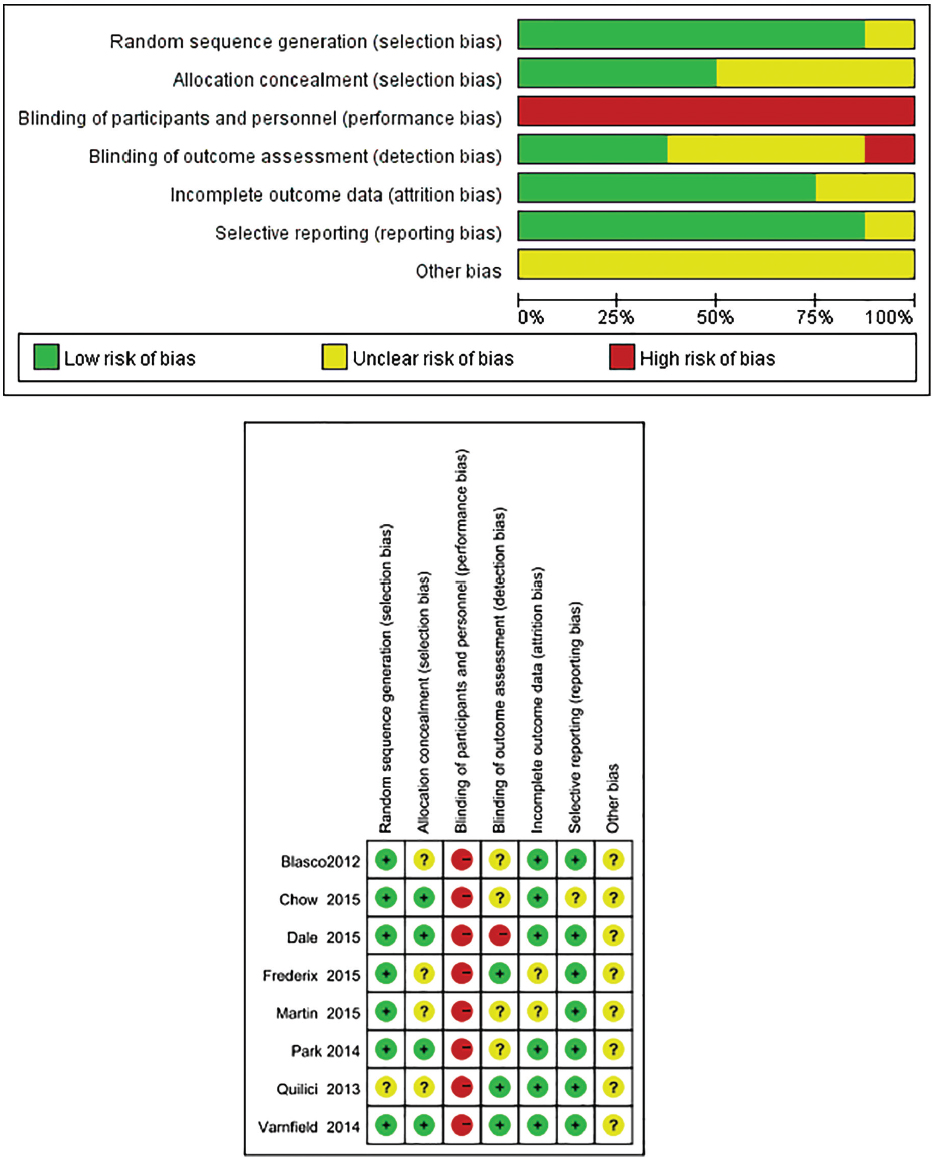
Figure 2
Bias risk assessments.