
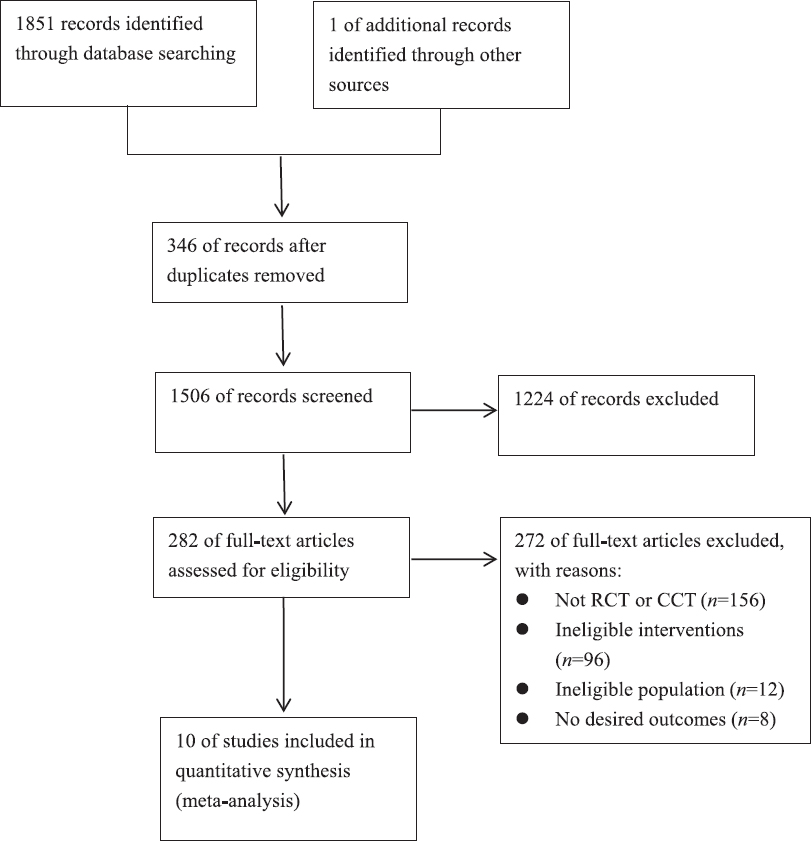
Figure 1
Preferred Reporting Items for Systematic Reviews and Meta-Analyses (PRISMA) flowchart of selection process of the meta-analysis.
Table 1
Characteristics of the included studies.
| Author | Study design | Sample size | Participants (gender, gestational age) | Interventions | Time/frequency | Controls | Outcomes |
|---|---|---|---|---|---|---|---|
| Verma et al4 | RCT | E:148 C: 147 | 203 males, 92 females; 28–42 weeks | 1. Preparation 2. Receive training 3. Participate in nursing | Not reported | Traditional care | Nosocomial infection; hospitalization time; breastfeeding |
| O'Brien et al3 | CCT | E:31 C:62 | Gender was not reported; <35 weeks | 1. Receive training 2. Participate in nursing | >8 hours/day | Traditional care | Nosocomial infection; weight gain; breast-feeding |
| Shen et al11 | CCT | E:36 C:38 | 43 males, 31 females; <34 weeks | 1. Preparation 2. Receive training 3. Participate in nursing 4. Discharge education | Not reported | Traditional care | Nosocomial infection; hospitalization time; breastfeeding; weight gain; readmission |
| Lv et al12 | CCT | E:54 C:52 | 64 males, 42 females; 26-34 weeks | 1. Preparation 2. Receive training 3. Participate in nursing | 3 hours/day | Traditional care | Nosocomial infection; hospitalization time; breastfeeding; weight gain; readmission; satisfaction |
| Li et al13 | CCT | E:23 C:23 | 27 males, 19 females; 28-36 weeks | 1. Preparation 2. Receive training 3. Participate in nursing 4. Discharge education | >3 hours/day | Traditional care | Care knowledge; satisfaction |
| Yu et al14 Ma10 Liang et al8 | CCT CCT RCT | E:58 C:56 E:48 C:48 E:34 C:34 | 58 males, 56 females; 28–37 weeks 43 males, 53 females; 28–33 weeks 37 males, 31 females; 24–36 weeks | 1. Receive training 2. Participate in nursing 1. Preparation 2. Receive training 3. Participate in nursing 4. Discharge education 1. Receive education 2. Participate in nursing | Every day, but intervention time per day was not reported Every day, but intervention time per day was not reported Not reported | Traditional care Traditional care Traditional care | Satisfaction Readmission Breast-feeding |
| Ding et al9 | RCT | E:56 C:62 | Gender was not reported; 32-37 weeks | 1. Receive training 2. Participate in nursing | >8 hours/day | Traditional care | Hospitalization time; breastfeeding |
| He et al5 | CCT | E:100 C:98 | Gender was not reported; E: 35.22 ± 1.70 weeks C:34.63±1.91 weeks | 1. Preparation 2. Receive training 3. Participate in nursing | >4 hours/day | Traditional care | Nosocomial infection |
[i] Notes: Preparation: learning sterile environment and operation, washing hand, wearing gown, learning NICU system, familiarizing with NICU environment. Receive training: any education or training about infant nursing. Participate in nursing: including feeding, bathing, dressing, holding, providing skin-to-skin care, kangaroo care, eyes care, oral care, umbilical care, massage, interaction, or other basic nursing. Discharge education: heath education about how to care infants after discharge. Traditional care: parents were not allowed to enter the NICU ward or there were only short-time visits within the time prescribed, and the care of infants was provided exclusively by medical specialists.C, control group; CCT, controlled clinical trial; E, experiment group; NICU, neonatal intensive care unit; RCT, randomized controlled trial.
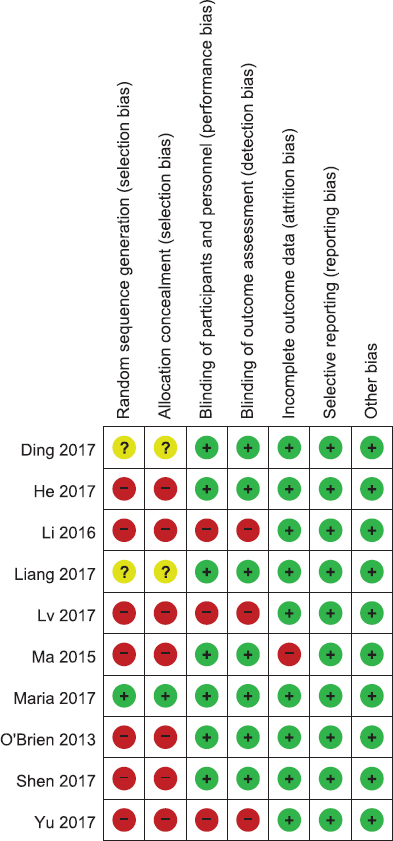
Figure 2
Table of the risk of bias of the included studies.
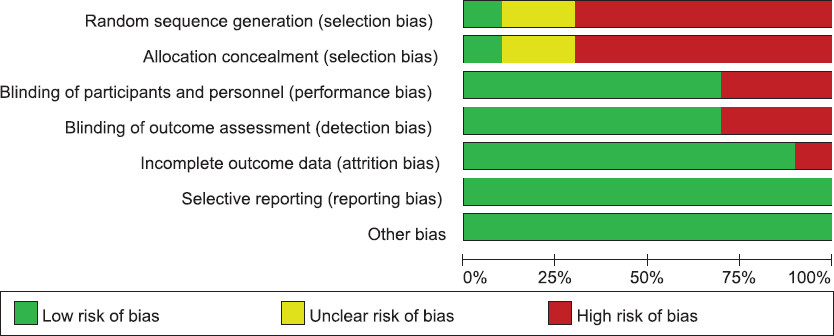
Figure 3
Quality assessment of clinical trials included.
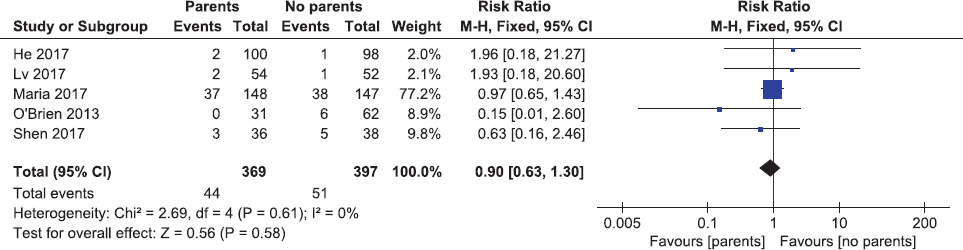
Figure 4
Effects of parental involvement care on nosocomial infection in NICU.
NICU, neonatal intensive care unit.

Figure 5
Effects of parental involvement care on weight gain in NICU.
NICU, neonatal intensive care unit.
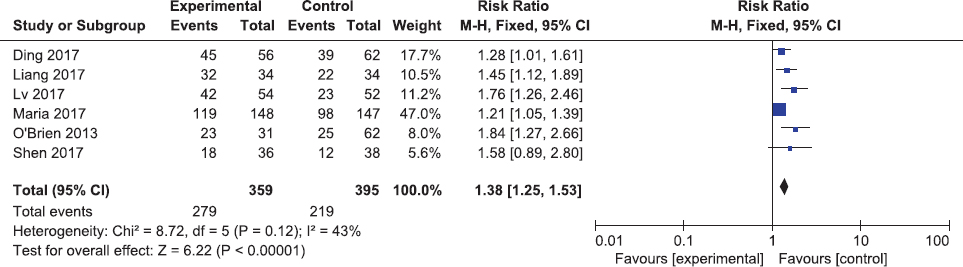
Figure 6
Effects of parental involvement care on breast-feeding in NICU.
NICU, neonatal intensive care unit.
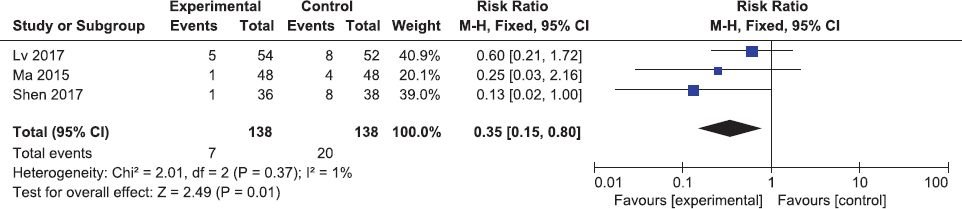
Figure 7
Effects of parental involvement care on readmission in NICU.
NICU, neonatal intensive care unit.
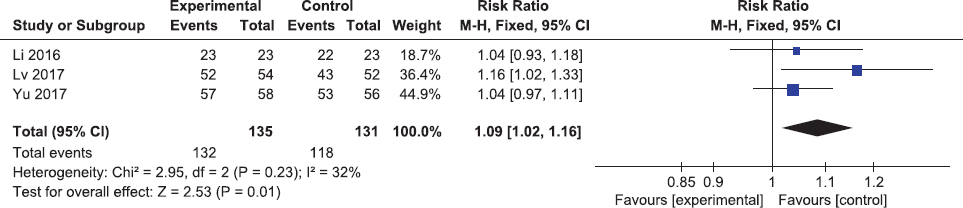
Figure 8
Effects of parental involvement care on parental satisfaction in NICU.
NICU, neonatal intensive care unit.