

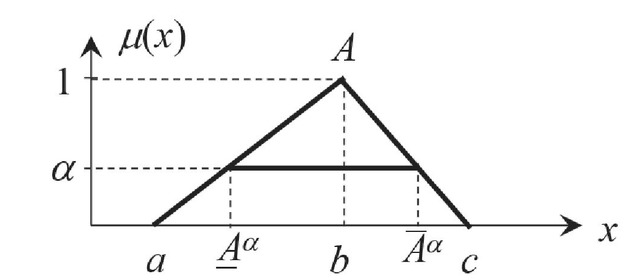
Fig. 1
Membership function of the triangular fuzzy number A = (a, b, c) and α-cut
Source: Author's own elaboration.
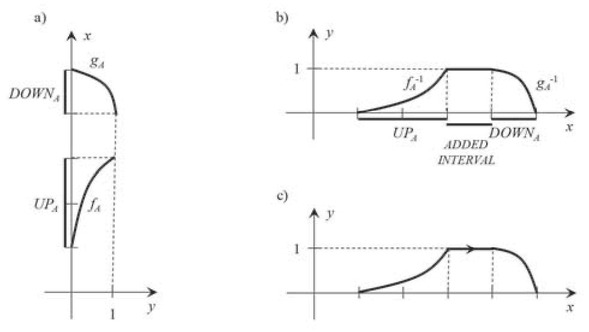
Fig. 2
a) Ordered fuzzy number, b) OFN presented in relation to CFN, c) Arrow showing the order of the reverse functions and the orientation of
Source: (Kosiński and Prokopowicz, 2004).
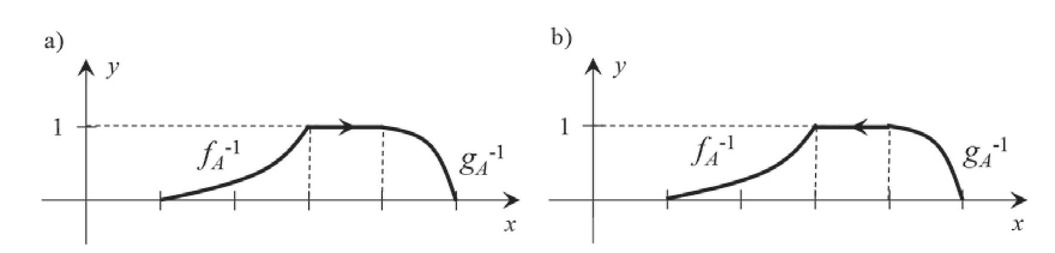
Fig. 3
a) OFN with positive orientation, b) OFN with negative orientation
Source: (Kacprzak, 2010).
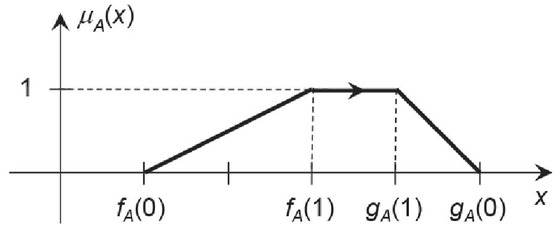
Fig. 4
An example of an OFN together with its characteristic points
Source: (Kacprzak, 2010).
Tab. 1
Input-output table
| Sector | inputs-outputs | Final output | Total output | ||||
|---|---|---|---|---|---|---|---|
| j | |||||||
| 1 | 2 | … | n | ||||
| 1 | x11 | x12 | … | x1n | d1 | X1 | |
| 2 | x21 | x22 | … | x2n | d2 | X2 | |
| i | ⁝ | ⁝ | ⁝ | ⋱ | ⁝ | ⁝ | ⁝ |
| n | xn1 | xn2 | … | xnn | dn | Xn | |
[i] Source: Author's own elaboration based on (Gruszczyński and Podgórska, 2004, 371).
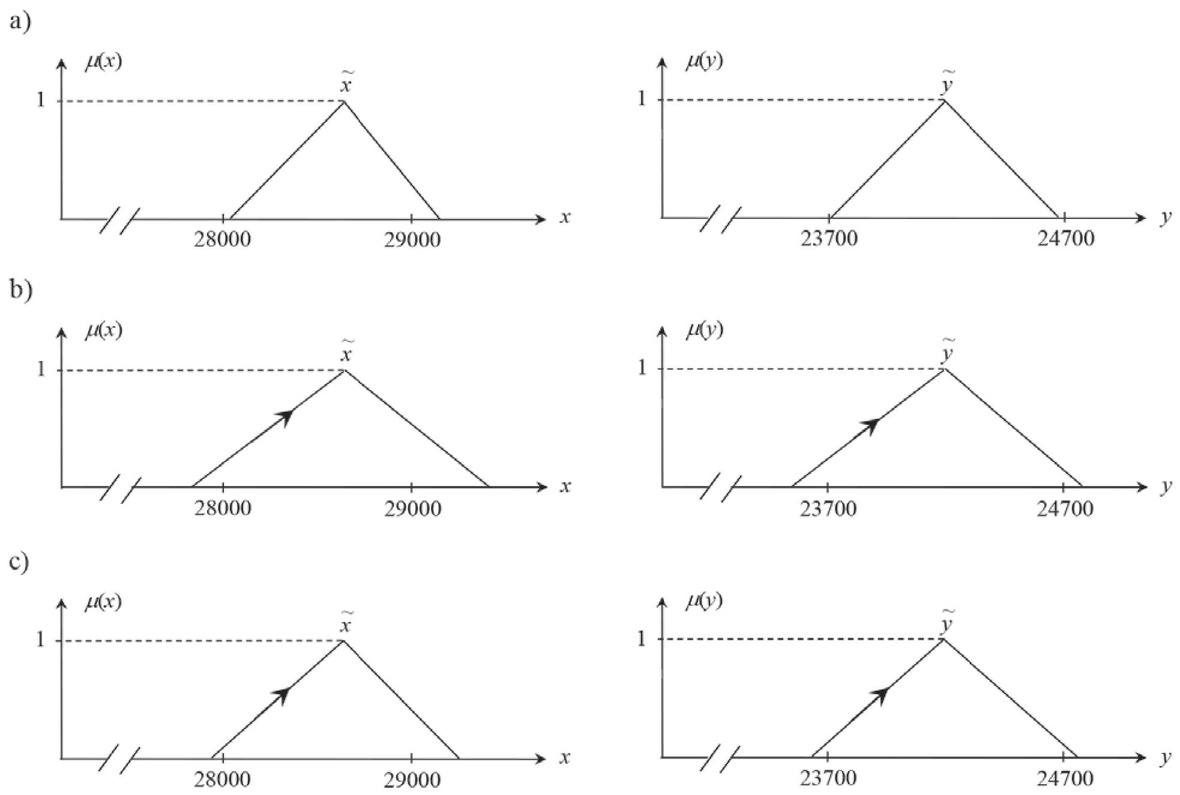
Fig. 5
Results obtained in Examples 3 and 4: a) constructed on a CFN, b) based on positively oriented OFNs, c) based on negatively oriented OFNs
Source: Author's own elaboration