
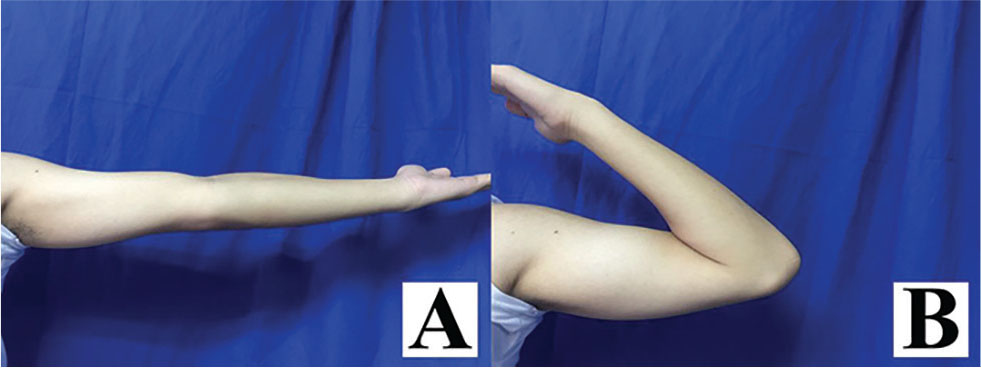
Figure 1
Photographic positions. Subject laterally abducted shoulder perpendicular to the floor and fully extended elbow (A). Elbow was maximally flexed (B).
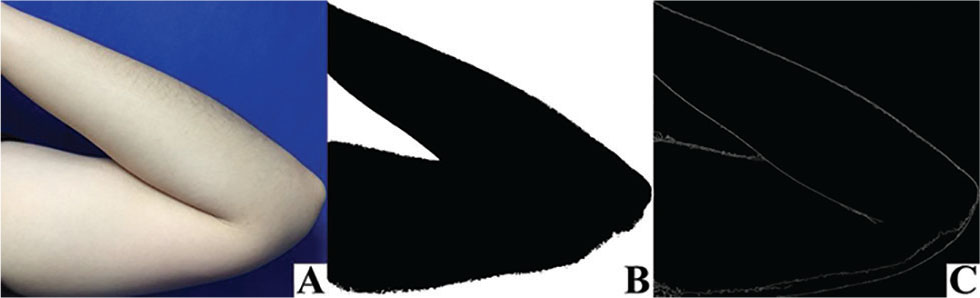
Figure 2
Line detection process. (A) Cropped image. (B) Converting red, green, and blue (RGB) to hue saturation value (HSV). (C) Detection of lines using Canny and Hough transformation.
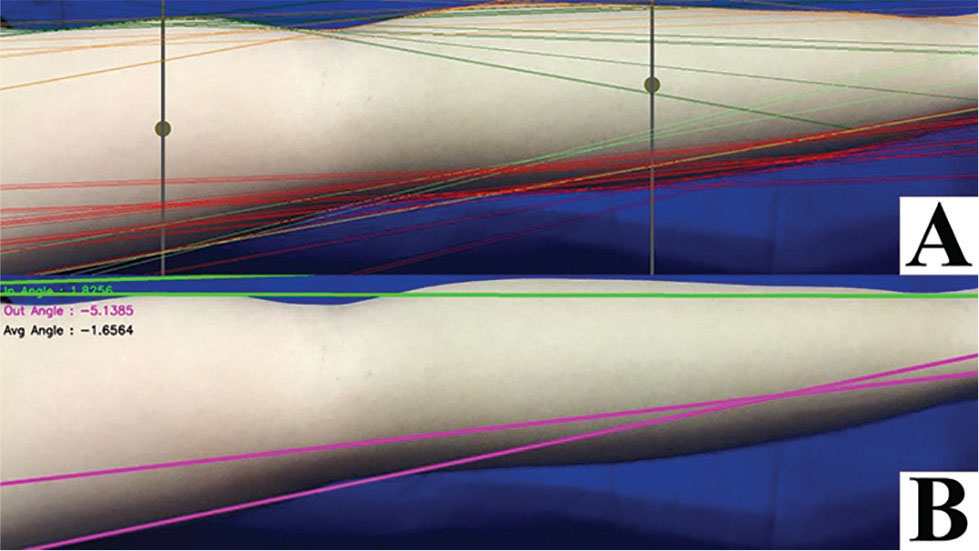
Figure 3
Angle calculation step for extended elbow image. (A): Locate middle points of arm and forearm from one-third of distance of both edges. (B): Calculate angle from difference between two slopes.
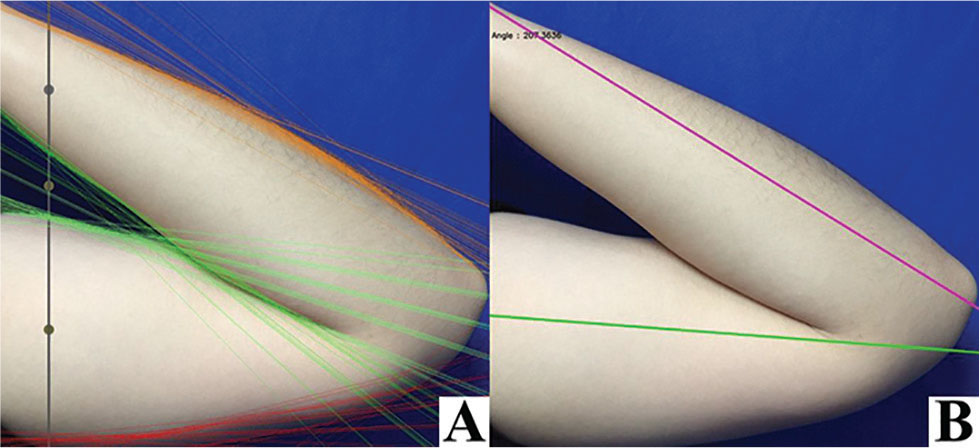
Figure 4
Angle calculation step for flexed elbow image. (A) Determine cutting point for classifying four reference lines. (B) Calculate angle from two slopes.
Table 1
Comparison measurement of digital image processing method with digital goniometer and digital inclinometer
| Angle measurement | Digital image processing | Digital goniometer | Digital inclinometer |
|---|---|---|---|
| Mean ± SD (range) | Mean ± SD (range) | Mean ± SD (range) | |
| Extension | −2.01 ± 6.30 (−16.86 – 8.92) | −6.67 ± 3.48 (−11.83 – 0.28) | −6.74 ± 3.58 (−11.87 – 0.15) |
| Flexion | 146.80 ± 5.20 (137.05 – 157.16) | 141.28 ± 4.71 (129.98 – 148.80) | 142.79 ± 6.58 (129.97 – 155.97) |
| Total ROM | 148.81 ± 7.72 (135.89 – 164.70) | 147.95 ± 6.89 (132.12 – 160.53) | 149.55 ± 8.36 (131.63 – 167.27) |
[i] ROM, range of motion.
Table 2
Bland–Altman analytic results and percentage of DIPT measurement error within 10° compared with goniometer and inclinometer
| Angle measurement | Mean of difference (95% CI) | Upper LOA (95% CI) | Lower LOA (95% CI) | Absolute maximal error† | Within 10° of error (%) |
|---|---|---|---|---|---|
| Goniometer | |||||
| Extension | 4.51 (3.14, 5.88) | 14.56 (12.2, 16.92) | –5.54 (–7.9, –3.18) | ±10.05 | 91.1 |
| Flexion | 5.46 (4.12, 6.80) | 15.26 (12.96, 17.57) | –4.35 (–6.66, –2.05) | ±9.81 | 82.1 |
| Total ROM | 0.94 (–0.95, 2.84) | 14.79 (11.54, 18.04) | –12.90 (–16.16, –9.65) | ±13.84 | 80.4 |
| Inclinometer | |||||
| Extension | 4.61 (3.25, 5.96) | 14.53 (12.2, 16.86) | –5.32 (–7.65, –2.99) | ±9.93 | 87.5 |
| Flexion | 3.98 (2.45, 5.50) | 15.15 (12.52, 17.77) | –7.19 (–9.81, –4.57) | ±11.17 | 85.7 |
| Total ROM | –0.63 (–2.64, 1.38) | 14.10 (10.64, 17.56) | –15.36 (–18.82, –11.9) | ±15.99 | 83.9 |
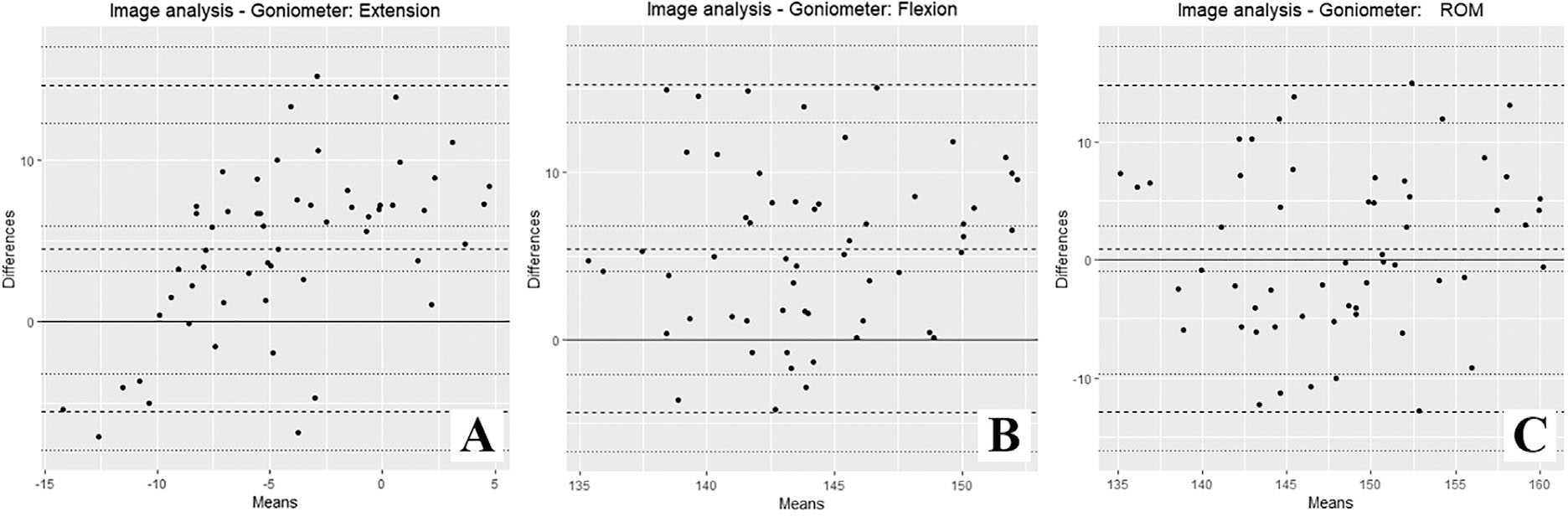
Figure 5
Bland–Altman plot of digital image analysis and goniometer. (A) Extension. (B) Flexion. (C) Elbow range of motion (ROM).
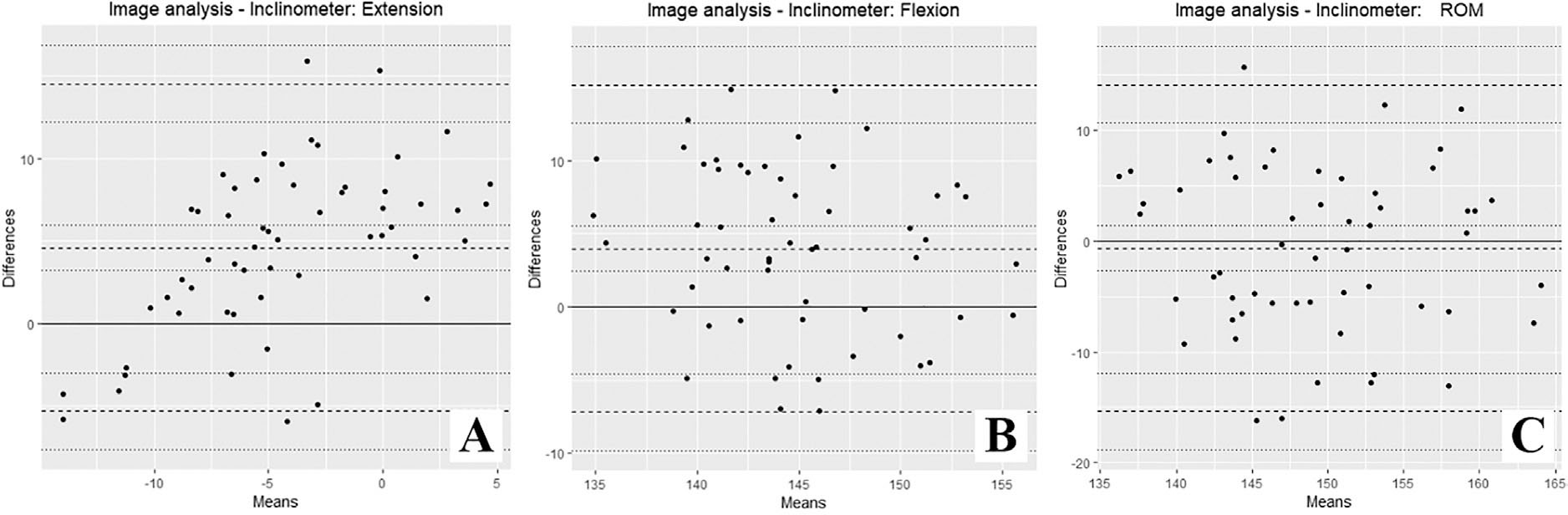
Figure 6
Bland–Altman plot of digital image analysis and inclinometer. (A) Extension. (B): Flexion. (C): Elbow range of motion (ROM).
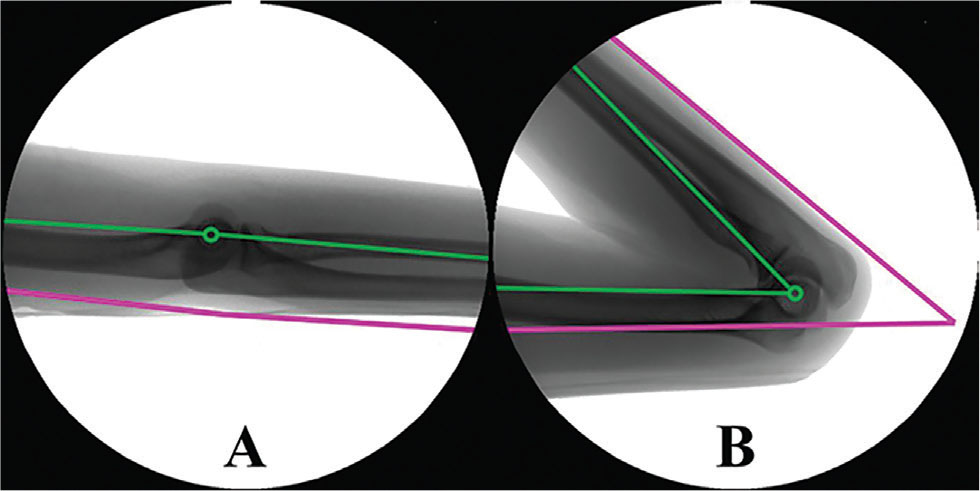
Figure 7
Conceptual illustration of systematic measurement bias between landmark-based method, goniometer and inclinometer, and contour-based DIPT. Green circles are lateral epicondyle location and green lines are imaginary lines of goniometer and inclinometer measurements. Pink lines are the result of using DIPT on fluoroscopic image. (A) Extension image. (B) Flexion image.
Table 3
The results of photography-based ROM of the elbow measurement from previous literatures compared with current study
| Study | Elbows | Reference method | Mean difference (°) | 95% LOA (°) | Within 10° (%) | ||||||
|---|---|---|---|---|---|---|---|---|---|---|---|
| Extension | Flexion | ROM | Extension | Flexion | ROM | Extension | Flexion | ROM | |||
| Blonna et al. [7] | 50 | DG | 0 | 1 | 7–31 | 8–21 | |||||
| Meislin et al. [1] | 64 | DG | 0.2–0.3 | 8.3–9.5 | 95 | ||||||
| Keijsers et al. [8] | 80 | DG | 1 | 0 | |||||||
| Russo et al. [4] | 20 | MCA | 4 | 11.7 | 16† | 93 | |||||
| Chanlalit and Kongmalai [5] | 60 | DG | 2.6 | 2.1 | 7.8 | 13.4 | 98.3 | 85 | |||
| Current study (DG) | 56 | DG | 4.5 | 5.5 | 0.9 | 10.1 | 9.81 | 13.8 | 91.1 | 82.1 | 80.4 |
| Current study (DI) | 56 | DI | 4.6 | 4.0 | 0.6 | 9.9 | 11.2 | 16 | 87.5 | 85.7 | 83.9 |