
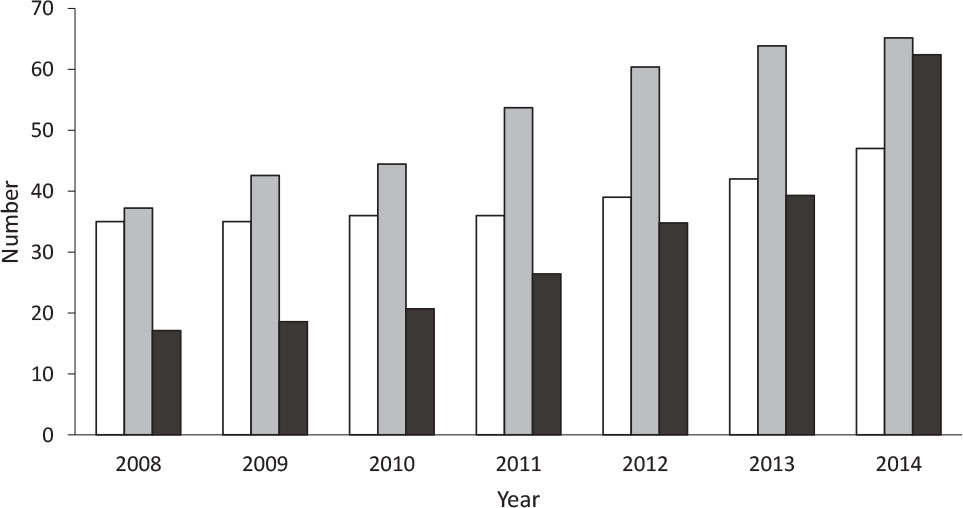
Figure 1
Trends of the number of ART centers (white bars) and total ART cycles (initiated cycles; light-gray bars and FET cycles; black bars) in Thailand (unit in hundred) between 2008 and 2014.
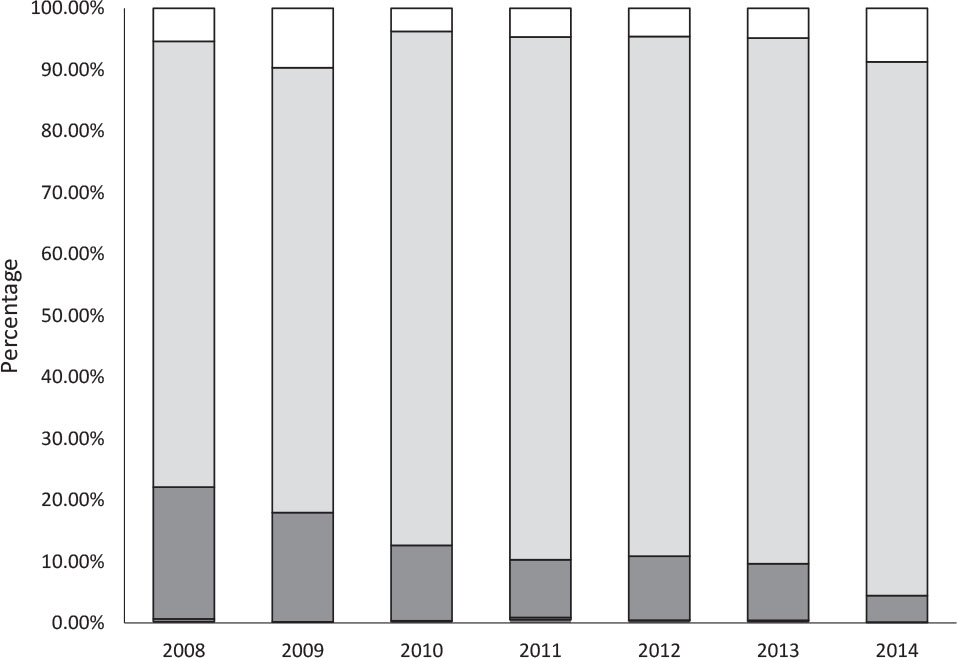
Figure 2
The proportion of ART techniques in Thailand between 2008 and 2014. The bars represent the ART techniques; ICSI surgically retrieved sperm (white bars), ICSI ejaculated sperm (light-gray bars), IVF (medium-gray bars), ZIFT (dark-gray bars), GIFT (black bars).
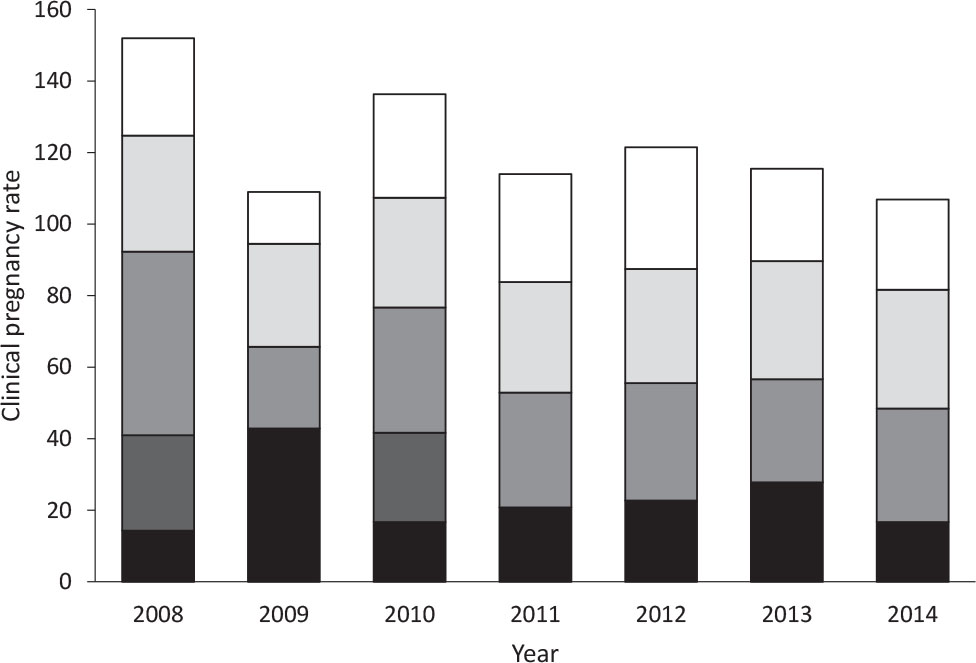
Figure 3
The clinical pregnancy rate per transfer of each ART techniques in Thailand between 2008 and 2014. The bars represent the ART techniques; ICSI surgically retrieved sperm (white bars), ICSI ejaculated sperm (light-gray bars), IVF (medium-gray bars), ZIFT (dark-gray bars), GIFT (black bars).
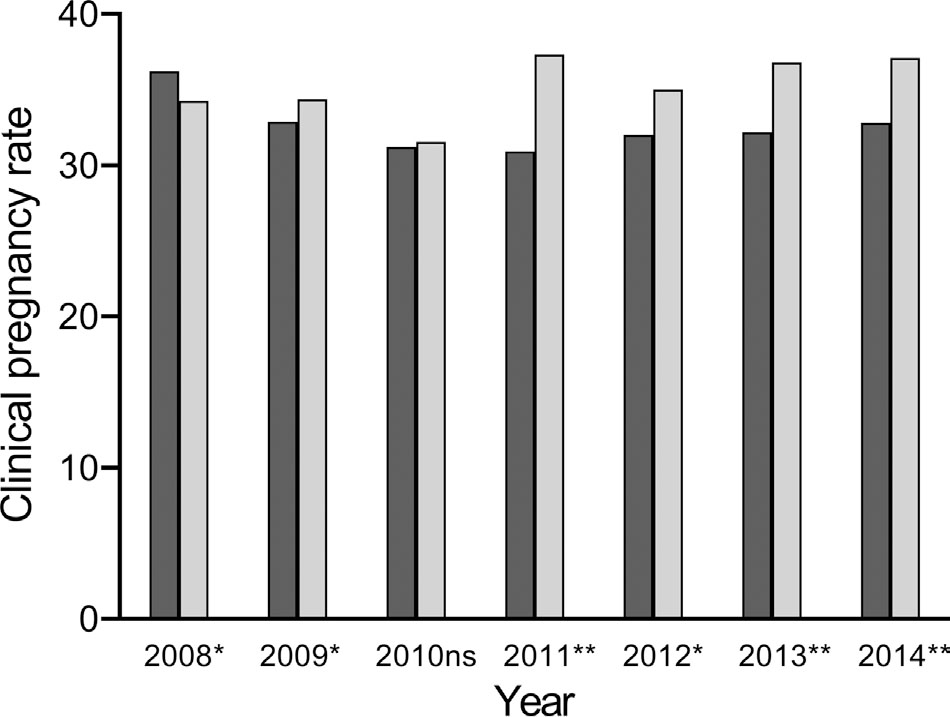
Figure 4
Comparison of the clinical pregnancy rate per transfer between fresh (dark-gray bars) and frozen-thawed (light-gray bars) cycles in Thailand between 2008 and 2014. *P < 0.05; **P < 0.01; ns = P > 0.05.
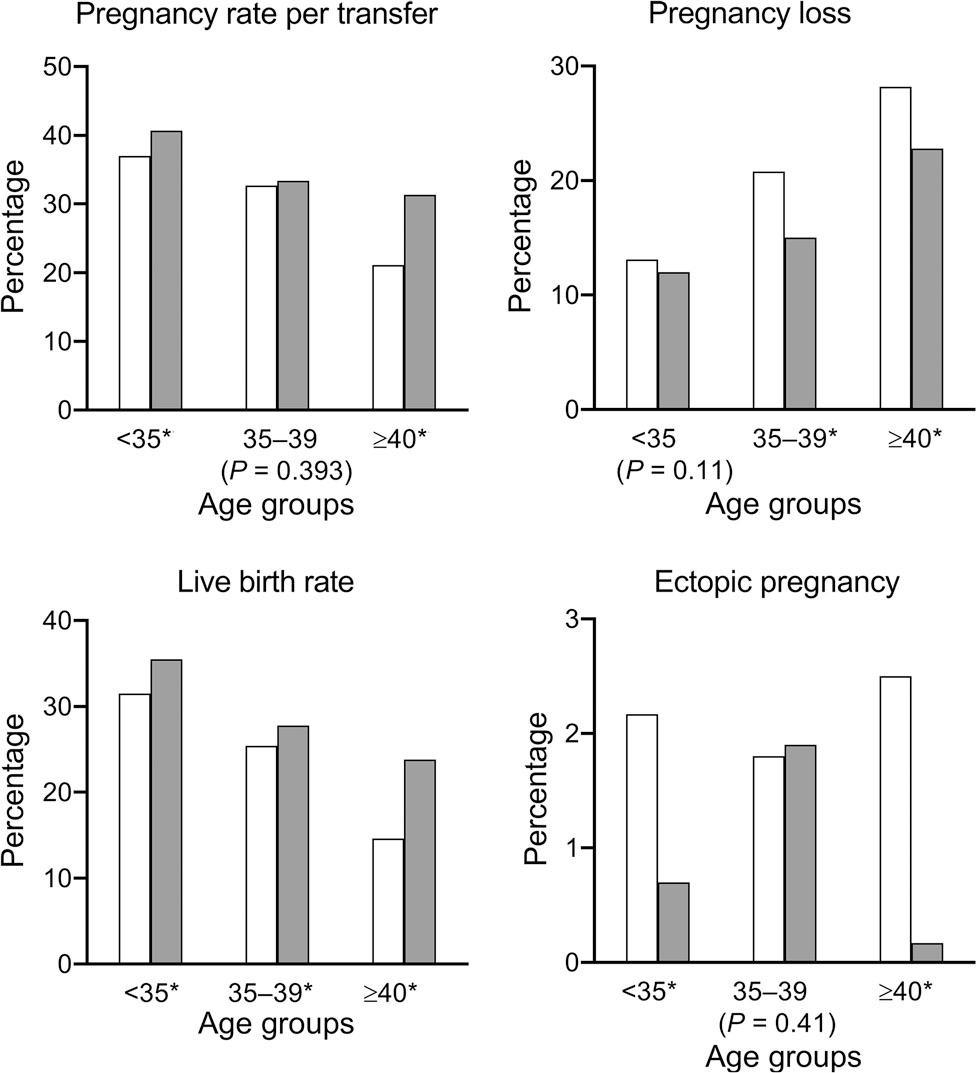
Figure 5
Comparison of the clinical pregnancy rate per transfer and the pregnancy results among different female partner age groups between fresh cycle (white bars) and frozen-thawed cycle (gray bars) in Thailand between 2008 and 2014. *P < 0.01.
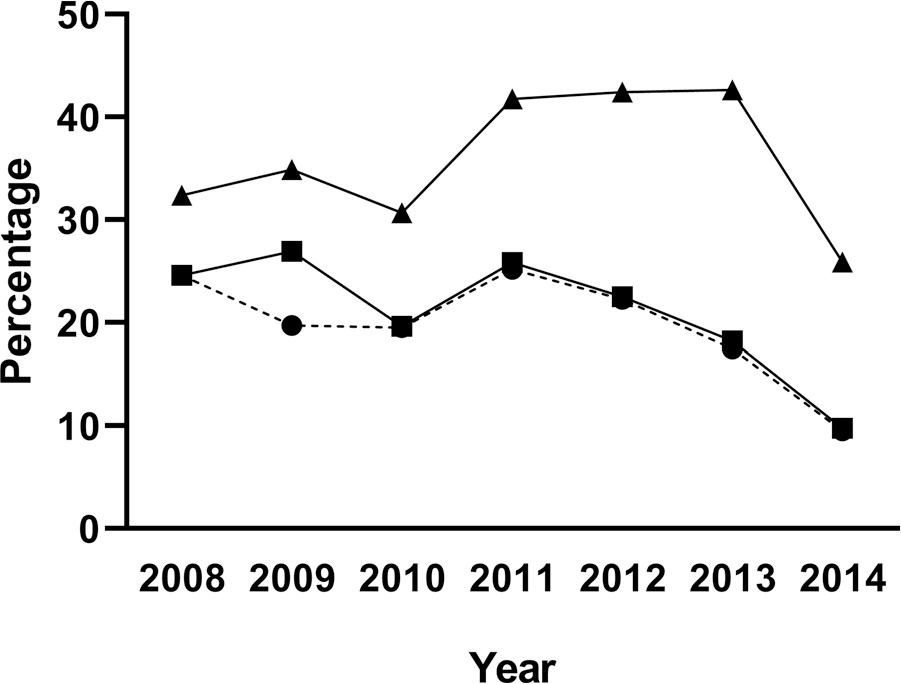
Figure 6
Comparison trend of the clinical pregnancy rates with PGS cycles in Thailand between 2008 and 2014. The lines show pregnancies/initiated cycles (circles, dashed lines), pregnancies/retrieved cycles (squares, unbroken lines), and pregnancies/transfer cycles (triangles, unbroken lines).
Table 1
Comparison of the clinical pregnancy rate per transfer between the size of ART centers in Thailand in 2008–2014
| Year | Cycles | No. of centers | Total cycles | Pregnancies/transfer cycle (%) | P* | OR (95% CI) |
|---|---|---|---|---|---|---|
| 2008 | <100 | 22 | 797 | 28.01 | – | 1 |
| 100–400 | 11 | 1,953 | 35.31 | <0.01 | 1.41 (1.18, 1.69) | |
| >400 | 2 | 872 | 28.01 | 0.99 | 1.0 (0.81, 1.24) | |
| 2009 | <100 | 16 | 454 | 34.04 | – | 1 |
| 100–400 | 16 | 2,962 | 35.66 | 0.53 | 1.06 (0.87, 1.32) | |
| >400 | 5 | 3,065 | 34.57 | 0.85 | 1.02 (0.83, 1.25) | |
| 2010 | <100 | 23 | 1,139 | 32.89 | – | 1 |
| 100–400 | 11 | 2,370 | 36.67 | 0.03 | 1.18 (1.02, 1.37) | |
| >400 | 2 | 978 | 31.96 | 0.66 | 0.96 (0.80, 1.15) | |
| 2011 | <100 | 22 | 1,045 | 30.86 | – | 1 |
| 100–400 | 12 | 2,384 | 34.48 | 0.04 | 1.19 (1.01, 1.39) | |
| >400 | 3 | 1,726 | 17.83 | <0.01 | 0.48 (0.4, 0.58) | |
| 2012 | <100 | 19 | 736 | 31.52 | – | 1 |
| 100–400 | 17 | 3,438 | 34.01 | 0.2 | 1.12 (0.94, 1.33) | |
| >400 | 3 | 1,707 | 8.7 | <0.01 | 0.21 (0.16, 0.26) | |
| 2013 | <100 | 18 | 618 | 33.32 | – | 1 |
| 100–400 | 20 | 3,546 | 30.79 | <0.01 | 1.66 (1.37, 1.96) | |
| >400 | 4 | 2,260 | 33.01 | 0.88 | 0.99 (0.81, 1.19) | |
| 2014 | <100 | 27 | 1,294 | 31.04 | – | 1 |
| 100–400 | 16 | 2,900 | 41.14 | <0.01 | 1.55 (1.34, 1.78) | |
| >400 | 4 | 2,142 | 40.35 | <0.01 | 1.50 (1.29, 1.74) |
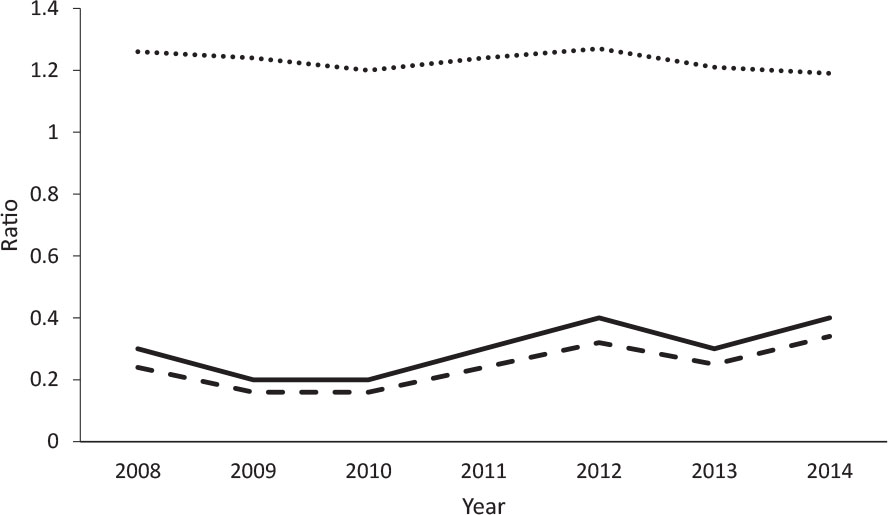
Figure 7
Trends of the percentage of the ratio of ART birth rate to natural birth rate in Thailand between 2008 and 2014. The lines show birth rate from ART/1000 (unbroken lines), national birth rate/100 (dotted lines), and birth rate from ART/natural birth rate (%) (dashed lines).