
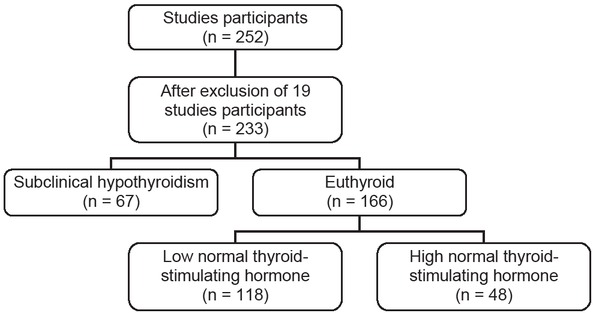
Figure 1
Flow diagram of the studied participants.
Table 1
Sociodemographic state of the study participants
| Parameter | Frequencies, n (%) |
|---|---|
| Age (years)† | 31.5 (52) |
| Age range (years) | 18–70 |
| Sex | |
| Female | 188 (80.69) |
| Male | 45 (19.31) |
| Body mass index‡ | 27.28 [4.84] |
| Waist circumference (cm)‡ | 84.88 [12.14] |
| Smoker (yes%) | 20 (8.6) |
| Education | |
| Educated | 155 (90.1) |
| Illiterate | 17 (9.9) |
| Work | |
| Student | 34 (14.8) |
| No work | 67 (29.1) |
| Employee | 85 (37) |
| Free work | 44 (19.2) |
| Marital status | |
| Married | 138 (60) |
| Single | 88 (38.3) |
| Divorced | 4 (1.7) |
| Exercise | |
| Rarely | 99 (44.4) |
| Some time | 82 (36.8) |
| Daily | 42 (18.8) |
[i] All non-descriptive data are presented as number (%)
†The parameters not normally distributed are expressed as median (range)
‡The normally distributed data are expressed as mean [±SD]
SD, standard deviation
Table 2
Characteristics of SCH and euthyroid subjects according to biochemical and clinical data. Bold numbers indicate significant P
| Parameters | SCH (n = 67), mean (±SD) | Euthyroid (n = 166), mean (±SD) | P |
|---|---|---|---|
| Age (years)† | 34 (52) | 31 (53) | 0.368 |
| Sex (female) | 85.1% | 78.9% | 0.281 |
| Marital status (married) | 68.3% | 56.9% | 0.289 |
| BMI (kg/m2)‡ | 27.95 [4.35] | 27.00 [5.01] | 0.183 |
| Waist circumference (cm)‡ | 86.77 [13.19] | 84.12 [11.66] | 0.202 |
| Biochemical data | |||
| TSH (mIU/L)† | 5.89 (6.54) | 1.95 (4.09) | <0.001 |
| FT4 (ng/dl)† | 1.15 (11.35) | 1.23 (1.22) | <0.001 |
| FT3 (pg/ml)‡ | 3.39[±0.46] | 3.43[±0.39] | 0.733 |
| TPO-Ab titer (IU/ml)† | 15.22 (606) | 6.64 (504.6) | <0.001 |
| Prolactin (ng/ml)† | 17.29 (45.13) | 15.01 (48.43) | 0.283 |
| TPO positivity | 43.8% | 10.2% | <0.001 |
| Hyperprolactinemia | 27% | 28% | 0.873 |
| Zulewski score† | 3 (5) | 2 (6) | <0.001 |
| Clinical data | |||
| Goiter | 15.1% | 4.9% | 0.017 |
| Menstrual disturbance | 51.2% | 39.7% | 0.193 |
| Decreased appetite | 29.8% | 19.9% | 0.126 |
| Fatigue | 80.3% | 58.2% | 0.002 |
| Muscle pain | 62.3% | 38.9% | 0.002 |
| Memory loss | 50.8% | 43% | 0.304 |
| Alopecia | 46.6% | 40.4% | 0.42 |
| Hirsutism | 24.5% | 22.1% | 0.723 |
| Cold intolerance | 37.3% | 23.8% | 0.05 |
| Galactorrhea | 3.6% | 1.9% | 0.473 |
[i] †The parameters not normally distributed are expressed as median (range), and the groups were compared using the Mann–Whitney test
‡The normally distributed data are expressed as mean [±SD], the comparison between groups are analyzed using independent sample t test, all
non-descriptive data are presented as %, and chi-square is used to find significance for frequencies
BMI, body mass index; FT3, free triiodothyronine; FT4, free thyroxine; SCH, subclinical hypothyroidism; SD, standard deviation; TPO-Ab, anti-thyroid
peroxidase antibody; TSH, thyroid-stimulating hormone
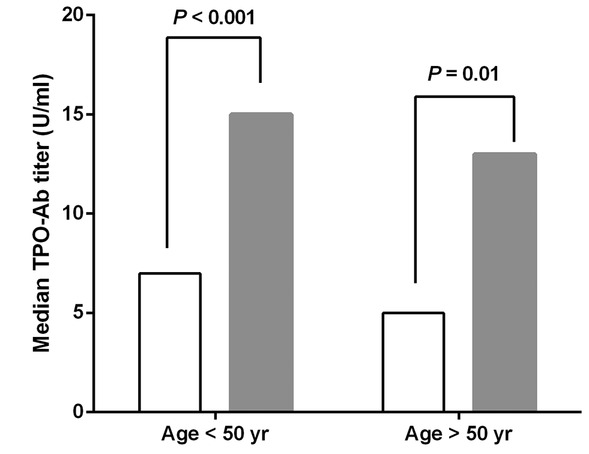
Figure 2
Comparison of median TPO-Ab titer on euthyroid (white bars) and subclinical hypothyroidism (gray bars) between 2 different age groups.
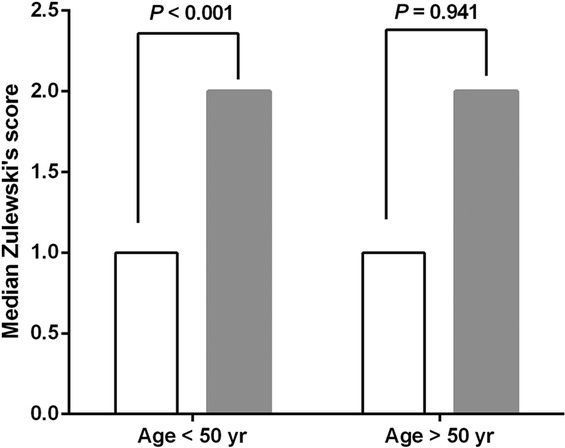
Figure 3
Comparison of median Zulewski score on euthyroid (white bars) and subclinical hypothyroidism (gray bars) between 2 different age groups.
Table 3
Characteristics, laboratory findings, and Zulewski scores among the 2 euthyroid groups with different TSH levels. Bold numbers indicate significant P
| Parameter | Euthyroid with LNT (TSH 0.5–2.5) (n = 118) | Euthyroid with HNT (TSH > 2.5) (n = 48) | P |
|---|---|---|---|
| Age† (years) | 30 (52) | 33 (52) | 0.373 |
| BMI‡ | 26.99 [4.96] | 27.23[5.12] | 0.782 |
| Waist circumference‡ | 84.13 [±11.92] | 84.69 [±10.76] | 0.812 |
| Biochemical data | |||
| TSH (mIU/L)† | 1.6 (2.17) | 3.15 (1.7) | <0.001 |
| FT4 (ng/dl)† | 1.24 (1.22) | 1.21 (0.64) | 0.046 |
| FT3 (pg/ml)‡ | 3.48 [±0.39] | 3.26 [±0.39] | 0.08 |
| TPO-Ab titer (IU/ml)† | 5.81 (265.6) | 10.23 (504.6) | 0.036 |
| Prolactin (ng/ml)† | |||
| TPO positivity | 14.8 (48.43) | 15.54 (35.77) | 0.986 |
| Hyperprolactinemia | 9 (7.6%) | 8 (17.4%) | 0.065 |
| 37 (31.4%) | 9 (20.5%) | 0.365 | |
| Zulewski score† | 2 (7) | 2 (7) | 0.149 |
[i] †The parameters not normally distributed are expressed as median (range), and the groups are compared using the Mann–Whitney test
‡The normally distributed data are expressed as mean [±SD], the comparison between groups is analyzed using the independent sample t test, all
non-descriptive data are presented as %, and chi-square is used to find significance for frequencies
BMI, body mass index; FT3, free triiodothyronine; FT4, free thyroxine; HNT, high-normal TSH; LNT, low-normal TSH; SD, standard deviation; TPO-Ab,
anti-thyroid peroxidase antibody; TSH, thyroid-stimulating hormone
Table 4
Correlation between studied variables using Spearman correlation
| Correlations | Age (years) | TSH level (mIU/L) | FT4 level (ng/dl) | Median TPO-Ab titer (IU/ml) | Zulewski’ score |
|---|---|---|---|---|---|
| Age (years) | 0.027 | –0.240** | 0.126 | 0.158* | |
| TSH level (mIU/L) | 0.027 | –0.275** | 0.319** | 0.287** | |
| FT4 level (ng/dl) | –0.240** | –0.275** | –0.203** | –0.149* | |
| Median TPO-Ab titer (IU/ml) | 0.126 | 0.319** | –0.203** | 0.200** |
[i] *Correlation is significant at the 0.05 level (2-tailed)
**Correlation is significant at the 0.01 level
FT4, free thyroxine; TPO-Ab, anti-thyroid peroxidase antibody; TSH, thyroid-stimulating hormone