
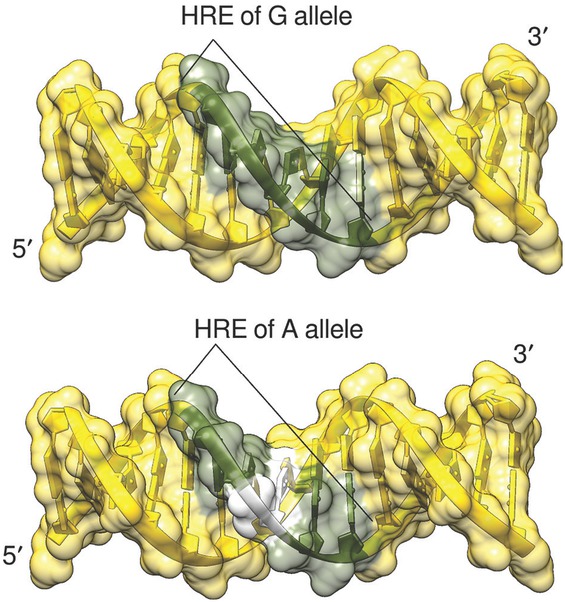
Figure 1
3D structural models of DNA (3D-DART *.pdb files) from sequences of the AGT promoter hypoxia-response element (HRE) region: G allele (top), 5′–GCGTG–3′ (olive green) and A allele (bottom), 5′–GCATG–3′ (olive green) with the mutation region (G→A) (white). Molecular graphics were created using the Chimera package (version 1.11.2), developed by the Resource for Biocomputing, Visualization, and Informatics at the University of California, San Francisco, with support from a U.S. National Institutes of Health grant P41-GM103311 [20].
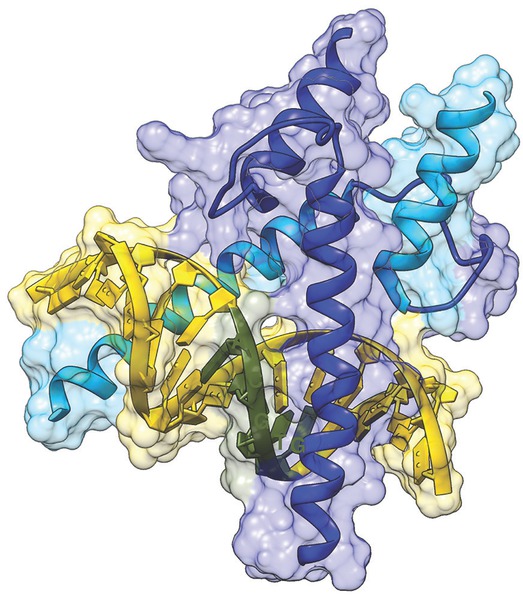
Figure 2
3D representation of the complex between hypoxia-inducible factor 1 (HIF-1) with its aryl receptor nuclear translocator (ARNT) subunit (dark blue) and HIF-1a subunit (sky blue) and DNA (gold) with hypoxia-response element (HRE) (chain A 5′–ACGTG–3′) (olive green). Molecular graphics were created from Protein Data Base entry 1D7G.pdb [21] with the Chimera package (version 1.11.2) [20].
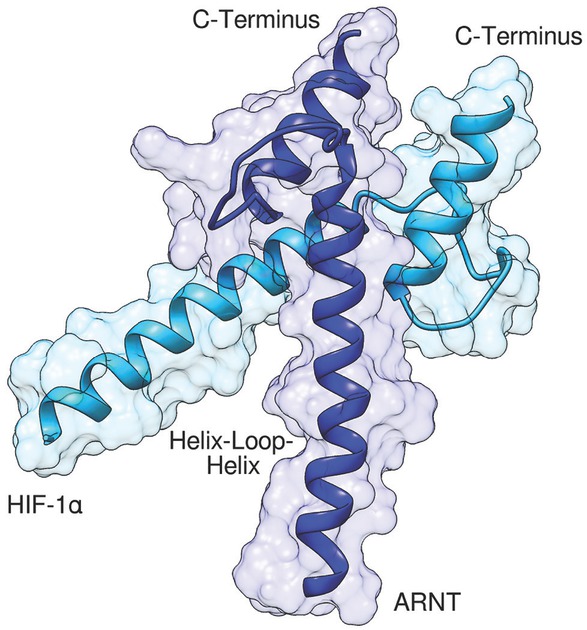
Figure 3
Visualization of isolated hypoxia-inducible factor 1 (HIF-1) protein with its aryl receptor nuclear translocator (ARNT) subunit (dark blue) and HIF-1a subunit (sky blue). We removed the 3D DNA structure and optimized the isolated HIF-1 protein (HIF-1a and ARNT complex) using VEGA ZZ software (release 3.1.1.42) [22] by removing water molecules and adding hydrogen atoms before creating the molecular graphics with the Chimera package (version 1.11.2) [20].
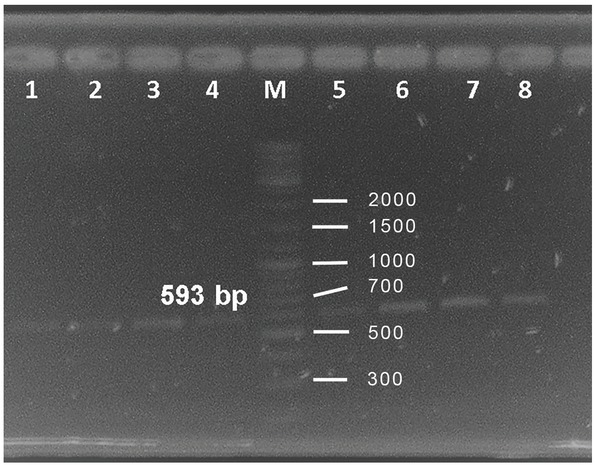
Figure 4
Polymerase chain reaction (PCR) products. Agarose gel (1.5%) electrophoresis showing a 593 bp band for 8 PCR products after amplification of AGT; presented is AGT in the promoter area; M: Invitrogen TrackIt 100 bp DNA Ladder (Thermo Fisher Scientific).
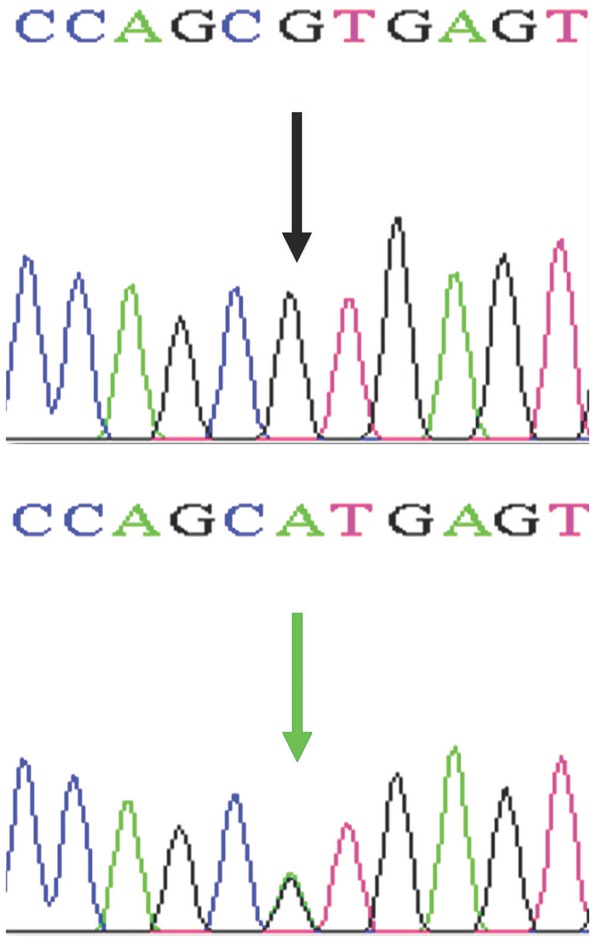
Figure 5
The single nucleotide polymorphism (SNP) G–152A of AGT (rs11568020) by direct sequencing. Electropherograms indicate the polymorphic site of GG (G allele) (black arrow, top) and AG (A allele) (green arrow, bottom) genotypes. No patients with AA genotype were found. C, cytosine blue; A, adenine green; T, thymine magenta; G, guanine black.
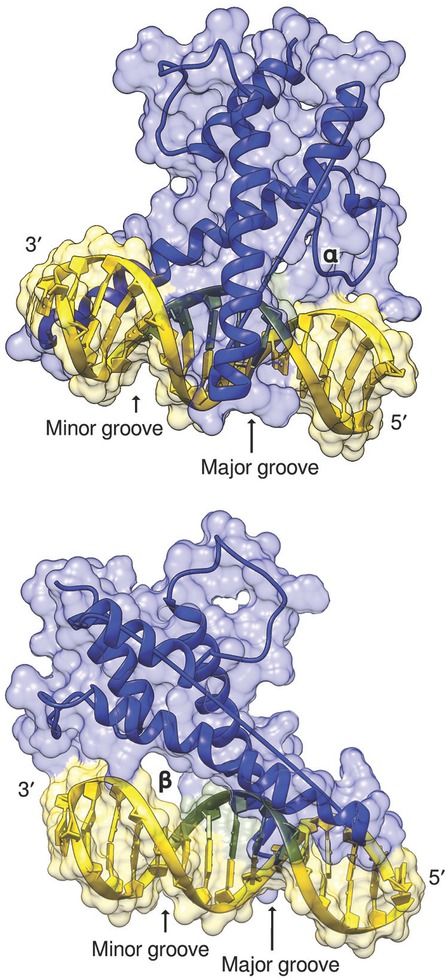
Figure 6
Differences in the binding pattern between G allele– hypoxia-inducible factor 1 (HIF-1) (left) and A allele–HIF-1 (right) interactions; molecular graphics were created using the Chimera package (version 1.11.2) [20] from the present docking results using High Ambiguity Driven protein-protein DOCKing (HADDOCK) [24] between the structures shown in Figures 1 and 3. HIF-1 protein (blue) with DNA (gold); hypoxia-response element (HRE) recognized (olive green).
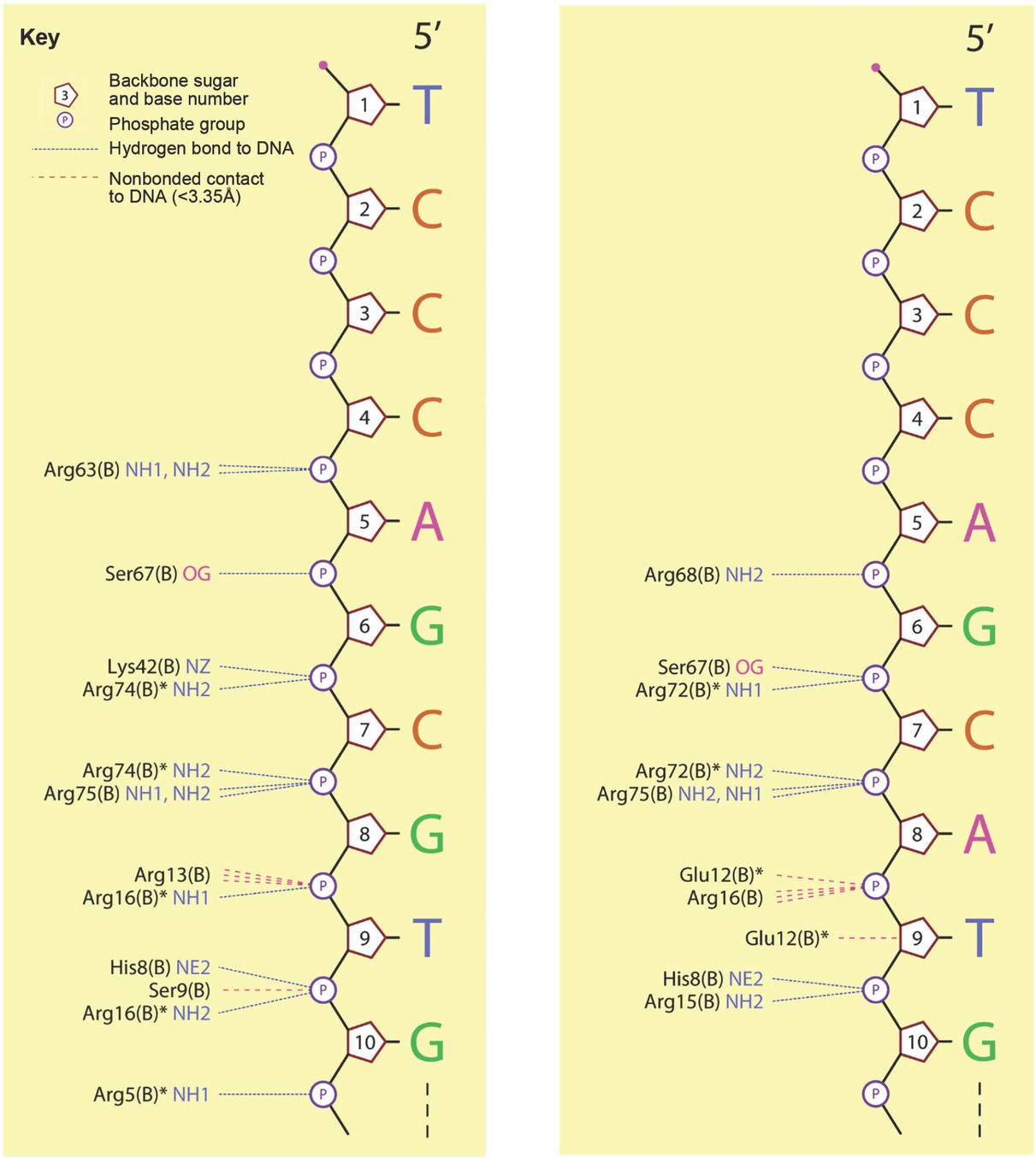
Figure 7
2D schematic representation of DNA–protein contacts observed in the hypoxia-inducible factor 1 (HIF-1) DNA-binding domain using NUCPLOT (version 1.0) [26]. The aryl receptor nuclear translocator (ARNT) subunit corresponds to amino acid residues 1–59, and HIF-1a subunit corresponds to residues 60–116 (or 1–57, arbitrary numbering). Left, G allele–HIF-1 contacts; right, A allele–HIF-1 contacts. C, cytosine brown; A, adenine magenta; T, thymine blue; G, guanine green. (B) indicates the amino acid acting as a ligand, and * indicates strong bonding between amino acids and nucleotides (either favorable or unfavorable contact).
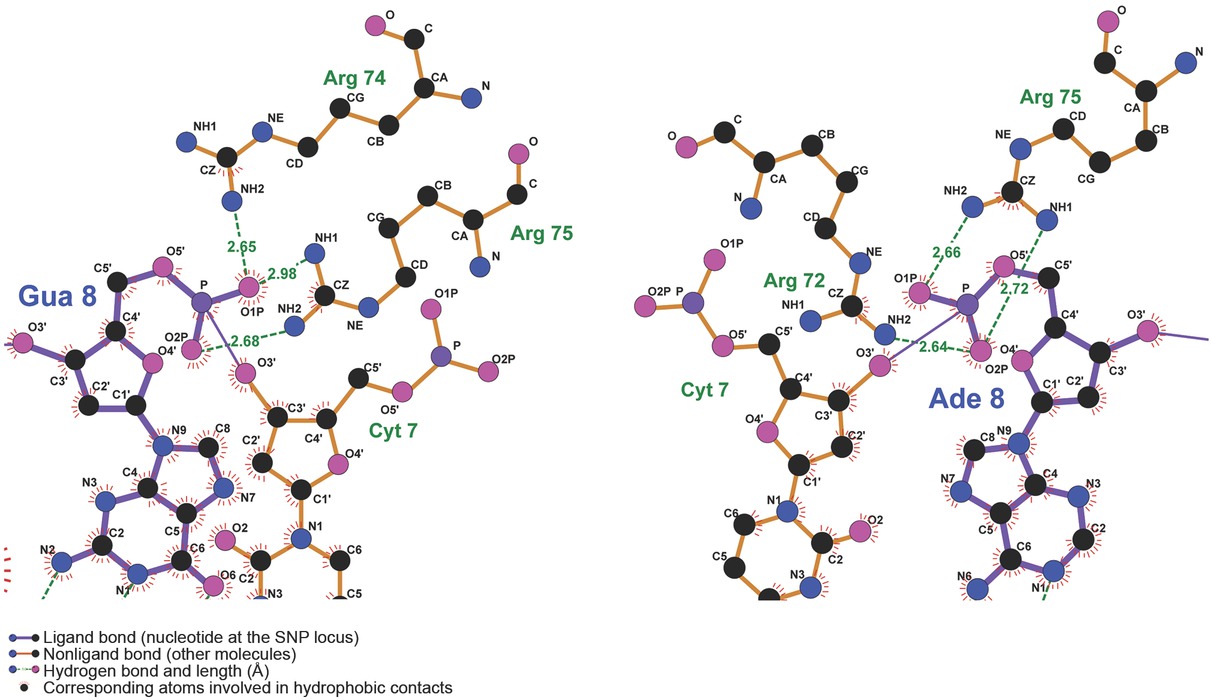
Figure 8
Visualization of hypoxia-inducible factor 1 (HIF-1)–hypoxia-response element DNA at the 8th nucleotide, guanine in G allele (A) and adenine in A allele (B) using LIGPLOT [27] with LigPlot+ (version 2.1) [28]. Here, the G allele (guanine) contacts arginine (Arg) 75 favorably. By contrast, the A allele (adenine) makes less favorable contact with Arg 75. Color key to atoms: carbon, black; nitrogen, blue; oxygen, magenta; phosphorous, purple.
Table 1
Protein–DNA contacts (hydrogen bonds) in the hypoxia-inducible factor 1 (HIF-1) DNA-binding domain complex observed in LIGPLOT [27] and NUCPLOT [26].
| Donor | Acceptor | Distance (Å) |
|---|---|---|
| Hydrogen bonds – G allele | ||
| Arg 63 NH1 | A5 O2P | 2.82 |
| Arg 63 NH2 | A5 O2P | 2.82 |
| Ser 67 OG | G6 O2P | 2.70 |
| Lys 42 NZ | C7 O1P | 2.86 |
| Arg 74 NH2 | C7 O5′ | 2.65 |
| Arg 74 NH2 | G8 O1P | 2.65 |
| Arg 75 NH2 | G8 O2P | 2.68 |
| Arg 75 NH1 | G8 O1P | 2.98 |
| Arg 16 NH1 | T9 O5′ | 2.94 |
| His 8 NE2 | G10 O2P | 2.88 |
| Arg 16 NH2 | G10 O2P | 2.73 |
| Arg 5 NH1 | A11 O2P | 2.74 |
| Arg 2 NH1 | G12 O2P | 2.77 |
| Arg 5 NH2 | G12 N7 | 2.87 |
| Glu 1N | A16 O2P | 2.79 |
| Glu 1N | A16 O1P | 2.72 |
| Arg 68 NH2 | T20 O5′ | 3.00 |
| Arg 68 NE | C21 O2P | 2.68 |
| Lys 64 NZ | C21 O5′ | 2.80 |
| Lys 39 NZ | G27 O5′ | 2.83 |
| Hydrogen bonds – A allele | ||
| Arg 68 NH2 | G6 O2P | 2.94 |
| Ser 67 OG | C7 O1P | 2.87 |
| Arg 72 NH1 | C7 O2P | 2.75 |
| Arg 72 NH2 | A8 O2P | 2.64 |
| Arg 75 NH2 | A8 O1P | 2.66 |
| Arg 75 NH1 | A8 O2P | 2.72 |
| His 8 NE2 | G10 O1P | 2.77 |
| Arg 15 NH2 | G10 O2P | 2.72 |
| Tyr 83 OH | C19 O3′ | 2.86 |
| Arg 2 NH2 | C25 O2P | 2.75 |
| Arg 2 NH1 | C25 O5′ | 2.67 |
| Arg 5 NH2 | T26 O3′ | 2.86 |
| Lys 64 NZ | G28 O1P | 2.64 |
| Ser 60 OG | G29 O5′ | 2.84 |
[i] We analyzed how HIF-1 recognizes the sequence of the hypoxia-response element nucleotides: 6–10. The aryl receptor nuclear translocator subunit corresponds to amino acid residues 1–59 and the HIF-1a subunit to amino acid residues 60–116 (or 1–57, arbitrary numbering) [21]. Typical observed contact in known structures is as follows. G allele: OG of serine (Ser) 67 with O2P of guanine (G) 6 = 2.70 Å (favorable contact), NZ of lysine (Lys) 42 with O1P of cytosine (C) 7 = 2.86 Å, NH2 of arginine (Arg) 74 with O5′ of C7 = 2.65 Å, NH2 of Arg 74 with O1P of G8 = 2.65 Å, NH2 of Arg 75 with O2P of G8 = 2.68 Å (favorable contact), NH1 of Arg 75 with O1P of G8 = 2.98 Å (favorable contact), NH1 of Arg 16 with O5′ of thymine (T) 9 = 2.94 Å, Ne2 of histidine (His) 8 with O2P of G10 = 2.88 Å (favorable contact), and NH2 of Arg 16 with O2P of G10 = 2.73 Å (favorable contact). A allele: NH2 of Arg 68 with O2P of G6 = 2.94 Å, OG of Ser 67 with O1P of C7 = 2.87 Å (favorable contact), NH1 of Arg 72 with O2P of C7 = 2.75 Å, NH2 of Arg 72 with O2P of adenine (A) 8 = 2.64 Å, NH2 of Arg 75 with O1P of A8 = 2.66 Å, NH1 of Arg 75 with O2P of A8 = 2.72 Å, Ne2 of His 8 with O1P of G10 = 2.77 Å (favorable contact), and NH2 of Arg 15 with O2P of G10 = 2.72 Å. G or A alleles. We only analyzed hydrogen bonding between the amino acids and nucleotides that was within 3.0 Å. When HIF-1 bound to the A allele, it formed only 14 H bonds between the HIF-1a/ARNT subunits and the nucleotides. By contrast, the G allele–HIF-1 complex binding included 20 H bonds between HIF-1a/ARNT subunits and the nucleotides (Table 1).