
Figure 1
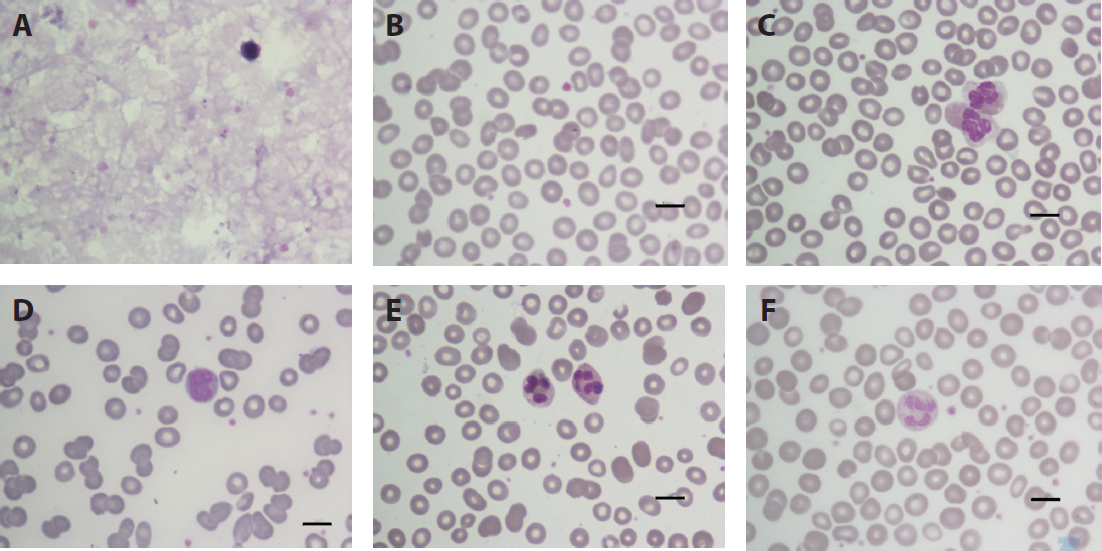
(A and B) Both thick and thin blood films showing a ring form of Plasmodium falciparum parasite with normal finding of red blood cells (RBCs) on the first day of admission. (C) Peripheral blood film from the fourth day after antimalaria treatment. The RBCs, leukocytes, and platelets are normal. (D) Peripheral blood film showing RBCs with autoagglutination and microspherocytosis. (E) On the fifth day after steroid treatment, some clumping of RBCs is seen on peripheral blood film. (F) Peripheral blood film showing RBCs, leukocytes, and platelets are normal at the second week after steroid treatment. All scale bars indicate 10 μm.
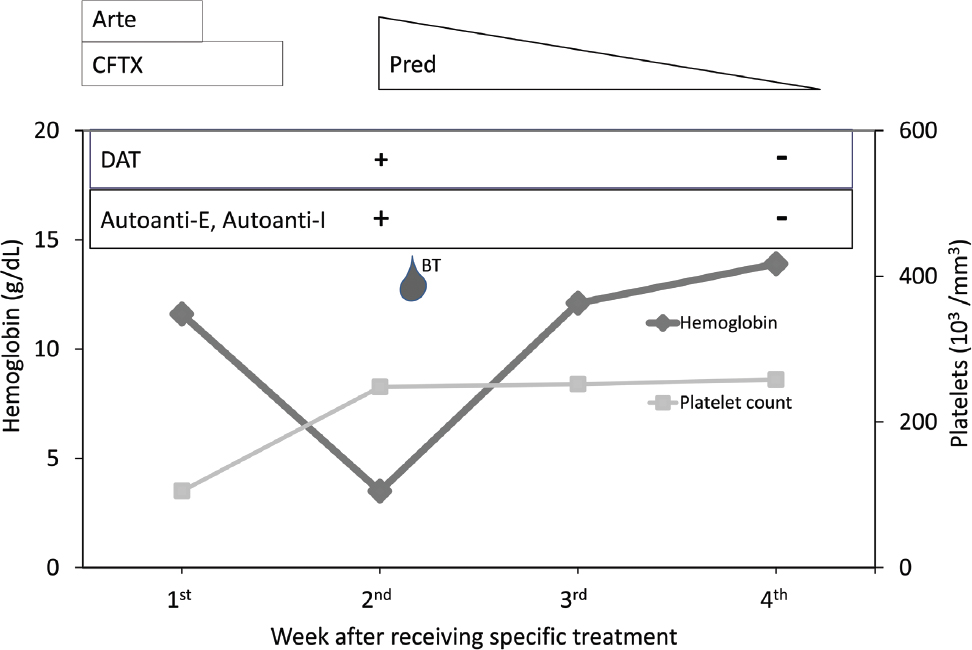
Figure 2
Evolution of autoimmune hemolytic anemia and development of autoantibodies during severe Plasmodium falciparum malaria infection treated with intravenous artesunate.
Table 1
Summary of patients with malaria concomitant with autoimmune hemolytic anemia
| Reference/ | Present | [2] | [3] | [4] | [7] | |||
|---|---|---|---|---|---|---|---|---|
| Characteristic | case (2016) | |||||||
| Age (years) | 42 | 27 | 17 | 15 | 7 | 15 | 7 | |
| Sex | Female | Male | Female | Female | Female | Female | Male | |
| Presenting symptom | Fever | Fever | Fever | Fever | Fever | Fever | Fever | |
| (7 days) | (2 days) | (7 days) | (4 days) | (7 days) | (14 days) | (3 days) | ||
| Malaria infection | P.f | P.f | P.f | P.v. + P.f | P.v. + P.f | P.f | P.v | |
| Anti-malarial | Artesunate | Antimalarial | Artemether/lumefantrine | Artesunate i.v | Artesunate | Artesunate i.v | Chloroquine | |
| regimen (duration) | i.v. (7 days) | treatment | (6 days) and then artesunate | (5 days) | i.v. (5 days) + | (N/A) | (2 days) + primaquine | |
| (unknown) | (2 days) | mefloquine | (14 days) | |||||
| Other antibiotic | Ceftriaxone | N/A | Ceftriaxone, metronidazole | Ceftriaxone | Ceftriaxone | Ceftriaxone | NEG | |
| treatment | gentamicin, piperacillin | doxycycline | ||||||
| ciprofloxacin | ||||||||
| Onset of AIHA (days | 12th | 1st | 14th | 9th | 7th | 11th | 2nd | |
| after antimalarial | ||||||||
| treatment) | ||||||||
| Diagnostic method | ||||||||
| Hemoglobin | 3.5 | Hct. 15.2% | 4.6 | 4.8 | 5.1 | 4.5 | 5.2 | |
| (g/dL) | ||||||||
| Coombs test | POS | NEG | POS | NEG | N/A | NEG | POS | |
| LDH (U/L) | High | N/A | High | High | High | High | N/A | |
| Identify cause | ||||||||
| ANA | NEG | N/A | NEG | NEG | POS | NEG | N/A | |
| CA test POS | CA test POS | |||||||
| Antibody | Autoanti-E | N/A | N/A | N/A | N/A | N/A | Autoanti-I | |
| identification | Autoanti-I | |||||||
| Specific treatment | Predni | No | Methylprednisolone | Prednisolone | Prednisolone | Prednisolone | Prednisolone | |
| for AIHA (dosage) | solone | (60 mg/day × 7 days) | (1 MKD) | (N/A) | (0.5 MKD) | (1 MKD) | ||
| (1 MKD) | Prednisolone (1 MKD) | |||||||
| PRC transfusion | 1 | 0 | 0 | 2 | 3 | 0 | 1 | |
| (unit) | ||||||||
| Duration of recovery | ||||||||
| Malaria infection | 5 | N/A | N/A | N/A | 7 | 11 | 2 | |
| (days) | ||||||||
| AIHA, anemia (days) | 8 | 4 | 7 | 28 | 28 | 56 | 10 | |
| Stop prednisolone | 30 | N/A | 60 | 42 | 28 | N/A | 56 | |
| (days) |
[i] AIHA, autoimmune hemolytic anemia; ANA, antinuclear antigen; CA, cold agglutinin; Hct., hematocrit; i.v., intravenously; LDH, lactate dehydrogenase; MKD, milligram per kilogram per day; N/A, no data available; NEG, negative; P.f., Plasmodium falciparum; PRC, packed red blood cells; POS, positive; P.v., Plasmodium vivax