
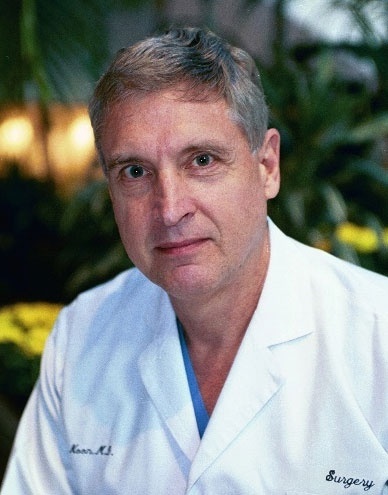
George P. Noon portrait, from the Ory Library.
In Memory of George P. Noon
The “In Memoriam” article by Dr. Jama Jahanyar and Uy Q. Ngo provides an impressive overview of Dr. Noon’s illustrious career.1 Additionally, Dr. Bhimaraj wrote an insightful summary of the history of Houston’s cardiovascular surgery world from Dr. Noon’s perspective in a 2015 interview facilitated by Matthias Loebe, MD, a cardiovascular surgeon who was working with Dr. Noon at the time. The interview, published in the Methodist DeBakey Cardiovascular Journal, presented Dr. Noon’s perspective on Houston Methodist Hospital, which was at that time affiliated with Baylor College of Medicine.2 That interview included a mix of Dr. DeBakey’s adventures while offering insight into the important and essential role that Dr. Noon played on the DeBakey team. The term “team” should be underscored, because partners of Dr. DeBakey—particularly George Noon—were essential to the successes achieved in the days of “The” Methodist Hospital and Baylor College of Medicine.
Quantifying Dr. Noon’s accomplishments while working with Dr. DeBakey and the Methodist Hospital team would be impossible because there were so many. Indeed, the impact Dr. Noon had on his partners, his trainees, his referring colleagues, his administrators, and the Methodist Hospital writ large was palpable. He was a giant. He was innovative, progressive, a dedicated clinician, and an ever-present supporter of the hospital, the affiliated medical school, and the residency and fellowship training programs.
It seemed that Dr. Noon’s virtual thumb was in every pie. Having witnessed Dr. Noon at patient bedsides, in cardiac surgical intensive care and coronary care units, working side-by-side with nurses, cardiologists, other clinicians, his partners, and students, it was clear his forte went far beyond surgery. He was respected and respectful, never rude or demeaning to those around him, and his associates and consultants gave him great praise.
Dr. Noon helped build new programs, and not only surgical ones. Dr. Albert Raizner recalls that when the hospital’s cardiologists traveled to learn percutaneous angioplasty from Andreas Gruntziz and establish their own program, it was Dr. Noon who agreed to serve as the surgical backup for the cardiac catheterization lab. Should any complications arise that required an emergent surgical “bail out,” he would be ready to step in. This willingness exemplified his commitment to progress and teamwork, values fundamental to the profession we all share.
We were also amazed at the breadth of Dr. Noon’s surgical talents. In addition to being a superb and trusted cardiovascular surgeon, he was a “go to” surgeon for thyroidectomy, cancer mastectomy, appendectomy, and vascular surgery during kidney transplant operations. All procedures were considered a service to the patients he cared for. As one story goes, after completing a complex surgery, when one of his patients required urgent vascular access, Dr. Noon was back at the hospital in the middle of the night taking care of it.
Dr. Young’s first interaction with George Noon occurred in 1971, when he was a first-year medical student at Baylor College of Medicine. At the time, Dr. DeBakey had secured a substantial state grant to support a program informally known as “Doctors for Texas,” a three-year fast-track curriculum that could at times feel chaotic. Amid this environment, Dr. Noon emerged as a steadfast champion for the medical students, welcoming them into his operating room and allowing them to accompany him on rounds in the cardiac surgery intensive care unit. He offered an extraordinary educational experience—one in which students were struck, above all, by his gentleness and caring attitude. He was a stupendous role model.
One major effort we joined—and one that Dr. Noon helped lead—was the revival of cardiac transplantation. A multispecialty team was assembled that ultimately became the Multiorgan Transplant Center of Methodist Hospital and Baylor College of Medicine. Although the initiative originated from Dr. DeBakey, it was Dr. Noon, together with his colleague Dr. David Short and other DeBakey team surgeons, who carried the bricks and mortar of its reconstruction.
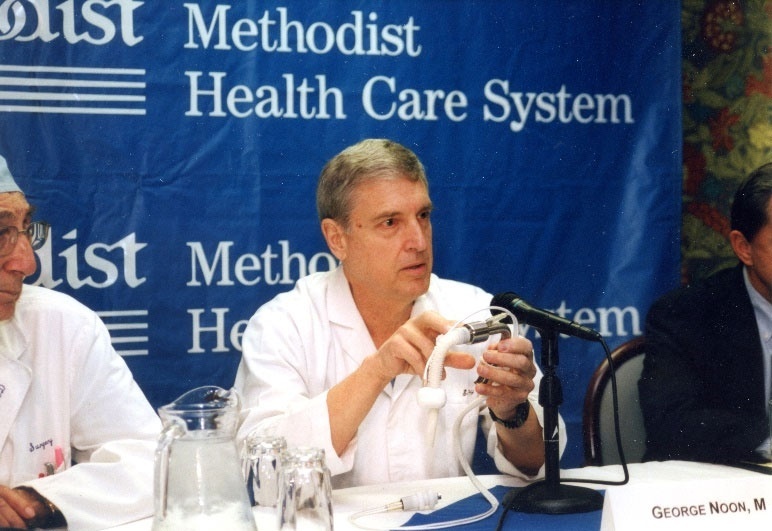
Dr. DeBakey with Dr. Noon, holding LVAD device, taken in 2000s, from the Ory Library.
On February 22, 1984, the second epoch of cardiac transplantation began at Houston Methodist Hospital. Shortly after that, David Saucier, a NASA engineer working on Space Station design, received a heart transplant from the program. At NASA, Saucier had led a team that developed a small, impeller-driven, continuous-flow pump for fluids to be used in space. Saucier had an interest in blood pumps due to spending several weeks in our coronary care unit, using a rudimentary temporary circulatory device in a heroic bid to keep him alive long enough to receive a new heart, which he did. After one of Saucier’s routine post-heart transplant biopsies, a mock-up of the NASA device was shown to Dr. Noon and Dr. DeBakey. Dr Noon embraced the device as a template for the commercialized MicroMed left ventricular assist device (discussed in Dr. Jahanyar and Ngo’s tribute).1,3
The true magic of Dr. Noon’s professional character was the way he treated his patients and colleagues. In the hurly-burley of modern clinical practice, bedside skills are not always what they should be. Dr. Noon’s patient care rounds were, however. He consistently set the standard. Watching him was a master class in clinical medicine, one that shaped generations of trainees and colleagues.
A recent editorial by Harlan Krumholz, MD, editor of the Journal of the American College of Cardiology, serves as a template for understanding the skills demonstrated when Dr. Noon made patient care rounds in the hospital and in his clinics.4 Krumholz lays out five “practices of skilled physicians.”
An annotated summary of skills needed during a caregiver’s patient encounters begins with making sure the patient and family understand what is happening. Second, the physician must discuss and name uncertainty honestly. It is imperative that the patient and family understand the risks and benefits of surgical interventions and treatments. Third, the caregiver must understand and treat the family as a secondary patient. The fourth skill is to realize that there are challenges and uncertainty when predicting outcomes. And the fifth is to acknowledge that there is more to a patient’s and family’s story than the problem being addressed in the clinic or hospital during rounds.
Long before the Krumholz essay, Dr. Noon exemplified these skills, passing them on to students, trainees, and colleagues during rounds. As a role model who embodied these principles, he ensured that those who trained under him learned to carry them forward as well. Indeed, in 2010, George P. Noon became the inaugural recipient of Houston Methodist Hospital’s Leading Hearts Award—an honor subsequently renamed the George P. Noon Award in recognition of his remarkable skills and enduring contributions.5
Finally, Dr. Noon was a calm, gentle presence, carrying a quiet sense of humor throughout his life. Dr. Bhimaraj fondly recalls a conversation with him a few years ago during his visit to the George P. Noon Conference, the signature educational event presented by the Houston Methodist J.C. Walter Jr. Transplant Center. When Dr. Bhimaraj described the tremendous growth of the heart transplant program—and the strain it placed on the surgeons as hiring the right talent inevitably lags—Dr. Noon looked up from his wheelchair and, in a meek voice, replied, “Why didn’t you call me, I could have been your transplant surgeon!” before breaking into a huge smile.
Dr. Noon has left an unprecedented legacy, impacting a generational wealth of training with resounding effects on our culture and society. He will be missed.