
Concord Hymn
By the rude bridge that arched the flood,
Their flag to April’s breeze unfurled,
Here once the embattled farmers stood
And fired the shot heard round the world.
The foe long since in silence slept;
Alike the conqueror silent sleeps;
And Time the ruined bridge has swept
Down the dark stream which seaward creeps.
On this green bank, by this soft stream,
We set today a votive stone;
That memory may their deed redeem,
When like our sires, our sons are gone.
Spirit, that made those heroes dare
To die, and leave their children free,
Bid time and Nature gently spare
The shaft we rise to them and thee.
Ralph Waldo Emerson, 1837.
This work is in the public domain.1
Commentary
The American Revolutionary War began on April 19, 1775, in what is now Minute Man National Historical Park, which stretches through Lexington, Lincoln, and Concord, Massachusetts. British casualties totaled 273 (73 killed) and colonial casualties were 95 (49 killed), with the battle being fought along Bay Road from Boston to Concord for at least 16 miles. The concept of a monument to this battle arose during the 50th anniversary of the Revolutionary War in 1825, but it was not completed until 1836 and was finally dedicated in 1837. The July 10th issue of that year’s Boston Courier described the event as “a scene calling forth sensations mingled with joy and sadness.”1,2,3
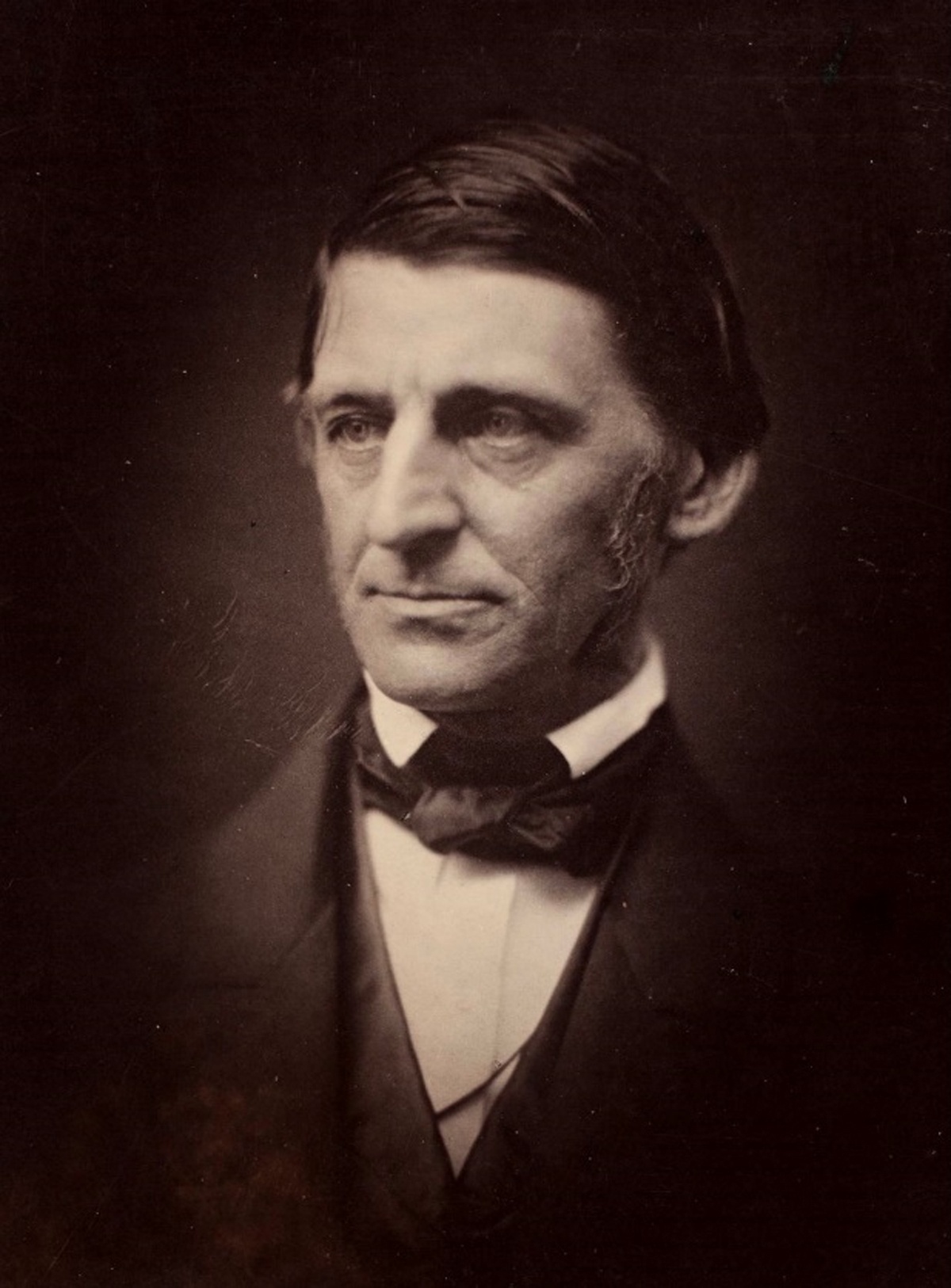
Ralph Waldo Emerson, albumen print by J. J. Hawes, copied from an 1857 daguerreotype portrait by A. S. Southworth & J. J. Hawes, 1880. In the George Eastman Museum, Rochester, New York. In the public domain.
These events were not without their controversies, however, which in retrospect seem similar to present day discussions about a golden triumphal arch in Washington, D.C., to mark the nation’s two-and-a-half-century anniversary. Local citizens of Concord wanted the monument to be in the center of their town, which was a distance from the North Bridge Battleground site. Its famous bridge, as Ralph Waldo Emerson’s second stanza suggests, had disintegrated many years before the memorial was built and dedicated. Nonetheless, it was there that the monument would ultimately be placed after prolonged and protracted fundraising efforts. Solomon Willard, the supervisor of construction, had overseen erection of Boston’s Bunker Hill Monument, which was much higher than the 1836 Concord North Bridge Memorial.
Emerson was chosen to create a commemorative poem for the dedication event on July 4, 1837. What resulted was “Hymn: Sung at the Completion of the Concord Monument,” comprised of 16 lines and four stanzas of iambic tetrameter with a simple ABAB rhyme scheme, including the iconic lines: “Here once the embattled farmers stood/And fired the shot heard round the world.” It was sung by those present to the melody of “Old Hundredth,” a prominent psalmist tune that would have been an appropriate choice in light of Emerson’s audience and religious inclination.
In much the same way, the author himself was a sensible selection for this work given that by 1837 he was a prominent writer and a much-respected academician. Emerson was steeped in the culture of Boston and the East coast, having moved to Concord in 1834 to a home located near the battlefield. It was there, on April 19, 1775, that his grandfather had witnessed the skirmish from the vantage point of the North Bridge. William Emerson Sr. was an American patriot and Congregational minister in Concord, both attributes that would have a lasting impact on his grandson more than 5 decades later.
From the time of the monument’s completion, Ralph Waldo Emerson’s academic, spiritual, and literary reputations would continue to burgeon, leading him to be described as the chief figure in American Transcendentalism. Spirituality and philosophical intensity seem to have driven much of what became Emerson’s persona, which was also greatly impacted by his education and familial immersion in Protestant religious doctrine. He studied theology at Harvard Divinity School and became an ordained preacher in Boston until the tragic death of his first wife, after which an emotionally distraught Emerson resigned his church commission and travelled abroad in 1832. He landed in Europe in 1833, where he would hobnob with Samuel Taylor Coleridge, William Wordsworth, and Thomas Carlyle, with whom conversations would inform his quasi-religious understanding and later influence the American school of Transcendentalism.
This 19th century movement within the literary, philosophical, and spiritual academic spheres emphasized intuition, individualism, and the inherent goodness of people as well as the natural world. He espoused these principles within many of his writings, perhaps most notably in his essay titled “Nature,” which has been described in terms of mystic realism and has proved immensely important to a large cohort of American and European audiences. Emerson returned to the United States later in 1833, moving to Concord the following year and remarrying in 1835. After a long and distinguished career as an author and public figure, he succumbed to pneumonia after becoming frail with generalized declining health and memory loss. He died in his home on April 27, 1882, just one month shy of his 79th birthday.
The site of the 1836 Battle Monument became part of the Minute Man National Historical Park when it was established in 1959. This brought the grounds under the purview of the National Park Service, which was instituted by President Ulysses S. Grant and the 42nd Congress on March 1, 1872. The memorial has thereby been preserved and can still be seen today, a token of gratitude in the heart of a thankful nation for the “Spirit, that made those heroes dare” and which will continue to carry our nation through its 250th anniversary and beyond.
Disclaimer
The views expressed are solely those of the authors and do not reflect the official policy or position of the US Army, US Navy, US Air Force, the Department of Defense, the US Government, or Houston Methodist Hospital.