
Introduction
Atherosclerosis, the cause of coronary artery disease (CAD), is highly prevalent throughout the world,1 and cardiovascular disease in general accounted for 20.5 million deaths in 2021.2 The development of atherosclerosis in vessels throughout the body is unintended and incidental to normal living. Cholesterol, the main culprit causing atherosclerosis, is synthesized by all cells of the body at the time of need.3,4,5 Cholesterol synthesized beyond the cell’s needs is deleterious if left to accumulate inside the cell.6,7,8 When this occurs, the excess is dumped into the circulation to avoid cell injury. It is then transferred to the liver to be disposed of as part of the body’s normal garbage disposal system. The presence of cholesterol in the circulation exposes blood vessels to penetration by low-density lipoproteins (LDL), which transfer cholesterol into the vessel wall to serve as substrate for atherosclerosis. Scientific, epidemiological, and clinical studies have documented that CAD is directly proportional to the concentration of plasma LDL-C.9,10 Recent studies have also shown that both plasma LDL-C concentration and the length of time a person is exposed to it contribute to risk, with coronary disease risk doubling for every extra decade of LDL-C exposure.11 Conventional risk factors such as hypertension or diabetes, when present, are effective in selecting individuals at increased risk for CAD. However, the conventional risk factors are age dependent and not usually present in young asymptomatic individuals.12,13,14,15,16 Genetic risk for CAD is independent of age, relatively independent of conventional risk factors, and has several complementary features.17,18,19,20 The combination of conventional and genetic risk stratification for CAD, if adopted into clinical practice, would be complementary and provide for more comprehensive screening, particularly in the detection of young asymptomatic individuals who are candidates for early primary prevention of CAD.
Coronary Atherosclerosis has a Long Subclinical Phase
The process of coronary atherosclerosis begins during the first decade of life. Fatty streaks, which are usually the early lesion associated with atherosclerosis, have been observed in young teenagers based on autopsies of soldiers dying during combat in the Korean War21 as well as children and teenagers dying from trauma.22 Berenson et al. published the results of autopsies performed on 204 individuals aged 2 to 39 years.23 They observed fatty streaks in the aorta and coronary vessels, which increased with age and were more severe in individuals with an increased number of conventional risk factors for CAD. The process of coronary atherosclerosis develops very gradually but is relentless in continuing to accumulate without clinical manifestations, referred to as the subclinical phase. Clinical manifestations, such as myocardial infarction, angina, or sudden death, are uncommon through the fifth decade, with only a 1% incidence of myocardial infarction in males.24 The peak incidence of myocardial infarction in males is in the sixth decade, around 58 years of age, whereas the peak incidence in females is delayed until 68 years of age.
The reason clinical manifestations of CAD appear later in females is not fully understood. The leading hypothesis points to the protective influence of reproductive hormones, as the decline in these hormones during menopause coincides with the emergence of CAD symptoms. Although the exact etiology remains unknown, the delay in clinical presentation appears to stem from slower progression of subclinical atherosclerosis. This was demonstrated in a study of 500 pre- and peri-menopausal women without heart disease, where coronary CT angiography (CCTA)—the most sensitive imaging method for detecting subclinical coronary atherosclerosis—showed a later onset of disease progression.25 Ultimately, the aim of primary prevention is to slow this subclinical atherosclerotic process.
CAD Risk in Cholesterol Years
The risk of CAD from LDL-C and the threshold at which subclinical atherosclerosis begins to manifest clinical symptoms is determined by both blood plasma concentration and the duration of exposure. Several investigators have attempted to capture the combined risk in a single numerical term, which is the product of the plasma LDL-C concentration times the age of the individual in years expressed in milligram years.26,27,28 For example, someone with a plasma LDL-C of 100 mg/dL at age 40 would have 40 × 100 mg, which equals 4,000 mg years of exposure to cholesterol.
In primary prevention, it is important to have some approximation of the minimal cholesterol threshold required to initiate clinical features. The incidence of myocardial infarction in US males is low in the fourth decade, at only 1%. The average plasma concentration of LDL-C in untreated US males varies widely; in one study, it varied from 125 mg/dL to 146 mg/dL.29 Based on these observations, an age of 40 years times a plasma concentration of 120 mg/dL gives a product of 5,000 mg years. Thus, it is reasonable to assume that 5,000 mg years approximates a threshold that is the minimum required to proceed from a subclinical stage of coronary atherosclerosis to that of clinical manifestation (Figure 1). Once the clinical threshold is reached, manifestations appear and progress quickly, with risk doubling every decade—rising from a 2% incidence of myocardial infarction in the sixth decade (6,250 mg-years) to 4% in the seventh (7,500 mg-years) and 8% in the eighth (8,750 mg-years).24
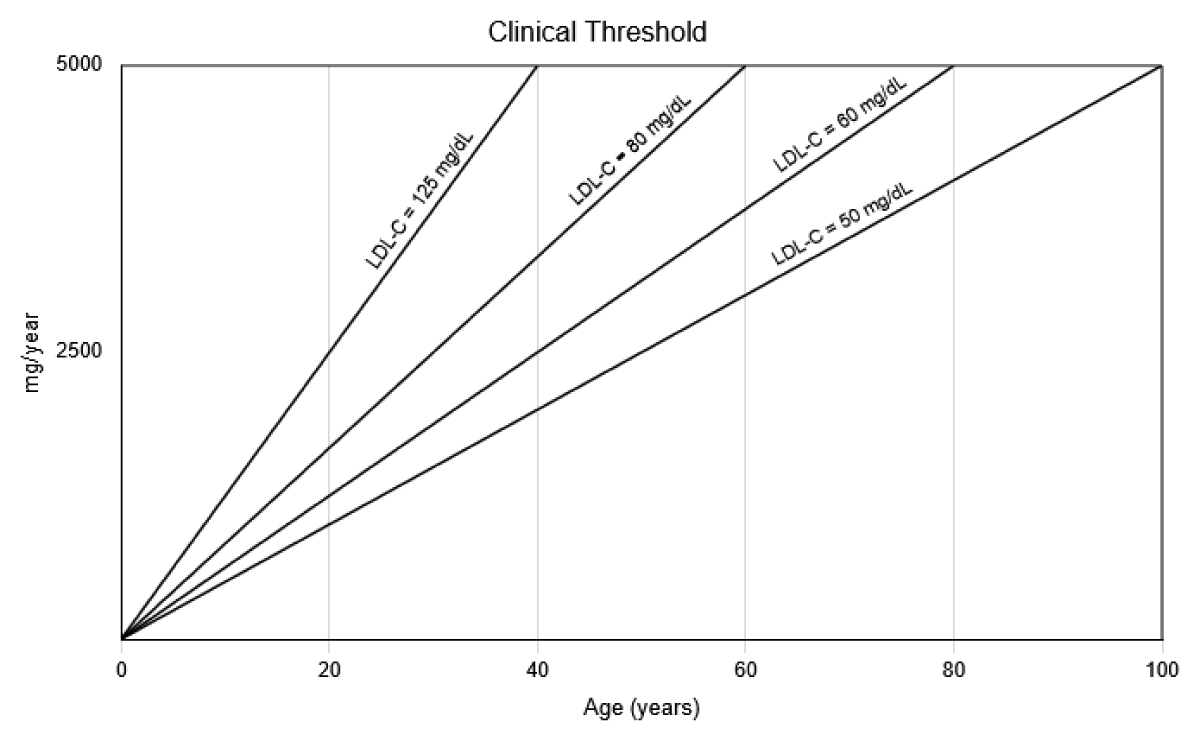
Figure 1
Showing on the ordinate is LDL-C in milligram years. 5,000 mg-years designates the minimum clinical threshold required for coronary atherosclerosis to induce symptoms. Showing on the abscissa is the chronological age in years. A plasma LDL-C of 125 mg-dL after 40 years of exposure is enough to break through the clinical threshold. In contrast, a plasma LDL-C of 80 mg/dL requires exposure up to age 60 to reach the clinical threshold. Decreasing the plasma LDL-C to 50 mg/dL requires exposure to age 100 years before clinical symptoms appear. Thus it is theoretically possible to delay the onset of the first myocardial infarction until age 100 years. LDL-C: low-density lipoprotein cholesterol
The goal for primary prevention is to delay the minimal clinical threshold as long as possible. If someone maintains a plasma LDL-C concentration of 80 mg/dL, they would reach the mg years threshold of 4,800 at age 80, which is still lower than the minimum threshold required for myocardial infarction. It is thus conceivable that if one decreased their plasma LDL-C to 50 mg/dL at age 30 and maintained it, this would delay the clinical threshold for myocardial infarction until age 100 years (Figure 1). In males, it would be prudent to initiate lowering plasma LDL-C in their 20s, definitely not later than their 30s, to achieve these goals. Females could potentially wait until their 30s or 40s since the onset of myocardial infarction is delayed by about 10 years. It is a gross oversimplification to assume that the only factor involved with cardiovascular disease is cholesterol. Lowering plasma LDL-C must also be accompanied by a healthy lifestyle, including diet and exercise. Nevertheless, the armamentarium available today through primary prevention can significantly delay the onset of cardiovascular symptoms.
The Limitations of Current Clinical Guidelines for Primary Prevention of CAD
The identification of several factors that increase the risk of CAD emerged in the 1960s, largely from studies conducted in the Framingham population. These risk factors were subsequently codified by cardiac societies such as the American Heart Association (AHA), the American College of Cardiology (ACC), and the European Society of Cardiology (ESC). In an attempt to direct preventative measures to those at highest risk for CAD and those who would benefit the most, the AHA formulated pooled cohort equations (PCE). Using these equations and the number of conventional risk factors present, it is possible to calculate an individual’s 10 year risk for a cardiac event. If the risk was equal to or greater than 7.5%, primary prevention was recommended. In individuals who already had CAD, conventional risk factors were the pillars on which therapy was initiated to prevent further events.
The application and follow through on these clinical guidelines produced a 50% reduction in cardiac events over a 30-year period.30 Randomized placebo-controlled clinical trials performed assessing the effect of statins in lowering plasma LDL-C confirmed a consistent decrease in cardiac morbidity and mortality.31,32,33 Meta-analyses of multiple trials showed a 20% decrease in cardiac events for each millimole (38.7 mg/dL) decrease in plasma LDL-C. This reduction in cardiac events per unit decrease in plasma LDL-C was observed regardless of the method used to lower LDL-C, whether statins, PCSK9 inhibitors, or ezetamide.34
Risk stratification for CAD based on conventional risk factors has had a profound effect on the prevention and treatment of CAD and will continue to be critically important. Nevertheless, PCE is less than adequate as a means to risk stratify for early primary prevention of CAD.12,13,14,15 The first restriction is the dependence of PCE on conventional risk factors such as diabetes, hypertension, and others. These factors are often not present until the fifth or sixth decade of life, which is late for primary prevention. Second, the PCE method was set up to screen for individuals between the ages of 40 and 70 years. We now know that by age 30 or 40, there is already considerable subclinical atherosclerosis present. Third, the sensitivity of PCE to predict cardiac events is highly dependent on age. Fourth, it would be more appropriate to predict cardiac event rate over a lifetime or at least over 30 years rather than just 10 years.
These limitations of PCE are illustrated in the case of a 40-year-old female with a single risk factor of 180 mg/dL LDL-C with no other risk factors. In her case, the calculated 10-year risk for a cardiac event is 2.1%. This would indicate that no further treatment is needed despite an LDL-C of 180 mg/dL. One may make the case that this is a missed opportunity in someone with hyperlipidemia at an early age who would benefit from aggressive, lipid-lowering therapy. The same person at age 60, with the same single risk factor of a 180 mg/dL LDL-C now has a 9.2% 10-year risk of a cardiac event simply due to increased age.
This lack of sensitivity of the PCE method based on conventional risk factors is emphasized in a recent retrospective study of 2,733 individuals with premature acute myocardial infarction (earlier than age 55).13 Retrospective risk stratification for CAD using PCE showed that only 39.4% of these patients would qualify for primary prevention.14
Discovery of DNA Risk Variants Predisposing to CAD
Genetic studies in twins have long shown that genetic predisposition accounts for about 50% of CAD risk.35 However, the technology to discover the DNA variants responsible for transmitting CAD risk was not available until about 2005,36 when the HapMap project identified millions of single nucleotide polymorphisms (SNPs) that were distributed throughout the human genome.37 These SNPs as DNA markers enabled the first genome-wide association studies (GWAS).37
Utilizing markers distributed throughout the genome enabled one to search for DNA variants exhibiting an association with a particular disease. To perform a GWAS requires sample sizes of several thousand individuals with the disease as well as several thousand without the disease to serve as controls.17 In 2007, with a sample size of 23,000 cases and controls, McPherson et al.38 and Helgadottir et al.39 independently discovered the first genetic risk variant for CAD, referred to as 9p21. Shortly thereafter, in an independent population of 17,000, the Wellcome Trust group confirmed 9p21 as a risk variant for CAD.40 9p21 was confirmed to be a risk factor for CAD throughout most of the world and estimated to be present in about 75% of the population.36 This risk variant was independent of the risk associated with conventional risk factors.41
Under the leadership of investigators Schunkert, Samani, and others, an international consortium was developed to pursue the discovery of genetic risk variants predisposing to CAD.42 This ultimately led to one of the largest international collaborations in cardiology—CARDIoGRAM (coronary artery disease, genome-wide, replication, and meta-analysis)—which later expanded with additional partners into CARDIoGRAMplusC4D. This consortium is continuing to perform GWAS in pursuit of CAD risk variants with a sample size of over 1 million and,43 along with several other investigators, has identified over 300 genetic risk variants predisposing to CAD. The results and analysis of these studies have been the subject of several reviews.17,18,44,45
Development and Validation of a Polygenic Risk Score for CAD
DNA risk variants can be encrypted on a microchip, and the number of risk variants per individual is determined by genotyping their DNA from blood, tissue, urine or saliva. The total number of DNA risk variants predisposing to CAD inherited by an individual is expressed in a single number, referred to as a polygenic risk score (PRS). The sensitivity and accuracy of a PRS has been evaluated retrospectively in several clinical trials. The first of these studies was by Mega et al.46 using a microchip containing 27 genetic risk variants for CAD in a sample size of 48,004. This study was a randomized placebo controlled clinical trial to assess the effect of statin therapy on cardiac events. The PRS was performed retrospectively from stored blood samples, and the individuals with the highest PRS had the highest risk for CAD. The capacity for PRS to predict cardiac events is independent of traditional risk factors. The individuals with the highest PRS also received the most benefit from statin therapy. The second study—the West of Scotland Coronary Prevention Study—genotyped 57 genetic variants associated with CAD risk.47 Individuals receiving statin therapy with the highest PRS score had a 44% reduction in cardiac events versus a 24% reduction in the intermediate and low genetic risk groups. In the high-PRS group, the number of treated patients required to prevent one cardiac event was 13, compared with 38 among individuals with intermediate or low PRS. Other retrospective studies have assessed the effect of PCSK9 inhibitors on cardiac events. The FOURIER trial48 (further cardiovascular outcomes research with PCSK9 inhibition in subjects with elevated risk) were genotyped using a microchip with 6 million SNPs. Patients with the highest PRS score were at high risk for CAD and also experienced the greatest benefit from decreasing plasma LDL-C. The ODYSSEY trial49 (evaluation of cardiovascular outcomes after an acute coronary syndrome during treatment with alirocumab) had a sample size of 11,953 patients. DNA was genotyped using a microchip with 6 million SNPs. Individuals with the highest PRS score had the highest risk for CAD. There was a 37% reduction in cardiac events by PCSK9 inhibitors in the high genetic risk group versus 13% in the low genetic risk group. These studies consistently indicated the PRS to be superior and independent of traditional risk factors.
To further assess the predictive accuracy of the PRS for CAD risk stratification, investigators genotyped populations drawn from multiple biobanks. Using a microarray with 1.7 million SNPs, Inouye et al.50 genotyped a population of 500,000 individuals from the UK biobank and observed that individuals ranked in the top 20% of the PRS had a fourfold increased risk for CAD. A separate group led by Khera et al.51 using a micro array containing 6.7 million SNPs genotyped a population of 288,978 individuals from the same UK bio bank. They observed that the top 8% of the PRS had a threefold increased risk for CAD while the top 5% of the PRS had a fivefold increased risk. It is worth noting that of those with a high PRS indicating high risk for CAD, only 20% had hypercholesterolemia, 28% had hypertension, and 35% had a family history of CAD. Risk stratification using the PCE approach based on these conventional risk factors would have detected less than half of the individuals at high risk for CAD.
Genetic Risk for CAD is Mitigated by a Favorable Lifestyle and Increased Physical Activity
Four prospective cohorts totaling a sample size of 55,685 individuals underwent genetic risk stratification for CAD using the PRS.52 The overall objective of the study was to compare a favorable lifestyle (no current smoking, no obesity, regular physical activity, and a healthy diet) to an unhealthy lifestyle (at least two unfavorable features). Individuals in the top 20% of the PRS had a 90% higher risk of cardiac events than the remainder. In the group with the highest PRS and a favorable lifestyle, there were 46% fewer cardiac events than in those with a high PRS and an unfavorable lifestyle. Tikkanen et al.53 genotyped 500,000 individuals from the UK bio bank and subsequently underwent genetic stratification for CAD based on the PRS. Those with the highest PRS and the highest fitness had a 49% decrease in risk for CAD.
Unique Advantages of the Polygenic Risk Score Complementing Conventional Risk Stratification
The PRS has been evaluated in more than 1 million individuals as a tool for CAD risk stratification. Those in the top 20% of the PRS carry up to a threefold increase in CAD risk. Individuals with a high PRS—reflecting elevated genetic susceptibility—also respond favorably to lifestyle modification and lipid-lowering therapy.
Conventional risk factors are most informative for individuals in their sixth or seventh decade of life. In contrast, PRS-based risk stratification is equally applicable to young, asymptomatic individuals, including children and teenagers, making it a complementary tool to traditional approaches. Optimal CAD risk assessment should therefore integrate both conventional and genetic risk, as reviewed in detail by Li et al. and Samani et al.54,55
Because the genetic risk captured by the PRS is randomly assigned at conception, it can be determined at birth and does not change throughout life, eliminating the need for repeat blood sampling. DNA remains stable for extended periods and can be shipped long distances for analysis, with per-sample costs likely comparable to routine laboratory testing ($200-$300). Across studies evaluating PRS for CAD risk stratification, genetic risk has consistently shown relative independence from conventional risk factors. As a result, optimal preventive management must incorporate both genetic and acquired risk to accurately identify individuals who stand to benefit most.
Primary Prevention: The Earlier the Better
We previously discussed the long subclinical phase of CAD, which spans at least three to four decades before clinical manifestations appear. The ideal time to initiate primary prevention is during this phase, and it is reasonable to expect that the earlier one intervenes, the more effective prevention would be in delaying the accumulation of mg-years needed to reach the minimal clinical threshold of 5,000 mg years of cholesterol exposure. Substantial scientific evidence supports that earlier application of primary prevention is more effective.
The recent discovery of the PCSK9 gene showed that a gain-of-function mutation is associated with higher plasma LDL-C levels and premature CAD.56 In contrast, a loss-of-function mutation in PCSK9 leads to low plasma LDL-C levels and an 80% reduction in the CAD risk.57 Lifelong exposure to low plasma LDL-C from birth is therefore associated with substantial protection from CAD. Ference et al.28 used Mendelian randomization58 to examine nine DNA variants associated with decreased plasma LDL-C. These variants, randomized at conception, maintain lower plasma LDL-C throughout an individual’s lifetime. In a population with a mean age of 50 years, they observed a 54.5% reduction in cardiac risk for each millimole decrease in plasma LDL-C. A millimole corresponds to 38.7 mg/dL of LDL-C. This reduction is markedly greater than the ~20% decrease in cardiac events per millimole of LDL-C lowering typically seen in clinical trials.
These clinical trials enroll individuals typically in their sixth or seventh decade of life, and the duration of prevention is lasts between 3 to 5 years. At this age, the subclinical phase of atherosclerosis is considerably advanced. Thus, there is a threefold greater reduction in cardiac events per millimole reduction in LDL-C when the lowering of plasma LDL-C is initiated at birth. In a previous follow-up study11 of a Framingham offspring cohort, investigators observed that cardiac risk increases about 10% per year for each additional year of exposure to plasma LDL-C. All of these studies indicate that the earlier prevention is initiated, the greater the reduction in cardiac risk from reducing plasma LDL-C.
Regulatory, Ethical, and Scientific Issues
PRS testing raises regulatory and ethical concerns that are not well captured by outdated regulatory frameworks designed for either monogenic diagnostics or routine laboratory testing. Unlike classic single-gene testing, PRS is typically probabilistic, often aimed at asymptomatic individuals, and estimates disease susceptibility by aggregating the effect of multiple common genetic variants to inform preventive care at population scale. That combination magnifies concerns about discrimination, data abuse, insufficient quality, and scientific accuracy standards in relation to the resulting genetic profile this type of algorithmic testing generates.
Genetic Discrimination
Fears that predictive genetic information may be used against individuals—for insurance eligibility or premium setting, or in employment decisions—remain a genuine barrier to uptake. In the United States, these concerns led to the passage of the Genetic Information Nondiscrimination Act (GINA) in 2008, which makes it illegal for health insurers and employers to use genetic information. Although a major step forward, GINA is incomplete in scope: it does not cover other forms of insurance such as life, disability or long-term care; and Title II, which prohibits employment discrimination based on genetic information, applies only to employers with 15 or more employees. Moreover, unlike Title II, Title I—which governs health coverage—is enforceable only by the federal government and does not create a private right of action for individuals whose data are disclosed. GINA’s protections also extend only to asymptomatic individuals. The Affordable Care Act (2010) later barred insurers from denying coverage or charging more because of preexisting conditions, but major gaps in protection persist.59,60,61,62,63,64
Some states have enacted their own laws, but many define “genetic information” more narrowly, creating loopholes that companies can exploit. In almost all of these states—Florida being the notable exception—insurers may use genetic information for underwriting if the findings can be sufficiently linked to an increased risk of developing a disease or disorder. Because PRS can identify statistically elevated risk in otherwise healthy people long before disease manifests, if it ever does, that gap is especially troubling.59,62,63,64
Informed Consent
Informed consent is not an adequate or ethical solution to these concerns. Many of the US state laws prohibit decisions based on genetic information unless the individual consents. However, when consent becomes a condition for obtaining insurance or employment, refusal is impractical, and consent, whether informed or not, becomes coercive. Prince and Eckel underscore this point: when an applicant must waive confidentiality, allow access to medical records, or accept testing as the price of coverage, consent becomes a procedural formality rather than meaningful control. The same structural concern applies wherever economic dependency undermines voluntariness.
For PRS, the problem is intensified because the information is probabilistic, of uncertain predictive accuracy, and inherently relational; it often applies to biologically related family members as well. Substantive regulation that prohibits or tightly restricts insurer and employer use of genotypes without exception would provide a more ethical and effective legal framework.59,62
Data Protection
Fears of inadequate data protection—leading to unauthorized access or downstream commercial selling of sensitive genetic data—remain a key concern. GINA brings genetic information within the Health Insurance Portability and Accountability Act (HIPPA) privacy framework in limited contexts, but HIPAA applies only to covered entities and certain business associates, leaving many situations in which genomic PRS data may fall outside its regulatory scope. Moreover, HIPAA does not create a private right of action for affected individuals.65 Enforcement is principally administrative through the US Health and Human Services Office for Civil Rights, with supplementary enforcement by state attorneys general.
Ethical and Scientific Concerns
At present, clinical use of PRS-CAD disproportionately benefits individuals of European ancestry because predictive performance is generally weaker in underrepresented ancestral populations. This reflects, in part, the composition of the datasets on which many PRS models were developed: the DNA risk variants encrypted on the microchip used to determine the PRS were identified in a population of which 85% were of European descent.17 It is also recognized that some CAD-associated variants may be unique to specific ethnic, racial, or geographical groups, meaning that PRS developed primarily in European populations may omit ancestry-specific contributors to risk. That gap is now being actively addressed through more diverse cohort development, including initiatives such as the National Institutes of Health All of Us program66 and the Million Veteran Program, which enrolled 625,989 individuals, 29% of whom were of non-European ancestry.67 In South Asians, Wang et al.68 observed that although most CAD risk variants overlap with those identified in European-ancestry cohorts, additional ancestry-specific variants may improve calibration and performance when incorporated into PRS models for South Asians.
PRS Enables Early Risk Stratification for Annual Vaccine
Despite the safety and efficacy of statin therapy in preventing CAD, less than one half of individuals at increased risk for CAD with hyperlipidemia are being treated with lipid lowering therapy.69 A major reason is lack of compliance, driven in part by the absence of symptoms from hyperlipidemia. One future approach to improve compliance is the use of long-acting injectable therapies. The current model is inclisiran, a small interfering RNA molecule with a long half-life that is administered by subcutaneous injection.70 Inclisiran lowers plasma LDL-C by inhibiting expression of the gene encoding PCSK9 and is approved in Europe and North America for the treatment of familial hyperlipidemia. In the ORION-1 trial,71 a single 300-mg dose reduced plasma LDL-C by 30% to 39% at 1 year.
It would be appropriate to use PRS to screen for CAD risk in young asymptomatic individuals in their teens, 20s, or 30s. Those identified as high risk could receive an annual injection of inclisiran to maintain a reduced plasma LDL-C level. If the LDL-C is maintained around 50 mg/dL, it would be expected to delay reaching the clinical threshold—primarily the onset of CAD symptoms—until approximately age 100 years (50 × 90 = 5000 mg years) (Figure 1).72
Clinical Concerns of the Polygenic Risk Score
Despite broad acceptance that genetic risk may account for up to 50% of the predisposition for CAD, genetic risk stratification is not approved for clinical practice. Nevertheless, recent guidelines do recognize the PRS and suggest that it may eventually be used to both initiate and intensify lipid-lowering therapy.73 The ESC is likewise evaluating the potential role of PRS in selected subgroups.74
Many physicians feel inadequately prepared to address genetic predisposition for CAD, and some still cling to the misconception that genetic risk implies inevitability—that “if it’s in your genes, nothing can be done.” The interaction of genetic factors with acquired and environmental influences may also modify the PRS, but the extent of this effect is currently unknown.
Conclusion
Primary prevention of CAD is more efficacious when initiated early. Risk stratification using PCE is inadequate for early primary prevention because the conventional risk factors on which it is based are age dependent and often not present until the fifth or sixth decade. In contrast, genetic risk—which accounts for about 50% of CAD predisposition—is randomly assigned at conception and remains the same throughout life. The polygenic risk score, based on the number of inherited genetic risk variants for CAD, has been validated in over 1 million individuals, with the top 20% associated with a one- to threefold increase in CAD. Because genetic risk is relatively independent of conventional risk, PRS is complementary to traditional assessment.
PRS stratification is most appropriate in young, asymptomatic individuals and should be used alongside the PCE, which is better suited for those in their fifth decade and beyond. Individuals identified as high risk in their 20s or 30s could receive an annual injection of a long-acting agent such as inclisiran, potentially delaying the onset of myocardial infarction until 80 or 90 years of age.
Key Points
Primary prevention of coronary artery disease (CAD) is two- to threefold more effective if initiated early.
Conventional risk stratification for CAD is inappropriate for young asymptomatic individuals.
Genetic predisposition accounts for about 50% of the risk for CAD.
Risk stratification for CAD using the polygenic risk score (PRS) shows that individuals in the top 20% have a one- to threefold increased risk of developing CAD.
The PRS can be used to risk stratify for CAD in young asymptomatic individuals because it is based on DNA risk variants randomized at conception and does not change in one’s lifetime.
Individuals in their 30s at high risk for CAD could delay the onset of myocardial infarction by decades if administered an annual injection of inclisiran.
Acknowledgements
We are grateful to Stephanie Burke for her help in preparing the manuscript.