
Introduction
“Freedom is the freedom to write two plus two equals four.”—George Orwell, 1984
A global consensus across major cardiovascular societies established low-density lipoprotein cholesterol (LDL-C) as the standard clinical metric for measuring and managing risk attributed to atherogenic apoB lipoproteins. The first definitive pronouncement was in 1988 by the National Cholesterol Expert Panel on Detection, Evaluation and Treatment of High Blood Cholesterol in Adults.1 Since then—first in the United States but subsequently around the world, right up to the present publication of the 2026 American College of Cardiology (ACC)/American Heart Association (AHA)/Multisociety Guidelines2—LDL-C remains the premier clinical tool to evaluate risk attributable to the atherogenic lipoproteins and to evaluate the effectiveness of therapy to reduce this risk. Over the past 40 years, countless expert presentations, innumerable teaching sessions organized by professional societies and pharmaceutical companies, and multiple guidelines have delivered, and redelivered, the message that LDL-C is the number one risk of heart disease. Every doctor and medical student continue to be taught that LDL-C should be the preeminent clinical tool in the diagnosis and management of dyslipidemia. This message has been delivered innumerable times all over the world with all the force, authority, and certainty the global medical field can muster. No medical message has been delivered more often, more passionately, and more persuasively. But the claim is no longer correct.
In 2019, the European Society of Cardiology (ESC)/European Atherosclerosis Society (EAS) Guidelines—on the basis of the evidence then available from prospective observational studies, Mendelian randomization analyses, and randomized clinical trials—determined that apoB was a more accurate marker and measure of atherogenic risk than LDL-C or non-high-density lipoprotein cholesterol (HDL-C).3 Finally (and this point is critical in the present era of intensive therapy with lower and lower levels of LDL-C and apoB), they concluded that apoB can be measured more accurately and precisely than LDL-C or non-HDL-C, particularly at lower levels of these markers (Figure 1).3 Clinical chemistry consensus reports in Europe and the United States have reached identical conclusions.4
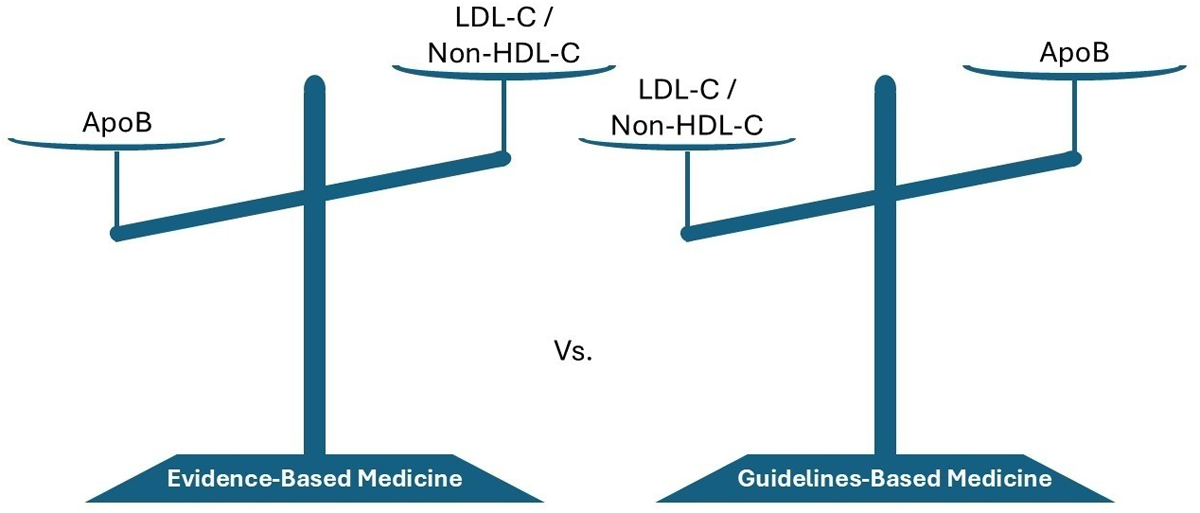
Figure 1
Ranking of apolipoprotein B (apoB) based on evidence versus guideline recommendations. The clinical recommendations of Evidence-Based Medicine are based on the clinical and experimental evidence. On this scale, apoB outperforms low-density lipoprotein cholesterol (LDL-C) and non-high-density lipoprotein cholesterol (HDL-C). The guideline admits that the evidence favors apoB but prioritize LDL-C/non-HDL-C.
Does this mean apoB will enter mainstream clinical care? Not likely, if the history in Europe is repeated in the United States. Seven years after the European guidelines were issued, emphasis in subsequent consensus reports and instruction at their professional meetings has remained focused on LDL-C.5 ApoB disappeared in Europe and, with the exception of the National Lipid Association, appeared minimally if at all in the mainline teaching of major medical societies concerned with the prevention of cardiovascular disease and in the teaching of pharmaceutical companies promoting their products to lower levels of atherogenic apoB lipoproteins. If the evidence supports apoB, how is this explicable? Thus the question must be asked: Is the commitment to LDL-C eternal? What follows is a personal analysis of the limitations of modern clinical decision-making, specifically examining how, in certain instances, it remains rooted in expert authority and institutional inertia rather than empirical evidence.
The History of apoB
In 1979, nine years before the first expert report on LDL-C, Avogaro and colleagues issued a report titled “Are apolipoproteins better discriminators than lipids for atherosclerosis?” and presented preliminary evidence that apoB was a better marker of cardiovascular risk than total cholesterol.6 The next year, Sniderman and colleagues from McGill and Peter Kwiterovich from Johns Hopkins published a paper in the Proceedings of the National Academy of Science presenting evidence that LDL apoB (the number of LDL particles) was a more accurate marker of cardiovascular risk than LDL-C (the mass of cholesterol within the LDL particles).7 In 1981, Avogaro et al. published a letter in the Lancet, “Need for new classification of lipoproteins derangements in human atherosclerosis,”8 citing the work of Alaupovic, who, a decade earlier, had called for classification of the dyslipoproteinemias based on apoproteins.9 This was the beginning, although the contributions of Goran Walldius and Ingmar Junger, who promoted the importance of the apoB/apoA1 ratio, must also be acknowledged as being in the forefront of this effort.10,11,12 There were also those who demonstrated hypertriglyceridemic hyperapoB as the unifying hallmark of familial combined hyperlipidemia,13 in particular Jacqeline De Graaf, Anton Stalenhoef, and their colleagues,14 Manuel Castro Cabezas,15 and Aguilar-Salinas.16
Over the years that followed, many publications appeared comparing LDL-C, non-HDL-C, and apoB as markers of cardiovascular risk. Most, but not all, favored apoB. But gradually, as more investigators used standardized methods to measure apoB, the picture became clearer: the results more consistently favored apoB. ApoB, LDL-C, and non-HDL-C are highly correlated variables. Conventional statistical methods were not designed to deal with this circumstance.17 Accordingly, the development of discordance analysis was a major analytical step forward. The results were now consistent and almost uniformly in favor of apoB.18,19
Arguably, the key publication was in 1970 by Dr. Robert Lees in Science titled “Immunoassay of plasma lipoproteins.”9 Although it covers less than two full pages of print, this short paper supplied the key information and insights that have driven my research for more than 50 years. In what would now be regarded as a trivial number of patients—less than 200 in all—Dr. Lees showed that (1) the level of LDL apoB was higher in patients with hypertriglyceridemia than in those with normal levels, notwithstanding normal levels of LDL-C, and (2) the level of LDL apoB correlated poorly with plasma triglycerides and only moderately with LDL-C. He demonstrated what mattered most: that discordance between the mass of LDL apoB and LDL-C is substantial. Early on, he suggested that increased secretion of VLDL particles was the most common cause of an elevated apoB, which was subsequently shown to be the case.20,21 As far as I know, no award has ever recognized the research showing apoB is a more accurate cardiovascular risk marker than LDL-C or non-HDL-C. If one was possible, I’d nominate Dr. Robert S. Lees.
Given that familial combined hyperlipidemia is the most common proatherogenic familial dyslipoproteinemia22 and that elevated apoB is the defining feature of familial combined hyperlipemia14 and therefore essential for its diagnosis,23 this should have ensured that apoB was widely available in clinical practice. Instead, all interest centered on familial hypercholesterolemia, and all interest in familial combined hyperlipidemia evaporated. How could this have happened?
Evidence-Based Medicine and Guidelines
In a 1992 issue of JAMA, Dr. David Sackett and colleagues introduced the concept of Evidence-based Medicine (EBM). In 1996, EBM was formally defined as “the conscientious, explicit, and judicious use of current best evidence in making decisions about the care of individual patients.” Randomized controlled trials (RCTs) were the best form of evidence to test therapies and diagnostic tools. But according to Sackett et al., RCTs were only one form of evidence, and the trial results had to be interpreted in the context of the specific patient. Generalizability, even then, was recognized as a major limitation of RCTs.
With the rise of statins, the guideline movement emerged. Knowledge was expanding too quickly for professors or practitioners to keep pace, prompting the creation of independent expert panels to review evidence objectively using disciplined rule-based methods. Professional societies oversaw the process, and eventually membership was limited to those without commercial conflicts. “Evidence-based medicine” became the mantra of guidelines, but not the original evidence-based medicine. In the guideline era, RCTs became the highest and virtually the only form of secure knowledge. All the other types of evidence fell to a distant second place. Clinical reasoning and expertise, for practical purposes, were declared irrelevant. Fast forward to the present, and guidelines have become the principal determinants of care. While they cannot compel governments and private payers to pay for the services they recommend, a negative or lukewarm recommendation has little prospect of being adopted. They have also become major sources of authority and purpose for the institutions that issue them.
In general, the impact of guidelines has been positive, but there are exceptions. For example, prior to the 2000 recommendation by the American Academy of Pediatrics to restrict exposure of infants to peanut butter for the first 3 years of life, serious allergy was a rarity.24 This recommendation, which was intended to reduce the incidence of severe eczema and which was based on limited evidence, was soon followed by an explosion of reports of life-threatening and life-ending allergic reactions to peanut butter. The recommendation was withdrawn in 2008, based on inadequate evidence about the benefit for eczema.25 Several years later, the LEAP (Learning Early About Peanut Allergy) study found that introducing peanuts to high-risk infants before 11 months of age dramatically reduced the subsequent development of peanut allergy, documenting the harm of the original recommendation.
Other examples include the recommendation by many guideline groups to restrict hormone therapy, which was based on the misleading presentation of the Women’s Health Study results, a major RCT.26 Also, one important contributor to today’s epidemics of diabetes and obesity was arguably the American Heart Association’s recommendation to lower cardiovascular risk by adopting a low-fat, high-carbohydrate diet.27 Dietary therapy remains an underused and poorly studied tool for preventing cardiovascular events, and this list is likely incomplete. The newest ACC/AHA/Multisociety Guideline recommendation on apoB may also—unintentionally—continue to limit the preventive and therapeutic benefits that wider use of apoB could provide.1
These examples should prompt a re-examination of the guideline process. The people who control the institutions that issue guidelines determine who writes them and set the rules for how they are developed. Deliberations occur in secret, and the panels that review the recommendations do not operate independently of the process. All recommendations are issued unanimously even though total unanimity is scientifically unrealistic for complex, under-studied topics where uncertainty is inevitable. This critique targets the closed nature of the process, not the integrity or capability of its participants. Science thrives on debate and diverse perspectives, not enforced dogma. Though previous warnings have been ignored, the process must be opened up to reflect true scientific inquiry.28,29,30
The 2026 ACC/AHA/Multisociety Guidelines
The 2026 ACC/AHA/Multisociety Guideline assigned apoB a 2B recommendation for assessing cardiovascular risk from apoB-containing lipoproteins and for improving the diagnosis of dyslipoproteinemia. A 2B rating is weak; it means measuring apoB may be reasonable and, by implication, may also be considered not reasonable. Yet the text of the guideline acknowledges that apoB is a more accurate marker of risk than LDL-C or non-HDL-C. This makes the 2B ranking inconsistent with the guideline’s own evaluation and therefore difficult to justify. The conclusion that apoB does not meaningfully improve diagnosis is similarly hard to defend.
Without apoB, neither type III hyperlipoproteinemia nor familial combined hyperlipidemia can be diagnosed.31 One is rare, the other common, but both are considered high risk for cardiovascular events. Because clinical attention has been so focused on LDL-C, doctors, even specialists, have not been taught about either. This should not be acceptable in the United States or anywhere else. Finally, in this category, all primary-prevention algorithms pair an estimated risk with an LDL-C threshold, and the new ACC/AHA/Multisociety Guideline follows the same approach. But higher-risk groups generally have higher apoB levels and more cholesterol-depleted LDL particles.32 As a result, using apoB instead of LDL-C would identify more people who qualify for therapy—and these individuals would be at the same, or potentially even higher, risk than those selected by LDL-C. In turn, more patients would benefit from prevention when selection is based on apoB rather than LDL-C.33
Is the 2026 ACC/AHA/Multisociety Guideline recommendation—that apoB be measured only after LDL-C and non-HDL-C are at target—actually reasonable? This application of apoB received a 2A rating, a strong recommendation, even though the text itself acknowledges that apoB is a more accurate marker of residual risk than LDL-C or non-HDL-C. Yet apoB is still ranked behind both, and used only after their targets are met.
The stated rationale is that discordance between LDL-C (estimated by the Martin–Hopkins equation) and apoB is minimal at the common guideline targets of 100 mg/dL and 70 mg/dL LDL-C. But there is a problem: the guideline assigns different apoB targets—90 mg/dL for low-risk individuals and 80 mg/dL for high-risk individuals—while the studies cited as evidence of “minimal discordance” used apoB comparators of 100 mg/dL and 80 mg/dL. These values are not equivalent. An apoB of 100 mg/dL is around the 65th percentile in the United States population, whereas an LDL-C of 100 mg/dL is around the 38th percentile. This is not a clinically relevant comparison.
Indeed, I cannot identify published analyses of discordance between apoB and Martin-Hopkins LDL-C at levels chosen by the 2026 ACC/AHA/Multisociety Guideline. Martin-Hopkins LDL-C does not differ substantially from Sampson LDL-C or from Friedewald LDL-C. Other published analyses at the guideline levels chosen for apoB and LDL-C demonstrate considerable discordance between apoB and LDL-C—again discordance with clinical significance.18,19,34,35,36,37,38,39
The bottom line is that the LDL-C cut points chosen at higher apoB concentrations were inappropriate, and the resulting recommendations are therefore flawed. A major development is the first comprehensive cost-benefit analysis of routine apoB testing in primary prevention, published by Luebbe et al. This study used population-equivalent apoB values,40 which are lower than the guideline targets and, for many reasons, are more reasonable—most importantly because they identify more people who qualify for treatment. And when more people receive treatment, more benefit. Prevention improves as eligibility expands.
Luebbe also showed that non-HDL-C improves clinical outcomes compared with LDL-C and is cost-saving.40 ApoB improves outcomes even more, though net costs rise modestly. Crucially, this increase is not due to the cost of apoB testing, which is trivial. In fact, apoB reduces overall cardiovascular costs by preventing procedures and clinical events. The additional expense comes from people living longer and developing other medical conditions. Put bluntly: avoiding apoB measurement lowers costs because more people die sooner.
Conclusion
Based on the available evidence, I believe there is no longer justification for measuring LDL-C. For every purpose for which LDL-C has been—and continues to be—used, apoB outperforms LDL-C. A normal LDL-C does not guarantee normal LDL particle levels, and an LDL-C at target does not ensure apoB is at target. ApoB is superior to both LDL-C and non-HDL-C for assessing risk and confirming that therapy is adequate. ApoB, together with a standard lipid panel, is essential for diagnosing clinically meaningful dyslipoproteinemias. Finally, despite decades of misplaced concern about apoB measurement—concern that persisted even though apoB was standardized in 1994—the real problem lies in the accuracy and precision of LDL-C and non-HDL-C estimation, not in apoB.4
LDL-C was a brilliant advance, and apoB is its natural extension. The question is whether, after so many decades, the message can be changed—and whether doing so would undermine credibility. The answer is yes: the message can change. LDL-C was not wrong; apoB is simply more right.
Physicians and patients can certainly be educated about apoB. “High LDL-C is bad; low LDL-C is good” becomes “high apoB is bad; low apoB is good.” No one is inherently attached to the term “LDL-C”—it’s just a word, and one word can be replaced with another word. The only real attachment lies with experts who have spent their careers championing LDL-C and continue to rely on it. Their reluctance is understandable, but it should not dictate practice. As for credibility, we lose it only if we fail to base care on the best available evidence.
Unfortunately, despite the evidence, the commitment to LDL-C appears unshakeable. And if that is true, what does it say about our commitment to science and to our patients? As Orwell wrote, “two plus two equals four.” ApoB is superior to LDL-C and non-HDL-C for patient care. Without apoB, specialists lack critical information for accurate diagnosis and management. Without apoB, follow-up remains unnecessarily complex and confusing for both specialists and nonspecialists.
The evidence shows that apoB alone is sufficient for follow-up. Using it would simplify care, sharpen focus, and improve outcomes. Yet we seem to be practicing authority-based medicine, not evidence-based medicine—a world in which two plus two does not equal four.
Key Points
The 2026 American College of Cardiology (ACC)/American Heart Association (AHA)/Multisociety dyslipidemia guideline states that apolipoprotien B (apoB) is a more accurate marker of cardiovascular risk than low-density lipoprotein cholesterol (LDL-C) or non-high-density lipoprotein cholesterol (HDL-C); that apoB is a more accurate marker of the adequacy of therapy than LDL-C or non-HDL-C; and that apoB is essential for fully accurate diagnosis of dyslipidemia.
Nevertheless, the 2026 guideline only weakly recommends apoB as a core test to assess dyslipidemia, and while it strongly recommends that apoB be measured to ensure therapy is adequate, it recommends that apoB be measured only after LDL-C and non-HDL-C are at target.
The evidence cited for this recommendation relies on comparator apoB levels that differ from those proposed in the guideline. Therefore, the recommendation does not appear to be grounded in the appropriate evidence.
These inconsistencies and errors suggest the guideline process needs to be reviewed and improved.