
Introduction
It is known based on clinical, epidemiological, and scientific data that plasma cholesterol is the main cause of coronary atherosclerosis,1,2 which leads to coronary artery disease (CAD) and its subsequent clinical features such as myocardial infarction and death. Cholesterol from the blood penetrates the endothelium and, upon oxidation, initiates an inflammatory response; this is the beginning of the process referred to as atherosclerosis.3 This process begins in the first decade of life and progresses very gradually and insidiously without clinical manifestations until the sixth or seventh decade of life.
The slow progression of coronary atherosclerosis makes it very amenable to primary prevention. In addition to cholesterol and genetic risk factors,4,5 several well-known acquired factors such as smoking and diet also contribute to the progression of atherosclerosis. Decreasing the risk associated with these risk factors, particularly hypercholesterolemia, significantly decreases mortality and morbidity from CAD.6,7 In the past two decades, physicians and the media have emphasized prevention of CAD, and the results have been remarkable, with mortality for acute myocardial infarctions significantly dropping from 2000 to 2020.8 Even so, CAD remains the number one cause of death worldwide.9
Despite the available preventive armamentarium, further reductions in CAD rates have been limited by several factors, including poor adherence to recommended lifestyle modifications. But the more important of these risk factors, in my opinion, is plasma cholesterol and its potential for early primary prevention of CAD. It is claimed that of those individuals with plasma low-density lipoprotein cholesterol (LDL-C) greater than the recommended level of 70 mg/dL, only about 50% are receiving lipid-lowering therapy.10 Furthermore, of these, only about 50% have a plasma LDL-C concentration of equal to or less than 70 mg/dL,11 the target for plasma LDL-C recommended by the 2026 American College of Cardiology (ACC)/American Heart Association (AHA)/Multisociety Guideline on the Management of Dyslipidemia.
The therapeutic core of CAD prevention has been statin therapy, which inhibits the synthesis of cholesterol and has been the routine therapy for primary and secondary CAD prevention for more than three decades. Statins have been administered to hundreds of millions of individuals throughout the world and are found to be both efficacious and safe.6,7 In fact, it is claimed to be one of the safest drugs, even safer than aspirin.12,13 Despite this long history, long-term safety concerns regarding lifetime use of these medications persist among both the medical community and the public. There is also some discrepancy as to the optimal plasma level of LDL-C for maximal efficacy and safety.
The management of CAD should always include prevention, whether it be primary or secondary. A change to a more favorable lifestyle should be emphasized regardless of the individual’s age and their overall well-being. However, individuals shown to have an increased risk for CAD almost always require lipid-lowering therapy in addition to lifestyle changes. When initiating cholesterol-lowering therapy in patients and in discussions with my colleagues, residents, and fellows, I have found that knowledge of the source, utilization, and turnover of circulating cholesterol sheds new light on therapeutic efficacy and safety.
Synthesis and Metabolism of Plasma Cholesterol
The following are pivotal facts on the synthesis and metabolism of circulating cholesterol that I believe are relevant to cholesterol-lowering agents (Figure 1).
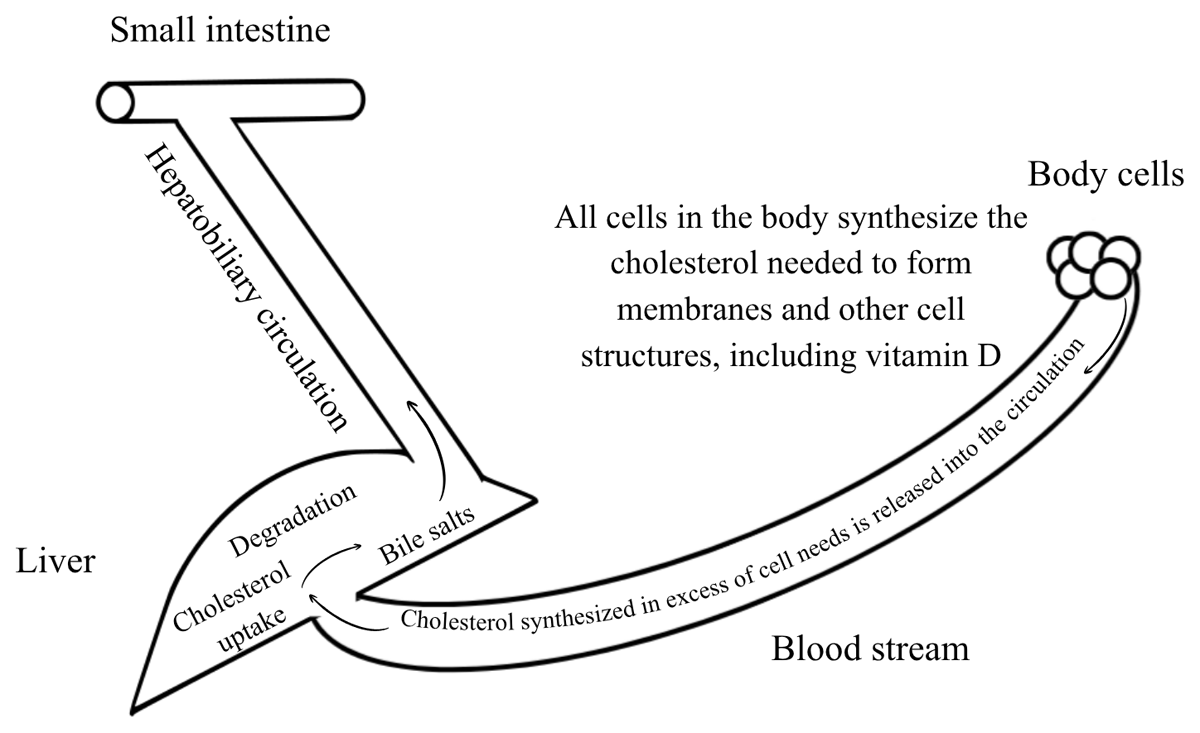
Figure 1
This illustration emphasizes that all cells in the body synthesize cholesterol to form membranes for the cell wall and other cellular structures. Any excess cholesterol synthesized in the cell is released into the circulation and transported to the liver for conversion into bile salts. These bile salts are subsequently secreted into the small intestine. It is estimated that 80% of the circulating cholesterol is derived from excess cholesterol synthesized by the cells. Lipid-lowering therapy, such as statins, decreases the concentration of plasma cholesterol, which is primarily destined to be secreted into the small intestine.
All cells in the body synthesize their own cholesterol when they need it.14,15,16 The cholesterol synthesized by the cell is used to form the cell wall and other cell structures, including vitamin D.
If the cell synthesizes more cholesterol than it needs, it must excrete the surplus because accumulation within the cell would induce injury and ultimately cell death.17,18
The cell does not have the biomechanisms to degrade cholesterol; therefore, to avoid injury, it dumps the excess cholesterol (analogous to garbage) into the circulation.
The source of over 80% of circulating cholesterol is endogenous, meaning it was synthesized in excess by the cells.19 All cholesterol synthesized by the cells is by definition under direct genetic control.
Dietary cholesterol is only a small component (less than 20%) of the circulating cholesterol.19
Cholesterol in the circulation is transported to the liver, which is essentially the only organ capable of biodegrading the cholesterol molecule. The degradation of cholesterol transforms it into bile salts, which are secreted into the small intestine.
Circulating plasma cholesterol, including LDL-C, is essentially only needed for the formation of bile salts. The only exceptions are the adrenal and gonadal glands, which extract a small fraction of this cholesterol to synthesize hormones, though these organs can also synthesize their own cholesterol if needed.
Statins are a group of drugs that inhibit the rate-limiting enzyme in the synthesis of cholesterol. Thus, they directly target cholesterol synthesized endogenously by the cell, the major source of circulating cholesterol.
Educating Patients Who Require Lipid-Lowering Therapy
It is essential to inform patients who need treatment that a statin is safe and effective, and that it only blocks excess cholesterol that the body does not need. Second, it may help to explain that since only a small fraction of circulating cholesterol comes from diet, lifestyle changes alone usually aren’t sufficient, and additional interventions, such as a statin, are typically required to effectively manage and reduce cholesterol levels.
For patients at intermediate or high risk for CAD with elevated LDL-C, the recommended treatment is to adopt a heart-healthy lifestyle and initiate medication with a moderate-intensity statin. It should also be stressed that they will be taking it for a lifetime. A decrease in plasma LDL-C not only decreases cardiac morbidity and mortality but also mortality and morbidity from atherosclerotic strokes and peripheral vascular disease.
Whether consulting a family doctor or a specialist, any patient at moderate to high risk for CAD with increased plasma LDL-C should be placed on a prevention plan that includes lifestyle improvements and cholesterol-lowering treatment at their very first visit. If the physician is uncomfortable in initiating such therapy, then the patient should be referred to a specialist, such as a cardiologist. Skipping primary prevention during an initial patient encounter is often a missed opportunity to intervene against the leading cause of death. It should also be reminded that CAD risk depends not only on the blood’s LDL-C concentration but also on the cumulative duration of that exposure. The risk for CAD doubles for every additional 10 years of exposure to plasma LDL-C.20 Each year of delay contributes a further 10% increase in risk for cardiac events. Furthermore, the earlier that therapy is initiated to decrease plasma LDL-C concentration, the more effective it is in preventing the development of cardiac events.21
Plasma LDL-C Levels for Optimal Efficacy and Safety
Several appropriately designed and randomized clinical trials have shown that a target of 50 mg/dL is associated with lower cardiac morbidity and mortality compared with 70 mg/dL or 60 mg/dL. The ACC/AHA/Multisociety guideline recommends a target of 70 mg/dL; however, they also stress that lower is better, implying that lower is more efficacious. The European Society of Cardiology (ESC) has changed their target to 55 mg/dL and also recommend that even lower is better. Thus, the overall target recommended for plasma LDL-C in routine clinical practice ranges from 55 to 70 mg/dL depending on whether you follow the ACC or ESC guidelines.
A large body of literature demonstrates that achieving LDL-C levels below current recommendations is associated with additional, significant reductions in cardiac events, with no increase in adverse effects. These retrospective analyses of clinical trials and subgroup analysis suggest that lower levels of plasma LDL-C, even at 5 to 10 mg/dL, continue to show increasing efficacy with no apparent increase in adverse effects.21,22,23,24,25,26 Furthermore, the “lower is better” postulate is supported by observations that the proportional decrease in cardiac events per unit reduction of plasma LDL-C remains constant down to levels of 5 to 10 mg/dL.6 This indicates a direct log linear relationship between the percentage reduction in plasma LDL-C and the decrease in cardiac mortality and morbidity. In a meta-analysis, Ference et al. have shown that this relationship is maintained regardless of the lipid-lowering agent used to decrease plasma LDL-C, whether it be statins, PCSK9 inhibitors, ezetimibe, or bile salt inhibitors.21 The proportional benefit is also independent of the starting baseline for plasma LDL-C.27 Before adopting lower targets for plasma LDL-C, clinical guidelines will likely require further validation from randomized clinical trials.
Meanwhile, the ESC is already evaluating evidence to establish an even lower recommended target of 40 mg/dL in future guidelines.28 Although the level for optimal efficacy and safety is yet to be determined, 40 mg/dL has been suggested since infants are born with plasma LDL-C levels ranging from 40 to 60 mg/dL, which rises to about 110 to 120 mg/dL during adolescence.29 Regardless of the level, there is need for greater awareness by physicians and the public to initiate early primary prevention. Early primary prevention with proven current therapy would drastically reduce the trajectory of morbidity and mortality from CAD throughout the world.
Conclusion
Despite coronary artery disease being the number one cause of death globally, there is still considerable inertia in implementing primary prevention. A favorable lifestyle and lipid-lowering therapy in individuals at increased risk for CAD should be part of the routine preventive approach. Statins have been administered to hundreds of millions of individuals over more than three decades and found to be both efficacious and safe.
Key Points
All cells in the body synthesize their own cholesterol when needed.
Excess cholesterol synthesized by the cells are released into the bloodstream and carried to the liver for secretion into the intestine.
Lipid-lowering agents such as statins prevent heart disease by decreasing excess cholesterol in the blood.
Statins have been administered to hundreds of millions of individuals over three decades and are shown to be both efficacious and safe.
The future treatment target for plasma low-density lipoprotein cholesterol is likely to be around 40 mg/dL, the level observed in infants.
Acknowledgements
Many thanks to Esperanza Acuna Luna for help preparing this manuscript.