
Otherwise
I got out of bed
on two strong legs.
It might have been
otherwise. I ate
cereal, sweet
milk, ripe, flawless
peach. It might
have been otherwise.
I took the dog uphill
to the birch wood.
All morning I did
the work I love.
At noon I lay down
with my mate. It might
have been otherwise.
We ate dinner together
at a table with silver
candlesticks. It might
have been otherwise.
I slept in a bed
in a room with paintings
on the walls, and
planned another day
just like this day.
But one day, I know,
it will be otherwise.
Jane Kenyon, “Otherwise” from Collected Poems. Copyright © 2005 by The Estate of Jane Kenyon. Reprinted with the permission of The Permissions Company, LLC on behalf of Graywolf Press, graywolfpress.org.
Commentary
Jane Kenyon was a dynamic poet whose life was cut drastically short by leukemia. Just 47 at the time of her death, she joined a tragic tradition of talented poets whose work is retrospectively viewed in light of their early demise. “Otherwise” is a touching testament to both the beauty and vulnerability of each day, particularly how fragile the separation is between life as we know it and life as it could be if altered by illness or death.
Kenyon was born in 1947 in Ann Arbor, Michigan, where she later attended the University of Michigan to attain both her undergraduate and graduate degrees. While there, she began writing in earnest and met her future husband, the established poet and professor Donald Hall. The two married in 1972 and moved 3 years later to Eagle Pond Farm in Wilmot, New Hampshire. They would live and work as freelance writers in a farmhouse inhabited by Hall’s ancestors since shortly after the American Civil War.1
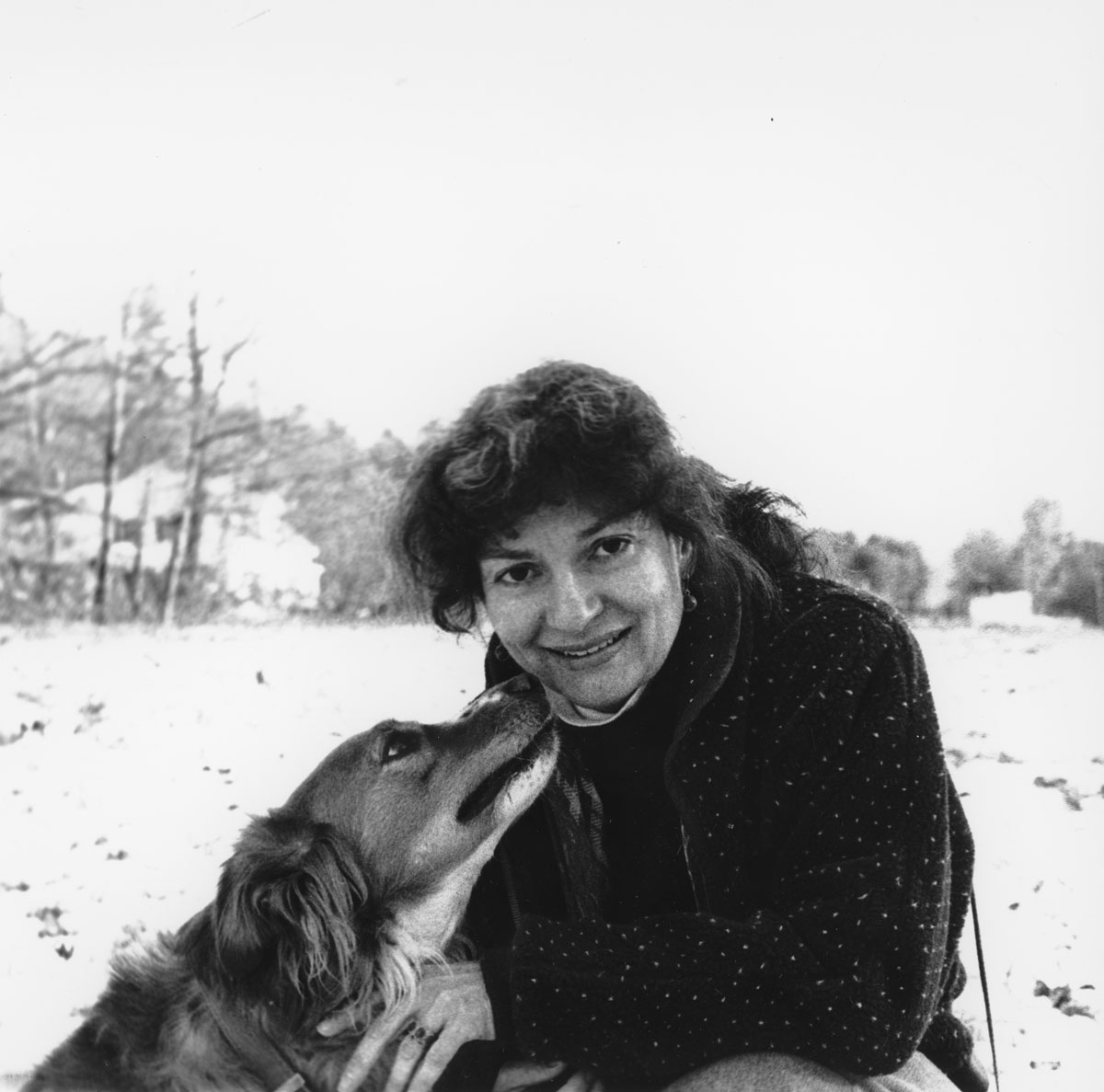
Poet Jane Kenyon with her dog, Gus. Photo taken during Nov. 27 (n.y.) shoot; 6×4. A, Box(s): 49, Folder: 5. Jane Kenyon papers, MC 164. University of New Hampshire Special Collections and Archives.
Over two decades in Wilmot, Kenyon and Hall established the “house of poetry”2 that would later be encapsulated by Bill Moyers’ 1993 documentary, A Life Together, which went on to win an Emmy Award.3 They played an influential role in the advancement of poetry across the nation and throughout the world, with each holding the post of Poet Laureate of New Hampshire at different periods and with Hall serving as the United States (US) Poet Laureate later in his career. The couple also participated in the Cultural Exchange Program through the US Information Agency, which sponsored trips for them to read their work throughout India, China, and Japan.1
“Otherwise” is a memorable poem, striking for its thoughtful repetition and use of the vivid imagery for which its author gained renown. It was originally printed in Harvard Magazine and, in 1993, was included in Constance, Kenyon’s fourth volume of poetry and the last to be published before her death. Readers can envision themselves beside her as she navigates through an idyllic day, almost tasting the “sweet / milk, ripe, flawless / peach” and imagining a future marred by drastic change. Across 26 lines and two stanzas, Kenyon provides a progressive development into what readers almost hesitate to reach as the poem’s inevitable conclusion.
Those familiar with Kenyon’s plight—her diagnosis with acute lymphoblastic leukemia (ALL) in 1994, her initial remission followed by recurrence, and her precipitate death in 1995—may mistakenly conclude that the piece was a reflection on her final years, perhaps as a penultimate poem or reaction to her illness. It was written, however, in response to a colon cancer diagnosis that Hall was facing in a period when their future was uncertain.4 He later developed liver metastases and what the couple thought to be a terminal prognosis, though he ultimately achieved remission before Kenyon was diagnosed with ALL and outlived her by more than 20 years.5
As Kenyon faced recurrence of her leukemia in 1995, she and Hall collated a sampling of her previously published and unpublished works, selecting “Otherwise” to be its title poem.1, 6 Though Kenyon published just four volumes of poetry in her lifetime, her work was met with increasing critical acclaim and popular recognition, including a Guggenheim Fellowship in 1992 and the inaugural PEN/Voelcker Award for Poetry in 1994. She reports being influenced by the works of Keats, Chekov, and Elizabeth Bishop, as well as by Anna Akhmatova—20 of whose poems Kenyon translated from Russian for US publication in 1985.4
Jane Kenyon died on April 22, 1995, just 11 days after the recurrence of her ALL. Her plight with leukemia was stunningly captured by Hall in two powerful works—a memoir titled The Best Day, the Worst Day: Life with Jane Kenyon1 and a book of poems published as Without.7 The former is a hauntingly beautiful recounting of her life, illness, and death, while the latter is a collection of poems that Hall began writing while attending to Kenyon on her sick bed.8 These works of Hall have been used extensively within the medical humanities,5 allowing students and physicians to understand a caregiver’s perspective of death, dying, and terminal illness. Kenyon’s work does not seem to have been featured as prominently as Hall’s within humanities curricula, but works such as “Otherwise” make a strong argument that it should be more frequently considered.
Kenyon also suffered from manic depression for most of her adult life,6, 9 which shows itself in many of her poems—most notably, perhaps, in “Having It Out with Melancholy.” This candid confrontation of her own mental illness has led some of her writings to be compared to the likes of Sylvia Plath, though Kenyon tended to show a greater focus on guiding her readers through depression by her example.6
Jane Kenyon and Donald Hall were influential figures within American poetry, both during her lifetime and in the final decades of his. They have been labeled the “Brownings of America”6—a reference to the Victorian-era poets, Elizabeth Barrett and Robert Browning, although more modern comparisons are also fitting. Appropriate examples include Joan Didion and John Gregory Dunne, Margaret Atwood and Graeme Gibson, or Geraldine Brooks and Tony Horwitz. One half of each of these authorly couples has chronicled the process of mourning the loss of the other, contributing to a growing body of bereavement literature that Hall has titled “necropoetics”—the poetics of death.5 Each has had to face the “day that it was otherwise” in their own life, giving echoes of Kenyon’s final lines in their own writings of bereavement. In doing so, they added their voices to an important subset of health humanities literature, of which Kenyon deserves to take her rightful place.
Disclaimer
The views expressed are solely those of the authors and do not reflect the official policy or position of the US Army, US Navy, US Air Force, the Department of Defense, the US Government, or Houston Methodist Hospital.
Competing Interests
The authors have no competing interests to declare.