
A patient with a prior ascending aortic repair, which used an elephant-trunk endograft extending into the aortic arch and descending aorta, underwent photon counting computed tomography angiography (PCD-CTA) for evaluation of suspected graft complication.
PCD-CTA demonstrated multiple residual complex dissection flaps distal to the endograft. Sharp delineation of the endograft struts on PCD-CTA reveals a type-IIIa endoleak, secondary to the modular disjunction in the proximal aortic arch (Figure 1).
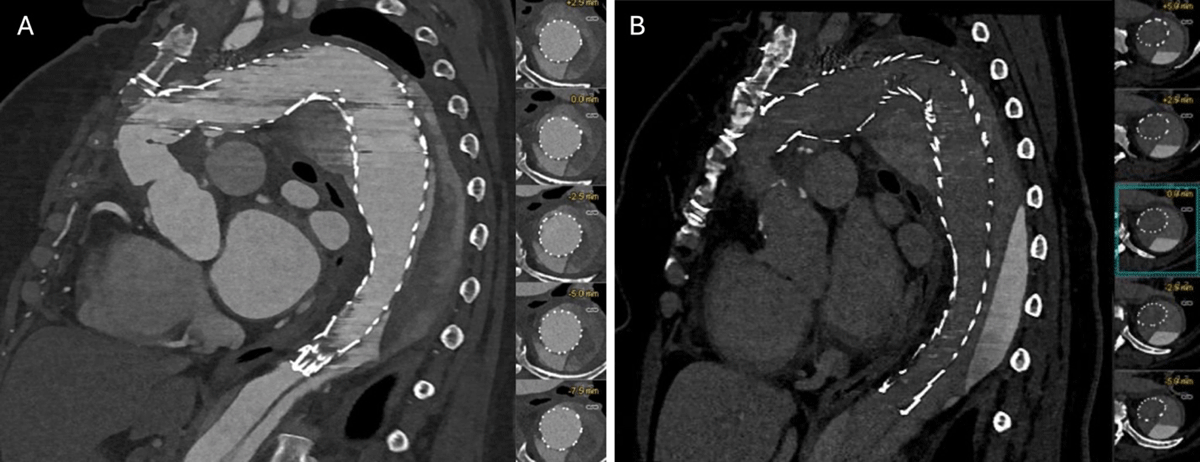
Figure 1
Photon counting computed tomography angiography sagittal reconstructions of a repaired complex aortic dissection with elephant-trunk endograft: (A) arterial phase; (B) delayed-venous phase. The centerline-based luminal reconstruction confirmed perfusion of the excluded sac, divided into two false lumens by a thick secondary intimomedial flap. Technical specifications are kernel: BV44; slice thickness: 0.4 mm; iterative configuration: Q3 iterative strength; monoenergetic 70 KV reconstruction.
Cinematic rendering (CR) is a three-dimensional volume-rendering technique that applies advanced lighting models to voxel-based imaging data, producing more photorealistic images than a traditional volume-rendering technique. In this case, CR provided clearer visualization of the graft, dissection flaps, and false lumen perfusion (Figure 2).
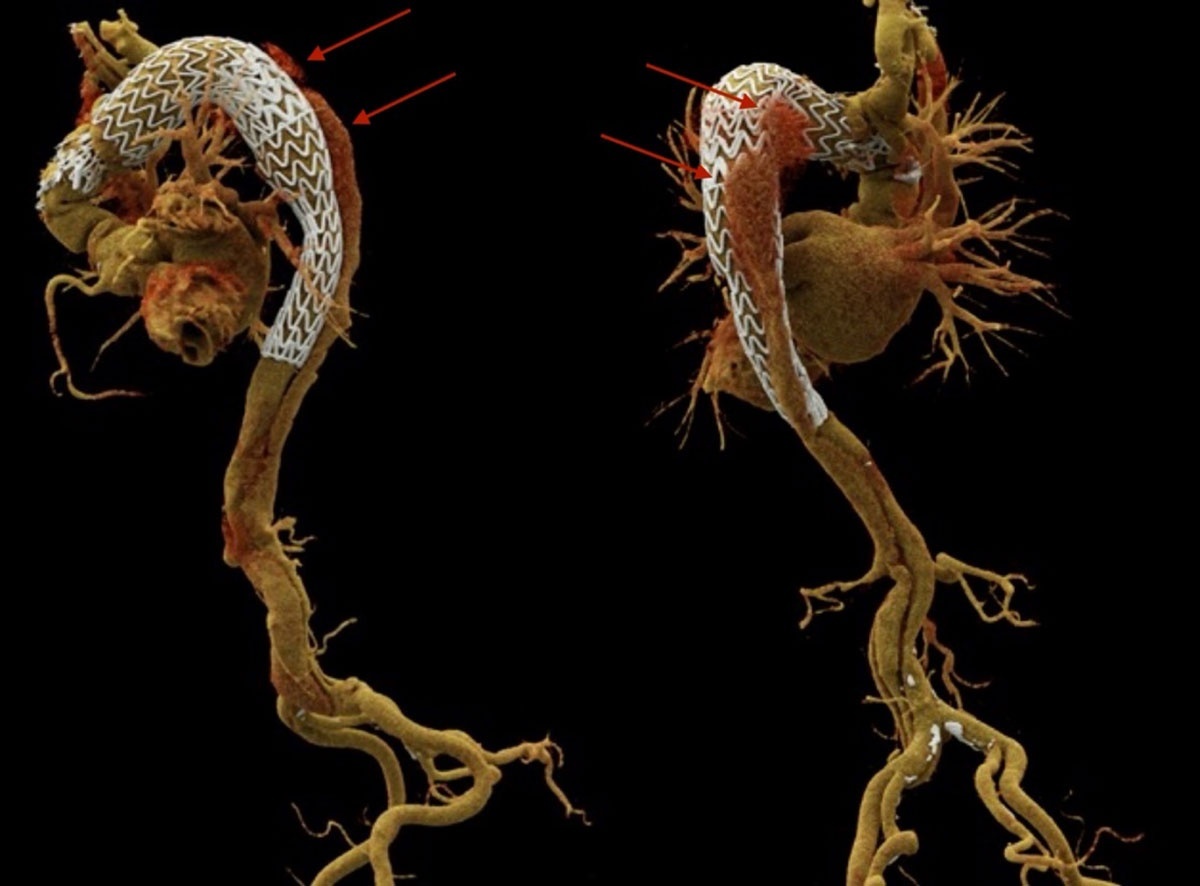
Figure 2
Cinematic rendering of the same photon counting computed tomography angiography study demonstrating false lumen perfusion (red arrows).
This report demonstrates how high-resolution, low-noise PCD-CTA imaging combined with photorealistic visualization from CR can enhance anatomical understanding and support clinical decision-making in vascular complications following endovascular repair.
Competing Interests
The authors have no competing interests to declare.