
Coronary artery disease (CAD) persists as the foremost driver of cardiovascular morbidity and mortality worldwide. From advances in physiologic lesion assessment to the emergence of novel preventive strategies, contemporary practice is shaped by the confluence of precision imaging, device evolution, and a deeper understanding of genetic and inflammatory contributors. In this issue of the Methodist DeBakey Cardiovascular Journal, we bring together a collection of reviews that reflect the breadth and depth of modern CAD management.
Drs. Nils Johnson and Lance Gould open the issue by revisiting coronary physiology in the left anterior descending artery (LAD), highlighting the complexity of interpreting fractional flow reserve (FFR) in a vessel supplying such extensive myocardial territory. The authors underscore that low FFR readings may reflect diffuse disease rather than focal lesions, risking overtreatment if not rigorously assessed. Their discussion of pressure pullback gradients and absolute perfusion imaging offers practical guidance for integrating physiologic and anatomic data in LAD interventions—a reminder that physiologic precision is indispensable in optimizing outcomes.
Addressing the critical domain of acute myocardial infarction complicated by cardiogenic shock, Drs. Saliha Erdem, Dhruvil Patel, and Joe Aoun present an authoritative review of temporary mechanical circulatory support (tMCS). They dissect the evidence and clinical nuances surrounding intra-aortic balloon pumps (IABP), Impella, TandemHeart™ (LivaNova, Inc), and venoarterial (VA)-extracorporeal membrane oxygenation. By emphasizing device selection, timing, and patient-specific considerations, this article provides a framework for leveraging hemodynamic support to improve survival in a condition still marked by unacceptably high mortality.
Intravascular imaging has reshaped percutaneous coronary intervention practice (PCI), and Drs. Safi Khan, Neal Kleiman, and Alpesh Shah deliver a comprehensive appraisal of intravascular ultrasound (IVUS)-guided PCI. They present robust trial data confirming reductions in stent thrombosis, target lesion failure, and mortality, particularly in complex lesions and left main disease. Yet, as the authors point out, real-world adoption remains inconsistent, underscoring a critical opportunity to align practice with evidence.
Equally transformative is the expanding role of drug-coated balloons (DCBs). Drs. Akash Patel, Mark Abdelnour, and Antonio Frangieh describe how DCBs have moved beyond in-stent restenosis into management of small vessels and bifurcations. They detail the pharmacologic distinctions between paclitaxel- and sirolimus-based technologies, procedural considerations in lesion preparation, and trial results supporting a “leave nothing behind” approach—an emerging paradigm with significant clinical promise.
Turning to congenital coronary anomalies, Dr. Ada Stefanescu Schmidt, research coordinator Jack Hoover, and colleagues offer a sweeping review of anomalous coronary arteries, aneurysms, and fistulae. Their article outlines the spectrum of anatomical variants—from anomalous aortic origin to anomalous left coronary artery arising from the pulmonary artery (ALCAPA)—and highlights recent advances in imaging, computational modeling, and surgical planning. In particular, the review clarifies the critical importance of meticulous anatomical characterization to guide shared decision-making about intervention versus observation in these rare but potentially lethal conditions.
At the intersection of cardiology and rheumatology, Drs. Attila Feher, Kenneth Wade Williams, and colleagues explore the impact of autoimmune rheumatologic diseases on coronary atherosclerosis. Their review underscores how chronic inflammation accelerates plaque development and coronary microvascular dysfunction, compounding traditional risk factors. By illustrating how multimodality imaging—from positron emission tomography to coronary computed tomography angiography—can unmask subclinical disease in these patients, the authors highlight an urgent need for more aggressive risk assessment and preventive care.
Drs. Anum Saeed, Aleesha Kainat, and Asad Natique present a portrait of coronary artery disease through an equity lens. Their focused review traces how conventional risk factors intertwine with structural and social barriers to keep Black, Hispanic, Native-American, and South Asian patients at a persistent disadvantage across every CAD benchmark—from symptom recognition to adherence. They challenge us to match clinical innovation with culturally attuned education, bias-conscious practice metrics, and inclusive research, arguing that only a systems-level commitment can close these stubborn care gaps.
Shifting focus to perioperative care, Drs. Purvi Parwani, Nikitha Murthy, and colleagues update the preoperative diagnostic assessment of patients with cardiovascular risk factors undergoing noncardiac surgery. They describe a paradigm shift away from routine ischemia testing toward judicious biomarker-guided evaluation and functional assessment. This nuanced approach aims to balance cost-effectiveness with clinical vigilance, reserving advanced testing for patients most likely to benefit.
In a forward-looking contribution, Dr. Robert Roberts advocates for the use of polygenic risk scores (PRS) as a transformative biomarker for early primary prevention of CAD. By quantifying lifetime genetic risk and proposing long-acting lipid-lowering therapies akin to an annual vaccine, the article makes a compelling case that the future of CAD prevention may lie in leveraging genetic insights to delay disease onset by decades—a vision with profound implications for public health.
Dr. Taha concludes the issue with a “Points to Remember” article that highlights key aspects of managing coronary artery disease in patients with radiation-induced heart disease.
Collectively, the contributions in this issue reflect the dynamism and multidimensionality of contemporary CAD care. Whether confronting the acute instability of cardiogenic shock, unraveling the subtle interplay between systemic inflammation and atherosclerosis, or exploring genomic strategies to preempt disease altogether, these reviews illuminate the progress—and the challenges—that define the current era of coronary intervention and prevention.
We trust this issue will inform, inspire, and equip our readers as we continue to advance the science and practice of cardiovascular care.
Guest Editor Biographies
The editorial team of the Methodist DeBakey Cardiovascular Journal wish to express our thanks to Dr. Nadeen Faza and Dr. Joe Aoun for their expertise, guidance, and dedication while curating this timely issue on coronary artery disease and its management.
Nadeen N. Faza, MD

Dr. Faza is a structural heart disease imaging specialist at the Houston Methodist DeBakey Heart and Vascular Center. She is the associate program director for Houston Methodist’s Cardiovascular Disease Fellowship program, an assistant professor of cardiology at the Houston Methodist Academic Institute and Weill Cornell Medical College, and an assistant clinical member of the Houston Methodist Research Institute.
Dr. Faza is a fellow of the American College of Cardiology, American Society of Echocardiography, and Society for Cardiovascular Angiography and Interventions. She has served on the American College of Cardiology’s Curriculum Design Committee and is currently a member of the College’s Competency Management Committee. She also is a member of the American Society of Echocardiography’s Public Relations Committee and serves as the Social Media Chair for the Texas Chapter of the American College of Cardiology. She is a member of the editorial boards of the Methodist DeBakey Cardiovascular Journal and the Journal of the American College of Cardiology - Case Reports.
Joe Aoun, MD
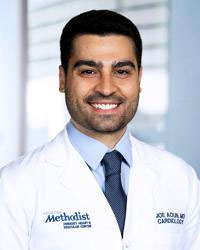
Dr. Aoun is an interventional cardiologist and structural heart disease specialist at the Houston Methodist DeBakey Heart & Vascular Center, Houston Methodist. His education includes a Doctor of Medicine from Saint Joseph University in Beirut, Lebanon, an internal medicine residency at Hotel Dieu de France and Saint Elizabeth’s Medical Center at Tufts University School of Medicine, and fellowships in cardiovascular disease and interventional cardiology at Houston Methodist Hospital. He has received numerous awards, including the Cardiology Chair’s Grant Award in 2024 and the Rising Star Award in 2020 from Houston Methodist Hospital.
Dr. Aoun holds multiple board certifications, including the American Board of Internal Medicine, Cardiovascular Disease, Interventional Cardiology, Echocardiography and Nuclear Cardiology, and he is an active member of several professional organizations. His research contributions include publications in peer-reviewed journals, book chapters, and presentations at national and international conferences. He also serves as an active reviewer for prestigious journals and is involved in editorial consulting.
In leadership, Dr. Aoun has served as chair of the cardiology fellows at the American College of Cardiology in Texas and chief cardiology fellow at Houston Methodist Hospital. His career reflects a commitment to advancing cardiology through research, education, and clinical excellence.
Competing Interests
The authors have no competing interests to declare.