
Introduction
Coronary artery disease (CAD) affects more than 20 million adults in the United States (US) and severalfold more individuals globally.1 Despite ongoing advances in diagnosis and treatment over the last several years, significant gaps persist in CAD care specifically in minority groups. This review outlines key inequities in CAD care across racial and ethnic groups, highlights contributing factors to these differences, and suggests potential solutions.
Epidemiology
Based on data from the 2018 National Health Interview Survey (NHIS), the prevalence of CAD among adults aged ≥ 18 years is estimated at 5.4% among African Americans, 8.6% among American Indian/Alaska Natives, 4.4% among Asians, and 5.7% among non-Hispanic White (NHW) individuals.2 Post-myocardial infarction (MI) outcomes vary significantly by race and ethnicity. Although national readmission rates after acute MI have declined, Black and Hispanic individuals continue to experience higher complication rates. Data from the REGARDS (Reasons for Geographic And Racial Differences in Stroke) and ARIC (Atherosclerosis Risk in Communities) studies show that Black men have the highest incidence of MI, and Black individuals overall face an increased risk of fatal MI compared to NHW individuals.3 Similarly, the National Health and Nutrition Examination Survey (NHANES) 2017 to 2020 data show that Black adults have the highest age-adjusted CAD mortality rates among all racial groups in the US.4
Compared with NHW individuals, Native American and Asian populations experienced higher in-hospital mortality and longer hospital stays as demonstrated by data from the National Inpatient Sample (NIS) between October 2017 and December 2018.5 Asian Indian adults also show a disproportionately high prevalence of premature CAD (defined as onset before age 65 in women and age 55 in men) compared with NHW adults (adjusted odds ratio of 1.77).6
Recognition of Traditional CAD Risk Factors
Hypertension, Hyperlipidemia, and Obesity
Hypertension (HTN) is one of the most crucial risk factors for CAD. The CARDIA (Coronary Artery Risk Development in Young Adults) study showed that HTN was most prevalent in the Black population: by age 55, roughly 76% of Black men and women developed HTN compared with 54.5% of White men and 40.0% of White women.7 Notably, HTN is the driver of CAD in the Black population, with a population attributable risk of 32.5% for CAD.8 In the HCHS/SOL (Hispanic Community Health Study/Study of Latinos) study, HTN prevalence in Hispanic individuals varied by country of origin (16-29%), with the highest prevalence seen in Dominican individuals and HTN independently associated with high risk of CHD in these individuals.9
Similarly, Black individuals have a higher prevalence of obesity, elevated total cholesterol and low-density lipoprotein levels (known as dyslipidemia, which is associated with CAD), and reduced high-density lipoprotein levels compared with NHW.10 Hispanic individuals also have higher rates of dyslipidemia than NHW individuals. Similar to Black adults, Hispanic individuals tend to have higher rates of obesity and physical inactivity than NHW individuals.11
Chronic diseases associated with increased CAD risk, such as chronic kidney disease and human immunodeficiency virus, also disproportionately affect Black individuals. Data from NHANES 2017 through March 2020 shows marked disparities in the prevalence of obesity across minorities, with Black females exhibiting the highest prevalence of obesity. The prevalence of obesity for males and females was 40.4% and 57.9% among Black individuals, 17.6% and 14.5% for Asians, and 45.2% and 45.7% for Hispanics compared with 43.1% and 39.6% for NHW, respectively.12
Compared with urban dwellers, individuals living in rural areas have a higher burden of inequities. Black adults in rural areas have significantly higher odds of obesity (OR 2.03; 95% CI, 1.71-2.4) compared to their NHW counterparts, a disparity that is slightly less pronounced in urban settings (OR 1.83; 95% CI, 1.78-1.88), indicating a significant race-rural interaction.13 In contrast, another analysis reported that Black adults who resided in urban areas had the worst obesity-related CAD mortality than those living in rural residences, whereas the reverse was true for all of the other racial and ethnic groups.14
Diabetes
Type 2 diabetes mellitus (T2DM) is a major risk factor and cause of CAD morbidity and mortality.15 Probably one of the greatest risk factor disparities in South Asian individuals is the higher incidence of T2DM and insulin resistance compared to NHW, even at a younger age and regardless of BMI, which contributes significantly to higher cardiovascular risk.16 Of note, this holds true for US-born South Asians who exhibit elevated insulin, unfavorable lipid profiles, and greater central adiposity from a young age.16 The MASALA (Mediators of Atherosclerosis of South Asians Living in America) study found a T2DM prevalence of 23% in South Asians compared with 6% in NHW and other ethnic groups even after adjusting for body fat.17 Both the MESA (Multi-Ethnic Study of Atherosclerosis) and MASALA studies also showed that South Asians have a worse adipokine profile and disproportionate fat-to-lean-mass ratio, which may explain the higher susceptibility of CAD.18 The international INTERHEART (Effect of potentially modifiable risk factors associated with myocardial infarction in 52 countries) study found a similar increased risk association between T2DM and MI in South Asians.19 Notably, similar to South Asians, Hispanic individuals also have higher rates of T2DM than NHW individuals.11
Smoking
Tobacco use is a preventable risk factor that contributes greatly toward CAD mortality.20 A cohort study of over 550,000 adults found that self-reported smoking was linked to significantly increased all-cause mortality across all racial groups. However, the magnitude of risk varied by race: NHW individuals had the highest hazard ratio (HR 3.00), while Hispanic (HR 2.01), Black (HR 2.19), and other non-Hispanic racial and ethnic groups (HR 2.16) showed comparatively lower, though still elevated, mortality risks.21
In the SHS (Strong Heart Study) trial, the highest tobacco use prevalence in the US was noted in Native Americans, with a population attributable risk for total mortality rate at 18.4% for males and 10.9% for females.22
Physical Activity
Physical inactivity plays a vital role in contributing to CAD mortality. NHIS 2020 data show that adherence to both aerobic and muscle-strengthening physical activity guidelines varies by race and ethnicity, with the lowest rates of adherence among Hispanic and Black women and the highest among NHW men.23
Diet
Lifestyle modification with dietary interventions is a well-established modifiable risk factor associated with CAD risk reduction.24 Various dietary patterns are associated with poor CAD outcomes and include high intake of processed sugars, sugar-sweetened beverages (SSBs), decreased fiber intake, and fried food. According to NHANES 2017-18, Black individuals had the highest intake of added sugar and SSBs along with the lowest fiber intake.4 Similarly, understanding the Southern dietary pattern (consisting of more fried food, SSBs, added fats, and organ and processed meats) was found to be substantially related to a higher risk of heart disease.25
Psychosocial Determinants of CAD
Literature suggests that various psychosocial factors greatly contribute to CAD risk, such as residence in low-socioeconomic-status neighborhoods,26 low income,27 education,28 food insecurity,29 and presence of mental health disorders such as anxiety and depression.30,31 These factors likely disproportionately impact CAD outcomes in Black and Hispanic individuals because these groups are more socioeconomically challenged than NHW and Asian individuals.11
Notably, neighborhood environment influences CAD risk through myriad factors, including access to transportation, medical care, pharmacies, and availability of reasonably priced groceries, among other factors. Data from ARIC show that Black and NHW individuals living in the most socioeconomically disadvantaged neighborhoods have a significant rise in CAD risk compared with their counterparts residing in the most advantaged neighborhoods.32 Furthermore, there is a perceived neighborhood insecurity among Black and Hispanic individuals, which in turn is associated with poorer cardiovascular health indicators.33 Conversely, a 17-year analysis from the Cooperative Cardiovascular Project revealed that even younger and socioeconomically privileged Black individuals had lower post-MI life expectancy compared to NHW individuals, which further speaks to a complex interplay between race, socioeconomic status, and health outcomes.34
Of note, although higher socioeconomic status typically improves cardiovascular outcomes, incorporating other factors such as social isolation and psychological stress may offset these benefits. This holds true when evaluating the influence of ethnic enclaves on certain CAD risk factors (such as diabetes) since outcomes vary significantly. Among certain Latino populations, residing in ethnic enclaves has been associated with improved dietary habits yet paradoxically also with increased physical inactivity. Evidence regarding the effect of enclave living on obesity rates remains inconsistent, reflecting the multifaceted role these environments play in shaping health behaviors and risks.35 The potential health benefits within Hispanic communities, such as cultural protection, strong family support, and residence in ethnic enclaves, remain important areas for future research, especially as the duration of US residence increases.
Lower educational attainment is linked to higher lifetime cardiovascular risk, with Black men and women experiencing greater increases in risk compared to their NHW counterparts. Even with high school completion, Black individuals, especially men, face significantly higher risks of CAD than college-educated peers.28 Remarkably, in the MESA study, Black participants had higher mortality risk than their NHW participants, which was partially mitigated after adjusting for socioeconomic factors.36 This underscores an opportunity to focus on addressing these risk factors, which may lead to equitable care in the future.
Primary Prevention of CAD
Socioeconomic disparities significantly influence global cardiovascular risk.37 These factors influence adherence to medical guidelines and disproportionately affect racial and ethnic minority populations. The 2019 American College of Cardiology/American Heart Association (AHA) guidelines for primary prevention of CAD recognize that socioeconomic and social determinants significantly impact atherosclerotic CVD (ASCVD) risk and care, and therefore effective prevention requires tailored, patient-centered approaches that integrate these factors through multidisciplinary care and shared decision-making.38
Clinical tools such as the ASCVD risk score using the pooled cohort equations (PCE) are commonly used for risk scoring in primary prevention of CAD, yet the ASCVD algorithm lacks the systematic validation of risk prediction information for races and ethnicities other than NHW and Black populations. The PCE tool often over- and underestimates risks for Hispanic and South Asian individuals.39
An electronic health record-based study from Northern California showed that the PCE overestimated ASCVD risk in over 56,000 Asian individuals and over 19,000 Hispanic individuals by 20% to 60%.39 Notably, South Asians often are found to have a coronary artery calcium (CAC) score of 0 despite being classified as low- to intermediate-ASCVD risk based on analysis from the MASALA and MESA study cohorts. Therefore, considering tools such as China-PAR (Prediction of atherosclerotic CVD risk in China) and the QRISK2 (QRESEARCH cardiovascular risk algorithm version 2) algorithm as an alternative to ASCVD risk may offer better risk prediction for South Asians.16
CAC detection by cardiac computed tomography (CCT) as a surrogate biomarker of CAD risk is helpful in guiding clinician decision-making.40 Black individuals are noted to have either similar or lower CAC prevalence but a higher carotid intima-media thickness compared with NHW individuals.10,41 The HANDLS (Healthy Aging in Neighborhoods of Diversity across the Life Span) study revealed a race-by-socioeconomic-status effect, where Black individuals with higher SES exhibited greater carotid intima-media thickness (0.71 vs 0.67 in NHW individuals) and increased aortic stiffness compared to other groups, which may indicate a higher burden of subclinical CAD.42 Compared with NHW, the prevalence of CAC was lower in Hispanic patients in the MESA study, and Mexican patients had a higher CAC compared with other Hispanic subgroups.11 In the MASALA and MESA cohorts, South Asian men had CAC levels comparable to NHW men and greater CAC burden than Black and Hispanic men.43 Additionally, it has been postulated that greater acculturation in both South Asians and Hispanics is linked to higher CAC levels.16,44
Disparities in diagnostic testing for primary prevention of CAD also exist.45 One study demonstrated that the normalized referral rates for CCT for NHW were significantly higher than non-Whites (1.2 vs 0.6, P < .001, 0.7 in black, 0.4 in South Asian).46 Similarly, an emergency room-based study revealed persistent racial disparity in using stress testing for patients presenting with chest pain, with Black patients having significantly decreased odds of receiving a stress test compared with NHW.47
These data reflect that racial discrimination may contribute to elevated CAD risk factors, including higher CAC score as well as C-reactive protein levels and HTN.48,49
Research from the National Epidemiologic Survey found that presence of structural racism was linked to increased MI risk among Black individuals.50 Structural racism is another important contributor to disparities in CAD yet remains under-researched.51 Historical mistreatment has fostered medical mistrust, particularly among Black individuals, with higher mistrust in Black men leading to delays in HTN screening.52
Gaps in Care for Acute Coronary Syndrome
Patient Presentation
Racial and ethnic disparities in acute coronary syndrome (ACS) care often originate at the stage of clinical recognition. This is profoundly impacted by the fact that symptom awareness, especially for MI, is lower among racial and ethnic minorities, particularly among Asian and Hispanic individuals and those with lower educational attainment.53 Guzman et al. highlight that Hispanic individuals not only tend to have a longer onset of symptom duration and time to presentation but often receive delayed medical care, such as time to first electrocardiogram and reperfusion compared with NHW individuals. These disparities may stem from language barriers, limited education about symptom recognition, lack of insurance, and reduced use of emergency services.54 Similarly, Black patients had persistent delayed presentation times to hospitals despite adjusting for various clinical and demographic factors compared with NHW.55
Guideline-directed Medical Therapy for ACS
Prior literature has reported that Black patients have a significantly lower likelihood of receiving guideline-directed medical therapy (GDMT) such as antiplatelets, beta-blockers, or lipid-lowering medications.56 A study of patients hospitalized with NSTEMI revealed that Black patients, despite having a greater comorbidity burden, were less frequently treated with GDMT.57 Consistent with this, a study examining the use of GDMT showed that racial and ethnic minorities reported lower use of effective cardiac medications compared with NHW individuals.58
Percutaneous Revascularization
In addition to the above, disparities also exist in the delivery of treatment for ACS by ethnicity and race. In fact, data from the Get With The Guidelines–Coronary Artery Disease registry has highlighted how disparities continue to persist despite improvements in various arenas of CAD care. Compared with NHW men, Black and Hispanic men not only continue to have longer door to balloon (DTB) times but also have a lower likelihood of achieving a DTB time of < 90 minutes.59 This study suggested that factors such as bias likely contribute toward the disparate DTB times by race and ethnicity. Importantly, this pattern also extends to STEMI transfers from non-percutaneous coronary intervention (PCI)-capable to PCI-capable hospitals, where non-White patients had a 19% higher risk of surpassing the recommended DTB of < 120 minutes.60
A study examining the impact of healthcare reform in Massachusetts on utilization of PCI procedures reported Black and Hispanic patients were less and Asians were more likely than NHW to receive PCI.56 These disparities in revascularization may contribute to worse cardiovascular outcomes and indicate potential bias in care delivery, as these gaps often persist even after accounting for comorbidities and CAD severity.
As highlighted by the CARDIA study, CAD risk among the Black population was mitigated after adjusting for clinical and socioeconomic factors, highlighting that the need to address gaps in clinical care for CAD as well as accounting for social determinants of health to reduce disparities.61
Coronary Artery Bypass Grafting
Racial and ethnic disparities persist for surgical outcomes in patients undergoing coronary artery bypass grafting (CABG) for CAD. The Society of Thoracic Surgeons (STS) database study of > 1 million patients who underwent CABG between 2011 and 2018 reported higher mortality for Black patients compared with NHW.62 Further data from STS indicate that Black patients undergoing CABG tend to have more comorbidities, are less likely to be referred to cardiac rehabilitation, and have poor operative outcomes, even after adjusting for confounders.63
Although overall CABG utilization has declined, Medicare data show that NHW individuals have a higher likelihood than Black individuals to undergo the procedure. Furthermore, Black individuals tend to undergo CABG at lower-performing centers more often and have higher mortality than NHW patients, although mortality rates in this group have shown a promising decline over past years.64
Notably, among Asian subgroups, Filipino individuals have the highest CABG rates, reflecting both a higher CAD burden and a greater prevalence of risk factors.65
Cardiac Rehabilitation
Like other ACS management strategies, cardiac rehabilitation referral and attendance vary significantly by race and ethnicity. Data from the 2005-2015 Behavioral Risk Factor Surveillance System show that fewer than 40% of patients reported participating in cardiac rehabilitation after MI, and Black patients were significantly less likely to participate compared to other ethnicities.66 Similarly, in a study among eligible Medicare beneficiaries who attended cardiac rehabilitation, lower participation was seen in Hispanic and Asian individuals.67 In another large cohort of eligible patients, the relative probability of participating in cardiac rehabilitation was 31% lower in Asian, 43% lower in Hispanic, and 19% lower in Black individuals compared to White individuals, even after adjustment.68
In another study examining comprehensive post-MI care, despite overall improvements in MI care from 2010 to 2017, Black and Hispanic patients consistently received lower rates of guideline-recommended care, including referral to cardiac rehabilitation or tobacco cessation counseling, prior to discharge than NHW individuals.69
Secondary Prevention of CAD
Mortality and morbidity after an ACS event differ among races. Results of pooled data from the National Heart, Lung, and Blood Institute reveals that median survival time (in years) after a first MI was 8.4 for NHW males compared with 7.0 for Black males. Similarly, compared to NHW individuals, Asian Indian and Chinese patients with angiographically confirmed CAD were at increased risk of MI within 1 year.65 In another pooled analysis of > 22,000 coronary stent trial participants, Black patients had significantly higher 5-year major adverse cardiovascular events even after adjustment for comorbidities, and Hispanic patients also had a higher rate, while Asian patients had a lower rate of MI compared with NHW individuals.70
These indices underscore the racial difference in secondary prevention for CAD, possibly reflecting not only the variability of CAD progression but also the unaddressed needs in secondary prevention strategies. Studies suggest that Black individuals with CAD are less likely to be on medications such as antiplatelets and statins for secondary prevention compared to NHW.71,72 Hence, continued efforts are needed to address the disparities in the optimization of medical therapy for secondary prevention of CAD.73
The above differences can be further accentuated by the fact that Black patients have a higher prevalence of the CYP2C19*2 polymorphism—which, when associated with impaired drug metabolism and suboptimal platelet inhibition, may explain the muted response to clopidogrel compared to NHW individuals.74 Similarly, East Asian individuals more commonly have inactive CYP2C19 genetic variants compared with non-Asian individuals; however, evidence on the efficacy and safety of P2Y12 inhibitors in Asian populations remains mixed, highlighting the need for further research to determine optimal antiplatelet therapy in this group.75
Medication adherence is another important factor to consider post-MI due to the huge gap among adherence rates by race and ethnicity.76 Notably, in one study Black and Hispanic patients had lower (30-36%) medication adherence rates at 12 months than NHW patients.77 In the international Reduction of Atherothrombosis for Continued Health (REACH) Registry study, Hispanics and East Asian individuals with ASCVD had lower adherence to GDMT than NHW individuals.78 Various factors have been identified in these studies that affect medication nonadherence, including but not limited to side effects and tolerability, psychosocial factors like financial strain, transport and accessibility, and life instability.79
The Post-Myocardial Infarction Free Rx Event and Economic Evaluation trial showed that non-White patients saw a 35% reduction in major vascular events or revascularization and a 70% decrease in healthcare costs after removal of medication copayments. This highlighted the potential of value-based insurance models to address racial and ethnic disparities in post-MI care.
Future Directions
Despite significant advances in ASCVD understanding and treatment in this modern era, inequities based on race and ethnicity persist across CAD prevention, care, and outcomes as highlighted in our central illustration (Figure 1).
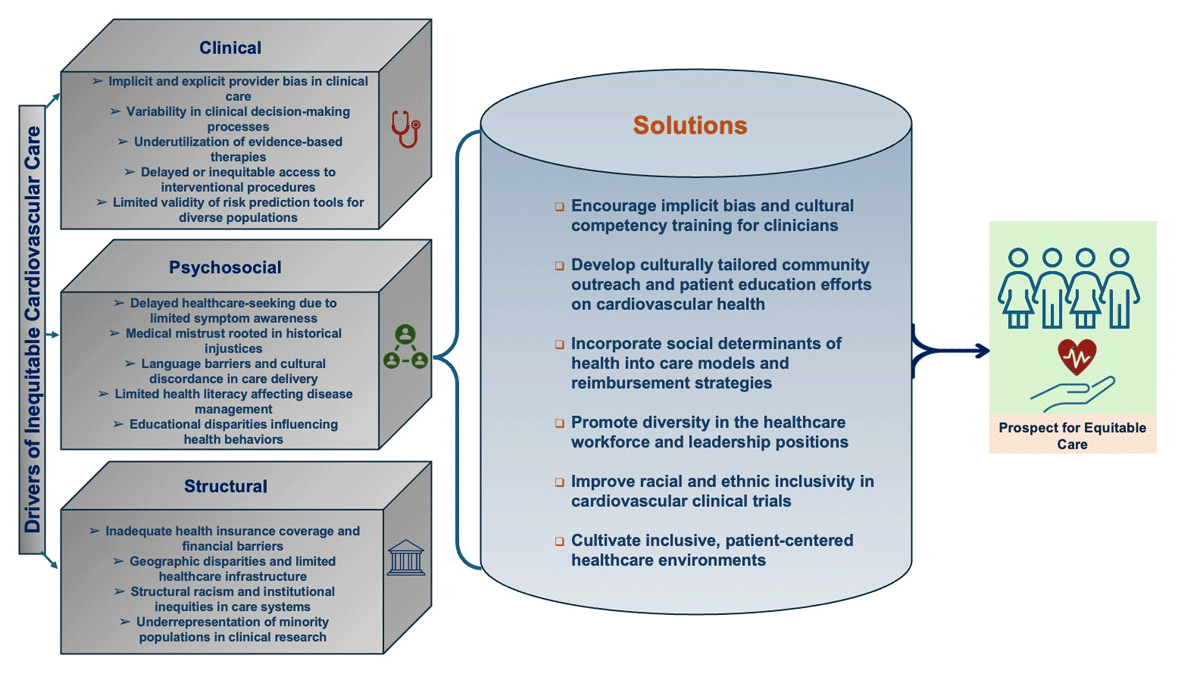
Figure 1
Framework highlighting drivers of racial and ethnic disparities in cardiovascular disease care and potential solutions.
In recent years, groups such as the AHA, Association of Black Cardiologists, and the Centers for Disease Control and Prevention’s Million Hearts Initiative have launched national efforts to raise heart disease awareness among racial and ethnic minority populations. Focused education regarding CAD health pertaining to these minorities should be part of routine primary care physician visits. Similarly, self-awareness strategies should be implemented to educate healthcare providers about structural factors that hamper delivery of equitable care pertaining to CAD. Healthcare organizations can be engaged to identify and implement strategies to provide equitable care for minorities, such as fostering healthcare environments that are inclusive for all racial and ethnic minorities.
Mital et al. proposed potential strategies to attenuate disparities in outcomes for racial and ethnic minorities, such as incorporation of culturally competent provider training and financial models that account for social determinants of health along with efforts to diversify the healthcare workforce.73 Similarly, a notable change in designing clinical trials that can enhance equal representation in cardiovascular research is recruitment of diverse populations, including minority principal investigators.80 There is a critical need for specific, real-world research that examines the CAD pathophysiology course across different groups and identifies true biological influences. These studies are essential for developing targeted strategies to reduce cardiovascular disparities that significantly impact health and lifespan across diverse communities.
Moreover, as highlighted in this review, social determinants of health are critical contributors to disparities in CAD care and should be systematically integrated into clinical care pathways and healthcare system strategies, including reimbursement models and incentive structures.
Key Points
Despite significant improvements, disparities persist in coronary artery disease care across racial subgroups.
Potential explanations and contributing factors underlying these disparities include structural, social, and clinical determinants.
Potential interventions at both the individual and system levels are necessary, along with identifying key areas for future research aimed at mitigating these disparities.
Competing Interests
The authors have no competing interests to declare.