
Beginning Again: The Second Epoch
Michael E. DeBakey was among a few cardiac surgeons from around the world who began heart transplant programs in the late 1960s, shortly after Christiaan Barnard’s highly publicized and controversial first human-to-human heart transplant in Cape Town on December 3, 1967. The donor had succumbed to a head injury in an automobile accident. Though the donor met brain death criteria, Barnard retrieved the heart only after cardiac arrest due to the uncertainty of the diagnosis at the time.1,2,3 This leads to our first question about pushing boundaries for the sake of medical advancement.
Given the rapid evolution of new medical and surgical specialties and treatments for advanced heart failure (such as cardiac transplantation), how do we decide when to cast off past practices and push for evolution of newer management strategies?
The answer is that we now have processes in place that are designed to help make these decisions—unlike in the late 1960s, which lacked the same rigorous oversight of new, usually experimental approaches to patient care for advanced illnesses. At the time, understanding of disease pathophysiology was rudimentary. The concept of allographic cardiac transplant was championed by a few cardiovascular surgeons and cardiologists around the world, with Dr. Barnard winning the race to perform the first human procedure. In Houston, Drs. Denton Cooley and DeBakey championed the procedure for a short time, although poor outcomes, mostly from immunologic rejection of the transplanted heart, forced discontinuation of most programs within a few years. Then, in 1984, the second epoch of heart transplantation began at The Methodist Hospital.
Institutional Review Boards (IRBs) were still in their infancy and evolving, but they did play a role. IRBs are administrative teams that review research involving human participants to ensure that the participants’ rights and welfare are protected and the research is conducted ethically and in compliance with a variety of regulations. Today we have very robust oversight and management when we desire changes to established healthcare practices. We must remember that—and also remember that organ transplantation, in general, is a ripe arena for development of new practices, tools, and drugs.4,5
Sometimes, even today, the importance of oversight is forgotten. One struggling area of research done on brain dead cadaveric organ donors and the new approach of Cardiac Declaration of Death (CDC) is discussed below. We must all remember the importance of these IRBs and embrace their recommendations with respect to donor organ recovery and transplantation.
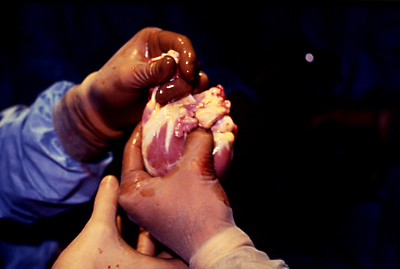
Photograph taken from the head of the operating table during cardiac organ recovery. This was taken in February 1984, the second epoch of cardiac transplantation at Houston Methodist Hospital. The photograph captures a solemn and sacred moment that highlights the touching humanity of cardiac transplantation. The heart was from a donor who was declared brain dead and was soon to be stitched into a patient with advanced heart failure and reanimated in an adjoining operating suite as “a gift of life.”
What was the difference between making a decision to do heart transplants in 1967-1968 and then 14 years later in 1984?
When Dr. DeBakey performed the 1984 heart transplant on February 21, The New York Times reported that he had stopped doing cardiac transplants 14 years earlier due to poor outcomes after his 12 heart transplants done between 1968 and 1970. He was quoted in the Times as saying, “Our experience at that time with 12 cases gave us results that we didn’t think were sufficiently justifiable to maintain the program.”6 The data in 1984 that pushed forward the second epoch of heart transplantation at Houston Methodist Hospital and Baylor College of Medicine, the hospital’s affiliate at the time, was primarily data that Norman Shumway, director of the Stanford heart transplant program, and a few others were sharing.
The Times reported that 11 centers in the United States (US) had performed a total of 635 heart transplants since the first one done in the US by Shumway in 1968. Of those patients, 295 were still alive, with current 1- and 2-year survival rates of 80% and roughly 75%, respectively. The Times report went on to note that of the 635 heart transplants done over 16 years, 173 occurred in the early 1980s when newer immunosuppression strategies appeared. Of the 12 heart transplants DeBakey did in the first epoch, only two patients lived more than a few months (one for 4 years and one for 6 years), but they all ultimately died due to chronic rejection that included myocardial inflammation and allograft arteriopathy.2 The advent of cyclosporin led to the second epoch of the heart, and subsequently multi-organ, transplant program at Houston Methodist Hospital and other institutions.
What is the status of heart transplantation today?
Robust data exists today revealing heart transplantation outcomes. Survival has continued to improve significantly. Also, there is robust governmental oversight of organ procurement and transplant programs in the United States and other countries. This is accompanied by several national and international professional societies focused on organ transplantation. For heart transplantation, the International Society for Heart and Lung Transplantation is a stalwart. Beginning in 1981 as the International Heart Transplantation Society, its mission was primarily to serve as an academic resource for sharing cardiac transplant outcomes and research data. As a small operation that over the decades grew dramatically, the most important thing that the initial organizers did was to create a database designed to document worldwide heart transplant outcomes. The organization has done that in abundance.7
Between 1967 and 2020, it has collected data on more than 120,000 heart transplant recipients. Annual meetings held across the world share data with members and guest attendants, providing an excellent repository of outcomes, problems, research, and administrative issues related to heart transplant programs worldwide. Naturally, reports vary about survival after heart transplant due to program idiosyncrasies. Yet the data show continuous improvement so that the current 1-year survival rate is approximately 90%, the 5-year rate is 70%, and median survival exceeds 12 years. Major issues are organ failure due to transplant allograft arteriopathy (which is thought to be a type of allograft rejection) and malignancies, both of which can be attributed to issues with immunosuppression. Tragically, about 10% of patients in the US die while on the wait list, and 12% are removed before transplant (usually for clinical deterioration that makes them unsuitable for transplantation).
How is heart transplantation in the US currently regulated?
In the 1950s and 1960s, only a few organ transplant programs existed in the US, and they focused primarily on kidney transplantation. In 1984, when Dr. DeBakey’s heart transplant program was relaunched, there was only nascent federal oversight of solid organ transplantation. Transplant programs were driven primarily by decentralized hospital-based donor organ procurement efforts and a few transplant professionals. The Uniform Anatomical Gift Act (UAGA) of 1968 provided a legal framework for donor organ procurement, focusing on kidney procurement.5 The New England Organ Bank was the nation’s first Organ Procurement Organization (OPO). Also in 1968, consensus emerged defining neurologic criteria for declaring brain death—developed after a report written by a Harvard University Ad Hoc Committee that defined irreversible coma and absence of brainstem neural function as a criterion for declaration of death. Subsequently, brain death laws were crafted in all 50 states.
The rise of more formal federal oversight began in 1984 with the National Organ Transplant Act (NOTA). This led to creation of the National Organ Transplant, Procurement, and Transplantation Network (OPTN) in 1986. In 1998, the Federal Department of Health and Human Services (HHS) created final regulations governing the OPTN and the United Network for Organ Sharing, requiring implementation of revised organ sharing schemes. Thus, the OPTN is a public-private partnership that manages the organ donation and transplant system including heart allocation schemes.
Some critics point out a variety of problems that have hampered optimal utilization of organs due to this structure, including donor hearts. Much debate has occurred recently regarding the challenges, imperfections, and inability of organ transplant centers to meet the needs of patients with end-stage organ failure, particularly with respect to the equity of organ allocation. The result has been that many patients cannot take advantage of solid organ transplantation. The National Academies of Science, Energy, and Medicine have issued at least two consensus reports pointing out opportunities for improvement in organ donor intervention research and recommending ways of creating greater fairness in the organ transplantation distribution system. Obviously, these are incredibly important issues when we ponder the challenges of organ distribution for cardiac transplantation, which is at the crux of making this dramatic lifesaving surgical procedure available to more patients.
Can healthcare providers join the transplant team?
Yes! Since the greatest challenge of solid organ transplantation is acquiring enough donor organs to meet the demands of numerous patients who are “listed” and desperately waiting for “the call of life.” It is important that everyone in the healthcare system understands issues regarding brain death declaration, donation after cardiac death (DCD), and operations of the organ transplant system. DCD occurs in an intensive care unit patient who is not expected to survive once life support is withdrawn. The decision to withdraw life support must be made before discussion of organ donation occurs. After the heart stops beating (death by cardiopulmonary criteria) or after traditional brain death criteria have been met, organs for transplant are retrieved.
We all should be champions of the organ transplant process, organ transplant teams, and our local organ procurement organizations. The work is heartbreaking and hard at times, but seeing and participating in the sanctity of the procedure by simply signing up to be an organ donor, or encouraging the process of organ transplantation, even from afar, is rewarding and a way to “join the team.” When we see situations where critically ill patients are candidates for heart transplantation or where brain injury of one type or another has set the stage for a declaration of brain death, particularly when we encounter family members in such a situation, we need to act compassionately and be supportive. Help with this challenge is nearby in most metropolitan areas.
The United Network of Organ Sharing has an integrated system to manage organ procurement for transplantation, and LifeGift in Texas is one successful example.8 Founded in 1987 shortly after Dr. DeBakey’s second epoch of heart transplantation began, LifeGift (initially called Gulf Coast Independent Organ Procurement Organization) was a partnership between Hermann Hospital, Houston Methodist Hospital, and St. Luke’s Episcopal Hospital, all in the Texas Medical Center where multi-organ transplant programs were established. Its goal was to improve donor organ availability by ultimately partnering with over 200 hospitals across 109 Texas counties to facilitate organ and tissue donation supporting transplantation while eliminating potentially destructive competition between hospital programs for organ donors. Now, 56 similar organizations are spread throughout the US. Also important is that all 50 states and the District of Columbia allow residents to indicate their desire to be an organ donor on their driver’s license or state identity card. Donate Life Texas, an advocacy nonprofit organization that promotes organ donation, is the only official donor registry in the state of Texas.9
What is the current role of mechanical circulatory support devices in cardiac transplant programs? Will we ever see a reliable total artificial heart for long-term support of patients with advanced heart failure?
Medications, a variety of cardiac surgical procedures, and cardiac transplantation have all had their successes with respect to ameliorating symptoms of advanced heart failure but still have significant limitations. When patients deteriorate despite treatment, become bedridden with severe heart failure symptoms, or simply are unable to take care of themselves because of heart failure, another approach is necessary.
This is when cardiac transplantation or “destination device therapy” are considered as potential options. Destination therapy means that therapeutic approaches for advanced heart failure would not include cardiac transplantation. “Destination” refers to being at home with some type of left ventricular assist device (LVAD) or total artificial heart (TAH).
Several LVADs have been utilized with significant success as a “bridge-to-transplant,” meaning the devices are implanted and the patient is listed for transplant.1 When an organ becomes available, the mechanical device is removed and organ transplant proceeds. Other uses of these devices include bridging a patient to heart failure recovery. Though this is not common, this was how LVADs demonstrated great potential.2,3 Dr. DeBakey had his laboratory build several prototypes of ventricular assist devices in the mid-1960s, and several made it through animal testing experiments. In August 1966, before the earliest human heart transplant experiences, Dr. DeBakey had a patient arrive from Mexico City for mitral and aortic rheumatic valvular heart disease surgery. After a 4-hour operation with double valve replacement, she could not be weaned from cardiopulmonary bypass support. Dr. DeBakey had a team working in his laboratory on a pneumatically driven, extracorporeal LVAD circuit (among other models) that could, theoretically, sustain a patient’s circulation for a period of time while in a hospital’s critical care unit. As this patient could not be weaned from cardiopulmonary bypass circulation after her valve replacements, she was supported on the LVAD device for 10 days and then weaned successfully. She was discharged and returned home to Mexico City a month after surgery and regularly returned to Houston annually for checkups. She lived several years after surgery, and proof of concept was provided.2
Dr. DeBakey’s lab built several LVAD and TAH prototypes, with one evolving into the device used for the first TAH operation by Dr. Cooley at St. Luke’s Episcopal Hospital in Houston in 1969.1 Multiple subsequent LVAD prototypes emerged from many labs around the world. Pulsatile devices that were very large, clunky, and prone to thrombus formation with emboli complications emerged. These early pulsatile prototypes rather abruptly gave way to continuous flow devises.
One of the earliest of these devices had an interesting story. An engineer from NASA became the fourth heart transplant patient at Methodist Hospital in 1984 after the second epoch had started. David Saucier’s story has been widely publicized by NASA.10 He was a Johnson Space Center engineer working on turbopumps sending propellant to the Space Shuttle’s main engines when he suffered a debilitating myocardial infarction. After a prolonged hospitalization with episodes of cardiogenic shock, he underwent heart transplantation. After his recovery and during a follow-up visit, he brought some of his NASA team and an example of a small, non-pulsatile continuous flow pump that was used on spacecraft, proposing that it could be made into a new type of LVAD. In 1998, it was the first device of its type (continuous non-pulsatile centrifugal flow) to be used in humans. It was approved by regulatory bodies in Europe and in the US for use in children particularly, because of its small size. It also provided proof of concept for development of other continuous flow devices that changed the paradigm for LVAD and TAH development.
Development of the TAH has been much slower than that of LVADs.11 Early attempts to use a TAH go back to the 1960s with, as an example, a flexible Dacron, double-chamber, gas-powered pump, originally developed by Domingo Liotta in Dr. DeBakey’s laboratory and subsequently modified with different valves and pump controllers in Dr. Cooley’s operation. The highly publicized surgery was performed at St. Lukes Episcopal Hospital in the Texas Medical Center on April 4, 1969. The recipient, Haskell Karp, was a 47-year-old with end-stage heart failure. The TAH kept Karp alive for 2 days until a donor heart was found, but he succumbed reportedly to an infection on April 8.1
The next highly publicized TAH operation wasn’t designed as a “bridge-to-transplant” but as a “destination therapy” procedure. Barney Clark received a pneumatic biventricular TAH with some characteristics similar to the previous device used for a TAH. This re-engineered device was labeled “Jarvic-7” after the individual who designed the system. Clark lived for 112 days but suffered several strokes and other postoperative complications. The coverage of his hospital course became a media circus. The operation and Jarvic-7 device did, however, lead to several subsequent iterations, leading to other pulsatile TAHs that became commercialized. The SynCardia device, for example, was a direct descendent of the Jarvik-7 and supported over 2,000 implants in over 20 countries.
The latest and perhaps most encouraging development in TAH technology is BiVACOR.12 This device uses biventricular levitation technology that replicates a more normal pulsatile continuous blood flow technology. The device has a small and durable structure with only one moving part that uses magnets to run the pumping mechanism, thus creating biventricular pulsatile flow. Clinical trials using this device have recently begun and experience is early but promising. TAH technology and use is lagging behind LVAD technology and use, but progress is definitely being made.
Summary
These six brief points regarding heart transplantation do not attempt to cover all nuances of this dramatic and sacred procedure; rather, they outline developments that made this evolving surgical procedure an unmitigated success. Though challenges remain, particularly the inadequate supply of donor organs and definitive management of allograft rejection, dramatic progress has been seen.
We must remember that this intricate, multifaceted procedure demands extraordinary teamwork—not only from the talented surgical and medical specialists who perform it but from society at large, organ donors, and families of organ donors.
Competing Interests
The author has no competing interests to declare.
Author information
Dr. James B. Young is one of the foremost leaders of the evolution in heart failure management and has been instrumental in advancing the heart failure/heart transplant fields.
After graduating from Houston’s Baylor College of Medicine and completing his clinical training, he joined the Baylor faculty and became professor of medicine in 1992. His clinical and research focus helped establish the subspecialty of heart failure. As clinical coordinator and scientific director of the DeBakey Multi-organ Transplant Center at Houston Methodist Hospital, he oversaw the clinical training, research, and clinical care in heart failure management. He was a founding medical director of the LifeGift Organ Procurement Center. In 1995, he relocated to the Cleveland Clinic as chief of the Section of Heart Failure and Cardiac Transplant Medicine. In 2003, he became chairman of the Division of Medicine of the Cleveland Clinic while still maintaining a strong commitment to the heart failure field.
Dr. Young’s research activities have been plentiful and focused on the pathophysiology of heart failure, mechanical circulatory support, and cardiac transplant therapeutics. He is a past president of the International Society for Heart and Lung Transplantation and has served as principal or co-principal investigator for many important multicenter clinical heart failure trials. In addition, he has authored or coauthored over 750 manuscripts and several textbooks.
While the historical profiles of cardiac transplantation shine a light on the dramatic achievements of Drs. DeBakey, Barnard, Cooley, Shumway, Noon, and their surgical colleagues, there are many less-heralded heroes of the heart failure/heart transplantation saga. James B. Young is among those men and women whose pre- and postoperative care of heart failure patients and whose research and clinical trials have propelled the science forward—to the point where physicians can, in good conscience, tell even the sickest of heart patients that “there is hope.”
—Albert Raizner, MD, Houston Methodist DeBakey Heart & Vascular Center, Houston Methodist, Houston, Texas