
From The Stethoscope Song; a Professional Ballad
There was a young man in Boston town,
He bought him a stethoscope nice and new,
All mounted and finished and polished down,
With an ivory cap and a stopper too.
It happened a spider within did crawl,
And spun him a web of ample size,
Wherein there chanced one day to fall
A couple of very imprudent flies.
The first was a bottle-fly, big and blue,
The second was smaller, and thin and long;
So there was a concert between the two,
Like an octave flute and a tavern gong.
Now being from Paris but recently,
This fine young man would show his skill;
And so they gave him, his hand to try,
A hospital patient extremely ill.
Then out his stethoscope he took,
And on it placed his curious ear;
Mon Dieu! said he, with a knowing look,
Why, here is a sound that’s mighty queer!
There’s empyema beyond a doubt
We’ll plunge a trocar in his side.
The diagnosis was made out,—
They tapped the patient; so he died.
Then six young damsels, slight and frail,
Received this kind young doctor’s cares;
They all were getting slim and pale,
And short of breath on mounting stairs.
They all made rhymes with “sighs” and “skies,”
And loathed their puddings and buttered rolls,
And dieted, much to their friends’ surprise,
On pickles and pencils and chalk and coals.
So fast their little hearts did bound,
The frightened insects buzzed the more;
So over all their chests he found
The râle sifflant and the râle sonore.
He shook his head. There’s grave disease,
I greatly fear you all must die;
A slight post-mortem, if you please,
Surviving friends would gratify.
The six young damsels wept aloud,
Which so prevailed on six young men
That each his honest love avowed,
Whereat they all got well again.
This poor young man was all aghast;
The price of stethoscopes came down;
And so he was reduced at last
To practice in a country town.
Now use your ears, all you that can,
But don’t forget to mind your eyes,
Or you may be cheated, like this young man,
By a couple of silly, abnormal flies.
Oliver Wendell Holmes Sr, MD
From Poems (Boston: Ticknor and Fields, 1883)
This poem is in the public domain.
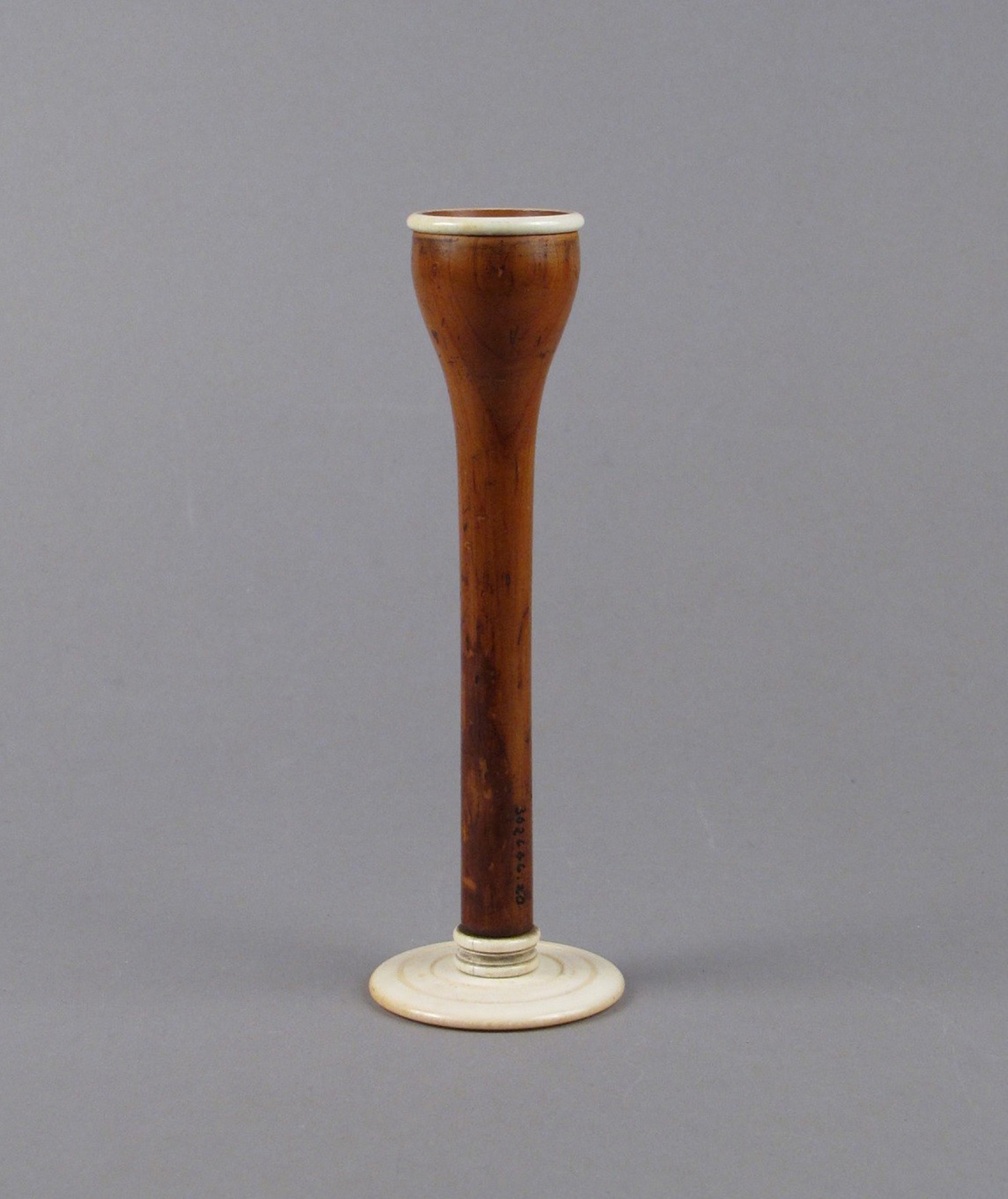
Image 1
Monaural stethoscope made of wood and ivory. Pierre Adolphe Piorry (1794-1879), a French physician, devised this form in 1829. Gift of The Medical and Chirurgical Faculty of the State of Maryland, National Museum of American History, online at https://americanhistory.si.edu/.
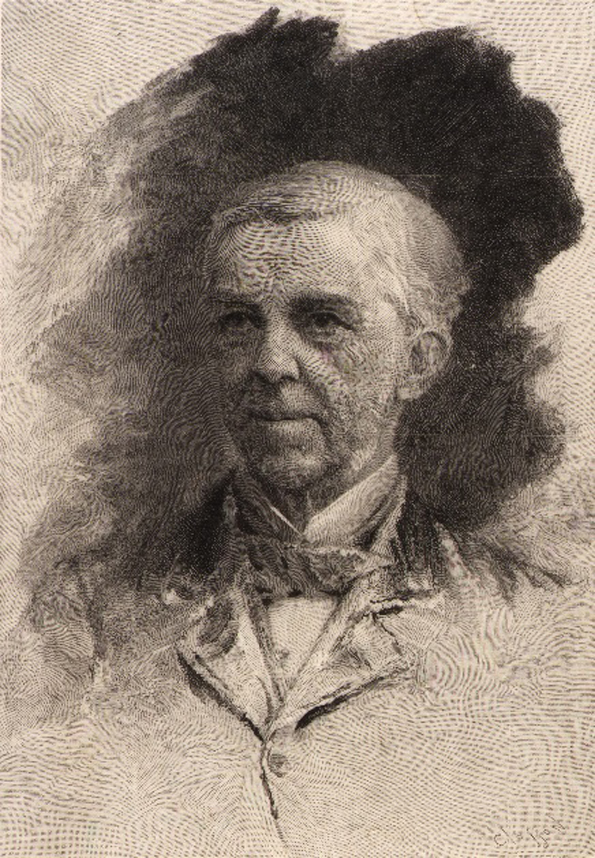
Image 2
William Baxter Closson, Oliver Wendell Holmes Sr. Transfer from the National Museum of American History, Division of Graphic Arts, Smithsonian Institution, 1971.169.
Commentary
“The Stethoscope Song” is an entertaining and memorable ballad from Oliver Wendell Holmes Jr, MD, one of America’s great physician-writers. The poem serves as a snapshot to capture the introduction and reception of the stethoscope in the mid-19th century United States. It was written relatively early in Holmes’ career, providing insight into his wit and wisdom at that stage of life while also potentially revealing a few small autobiographical details. In writing this poem while practicing medicine, Holmes showcased the opportunities available for physicians to pursue advances in literature in addition to their work as clinicians.
Holmes was born in Cambridge, Massachusetts, on August 29, 1809, the same year as Charles Darwin, Abraham Lincoln, and Alfred Tennyson.1 He would spend the majority of his life in the vicinity of Boston and Cambridge, completing both his undergraduate and medical degrees at Harvard University. Cambridge is also where he briefly studied law before continuing his medical studies in Europe2 and where he penned “Old Ironsides” in 1830 to begin his writing career. It was written as a response to the planned destruction of the USS Constitution, which was then anchored in the Boston Harbor and remains so on account of his efforts.3 He published “The Last Leaf” the following year—a poem that Abraham Lincoln could reportedly recite from memory2—and continued a steady stream of authorship throughout his career. In 1833, Holmes departed for Paris to study under Pierre Charles Alexandre Louis, an expert in the field of medicine and skilled practitioner in the art of auscultation.1 He would return to the United States in 1835 seeking to incorporate his training, including the use of stethoscopy, into the American medical system. He initially did so as a private clinician and later as an educator, becoming a professor at both Tremont and Dartmouth medical schools in 1838.4
It was during his time at Tremont and Dartmouth that Holmes likely wrote “The Stethoscope Song,” the majority of which is presented here.1 The stethoscope was invented by René Laennec in 1816, though it initially met with widespread disdain and significant resistance to its use. Holmes superbly captures the initial response of the staid medical establishment while also advising that auscultation should not be done in isolation but as a supplement to the traditional tenets of an effective physical examination. A close reader also has to wonder if this “young man in Boston town…being from Paris but recently” could have represented Holmes himself, who was one of the earliest proponents of stethoscopy in the United States.4 The poem is an entertaining blend of satire and mirthful advice, much of which remains as true today as when these words were penned.
In addition to his work as a clinician, writer, and educator, Holmes found time to wed in 1840, marrying Amelia Lee Jackson, the niece of a fellow physician who accompanied him to Paris.1 They would give birth to their eldest son the following year, Oliver Wendell Holmes Jr, who would pursue the legal profession his father had contemplated, eventually gaining renown as an associate justice of the United States Supreme Court, a post he held for three decades.4 In 1845, Holmes became the first dean of Harvard Medical School and continued to amass a prolific number of accolades in the world of medicine. He is credited with first coining the term “anesthesia”3 and wrote a highly controversial treatise identifying improper handwashing as the source of spreading puerperal fever.2 This claim was later substantiated by empirical evidence and had a significant impact upon the health of women during childbirth. Holmes also became an advocate for the role of women as medical practitioners, using his position as dean of the Harvard Medical School to enroll a woman there in 1850, although his efforts were later rebuffed and the institution remained male-only until 1945.1
Alongside his contributions to medicine, Holmes would play a significant role in the foundation of a distinctly American literary culture. As a Bostonian in the latter half of the 19th century, he could not have chosen a better literary milieu within which to circulate. Holmes was a regular member of the Saturday Club, a collection of local thinkers, writers, and professionals that included the likes of Ralph Waldo Emerson, Henry Wadsworth Longfellow, Nathaniel Hawthorne, and James Russell Lowell.2 Their monthly discussions eventually led to the founding of a literary magazine in 1857, which Holmes helped to christen The Atlantic,2 and to which he would become a stalwart early contributor. Several of his most memorable works appeared there, including selections from his popular “Breakfast-Table” series and many of his most famous poems like “The Chambered Nautilus” and “The Wonderful One-Hoss Shay.”
Although medicine remained his primary pursuit until the final decades of his career,4 Holmes is perhaps best remembered for his work as an author. This does not make him unique among physician-writers, whose literary achievements generally far outshadow their contributions to the field of medicine. This holds true for trained physicians who chose not to practice, such as Keats and Maugham, but especially for those practicing physicians who also elected to become literary men, such as Chekov, Conan Doyle, and William Carlos Williams. What sets Holmes apart is that he was one of the first to become a physician-writer, with no one to emulate and especially not within the budding American medical establishment. His accomplishments should certainly rank among those of these other literary titans, especially when one considers the impact he must have had upon the decision of future generations to pursue writing alongside the study or practice of medicine.
Holmes continued to write until close to his death in 1894, and he holds a distinguished place in the American literary canon. His passing preceded the advent of the Nobel and Pulitzer Prizes as well as the creation of posts like the United States Poet Laureate, although it is tempting to postulate which of these laurels he may have deservedly received. Whether through poems like “The Stethoscope Song,” medical articles on the topic of puerperal fever, or in the prose of his “Breakfast-Table” series, Holmes left an indelible mark on the world of literature and of medicine. In doing so, he carved a path for future generations of physician-writers to follow.
Practice Perspective
So, what of the stethoscope today? First, the cautionary words of Holmes mentioned above and prompted by the unfortunate outcome of a patient described in the poem must be remembered. The stethoscope should not replace detailed physical examinations or other appropriate and available tests, including newer tools clinicians use to enlighten clinical situations, particularly cardiovascular, pulmonary, and gastroenterological pathologies. Today, cardiovascular-focused clinicians have a wealth of sophisticated “stethoscopes”—echocardiograms, magnetic resonance imaging, cardiac computed tomography, and nuclear cardiovascular studies, to name a few. Indeed, the evolution of diagnostic vital organ assessment has been explosive. Why even bother with the stethoscope in the 21st century? After all, we still see iconic images of healthcare providers with a stethoscope dangling from their necks in one fashion or another or crammed into a pocket of a white coat. Certainly, there are impoverished areas of the world where sophisticated physical examination tools aren’t available or where there is a need to quickly evaluate a patient in an environment outside of a well-equipped healthcare facility. Let’s not forget that, arguably, the most important reason for clinicians to carry and use a stethoscope is so that patients can readily identify them as professional healthcare providers; perhaps more important, the use of stethoscopes can create the opportunity to touch, instill confidence, and bond with patients.
Disclaimer
The views expressed are solely those of the authors and do not reflect the official policy or position of the US Army, US Navy, US Air Force, the Department of Defense, the US Government, or Houston Methodist Hospital.
Competing Interests
The authors have no competing interests to declare.